





March 16, Kathmandu. Following defeat in the recent elections, the Communist Party of Nepal (UML) has initiated a review of the House of Representatives election results starting from its lower-level committees. Some committees have independently begun the evaluation process, while others have started discussions in line with party central directives.
Under the guidance of General Secretary Shankar Pokharel, virtual meetings are being conducted in Kathmandu by UML. “Election reviews are underway in most committees,” said Dipak Niraula, Chairperson of the UML Kathmandu District, “analyzing why our party suffered defeat.”
Kathmandu, the capital long regarded as a stronghold of UML, and the Bagmati Province experienced a clean sweep by the opposition this time. Since the first election in 1959 when the Communist Party first triumphed, Kathmandu has always held special significance for UML.
The party, established firmly in the capital after Madan Bhandari defeated then-Prime Minister Krishna Prasad Bhattarai in 1991, has suffered a significant setback in this election.
In Kathmandu, where many direct candidates lost their deposits, UML received only 36,854 proportional votes while the Rastriya Swatantra Party (RSP) garnered nearly 300,000 votes. From the capital’s 10 constituencies with 710,000 voters, RSP secured 296,557 votes.
“We will determine where the weaknesses were and review which levels of leadership were responsible,” Niraula stated. “If central leaders made mistakes, those will also be scrutinized.”
General Secretary Pokharel has instructed provincial and district chairs to conduct reviews through virtual meetings. Subsequently, review processes have commenced in district committees including Kathmandu.
Some districts had already begun their assessments before central directives. After losing decisively in Gandaki Province, district leaders there have completed preliminary reviews. “The initial conclusion suggests that the party may have to consider restructuring or even dissolution,” a Gandaki leader reported.
In Palpa, once considered a UML bastion, defeat has sparked efforts for party reorganization. Following a meeting led by Thakur Gaire, aimed at thanking voters and reviewing the election, the Tansen Municipal Committee was dissolved and an assembly date set.
Senior party leaders have welcomed the decision to dissolve the Tansen committee and have suggested adopting a similar approach from the central to local levels.
“This campaign in Tansen is an excellent start and should be expanded from the central level down to ward committees,” wrote Central Member Naresh Rokaya on social media. Fellow Central Member Samik Badal also expressed support, saying, “I liked this campaign, excellent planning for local elections is necessary to preserve the party’s reputation.”
The Responsibility Does Not Lie Solely with the Cadres!
UML’s Propaganda Coordinator Min Bahadur Shahi explained the delay in formal reviews, stating, “We did not hold a formal meeting for 13 days, only then did discussions begin.” The delayed review is partially attributed to the bereavement of Chairman KP Sharma Oli.
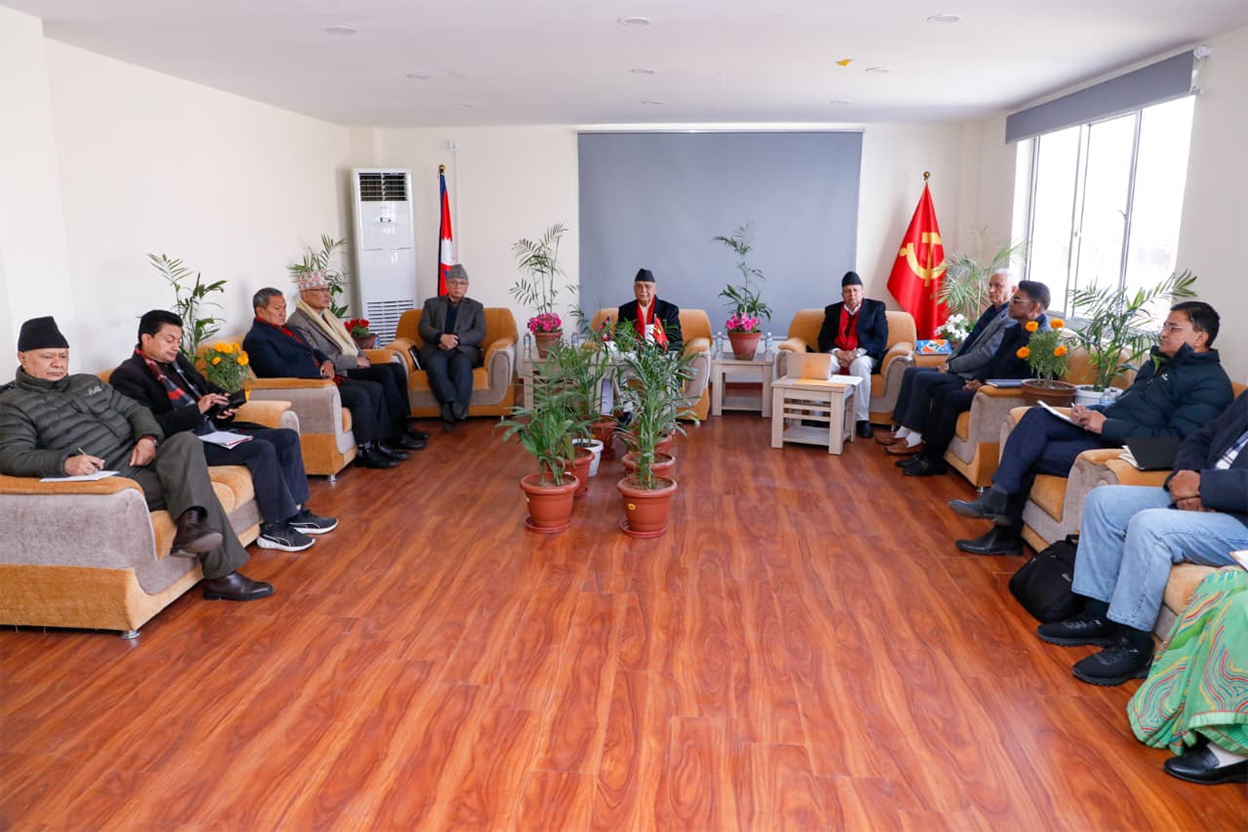
According to Shahi and other leaders, a meeting chaired by Vice-Chairman Rambahadur Thapa is underway for proportional representation MP selection. “Under such circumstances, there is no plan to start an immediate discussion about the grave defeat.”
The Secretariat meeting held on February 12 decided to finalize proportional MP recommendations and adopt a condolence proposal. “No party committee has yet started a review; suggestions may come in upcoming meetings,” said an official.
However, General Secretary Pokharel has directed local committees to conduct reviews through virtual meetings, presenting conclusions about UML’s defeat. “The rise of the new political force is based on spreading confusion and anarchism against KP Oli and UML to gain popularity,” he told leaders.
Pokharel indicated that political analysis is complete and now the reviews at the grassroots will focus on technical aspects. “The review style appears to cause diversion from core issues,” a leader commented.
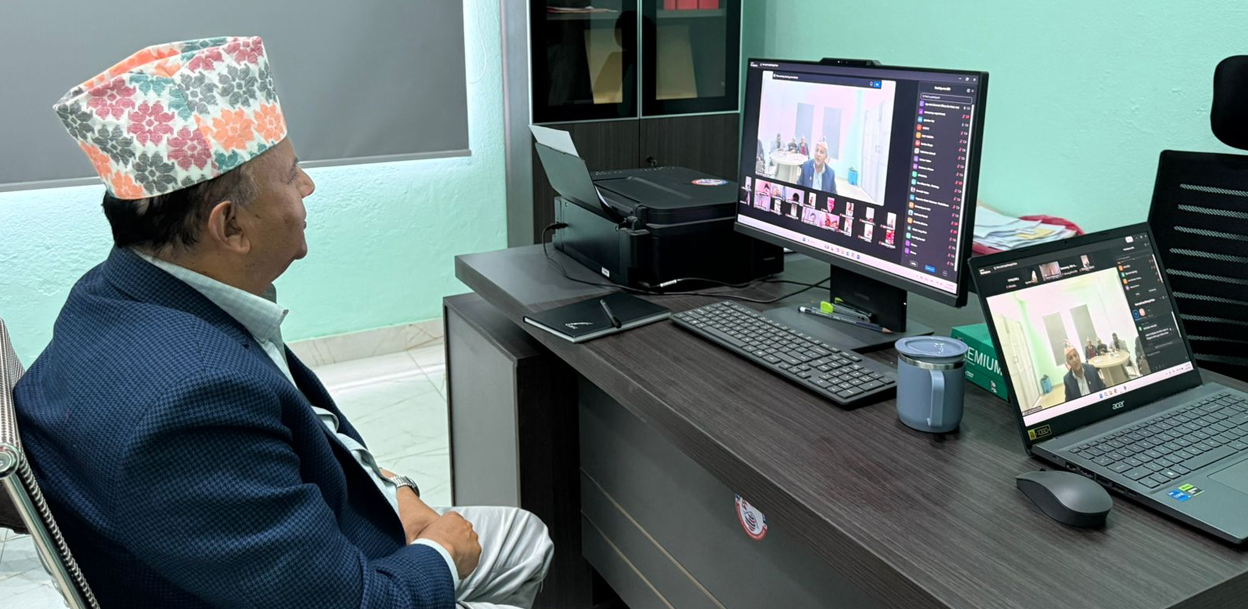
Following the post-Jana Andolan II void, UML had adopted a similar review process. Initially, Oli held virtual meetings with district chairs before setting central-level programs. Even then, calls for leadership reorganization surfaced.
“This resembles the style of the Jana Andolan II phase,” a leader observed. “Oli might be planning to hold virtual meetings again with district chairs.”
One leader noted that by reviewing grassroots committees and cadres, there is an attempt to absolve the leadership from responsibility.
“There is disagreement over whether the Jana Andolan II election results favored KP Oli or Balen, but as a candidate from UML, I say the review should start from the leadership, not the grassroots.”
Voters reportedly focused less on local issues or candidates and more on the rivalry between Oli and Balen.
Vice-President Vishnu Prasad Paudel, Deputy General Secretary Yogesh Bhattarai, former Vice-President Surendra Pandey, among others, have also voiced calls for leadership restructuring.
Leaders argue that changing policies, leadership, organization, and style is the way to revive UML.
General Secretary Pokharel stated, “Winning or losing in democratic processes is natural. Please do not be disheartened; I urge everyone to continue their duties with a positive outlook.”
His conclusions still reflect a perspective that blames external factors for the defeat.
The election outcome shows that mere moderate effort and reorganization will not restore UML to its former status. The number of directly elected MPs has fallen to nine, and proportional votes received are also low.
Even in Jhapa, the home region of the four-time Prime Minister Oli, the party lagged significantly in the contest. Vote analysis reveals little evidence of internal betrayal there.
“Had the vote margin been larger, it would be called an internal betrayal, but here the difference is around 50,000 votes,” said a leader from Jhapa. “Now the people need to be held accountable.”
In Jhapa–2, former Speaker Devaraj Ghimire lost by 11,368 votes, while former Deputy Speaker Indira Ranamagar won with 60,110 votes.
In Jhapa–1, RSP’s Nisha Dangi secured 45,680 votes; UML’s Ramchandra Upreti came fourth. In Jhapa–3, RSP’s Prakash Pathak was victorious with UML’s Hari Rajbanshi in fourth place. Jhapa–4 also saw RSP’s Shambhu Dhakal elected, with UML’s Lal Prasad Sangwal receiving fewer votes.
Oli faced nearly a 50,000 vote deficit in Jhapa–5. Balen secured 68,348 votes versus Oli’s 18,734. Had Samir Tamang from the Labor Culture Party not run, Balen’s vote count would likely have been higher.
Tamang, a third-place candidate, received 9,233 votes. As a new party, it is expected that those votes might have gone to Balen.
Despite this, Oli and his supporters are pursuing a review focused on internal betrayal. “The chairman repeatedly asked leaders why he lost, alleging internal betrayal,” said a senior source. A preliminary list of 15 suspects for betrayal in Jhapa–5 is being prepared and likely to expand during reviews.
Former Vice-Chairman Surendra Pandey may have appealed to leaders not to threaten cadres with punishment.
“When the people have rejected you through ballots, it is unwise to threaten your own cadres for speaking the truth,” Pandey wrote on Facebook recently. “After such a huge moral defeat, the leadership has no basis left for punishing others.”
However, review meetings have started in UML with clear signals that those involved in internal betrayal will face consequences. Comparatively, much deeper review is needed within UML.
In proportional representation, UML’s 16 seats place it fourth in Koshi Province. With 853,000 votes, RSP leads the province while UML managed only 288,000 votes. The Labor Culture Party secured 292,049 votes, leaving Congress as the third force. In the other six provinces, UML has slipped to the third position.


