




March 18, Kathmandu – With the submission of the report including the results of the House of Representatives election held on February 4, the path to forming a new government has now opened.
According to Section 62 of the House of Representatives Member Election Act, 2017, the Election Commission is required to present the final report, including the election results, to the President within one week of announcing the election outcome.
The act states, “The Commission shall submit the report including the election results of the first-past-the-post and proportional representation systems to the President within seven days of the declaration of election results.”
Following this provision, on Thursday, Acting Chief Election Commissioner Ram Prasad Bhandari and other commissioners submitted the report to the President. With the Election Commission’s submission, the parliamentary session can be convened and the government formation process can move forward.
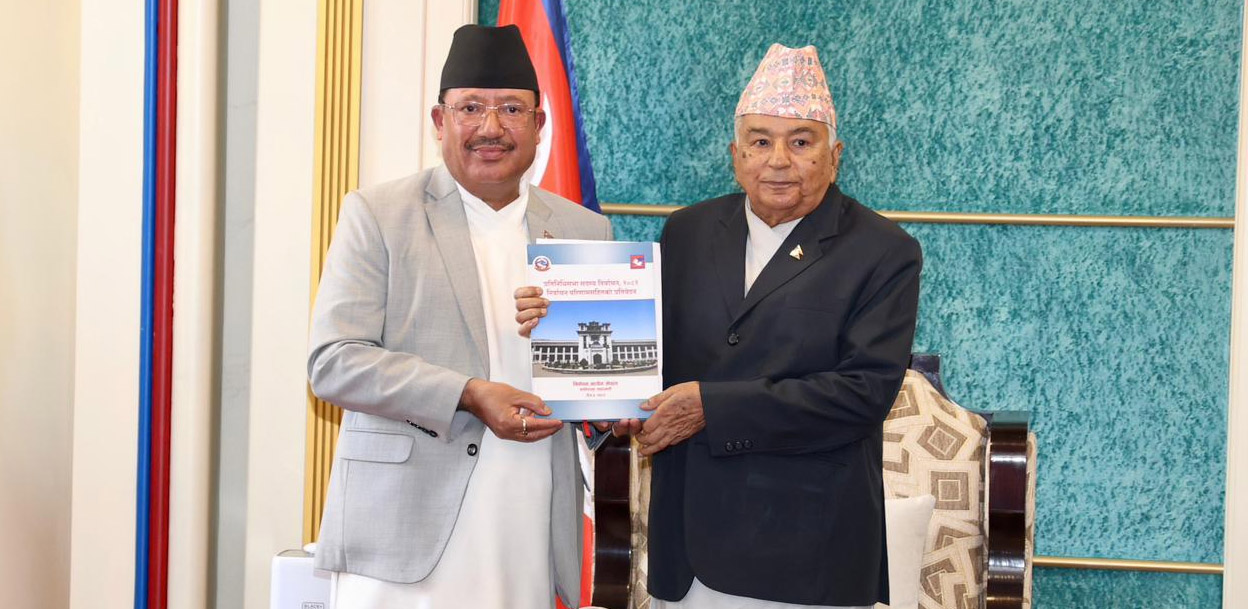
After reviewing the report, President Paudel will initiate the next steps. The first will be the oath-taking ceremony of the elected members of parliament.
The oath-taking ceremony for the senior-most member is scheduled for 11:30 am on March 26.
According to the Election Commission, among the elected members, Arjun Narasingh KC is the senior-most at 78 years old. After taking the oath from the President, KC will administer the oath to other members on the same day. Following this, the new government formation process will proceed.
The report submitted by the Election Commission to the President includes details of the number of seats won by each party, a matter directly related to the formation of the new government.
Six political parties have secured national party status from this election.
The Rastriya Swatantra Party (RSP) emerged as the largest party with 182 seats, followed by the Nepali Congress with 38 seats in second place, the Communist Party of Nepal (UML) with 25 seats in third, and the Nepal Communist Party with 17 seats in fourth.
The newly emerged Labour Culture Party gained five seats, becoming the fifth largest, while the Rastriya Prajatantra Party (RPP) secured five seats, ranking sixth. Additionally, there is one independent candidate.
The widely discussed Article 76 of the Constitution outlines the government formation process. According to it, the President will determine whether a single-party majority government can be formed. This time, with RSP winning approximately two-thirds majority, a single-party government will be formed under their leadership.
Article 76(1) of the Constitution states, “The President shall appoint the leader of the parliamentary party with a majority in the House of Representatives as Prime Minister, and under his leadership, the Council of Ministers shall be formed.”
For this, the President must know who the leader of the RSP parliamentary party is. Accordingly, the RSP will select its parliamentary leader after the oath-taking ceremony on March 26.
Simultaneously with government formation, the President must convene the parliamentary session. Article 93 of the Constitution mandates that the President call a session of the Federal Parliament within one month of announcing the final election results. It states, “The President shall summon the Federal Parliament within thirty days of the final declaration of the election results for the House of Representatives.”
The Office of the President is reportedly preparing to convene the Federal Parliament session on March 30. This intention has been informally communicated to political parties and to the Secretariat of the Federal Parliament.


