Bir Hospital Introduces Advanced SPECT-CT Equipment for the First Time to Monitor Organ Function





News Summary
Editorially Reviewed.
- For the first time at the government level, Bir Hospital has introduced the state-of-the-art SPECT-CT equipment, which will assist in diagnosing conditions related to cancer, heart, bone, and kidneys.
- Service using the SPECT-CT machine is expected to begin within a month, reducing the need for patients to seek treatment abroad.
- The SPECT-CT machine, valued at approximately NPR 150 million, was acquired through the International Atomic Energy Agency and can serve 10-15 patients per day.
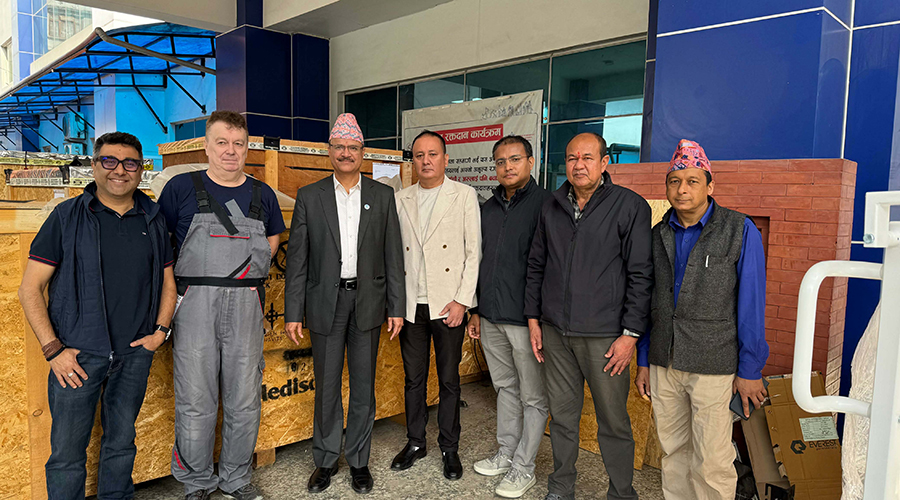
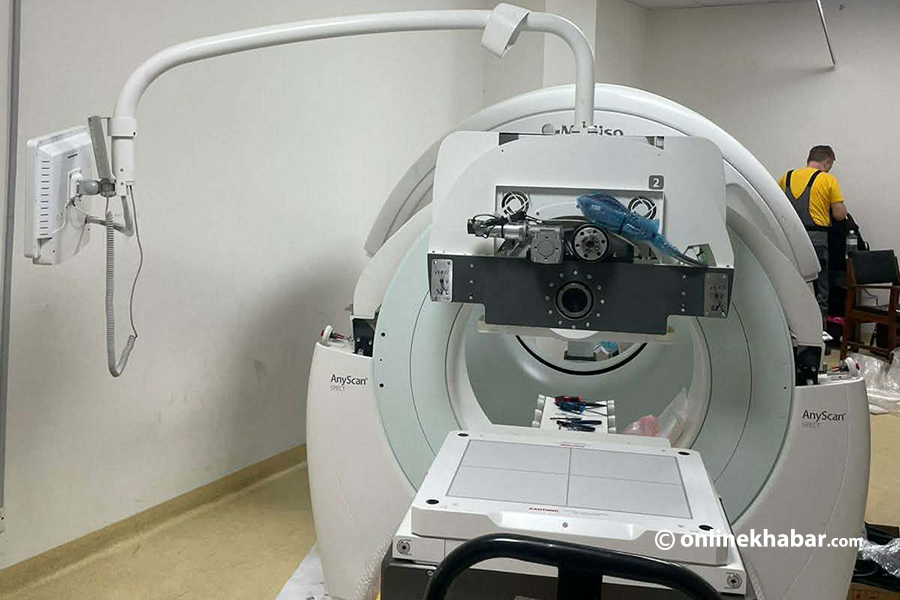
March 21, Kathmandu – Bir Hospital has introduced an advanced ‘SPECT-CT’ machine for the first time in Nepal’s government healthcare sector. This equipment aids in assessing the functional status of organs affected by cancer, heart disease, bone, and kidney conditions.
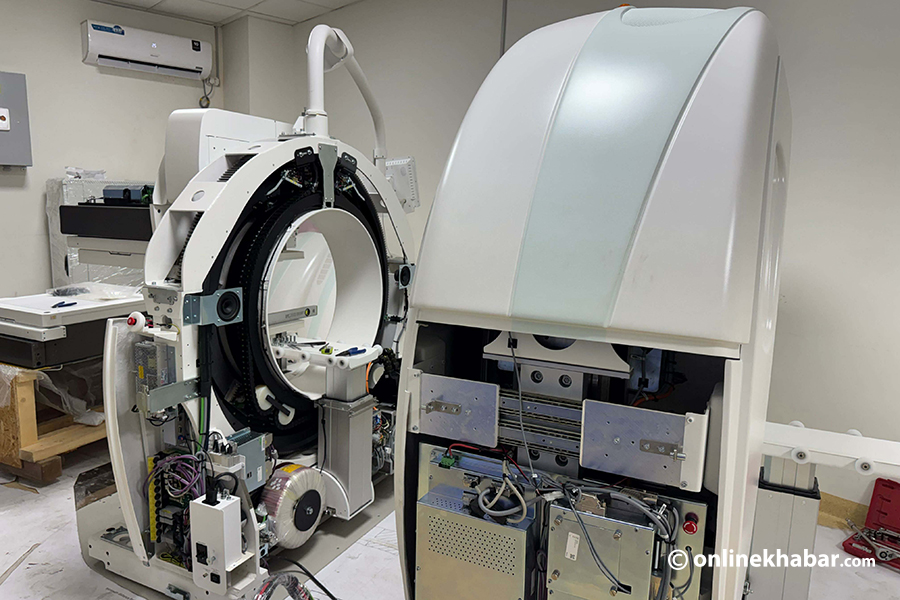
The installation process of the SPECT-CT device is ongoing. According to Professor Dr. Kanchan Prasad Adhikari, Medical Physicist at Bir Hospital, services will commence within a month.
“Once operational, patients will no longer need to travel abroad for tests as high-quality diagnostic services will be available locally,” Dr. Adhikari said.
As a Radiation Safety Specialist, Dr. Adhikari explained that the machine helps detect cancer at an early stage, evaluate disease progression, and monitor treatment effectiveness.
“It enables physicians to make faster decisions and initiate patient treatment promptly,” he added.
“The SPECT-CT machine is distinct and based on advanced technology compared to conventional CT scans.
It combines SPECT and CT technologies,” Dr. Adhikari detailed. “SPECT displays how organs function, while CT shows their structural details.”
He further clarified that ‘SPECT’ stands for ‘Single Photon Emission Computed Tomography,’ which is a nuclear medicine procedure.
In this test, a small amount of radioactive substance (isotope) is injected into the patient. This substance travels to organs, emitting gamma rays that the machine captures to generate images.
“These images reveal how the organs are functioning, providing physiological information that regular scans cannot show,” Dr. Adhikari noted.
The CT scan component clearly illustrates the body’s structure.
Because both technologies are integrated in the same device, this is termed ‘hybrid imaging,’ enhancing speed and accuracy in disease diagnosis.
Which Diseases Benefit?
Dr. Adhikari stated that SPECT-CT is especially effective for cancer detection.
“Radioactive materials accumulate in cancer cells, making it easier to identify disease locations,” he explained.
Additionally, it is useful in diagnosing heart conditions, bone diseases, and kidney disorders.
“It can assess heart blood flow, bone infections or cancer spread, and kidney function,” he added.
Dr. Bhupendra Kumar Basnet, Vice Chancellor of the National Academy of Medical Sciences, noted that this machine, valued at nearly NPR 150 million, was procured through international collaboration.
It was provided to Bir Hospital with support from the International Atomic Energy Agency.
Dr. Basnet mentioned that legal frameworks and standards had to be fully established in Nepal before acquiring this device.
“Previously, Bir Hospital had a gamma camera machine that served for 15 years but eventually broke down,” he said.
“After the gamma camera malfunctioned, that service was unavailable for about a year,” he added. “Now, with this advanced machine, patients will have easier access to diagnostic services.”
Capacity to Serve 10–15 Patients Daily
For this service, the required radioisotopes must be imported from abroad. Dr. Adhikari explained that with consistent isotope availability, they can conduct tests on 10 to 15 patients daily.
Because Nepal lacks facilities like a cyclotron or nuclear reactor to produce these isotopes domestically, they must be sourced internationally.
SPECT-CT allows the collection of multiple diagnostic insights simultaneously.
“Previously, patients had to undergo separate CT scans, MRIs, or other tests at different times,” Dr. Adhikari said. “Now, one procedure delivers comprehensive information, saving both time and expense for patients.”
This reduces unnecessary tests and minimizes patient discomfort.
Dr. Adhikari added that the technology is not limited to diagnostics; it can also be used for treatment.
“Therapies like iodine therapy for cancer treatment that use radioactive substances are also possible with this machine,” he said.
The hospital aims to provide services at affordable rates.
“As a government hospital, providing service is our priority over profit,” Dr. Adhikari stated. “We are striving to offer this at a reasonable cost to the general public.”


