




Summary of Key Points
- Following the February 21 elections, Nepal’s communist parties face ideological vacuum with no clear direction or future plans.
- Communist parties have secured 44 seats in the House of Representatives; a united left could potentially become the main opposition.
- In the local and provincial elections scheduled for 2084 BS, the left will confront policy pressures and political challenges, necessitating strategic planning.
When anyone is unclear about their direction or purpose, confusion sets in, marking the onset of a void. Nepal’s communist parties find themselves trapped in such ideological emptiness following the February 21 elections. Questions like “Where to go now?” and “What to do?” lack clear answers among communist leaders. They are bewildered, confronting a yawning ‘black hole’ ahead.
The Communist Party of Nepal (Unified Marxist-Leninist), led by KP Sharma Oli, has expressed intentions to mobilize a movement for the release of their detained chairman. However, after the court extended the deadline, the case has become “subject-judiced.” Past experiences, particularly the weakening of judicial ethics after Ravi Lamichhane’s arrest, have shown that such movements only undermine the judiciary’s standing. Earlier, the Rashtriya Swatantra Party (Raswapa) attempted to protest against the court but later withdrew.
Opposing Oli’s arrest is considered “reactionary politics.” It is natural for supporters to defend their chairman. Yet, UML leaders must now clarify their stance and strategies in the new political landscape post-February 21. What is UML’s forthcoming agenda? What will UML undertake over the next five years? What opportunities will it provide its cadres? These questions are crucial for the party’s survival.
Meanwhile, the party led by Pushpa Kamal Dahal (Prachanda) is presently in a weakened state. After unification with Madhav Kumar Nepal’s faction, the “Maoist” name was dropped, but poor election results on February 21 have cast a shadow of disappointment from the top ranks to the grassroots. Activists are disheartened and unemployed; leaders are demoralized. Dissension within, led by figures like CP Gajurel, Janardan Sharma, and Ram Karki, has debilitated Prachanda’s leadership.
Given the dire situation of Oli and Prachanda’s parties, one may wonder about the conditions of smaller communist factions. Groups such as the Revolutionary Party led by Mohan Baidya, Janamorcha headed by Chitra Bahadur KC, the Pralopa faction of Baburam Bhattarai and Janardan Sharma, Narayanman Bijukchhe’s NEMKIPA, Netra Bikram Chand (Biplav) and other fragmented leftist groups each carry their own narratives of struggle.
A Tribe Never United with Its Own
Civilized societies typically maintain cordial personal relations despite ideological differences, but Nepalese communists show the opposite. Even when their ideas align, they fail to unite and often conspire against one another when they do.
Among the communists exists a form of tribalism — the tradition of mutual mistrust. Labeling each other with various accusations is a longstanding issue. Using ideological differences as an excuse, divergent factions established separate groups, a hereditary pattern in Nepal’s communist history.
Distinct groups exist for CP Mainali, Rishi Kattel, Mohan Bikram, and Mohan Baidya. Those who parted ways with Biplav, like Dharmendra Bastola’s group called “CPN Majority,” further fragment the movement. Ghanshyam Bhusal, Ram Karki, and Janardan Sharma lack coordination; Sudhan Kirati belongs to another faction. Baburam Bhattarai also heads his own group, prioritizing the “Populists.” Tensions have escalated between KP Oli and Bidya Devi Bhandari factions within UML, and the relationship between Prachanda and Oli is now more strained. Oli even criticizes Madhav Kumar Nepal merely by name. Jhulanath Khanal’s stance differs as well.
This communist leadership, draping conflicting views like twin garments, can neither unite nor move forward independently. Their predicament resembles the poetic image of a frog half-swallowed by a snake, yet enjoying the day by catching flies.
The fundamental psychological question remains: why have communists been unable or unwilling to unite and serve the people collectively? This question is challenging to resolve. Nepal’s communist leaders bear a future laden with discord. Even where ideas and practices align, personal relationships deteriorate, marked by insults and hostility.
Ideological Vacuum and Cultural Deviation
Regardless of the party name—UML, Maoist, or others—the common issue confronting Nepal’s communist parties today is ideological emptiness. They are seriously confused and vacant on the question of future directions.
UML leaders still harbor egos and animosities. Madan Bhandari’s principles remain nominal, while feudalistic and Stalinist practices persist in behavior. Maoist leaders, alienated from the masses, have weakened their parties.
Party leaders live lifestyles marked by corruption and brokerage. Nepotism, factionalism, and favoritism plague the parties. Accusations of involvement in violence against women have increased. A culture of punishing critics has emerged. Leaders colluding with intermediaries risk jail time.
In summary, Nepal’s communist leaders have grown corrupt not only in words but also in conduct. They lack solid ideology, appropriate behavior, or coherent plans—mere emptiness prevails.
Historically, leftist leaders contributed significantly to the nation. Yet, history alone doesn’t propel progress. Without answers to “What next?” winning public trust is impossible by mere historical narration.
So, What Next?
Looking ahead, here are brief recommendations for Nepal’s leftist forces:
First— The Balen government is investigating the assets of post-2046 leaders, aiming to punish corrupt brokers. Leftist parties must cooperate in this effort. They should remain vigilant against attempts to shield Raswapa affiliates or to practice selective prosecution.
Corrupt communist leaders and cadres must be removed from parties—like skimming flies from milk. Those implicated in polygamy or violence against women should not be protected. The left should align as partners in governance reform campaigns and stand for justice.
Second— The left must consolidate and advance united. UML, Maoists, and other parties should merge into a single “Socialist Party” (SOPA). The communist label is unnecessary. Second-tier leaders must prepare internally and announce SOPA and a five-year plan within three months.
Third— Parties cannot be maintained by elder leaders indefinitely. A “Senior Communist Advisory Council” should be created for veteran leaders such as Oli, Bidya, Prachanda, Madhav, Jhala Nath, Mohan Bikram, Chitra Bahadur, CP, and Bamdev. They should step away from active politics and live personal lives. Those who refuse should be gently encouraged to retire. This task falls to second-tier leaders.
Fourth— Many second-generation communist leaders are irrelevant; the new generation must emerge. Elders should be honored with institutional roles while the youth engage directly with citizens. The second generation should actively facilitate this transition and withdraw from politics.
Fifth— Nepal has many communist leaders but lacks policies and programs. Without clarity on grassroots activities, efforts will flounder. SOPA must prepare clear policy agendas and action plans similar to the Balen government’s 100-point plans. Progress isn’t possible without a work plan.
Sixth— The leftist agenda must center on village issues. They should launch campaigns addressing rising social problems like alcohol abuse, gambling, and the increased burdens on women. The left’s role here is crucial.
Seventh— Raswapa represents an anti-communist force and opposition party. Its government likely serves the wealthy, suppresses critics, and applies city-centered policies.
Therefore, the left must champion village concerns and marginalized, oppressed groups—farmers, laborers, and minorities. Mere criticism on social media or political circles around Singha Durbar won’t suffice. Only by forming a new, united left can revival be achieved; otherwise, the leftist movement will end alongside figures like Oli and Prachanda.
Though communists in Nepal have been discredited, the justification for leftism remains. As long as exploitation and discrimination persist, the left’s existence continues. Internationally too, such as in the US, protests against leaders like Trump show ongoing leftist relevance.
Attention must also be given to leftist status in parliamentary fronts, federal parliament, provincial assemblies, and local levels.
Potential for Leftist Main Opposition in the House of Representatives
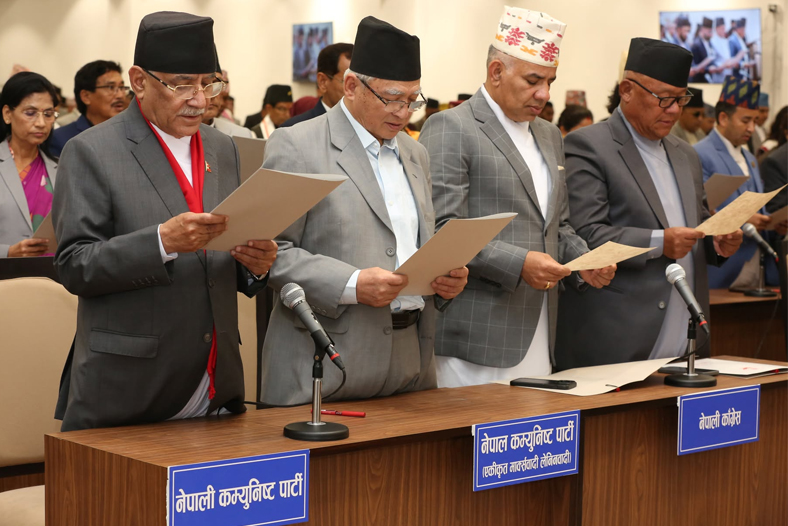
In the House of Representatives elections, Raswapa secured nearly a two-thirds majority (182 seats) and formed the government for five years. The Nepali Congress became the second largest party and main opposition.
UML won 25 seats, while Prachanda’s CPN secured 17 seats. There are only six parties in Parliament: the Labour Culture Party holds 7 seats, Rastriya Prajatantra Party (RPP) has 5 seats, and independent Mahavir Pun won one seat. Combined, the communist parties have 42 seats.
If UML and CPN unite, the left could select the Leader of the Opposition, gaining membership in the Constitutional Council and influencing constitutional appointments. Otherwise, the left will remain marginalized.
As main opposition, the left could pose strong warnings to the government and be seen by the public as the principal opposition group. Congress would remain the third force. Even if unable to run the government, the left’s opposition role would be significant. Remaining the second largest power would maintain their relevance for five years.
Opportunity to Become the Largest Party in the National Assembly
The National Assembly consists of 24 members from Congress, 11 from UML (including nominated members), and 17 from Prachanda’s CPN. Other parties have smaller numbers. Raswapa may nominate one member soon.
With a total of 59 seats, 30 are required for a majority. UML, CPN, and Janamorcha together have 29 seats; if supporting JASPA’s two members, the left can form a majority.
Conversely, if UML and Congress form an alliance in the National Assembly, they would reach 35 seats. Whether the left aligns or competes with Congress on key issues remains to be seen. At least for the next two years, the left is expected to have significant presence in the National Assembly.
However, it currently seems unlikely that UML and CPN leaders will capitalize on the chance to be opposition leader in the House and largest party in the National Assembly.
Mission 2084: The Next Challenge
Local and provincial elections are slated for 2084 BS. The left’s presence will continue until then. However, the federal government is showing signs of increasing policy pressure and interference at provincial and local levels.
For example, the government has banned advertisements at the local level. Policy interventions from Singha Durbar (the administrative center) are expected to increase.
The political pressure from Raswapa’s popularity in the House elections will confront leftist and Congress parties in the upcoming elections.
Raswapa plans to conduct independent local elections and has proposed banning political party-affiliated organizations. If local elections are independent, parties’ influence will be confined to provincial and central levels.
Raswapa also intends to amend the provincial assembly structure, allowing direct election of Chief Ministers and automatic membership for heads, potentially eliminating the election of 550 provincial members. This would leave many leaders without positions.
How will the left survive policy pressure from Raswapa-led governments and ruling parties at provincial and local levels? What is the Mission 2084 strategy? Leaders like Oli, Prachanda, and others have little time to contemplate; their disputes and personal attacks on figures like Balen and Ravi have fragmented the communists.
In conclusion, a prayer: May God grant wisdom to Nepal’s communists!


