




Summary of the Report
Editorial overview completed.
- The new government has announced a plan to distribute Soil Health Cards within three months as part of agricultural development.
- These cards provide information on soil health status, including carbon content and advice for improvement.
- Nepal is implementing policies and programs to increase soil carbon content in efforts to achieve sustainable development goals.
The recently formed government, elected with nearly a two-thirds majority, carries high expectations from the public. This majority strengthens the responsibility to deliver tangible results.
In its recently published 100-point reform agenda, the government outlined priorities including agriculture, land, infrastructure, and essential services development. Among key initiatives for the agricultural sector is the distribution of Soil Health Cards within three months to commercial farmers.
Productivity and yield increase, the main indicators of development, are directly connected to soil, with a core focus on the amount of carbon that can be stored and stabilized in the soil.
Out of the three agricultural development tasks in the government’s 100-point agenda, the last specifies distributing Soil Health Cards to farmers running commercial agricultural farms within three months.
The Soil Health Card provides details about the soil’s condition, including carbon and other essential nutrients and soil health indicators. It also offers recommendations for necessary nutrient additions and remedial measures.
While distributing Soil Health Cards is a commendable practice, it is not new. Currently, soil and fertilizer testing laboratories across all seven provinces are already providing similar cards to farmers.
The government’s priority should extend beyond merely distributing these cards to implementing policy programs aimed at enhancing soil health by increasing soil carbon content, a key indicator of soil quality.
Increasing soil carbon helps reduce nutrient loss, maintain moisture for longer periods, enhance root spread, improve soil aeration, boost microbial populations, and maintain ecological balance, thereby improving the physical, chemical, and biological properties of soil.
This increase in soil fertility plays a vital role in improving production and productivity. Soil is often overlooked in climate change discussions, but the carbon content in soil is crucial for climate change predictions and impact assessment.
Globally, soil stores twice the amount of biological carbon compared to biomass and three times the atmospheric carbon. Soil carbon reduces atmospheric CO2 levels, improves soil health, and enhances productivity.
However, land management and land use practices in Nepal have not adequately focused on increasing organic matter (soil carbon) or addressing carbon degradation.
Many policies and programs have superficially addressed soil health improvement without a deep understanding of soil conditions.
To modernize, commercialize, and diversify the agricultural sector toward self-sufficiency and farmers’ welfare, it is essential to activate the soil carbon cycle to boost production and productivity.
Since fiscal year 2015/16, Nepal has implemented a 20-year agricultural development strategy aiming to increase soil organic matter from 1.96% in 2015/16 to 4% by 2034/35.
However, the mid-term target for the past decade was to reach 3.92% organic matter, but current levels fall short of this goal. The Cabinet has also approved a national contribution target to raise soil carbon to at least 4% by 2035.
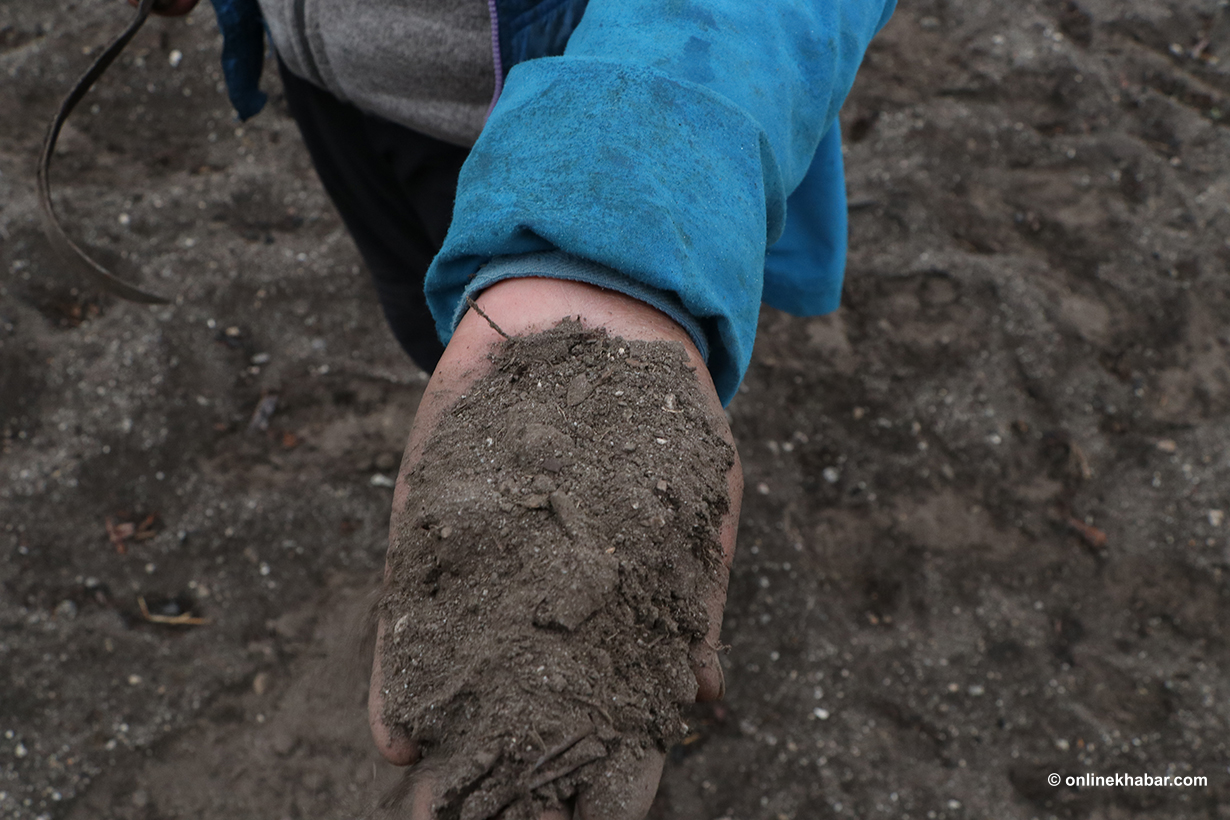
The current sixteenth five-year plan has set a target to raise organic matter from 1.96% to 2.5%, which shows only a slight improvement compared to previous plans.
This marginal increase clearly indicates that effective measures to increase soil carbon have not been achieved yet.
Though policies exist to increase soil organic matter, implementation remains weak and does not correspond with key agricultural production indicators. To increase agriculture production and productivity, soil carbon content must rise in parallel.
Nepal has already gained acceptance from the United Nations in 2021 to upgrade its status as a developing country by 2026, and it aims to meet the Sustainable Development Goals (SDGs) by 2030.
Among the 17 SDGs, nine relate directly to soil and contribute about 90% to agricultural productivity, while five others are indirectly connected.
Therefore, it is crucial to consider soil health when formulating government policies and programs to achieve sustainable development.
Healthy soil typically contains over 4% organic matter, whereas in Nepal, most agricultural lands have about 2% or less.
The government must focus closely on increasing soil carbon through programs promoting organic fertilizers, clean biochar production, local organic fertilizer manufacturing and incentives, regulation of heavy equipment use, and nutrient management in soil.
Every year, soil rich in carbon is washed away by rain, reducing soil carbon reserves with restoration potentially taking years.
Research shows that approximately 369 million tons of soil erode annually in Nepal, and the problem is worsening.
Soil organisms rely on carbon as an energy source; thus, a lack of carbon negatively impacts production, productivity, food security, and ecological balance.
There are two types of soil carbon – labile (quickly decomposed) and stable (slowly decomposed). Labile carbon is more sensitive to environmental changes, while stable carbon remains fixed longer.
Continuous cultivation reduces soil carbon, highlighting the need to increase organic matter. Erosion is higher on fallow lands, but over time, vegetation on such lands can increase soil carbon levels.
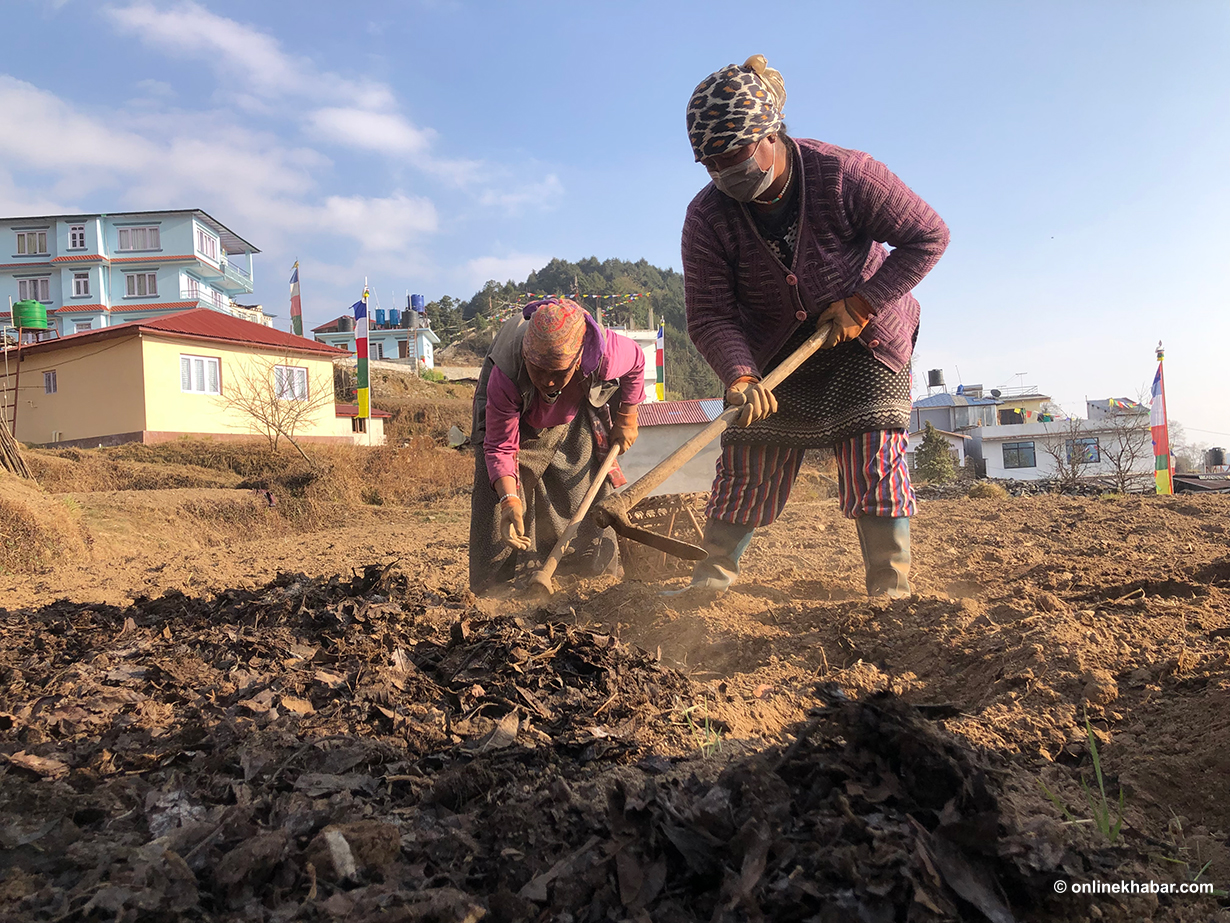
Other studies show labile carbon increases initially, followed by stable carbon growth. However, encouraging fallowing is not recommended as it may reduce carbon gains and increase opportunity costs.
Meeting the growing population’s food demand requires simultaneous increases in both soil productivity and carbon content.
Nepal has the potential to turn the carbon challenge into an opportunity, particularly through carbon trading. Countries reducing greenhouse gas emissions can earn revenue by trading carbon offsets.
Recently, Nepal approved the Carbon Trading Regulations 2025, which include projects by private sector and NGOs beyond just alternative energy.
Nepal must generate income by implementing projects that reduce greenhouse gases through forestry, alternative energy, waste management, agriculture, and land use sectors.
Carbon trading projects need to be implemented from federal down to local government levels. Immediate soil organic matter improvement programs should start in the Terai region and be integrated into carbon trading initiatives.
By establishing credible carbon credit systems and ensuring regulation implementation without political interference, carbon trade can become a sustainable foreign exchange source for Nepal.
Increasing soil carbon is not instantaneous; structured programs considering soil health must be executed.
While past political instability hindered effective soil health improvement plans, the current two-thirds majority government is better positioned to understand soil issues and implement appropriate programs.
Increasing soil carbon and addressing the carbon crisis are essential to boost production and achieve agricultural self-reliance.
(Authors Suvedi are experts at the Soil and Fertilizer Testing Laboratory in Madhesh Province, and Dr. Ojha is a soil scientist at Nepal Agricultural Research Council, Khumaltar.)


