




Farida Khatun, who works at an NGO in Phulwari Sharif, Patna, is the most educated member of her family. She has completed her postgraduate studies.
Her family, who worked as laborers, enrolled her in 2007 at the Kasturba Gandhi Residential School in Araria.
Farida is originally from Araria, a Muslim-majority district where over 40% of the population is Muslim.
She says, ‘We live in an area where girls were traditionally given only Islamic education, but I got enrolled in this school. I benefited from school uniforms, sanitary pads, bicycles, and many schemes under the Girl Empowerment Program, eventually earning my postgraduate degree from Patna University.’
‘At that time, it seemed Nitish Kumar was a leader for girls, but in recent years, it feels he has become just a political figure and has engaged in religion-based politics as well.’
Farida’s observation aptly encapsulates Nitish Kumar’s political journey.
Recently, Nitish Kumar resigned as Bihar’s Chief Minister. He submitted his resignation at the Lok Bhawan to Governor Lt. Gen. (Retd.) Syed Ata Hasnain.
He first became Chief Minister in 2000 for seven days, but his continuous tenure began in November 2005.
Nitish earned the nickname ‘Sushasan Babu’ (Mr. Good Governance), but in recent years he has been known as ‘the party-hopper.’ He has been the subject of many memes and analysts have questioned his ideological commitment.
‘There Is No One Like Nitish’
When Nitish decided to move to the Rajya Sabha, his son Nishant Kumar began visiting the JDU office in Veerchand Patel Nagar, Patna, causing quite a stir.
However, JDU workers do not see him as the ‘second Nitish.’
Ashok Kumar, who has supported Nitish since his first election in 1977, says, ‘There is no one like Nitish Kumar.’
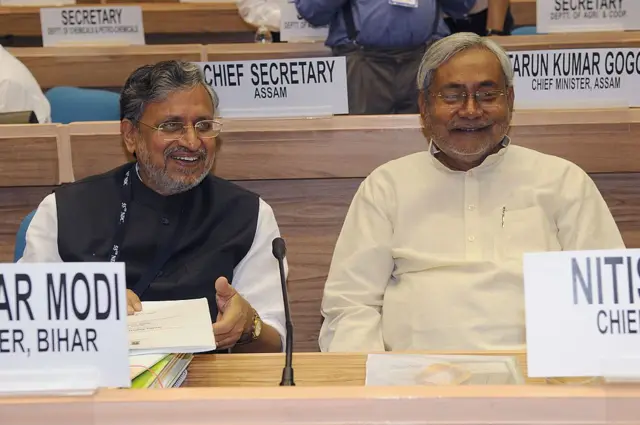
One of Nitish’s first major challenges was modernizing government offices from typewriters to computers, where BJP leader Sushil Kumar Modi was a key aide, famously always carrying a tablet.
Modi served as Deputy Chief Minister and handled important responsibilities in the Finance Ministry.
IAS officer Vyas Ji, from the 1982 batch and now retired, remarks, ‘Both Nitish and Sushil Modi had sharp temperaments. I also witnessed Lalu Prasad Yadav’s tenure. The key difference was – Lalu was a leader, Nitish was an exceptional administrator.’
‘He welcomed new ideas in meetings and reviewed previous directives at every departmental meeting. He had a strong desire to progress Bihar.’
Socialist Nitish’s ‘Vote Engineering’
After taking power, Nitish Kumar released a white paper stating that Bihar ranked the worst on all development indicators.
The Nitish government faced huge challenges in law and order, roads, electricity, and infrastructure.
Coming from the Kurmi caste, Nitish had to practice vote engineering to remain in power for years.
For his strategy, he targeted women and the most backward classes.
Senior journalist Santosh Singh writes in his book ‘Kitna Raaj, Kitna Kaaj,’ ‘Nitish granted women 50 percent reservation and provided 20 percent reservation to extremely backward classes (EBC) Hindus and Muslims in panchayat and local bodies.’
‘This drew criticism from his own caste, who claimed he sacrificed them to benefit other groups. But Nitish recognized women, even by caste, as backward.’
Later, the Mahadalit Commission was formed in 2007.
His ‘Love-Kush’ (Kurmi-Koeri) equation is said to fetch him about 20% votes, although their population is roughly 7%.
‘Complacent in Himself’
Upon coming to power, his two flagship schemes—school uniforms and bicycles—were seen as symbols of change.
Girls in rural areas riding bicycles to school symbolized this transformation.
Initially, this reflected the welfare-oriented socialist Nitish and improvements in law and order.
Later, however, accusations emerged that the government focused more on publicity than effective implementation of these schemes.
Social activist Shahina Parveen says, ‘During Nitish’s early tenure there were diligent employees and good initiatives for women, but later stability was lost.’
‘Nitish himself seemed to enjoy his work, but in later days, it became more about show. Publicity increased but sustainability decreased.’
‘Reservations were given to women in panchayats, but few became ministers or MLAs. The initiatives reinforced traditional roles, like distributing sewing machines and organizing papad-making trainings.’
Before the 2025 Assembly elections, ‘Jeevika Didi’ was given Rs 10,000 to start employment, but even then questions arose about changes in Nitish’s politics.
JDU leaders say, ‘Earlier our leaders brought change through policies; now they resort to election gimmicks.’
Crime, Corruption, and Communalism — Nitish’s ‘Three Cs’
Nitish repeatedly asserted that he would not compromise on the ‘Three Cs’: crime, corruption, and communalism.
In 2005, Bihar Police ADG Abhayanand recalls, ‘When Nitish became CM, he called me and said we need rule of law.’
‘Work was done on the Arms Act, speedy trials, and witness protection processes. SAP (Special Auxiliary Police) was created and police modernization was initiated.’
Yet in recent years, there were incidents against the Nitish government—for example, in 2015, a journalist was held hostage at the home of MLA Anant Singh in Mokama.
After the killing of Ranveer Sena chief Brahmeshwar Mukhiya, his supporters sparked violence in Patna, including arson at Dak Bangla Chowk.
Advocate Manilal says, ‘At that time, it seemed like the state could descend into 1990s-style caste violence, but it did not happen.’
‘Still, riots occurred in Aurangabad, Chapra, and Biharsharif. Corruption became widespread; nothing progressed without bribery. Nitish’s grip was not as strong as before.’
Many New Schemes but Limited Ground Success
Nitish launched the ‘CM public court’ program to make the government accountable.
Programs such as the Information Call Center, ‘Your Government Your Doorstep,’ and Bihar Public Service Rights started enthusiastically but later weakened.
The Information Call Center was established in 2007.
RTI activist Shivprakash Rai states, ‘It started well but is now closed. Accountability has ended. Activists have been threatened, attacked, or falsely charged.’
Shahina Parveen notes, ‘There was progress in education and health infrastructure, but poor quality of teachers and doctors made benefits negligible. The PPP model increased privatization, diverging from earlier approaches.’
Improvements in Electricity and Roads
According to a 2006 white paper, Bihar’s average electricity consumption was 60 kilowatts, which increased to 134 kilowatts in 2011–12 and 374 kilowatts by 2025–26.
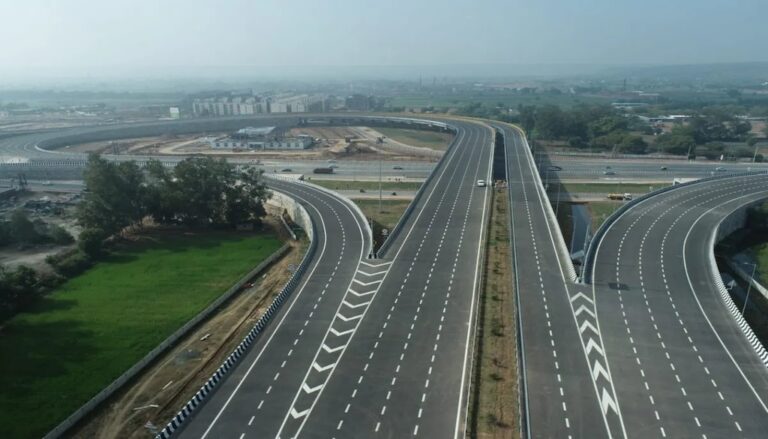
Road construction in 2005–06 stood at 835 kilometers, now reaching 119,067 kilometers. Bridges and flyovers have made travel faster.
However, the claim that all areas in Bihar can reach Patna within five hours remains unmet.
Progress in land reforms, education, health, and industry was limited under Nitish’s government.
Committees led by D. Bandopadhyay and the commission headed by Muchukund Dubey were formed for land reforms and the Common School System respectively.
Former director D.M. Diwakar says, ‘Nitish had good intentions but joint reports were not implemented. Private institutions grew but public ones weakened.’
‘At the panchayat level, unregulated teacher appointments further deteriorated education quality.’
Senior journalist Arun Srivastava comments, ‘Bihar’s government has become one of contractors. Flyovers only serve middle-class needs. What about the marginalized communities?’
‘Documents talk about development, but the state lags in industry, employment, and migration.’
Nitish’s Changing Political Loyalties
In the 2010 Bihar Assembly elections, the NDA alliance won 206 of 243 seats, with JDU securing 115 and RJD 22 seats.
However, disagreeing with Modi’s rise nationally, Nitish left BJP and allied with RJD and Congress for the 2015 elections.
In 2015, Nitish symbolically sent the DNA samples of Biharis to Delhi to express dissent.
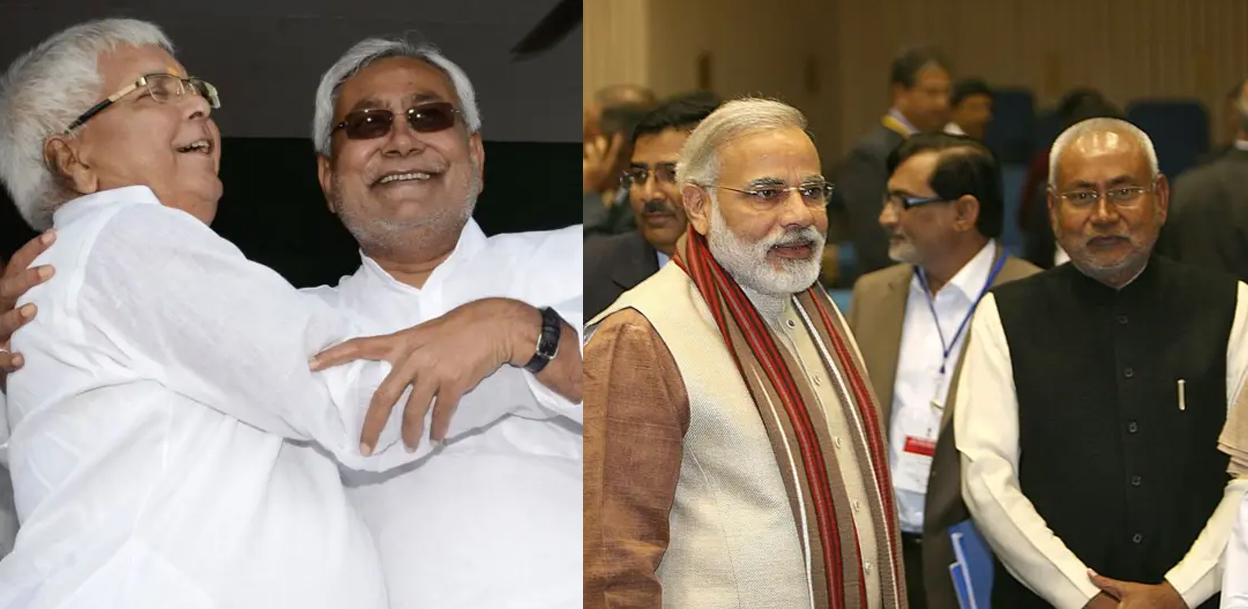
He returned to the BJP alliance in 2017, again allied with RJD and Congress in 2022, but broke that alliance in 2024.
Currently, Nitish’s JDU and BJP are united. In recent elections, Nitish repeatedly admitted that allying with RJD was a mistake and that he would not switch sides again.
Once a fighter for special state status for Bihar, Nitish now appears satisfied with special packages.
Previously, he proudly celebrated Bihar Day, promoting Bihari identity, but now his influence has waned. He assumed office at 54, and is now 75 years old.
(Translation based on original Hindi content)


