




News Summary
With Editorial Review.
- Although discussions about unity between UML and NCP left-wing parties exist, leaders say no concrete advice is present and internal reforms are needed within the parties.
- UML Vice-President Bishnu Prasad Paudel emphasized prioritizing election review and party restructuring.
- Despite talks on left alliance after meeting between Prachanda and Oli, leaders agree immediate unity is unlikely.
April 20 (7 Baishakh), Kathmandu – After suffering a significant defeat in the House of Representatives election, discussion on left-wing unity has emerged in Nepal’s leftist political sphere. Particularly, debates and analyses are underway on whether unity is possible between the two major parties, UML and NCP. However, contrasting views prevail regarding internal reforms and alliance prospects within both parties.
Some senior leaders of the Nepal Communist Party (UML) have dismissed the left unity topic as irrelevant, emphasizing internal reforms instead. Vice-President Bishnu Prasad Paudel stated that election review and party restructuring should be the priorities and remarked that the excessive discussion on left unity has sidetracked focus.
“For UML, a serious review of electoral defeat and party reorganization are today’s primary agenda,” Paudel wrote on Facebook, “So why is there unnecessary talk about left unity that diverts attention from this reality?”
Similar sentiments are shared by Surendra Pande and Pradeep Gyawali. Pande questioned on Facebook, “Many comrades, citing leadership crisis, have engaged again in the race for left unity. Yesterday it was for positions; today to survive. But is party unity about clear ideas and principles or about fulfilling limited self-interests?”
Gyawali also suggested prioritizing internal party reforms first.
While political circles discuss possible unity between UML, NCP, and other left parties, no concrete guidance has emerged. Instead, calls for internal reforms have been more prominent.
“At this time, all leftist parties are undergoing review processes. UML and NCP both faced major setbacks. There are also parties formed by splinter groups. Challenges are not uniform and solutions might differ,” Gyawali said.
This debate has reached grassroots levels within UML, with top leaders’ opinions guiding the path forward.
“Now is the time to review the election defeat, identify causes, and provide correct solutions,” central committee member Bishnu Rizal said. “But it is natural for party members to be interested in talks about merging with another party that could help resolve crises.”
Rizal added that not all left parties share the same crisis; rather, unity could occur around certain common problems.
What is the situation in the Nepal Communist Party?
Although UML leaders have not openly opposed unity, some within NCP believe immediate unification isn’t feasible. At the central committee meeting held on March 31 (19 Chaitra), leaders stated that immediate unity is unlikely.
In the document presented by Coordinator Pushpa Kamal Dahal (Prachanda), many leaders took positions against left unity.
“It is essential to clarify the basis and necessity for left unity,” said a participant in the meeting. “Our stance is that the party cannot be united by just agreeing with KP Oli.”
The NCP document cited the division among left forces as one reason for the election defeat on February 3 (21 Falgun). Prachanda believes if leftists unite, they could have gained 26 more seats.
“UML and NCP had 42 seats combined. The conclusion was that contesting elections under a single symbol would have secured an additional 26 seats,” a leader said. “This document seems to have initiated talks regarding left unity.”
Discussions After the Oli-Prachanda Meeting
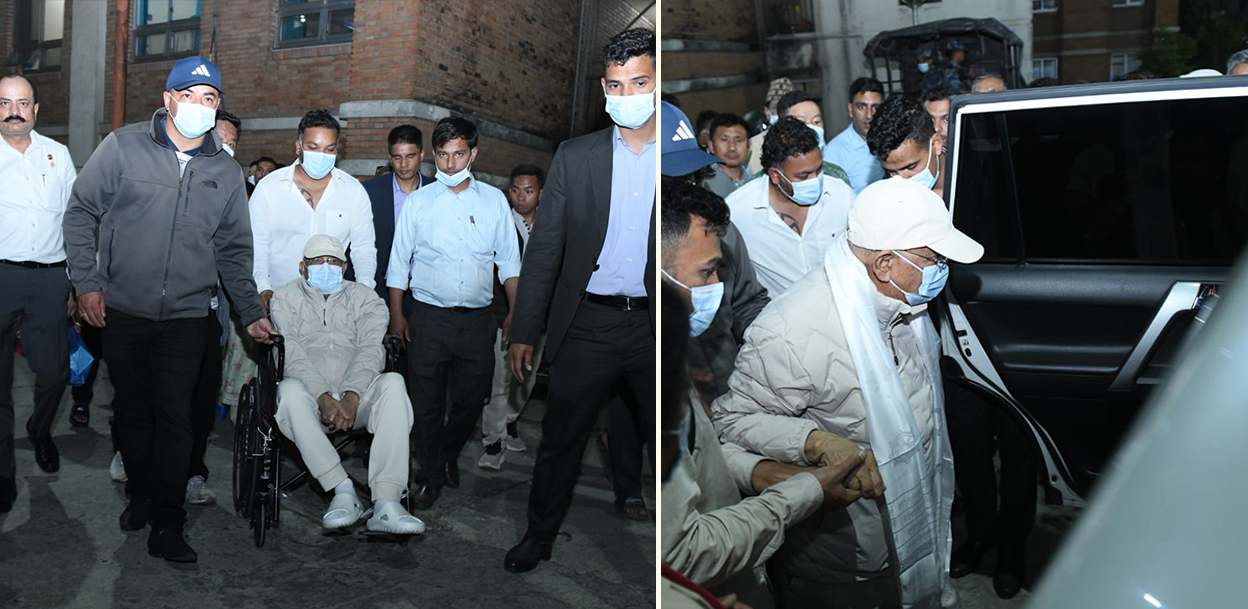
Another factor increasing talk of left unity was Prachanda’s visit to Maharajgunj Teaching Hospital on Thursday to meet Oli. Though claims surfaced that left unity was discussed at the meeting, disagreements remain among leaders.
Even UML leaders expressed skepticism regarding unity discussions following the meeting. However, sources close to Prachanda say no discussion on left unity took place during the visit.
“Prachanda extended best wishes for Oli’s recovery. Oli tried to raise political matters,” a source said, “Oli voiced concerns about past weaknesses, but Prachanda did not say much.”
Prachanda assured further discussion later. “Let’s talk after you recover,” the source added. “That’s how rumors escalated.”
Status of UML-NCP Unity
A senior NCP leader asserted that although Prachanda discussed unity with Oli, immediate alliance is not feasible.
“It’s natural to visit the hospital and wish for health. Unity discussions are internal party matters,” he added.
Another leader noted that the party’s current power dynamics make immediate unity with UML impossible. “Even the pre-election unity has not been finalized. Leaders still do not know each other well,” he said, “There is considerable disagreement regarding leftist consolidation.”
Currently, some leaders strongly support unity, while distrust towards Oli and Prachanda also persists.
“Their past has troubled many. Their style of uniting with another party is seen as a personal survival tactic,” another NCP leader said. “There is chaos within the party, which fuels suspicion.”
However, a few leaders on both sides advocate for unity. UML’s Mahesh Basnet posted support for unity on social media.
“It is natural for forces opposed to the communist party’s unity and who reject socialism and people’s democracy to resist,” Basnet said.
Basnet also criticized UML members who oppose left unity publicly. “It is surprising to see some leaders unnecessarily criticizing despite being associated with the leftist name,” he stated.
NCP leader Ashesh Ghimire stated that the opposition to long-term left unity arises more from leadership intent than principle.
“In crisis, work unitedly; don’t split in easy times. We must question this mindset. After electoral defeat, there should be detailed reviews and planned dialogues,” he said. “Quick, superficial unity reviews are not helpful.”


