



News Summary
With Editorial Review.
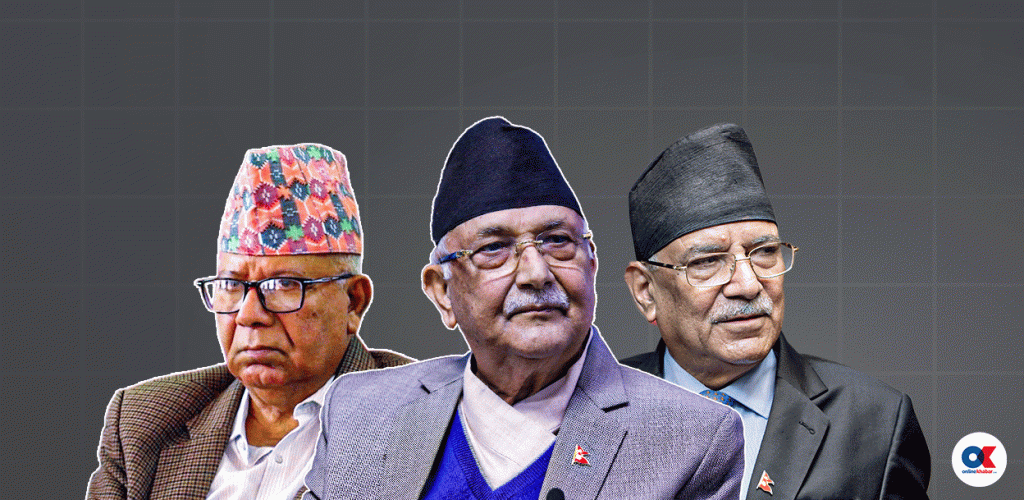
- Following a humiliating defeat in the House of Representatives elections, pressure for leadership change has mounted in the CPN-UML and Nepal Communist Party (NCP), prompting Prime Minister KP Sharma Oli and NCP Chair Pushpa Kamal Dahal ‘Prachanda’ to engage in efforts for leftist unity.
- On the occasion of the Communist Party Foundation Day, Prachanda publicly called for unity among all leftist factions aiming for socialism and communism.
- Since the 2022 elections (2079 BS), leftist parties have been struggling for survival, with prospects indicating they may lose leadership of the Singha Durbar administration for the next five years.
April 22, Kathmandu – Intense debates about restructuring have been ongoing among the older political parties after their disgraceful defeats in the House of Representatives election.
Particularly in CPN-UML, Nepal Communist Party (NCP), and Rastriya Prajatantra Party (RPP), pressure for leadership changes has increased. Following the Supreme Court ruling appointing Gagan Thapa as party chair, the Nepali Congress is also likely to proceed toward its regular general convention.
However, CPN-UML Chairman KP Sharma Oli and NCP Coordinator Pushpa Kamal Dahal ‘Prachanda’ have so far resisted the pressure for leadership change and are actively pursuing renewed leftist unity initiatives. In a statement released today on the occasion of the Communist Party Foundation Day, Prachanda issued a public call for leftist unity.
“…Advancing the Nepali revolution, ending all forms of discrimination, and building an egalitarian society with socialism and communism as the goal, unity among all leftists and communists has become a historic necessity today,” Prachanda stated.
Sources reveal that second and third-tier leaders, who understand the wishes of Oli and Prachanda, have been actively working to foster an environment conducive to unity. Recent disputes on social media also suggest ongoing efforts toward leftist unity.
CPN-UML leaders seeking to remove Oli allege that the talk of leftist unity is being used to sideline party restructuring efforts. Among these leaders are Vice-Chairman Bishnu Prasad Paudel and Deputy General Secretary Yogesh Bhattarai.
Mahesh Basnet, a leader close to Oli, strongly rejects such allegations, saying, “It is natural for those opposed to socialism and populism, fearing destruction if the communist party unites, to resist it.”
However, sources indicate the number of leaders supporting Oli has dwindled since the elections. Only a handful of officials, such as Ram Bahadur Thapa, Mahesh Basnet, and Khag Raj Adhikari, continue to advocate for his continuation. Of these, only Thapa and Basnet have openly voiced their support.
In a short span after the party’s formation, the Rastriya Swatantra Party (Raswap) sent a strong political signal with its performance in the December 2022 elections. However, Oli and Prachanda appear to have overlooked this electoral message, aided by second and third-tier leaders.
Leaders such as Basnet and Thapa have publicly commented against those who express opinions or make decisions contrary to Oli’s wishes. On Chaitra 25 (April 8), addressing a UML gathering in Kaski, Thapa revealed the party’s right-wing elements had surfaced.
“Certain individuals were provoked by that statement and previously hidden ones emerged because it exposed the right-wing tendencies within the party,” he said, implicitly referring to Vice-Chairman Bishnu Prasad Paudel.
Following Thapa’s speech on Chaitra 19 (March 31) in the House of Representatives, the next day a secretariat meeting was held to correct his statements, reportedly under Paudel’s influence to align it with Oli’s stance.
Thapa’s assertion blaming the UML’s electoral loss on the Nepali Army, civil servants, the government led by Sushila Karki, and external powers was rectified at that meeting.
These incidents indicate lobbying by second and third-tier leaders aiming to keep Oli in leadership. Their actions have also prevented young leader Suhang Nembang from becoming the parliamentary party leader.
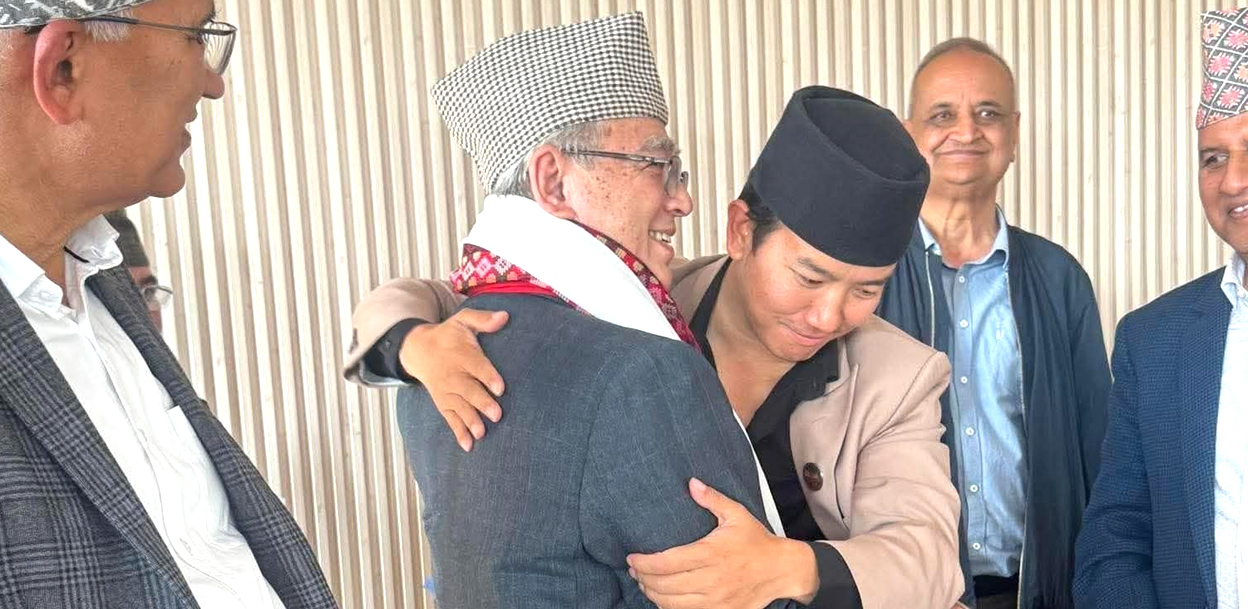
Suhang, who has been directly elected twice and is popular both within and outside the party, had widespread youth demand for him to lead the parliamentary party. Nevertheless, proportional representative member Ram Bahadur Thapa was appointed party leader.
While conflicts and public struggles continue in the UML, there is no shortage of leaders willing to play roles aligned with Prachanda’s wishes. Past experiences show young leaders often provoke public disputes serving Prachanda’s interests.
After the January Movement, Prachanda’s leadership was sustained with support from the party ranks. Agni Sapkota, Pampha Bhusal, Krishna Bahadur Mahara, Dev Gurung, Barshaman Pun, Shakti Basnet, and Devendra Paudel were prepared to relinquish their posts on Prachanda’s proposal. Subsequently, Prachanda, as coordinator, abolished the posts of other leaders.
Leaders questioning leadership restructuring, such as Janardan Sharma, Ram Karki, and Sudan Kiranti, were pressured to leave the party. The list of leaders expelled for opposing Prachanda is extensive.
Upon becoming coordinator and bringing eight factions together, Prachanda abandoned the ‘Maoist’ label, the ‘Maoism’ principle, and the electoral symbol featuring the hammer and sickle within a circle. “Nowadays, referring to the Maoist brand seems to be associated only with Prachanda himself,” noted a party insider.
Post-unity, the party has appeared to be led mainly by Prachanda and Madhav Nepal. “Only Prachanda seems aware of who formed unity and who the leaders are; even Madhav Nepal seems largely uninformed,” the insider added. Nevertheless, election results have confirmed the party’s declining trajectory.
Madhav Nepal had also adopted Prachanda’s style. After Jhulanath Khanal and Ghanshyam Bhusal escalated proposals for party reformation, Madhav prioritized unity with Prachanda.
CPN-UML leader Surendra Pande analyzes the crisis in leftist parties as resultant from their leadership and bureaucratic structures.
“Political parties are not civil service commissions where seniority is based on age; in politics, juniors with capability can become senior leaders. However, we bureaucratized parties, suppressing critical thinkers and fostering an environment of fear,” he explained.
Facts underline that the crisis in leftist forces is not merely due to leadership. For example, voters delivered a clear message for generational change in the 2022 elections. Independent candidates won mayoral posts in Kathmandu Metropolitan, Dharan Sub-Metropolitan, and Dhangadhi Sub-Metropolitan, reflecting public sentiment.
Raswap’s vote share in the short period following its formation also signaled shifting political dynamics in 2022. Yet, Oli and Prachanda disregarded these signals, supported by subordinate party leaders.
The Worst Phase in History
As left parties, which should herald change, maintain the status quo, the country for the first time in 20 years has a fully non-communist government.
Since 1995 (2051 BS), CPN-UML entered government, and since 2005 (2062 BS), Maoists joined at the central level, except for exceptions. Though an election government led by Chief Justice Khil Raj Regmi was formed in 2012 (2069 BS), UML and Maoist-affiliated ministers were included. The January Movement led to a government under Sushila Karki, institutionalizing leftist presence via the 2015 (2071 BS) election.
However, within eight years, leftists are now struggling for survival. The last election weakened UML more than in 2008 (2064 BS) and Maoists more than in 1991 (2048 BS). Some compare this situation to that of 1958 (2015 BS).
If no unforeseen political decisions occur, communists are unlikely to lead Singha Durbar for the next five years.
Communists are no longer the main opposition in the current parliament, securing only 25 seats—15 for UML and 10 for NCP. In direct elections, UML won 9 and NCP 8 seats.
Eight years ago, in 2017 (2074 BS), the left alliance had dominated the 275-member House of Representatives with 176 seats: NCP with 80, Maoist with 36, Nihkpipa and Janamorcha with one each. They held two-thirds majorities in most provinces.
The strongest showing for communists was in the 2010 (2064 BS) Constituent Assembly election where communists held 368 of 601 seats. Maoists won half of 240 seats at that time, with leftists receiving 55.8 percent of the vote.
Even without winning major votes in 2010, communist forces managed to hold power consistently. After the 2017 election, they claimed to have permanent control over the state for 20 years.
However, before eight years passed, leftists are now in existential crisis. The fault lies not only with Oli and Prachanda, but also with their supporting leaders, as confirmed by decisions taken after the January Movement.
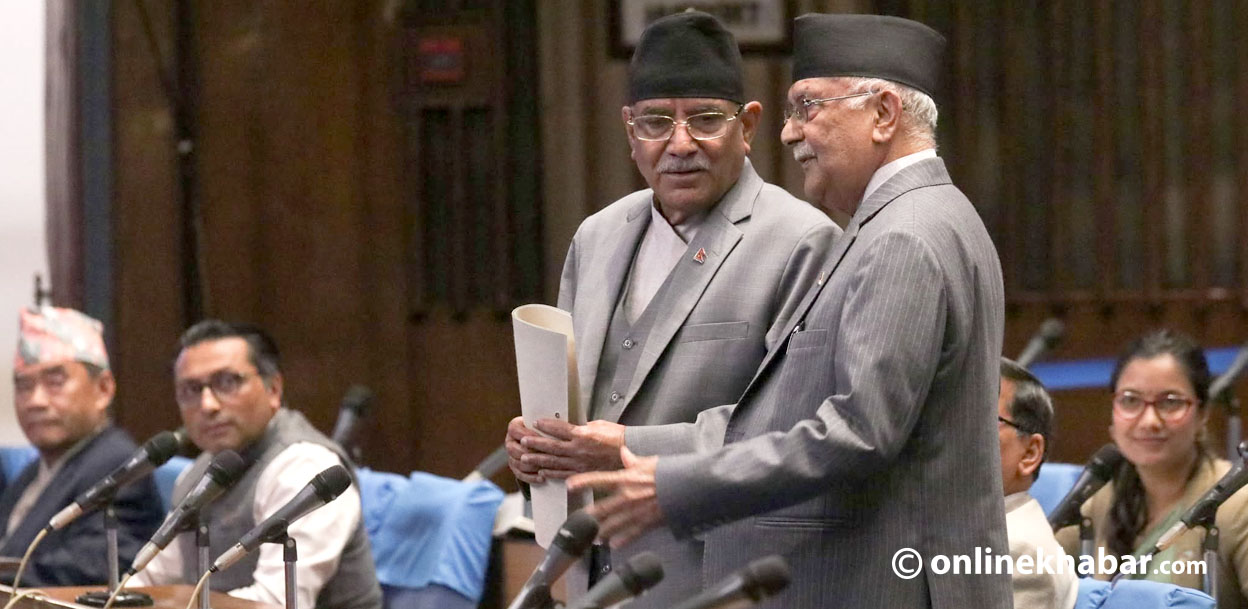
During the January Movement, although the Nepali Army rescued Prime Minister Oli by helicopter, his autocratic leadership did not halt. Oli manipulated party bylaws and decisions in his favor.
General Secretary Shankar Pokharel defended Oli’s statements with reasoned arguments and even mobilized the party.
Vice-Chairmen Bishnu Prasad Paudel, Prithvi Subba Gurung, Raghubir Mahaseth, Lekhraj Bhatt, and Chhabilal Bishwakarma helped maintain Oli in leadership.
In the eleventh general convention in December 2022, Paudel’s faction supported Ishwar Pokharel’s candidacy, creating conditions to ease the party crisis.
Yet, after the February 2023 election, Paudel’s group began pushing for leadership changes.
Prachanda did not have to face such challenges. After Maoists split, a ‘national convention’ at Bhrikuti Mandap led to leadership renewal.
Leftists have failed to pressure for change despite the clear message from street protests, while Congress embraced the rebellion from the same platform.
Leftist analyst Ghanshyam Bhusal believes their continuous crises stem from weak principles and ideologies. After joining power under the name of multiparty populism, right-wing characteristics surfaced within UML and were mirrored by Maoists, worsening the crisis.
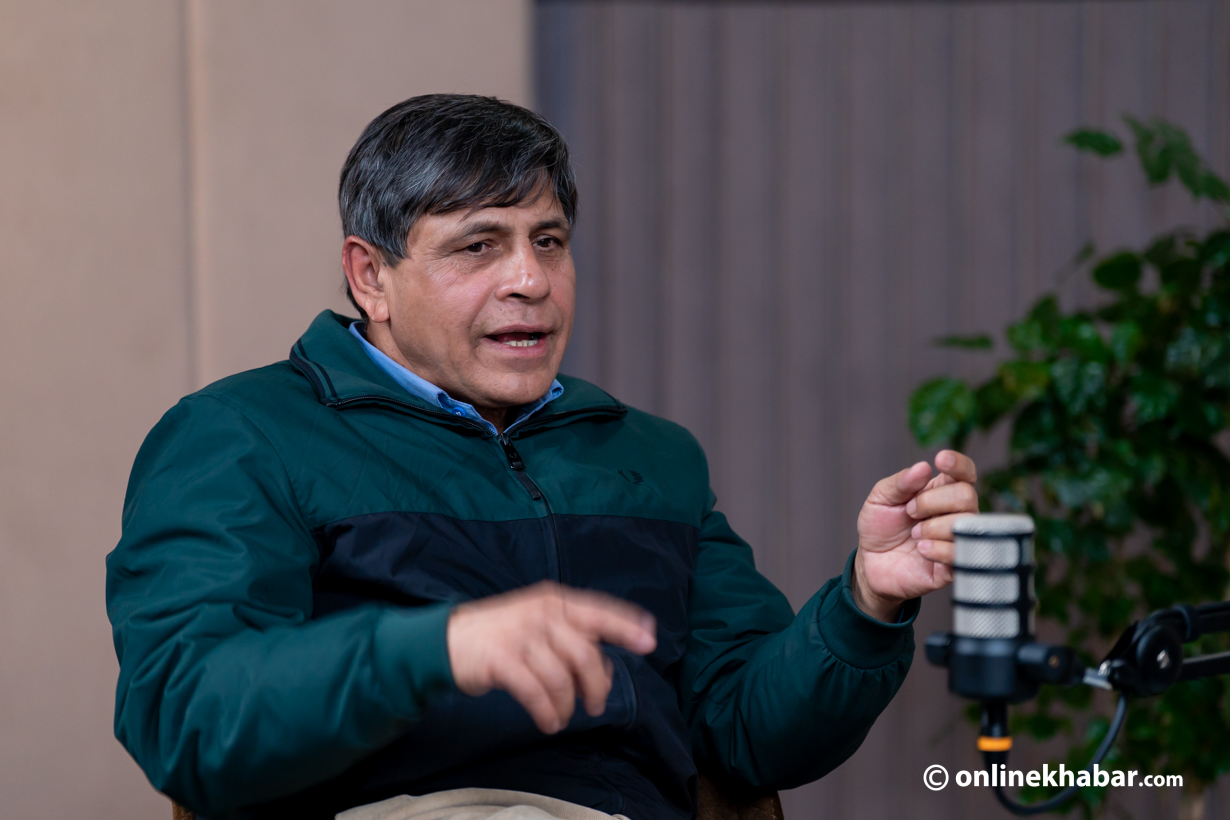
According to him, UML was trapped in power since 2002 (2059 BS) and Maoists since 2005 (2062 BS).
Though Madan Bhandari had urged revolution through popular power, the allure of power entangled the party. To please the leadership, subordinate leaders mobilized cadres to win elections.
Former Chief Election Commissioner Dinesh Thapaliya says parties have registered 6 million members as workers, but this structure failed to protect votes of Congress and leftists.
This failure partly explains why the country has yet to develop fully, and it shows why voter sentiment entrusted Balendra Shah with the key to the country.


