Residents Fearful in Pokhara as 450 Houses Face Demolition; Bulldozers Stand Ready at Bus Park





News Summary
Editorial review completed.
- Pokhara Metropolitan City on April 17 issued a notice ordering all squatters unlawfully occupying public land to vacate within 35 days.
- Preparations are underway to deploy bulldozers to remove unauthorized settlements and structures built by squatters in Pokhara Bus Park and surrounding municipalities.
- Kaski’s National Land Rights Forum has formed a 35-member struggle committee to oppose displacement.
April 27, Pokhara – Management of unplanned settlements and squatters has become a primary agenda for mayoral candidates in Pokhara Metropolitan City. The Pokhara Bus Park area, in particular, has emerged as a focal point of this ongoing issue.
The Pokhara Bus Park land was acquired in 1974 (2031 BS) and today hosts numerous unauthorized settlements and structures erected by squatters, especially near Prithvi Chowk and other municipal locations.
Political party organizations, labor unions, and youth groups have also occupied land within the Pokhara Valley Urban Development Committee’s jurisdiction, constructing unauthorized buildings. It is alleged that labor unions affiliated with the Congress, UML, and NCP parties have been renting out these seized structures.
Following a nationwide movement, the municipality had attempted to remove party-affiliated structures in the municipality area but failed.
After the executive committee meeting held on April 16, the metropolitan city issued a formal notice on April 17. However, many disregarded the order. The situation escalated when Prime Minister Balendra Shah ordered bulldozers to remove unauthorized settlements and occupied structures, provoking widespread tension in Pokhara.
The municipality directed that unauthorized structures on publicly registered land—including long-term occupants and municipalities—must be removed within 35 days.
This directive followed complaints related to land rights, illegal office operations, rental of seized properties, and boundary disputes. The municipality called upon occupiers to voluntarily vacate their premises.
The metropolitan authority declared its readiness to operate bulldozers as a priority anywhere within its jurisdiction, sparking anxiety among approximately 25,000 unauthorized settlements and squatters across Kaski district.
Similarly, on April 21, the Pokhara Valley Urban Development Committee issued a notice demanding removal of unauthorized buildings within 35 days, warning that any buildings erected without permission or agreement would be immediately demolished. The committee owns the Pokhara Bus Park and other associated properties.
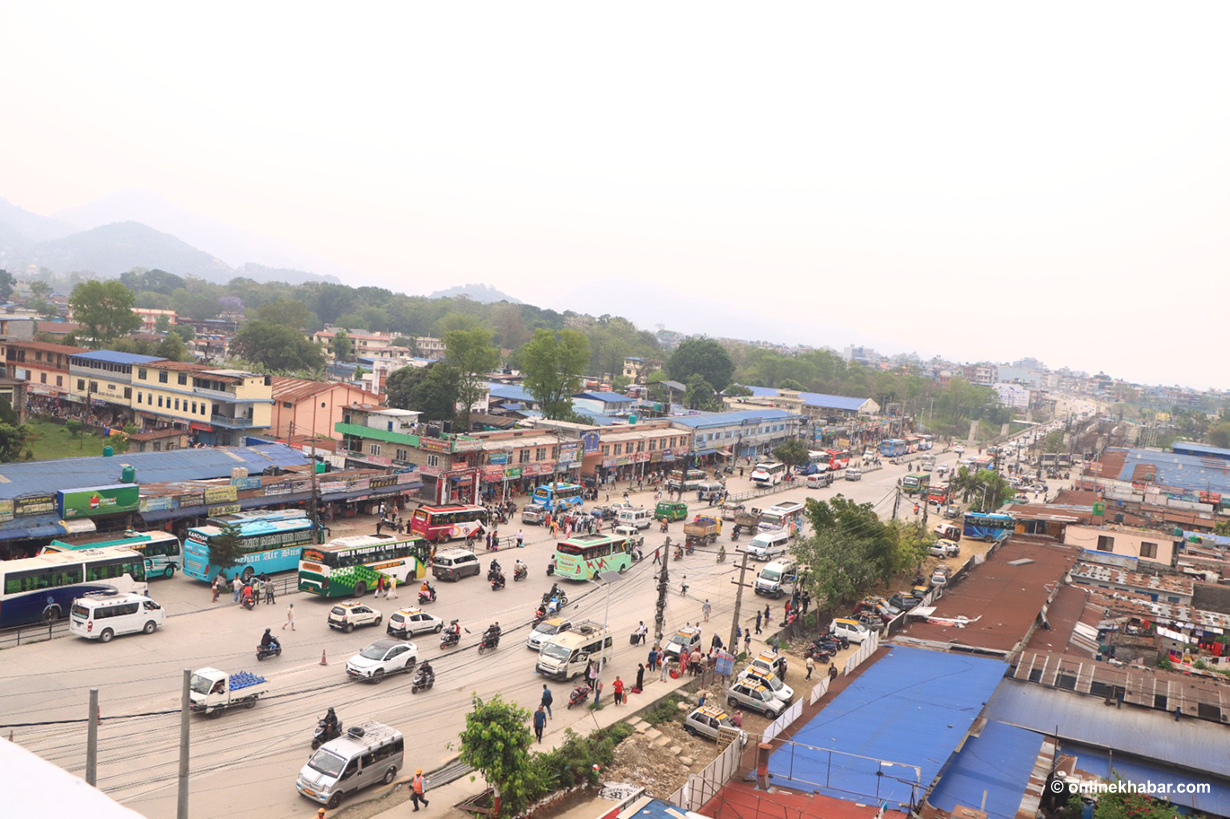
As demolition preparations advance, squatters near the contentious Pokhara Bus Park by Prithvi Chowk are particularly fearful of bulldozers.
Pokhara’s urban plan was approved in 1973 (2030 BS) and the master plan developed in 1974 (2031 BS). The acquired land of 205 ropani (approximately 10.5 hectares) included sections of Ward No. 9 bordered by the Seti River to the east, Prithvi Highway to the west, highways to the north, and the airport grounds to the south. Locally, it is known as the Dhikhyaadhik and Goreto Road area.
After some landowners did not receive compensation, they took legal action. Following the court’s decision to provide compensation, the bus park area was effectively managed through a multi-party agreement in 2003 (2060 BS), ensuring compensation and relief mechanisms, according to the metropolitan city’s recent report.
Hotel operators displaced from the airport area were allocated 79 ghaderi of land within Bus Park by the Pokhara Valley Urban Development Committee.
On November 14, 1977 (Kartik 29, 2034 BS), hotel businesses were officially shifted from the northeast section of the airport to the Bus Park area. Although 205 ropani were acquired, only 196 remained after adjustments including a 75-foot reduction in road width, bringing the final area to 187 ropani.
Presently, about 457 families, alongside a community school, occupy roughly 207 ropani of irregular settlements and squatters, with a significant portion restricted to approximately 19 ropani of land.
The Lower Valley Development Committee, chaired by Ashok Palikhe, Bishnu Bastola, and Kshetra Bahadur KC, registered roughly 21 ropani of land under the names of 30 individuals. At that time, the land’s value ranged from NPR 180,000 to 300,000, the latest metropolitan report notes.
Multiple plans have been formulated for the bus park’s construction and squatter management, often used as political agendas or vote banks.
The metropolitan report identifies disputes among valley development committee leaders and stakeholders, indicating misuse of the acquired land for personal economic gains.
Previously uncompensated landowners were given alternative land near Prithvi Highway, but reports indicate many misused this provision for commercial interests.
The municipality has ordered all squatter settlements, unauthorized occupants, and illegal holders on public and registered land across all wards to vacate immediately, with the highest tension found in the Pokhara Bus Park area. The bulldozer campaign has caused widespread fear similar to that observed in Kathmandu following Prime Minister Balendra Shah’s initiative there.
Following Kathmandu’s bulldozer drive, similar measures are now being implemented in Pokhara, with affected groups forming committees to challenge government actions.
After years of study and planning, Mayor Dhanraj Acharya confirmed there will initially be a voluntary request to vacate, followed by forcible eviction if necessary.
Led by chairman Prem Gurung, Kaski’s National Land Rights Forum has created a 35-member struggle committee aiming to protect land rights and resist displacement, Gurung stated.
The committee’s agenda includes demands for ownership documentation, settlement rights assurance, government coordination and management negotiations, and advocating for squatters’ interests. They accuse political parties of using squatter issues for political gains but now seek sustainable resolutions.
Mayor Acharya said that unauthorized occupants and affiliated bodies on metropolitan and valley development committee lands were already notified to vacate voluntarily. Previous requests had also been made for voluntary clearance.
“Before the central government’s directive, we had already issued the notice on April 17. The valley development committee has also sent letters to everyone. This is the final notice,” Mayor Acharya stated. “Surveys were conducted across Pokhara on public, registered, and rented lands, but data was lost during the people’s movement. We have now recovered most of it.”
He added that government and school lands have also been occupied illegally and occupants have been ordered to vacate. “There is illegal occupation around Bus Park, Firkhola, and other rivers, lakes, and schools. All have been instructed to leave, otherwise the municipality will clear based on planning and priorities.”
Following years of research and planning, the first phase involves requests for voluntary evacuation, followed by enforced removal if occupants fail to comply. The detailed project report for Bus Park construction is ready and the budget allocated, Mayor Acharya claimed.


