72% of Deaths in Custody Are from Marginalized Communities: Is This State Silence or Structural Crime?





News Summary
Reviewed.
- Of the 39 reported mysterious deaths in detention cells in Nepal, 72% are from Dalit and marginalized communities, reflecting structural violence.
- Following the death in custody of Shrikrishna Bik from Sindhuli, a high-level investigation committee was formed, with the National Dalit Commission prioritizing the issue with the Home Ministry and police.
- Reports of investigations into custodial deaths remain confidential, allowing perpetrators to evade punishment and highlighting impunity within the justice system.
Nepal’s constitution guarantees every citizen the right to live with dignity. However, numerous individuals taken into custody for investigation die mysteriously in detention cells, raising serious concerns about full state control and security mechanisms. The recent case of 23-year-old Shrikrishna Bik from Sunakoshi Rural Municipality–3 in Sindhuli is a prominent example.
During the Panchayat era, police custody was known as “kalakothari” (dark rooms). Many people brought in for routine questioning lost their lives there. Even during the decade-long conflict, detention cells were referred to by the same term, and this grim reality has remained unchanged to this day.
Similarly, most of those who mysteriously die in custody belong to Dalit and other marginalized communities, pointing to serious concerns of structural crimes by the state.
Recent incidents indicate that deaths in custody are not merely technical accidents but are consequences of deep social prejudices and systemic violence. Below are details of five major custodial death cases:
“Insecure Victims at the Boundary of Security”
1. Shrikrishna Bik (Sindhuli, Date: 7 Baishakh 2083):
23-year-old Shrikrishna Bik, from Sunakoshi Rural Municipality–3, Sindhuli, was a vehicle driver who had a love relationship with an upper-caste teenage girl. Despite marrying on 28 Chaitra 2082, the girl’s family filed a rape complaint citing her young age. Arrested at Satdobato, Lalitpur, he was handed over to Khurkot Police in Sindhuli. On 4 Baishakh, he was placed in custody at Khurkot; police declared his death by suicide on 7 Baishakh around 6 pm.
Suspicion surrounds this supposed ‘honor killing’ as he was found hanging on a three-foot measuring window with bodily injuries, and police delayed showing CCTV footage.
2. Bijayram Mahara (Rautahat, Date: 10 Bhadra 2077):
19-year-old Bijayram Mahara from Garuda, Rautahat, was arrested for investigation in a murder case. During custody, he was tortured so severely that both kidneys failed. While undergoing treatment in Birgunj, he died on 10 Bhadra 2077. Before death, via a video message from the treatment room, he revealed being tortured with pipes and boots by the police. Police tried to erase evidence but under pressure, some officers faced legal action.
3. Shambhu Sada Musahar (Dhanusha, Date: 28 Jestha 2077):
23-year-old Shambhu Sada Musahar was found dead in custody at the Sabaila Area Police Office, Dhanusha, on 28 Jestha 2077. Police said he hanged himself in the detention toilet, but the height of the hanging spot didn’t match his stature. This incident sparked large protests in the Madhesh region. Although the family alleged police torture leading to murder, the truth never emerged.
4. Rajkumar Chepang (Chitwan, Date: 7 Shrawan 2077):
24-year-old Rajkumar Chepang from Rapti Municipality, Chitwan, died due to brutal police torture. Arrested on 1 Shrawan, he died on 7 Shrawan during treatment. Activists reported severe torture inflicted upon him.
5. Paltu Ravidas (Dhanusha, Date: 15 Shrawan 2078):
40-year-old Paltu Ravidas from Lakshminiya Rural Municipality–2, Dhanusha, highlights the state’s lack of sensitivity. Released on bail of Rs. 200,000 on 11 Shrawan 2078 for a murder charge, he was held in custody due to delays in raising bail money. On the morning of 15 Shrawan, he was found hanging in the police station’s toilet. The family claimed murder and refused to accept the body. Following suspension of a police constable, an investigation team was formed; however, reports have not been made public and justice remains elusive. This case exemplifies how caste arrogance and police violence kill innocent people in custody.
Statistics of Deaths in Custody: 72% from Marginalized Groups
Data from Advocacy Forum collected between 2018 and 2022 shows that 72% of 39 custody deaths were Dalits, Janajatis, Madhesis, and other historically marginalized communities.
Table 1: Ethnic Breakdown of Deaths in Custody (2018–2022)
The table clearly indicates the majority of victims belong to marginalized communities.
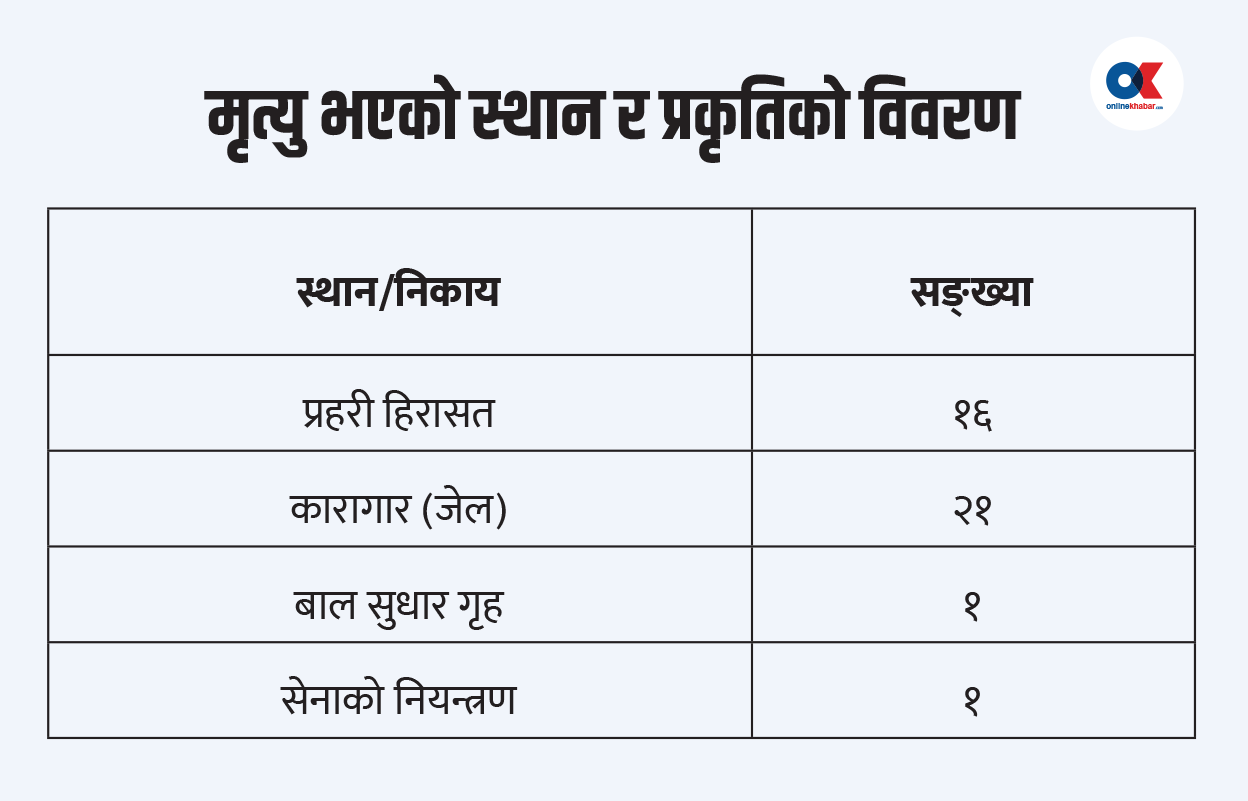
Table 2: Location and Nature of Deaths
Reports show that out of 39 deaths, 16 were caused directly by police. Many incidents involve hanging in toilets, a factor closely linked to caste and social disparities.
Advocacy Forum’s 2018 report “Rise of Torture” and others demonstrate that deaths and torture in custody are directed along ethnic and class lines.
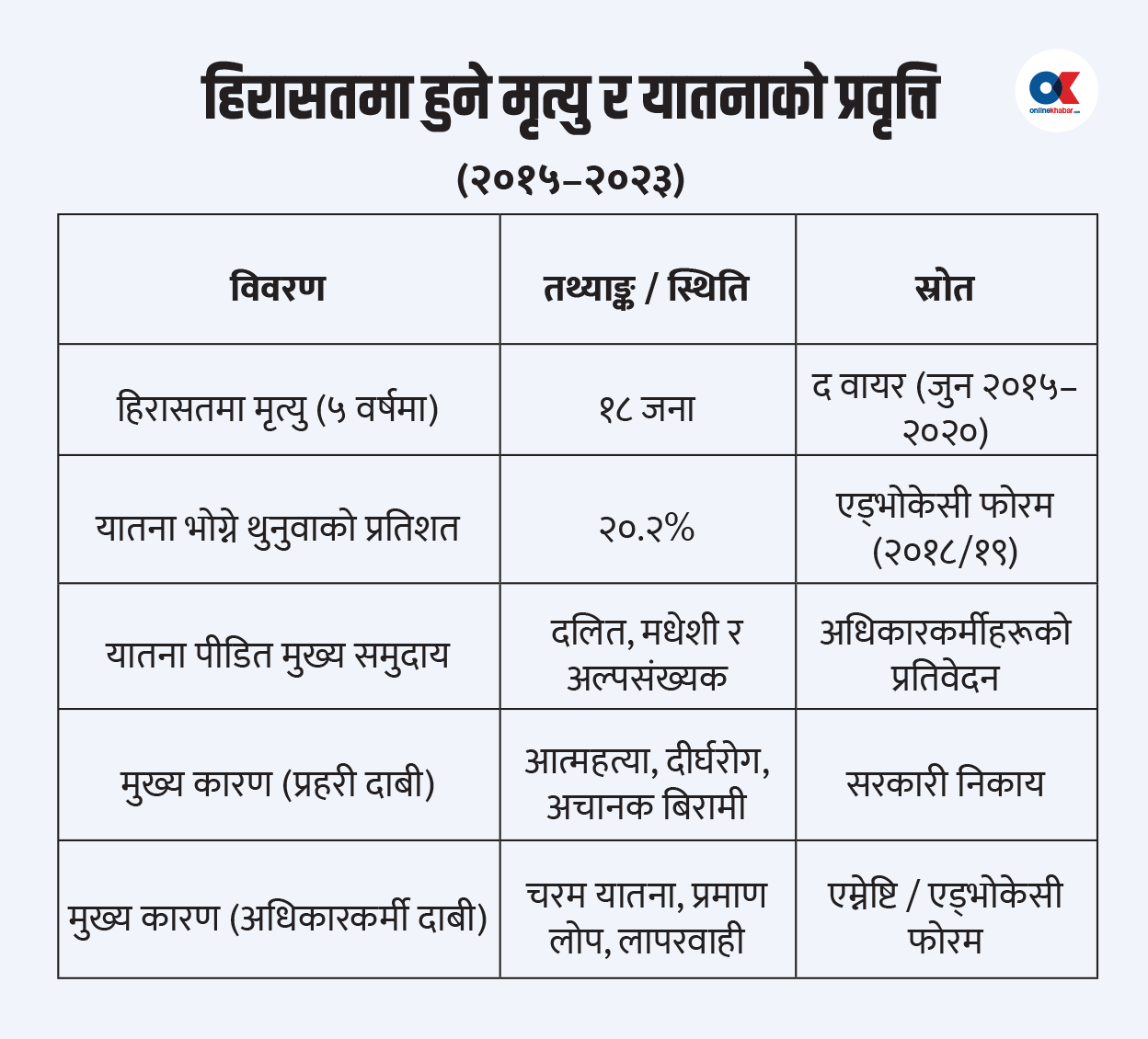
Investigation Committee Outcomes: Protection for the Culprits
The state rarely forms investigation committees after custodial deaths. When formed, these committees frequently serve only to shield the guilty from legal accountability.
According to Advocacy Forum’s 2022 report “Custodial Deaths in Nepal,” investigation committees habitually exonerate the perpetrators, confirming the impunity prevalent in the justice system.
Accused Also the Investigator: According to principles of fair justice, one cannot investigate their own case. Yet, in Nepal, police departments themselves investigate incidents that occurred under their own supervision.
In Bijayram Mahara’s case, police refused to collect evidence and attempted to protect colleagues by erasing evidence and fabricating false ones.
Low-Level Staff Blamed, Higher-Ups Protected: Custodial deaths usually happen under orders or tacit consent from senior officials. However, only lower-ranking staff are suspended or penalized, serving as scapegoats, while senior officials face no consequences.
Example 1 (Paltu Ravidas): After his death, 30-year-old police constable Jayprakash Yadav was suspended for six months, yet no action was taken against commanders or station chiefs.
Example 2 (Bijayram Mahara): Despite complaints filed against SP Raviraj Khadka, DSP Gyankumar Mahto, Inspector Nabin Kumar Singh, and Sub-Inspector Birendra Yadav, only some lower and mid-level officials were suspended or transferred in what appeared to be damage control.
Investigation Reports Remain Confidential: Non-disclosure of committee findings fosters impunity, as reports remain shelved in the Home Ministry.
Despite recommendations from the National Human Rights Commission, the Dalit Death Investigation Committee formed by the Madhesh government remained only on paper, citing COVID-19 as a reason.
Obstacles in Filing Cases: Filing complaints against police is difficult. In Shambhu Sada Musahar’s case, a complaint against Inspector Chandrabhushan Yadav was rejected, and later the Attorney General’s Office decided not to proceed, confirming police impunity.
Activists note police reluctance to register complaints against themselves and exclusion of senior officials from investigations institutionalizes impunity, increasing abuse by higher-ups and fear among lower rank officers.
Failure by the National Dalit Commission and Human Rights Commission to enforce recommendations perpetuates custodial deaths among Dalits.
“Apologies from the Podium, Handcuffs in Custody”
How personal freedoms like love and marriage transform into structural violence due to caste arrogance.
On 13 Chaitra 2078, the Cabinet acknowledged injustices against Dalit and marginalized communities and decided on corrective measures. However, before the Prime Minister’s government could implement programs, Shrikrishna Bik died mysteriously, mocking governmental commitments.
One month prior to his death, Rajpa had repeatedly apologized to Dalits and promised to end caste-based injustice. Yet, just days later, Shrikrishna’s love marriage collapsed, and he died in custody. None of the apologizing parties have formally responded to this tragedy.
No major political party has officially addressed the issue, and caste violence remains largely confined to “Dalit issues.” Shrikrishna’s death and investigation reports reveal the state’s structural mindset. Unless these reports are disclosed and culprits punished, calls for justice will remain mere promises deceiving the Dalit community.
Inter-Caste Love: Some Die, Others Are Imprisoned
The suffering of Dalits in Nepalese society is profound and inhumane. The cases of Jyoti Paswan from Saptari and a 19-year-old in Sarlahi show that although laws outlaw caste discrimination, medieval social attitudes persist.
Jyoti Paswan married Krishna Mishra in a love marriage in Falgun 2077, but family pressure due to caste differences caused Krishna to sever ties. Unable to bear the rejection, she committed suicide in Shrawan 2078.
In Sarlahi, a Dalit girl was sexually exploited under the guise of marriage and then kept imprisoned like livestock for 23 days because she was considered “untouchable.” These cases illustrate how love and marriage issues become structural massacres.
Nepal’s caste structures cruelly punish Dalit youth: Dalit men are killed in custody for loving non-Dalit women, while Dalit women face social scorn and familial rejection forcing them to end their own lives.
The Shrikrishna Case: A Test of State Justice Commitment
The state has policies to encourage inter-caste marriage, but silent tolerance of murders or fatal conditions for Dalit partners reveals the real problem.
Previous investigation committees into the deaths of Bijayram Mahara and Shambhu Sada limited themselves to shielding culprits. In Shrikrishna Bik’s case, the current urgency must not merely pacify public outrage but must ensure justice. Failure to do so will severely damage not only democracy and human rights but also the moral standing of a government that has apologized to Dalits.
As long as Dalit youth face death or imprisonment for love and marriage, the state’s claims of inclusivity and citizen rights will remain hollow slogans. Shrikrishna’s death cannot be closed as suicide; it must become a test case to punish offenders. Otherwise, detention centers will become slaughterhouses for marginalized communities, and laws will mirror the ugly face of impunity.
The caste prejudice surrounding love in Nepalese society is so harsh that Dalit men die in custody for loving, while Dalit women end their lives. Although policies promote inter-caste marriage, silence over Dalit deaths is the greatest manifestation of structural crime.


