




Summary
Technically reviewed.
- Nepal is forecasted to experience less than average rainfall and higher temperatures during this year’s monsoon season.
- The El Niño phenomenon in the Pacific Ocean and the Indian Ocean Dipole (IOD) in the Indian Ocean are identified as key factors weakening the monsoon.
- A weaker monsoon is expected to impact agriculture and hydropower sectors, raising concerns about increased food insecurity risks.
April 6, Kathmandu – Nepal is expected to receive below-average rainfall and experience higher temperatures during the monsoon season this year.
The weakening of the monsoon is attributed to the development of the ‘El Niño’ phenomenon in the Pacific Ocean and the neutral state of the ‘Indian Ocean Dipole’ (IOD) in the Indian Ocean. However, some areas of Nepal may still receive rainfall above normal levels.
The monsoon season in Nepal lasts from June to September, typically accounting for about 80 percent of the total annual rainfall. This seasonal rain is crucial for crops and the national economy, and also causes flood and landslide risks, which often harm lives and property. As a result, public attention remains focused on the monsoon performance.
Therefore, the South Asian Climate Outlook Forum (SASCOF), a regional institution for seasonal weather prediction for South Asian countries, issues annual monsoon forecasts. Based on SASCOF’s findings, Nepal’s Department of Hydrology and Meteorology (DHM) also releases information about the expected monsoon conditions each year. This year, the department has scheduled a briefing session on Friday to update all stakeholders about the monsoon outlook.
What does the SASCOF report say?
Recently, the SASCOF meeting was held in Malé, Maldives. Meteorological experts from nine South Asian countries including Afghanistan, Bangladesh, Bhutan, India, Maldives, Myanmar, Nepal, Pakistan, and Sri Lanka participated in the meeting.
The report released during the meeting projects that from May to September, parts of northwestern, northeastern, and southern South Asia will receive normal or above-normal rainfall. However, the central regions are expected to experience below-normal rainfall.
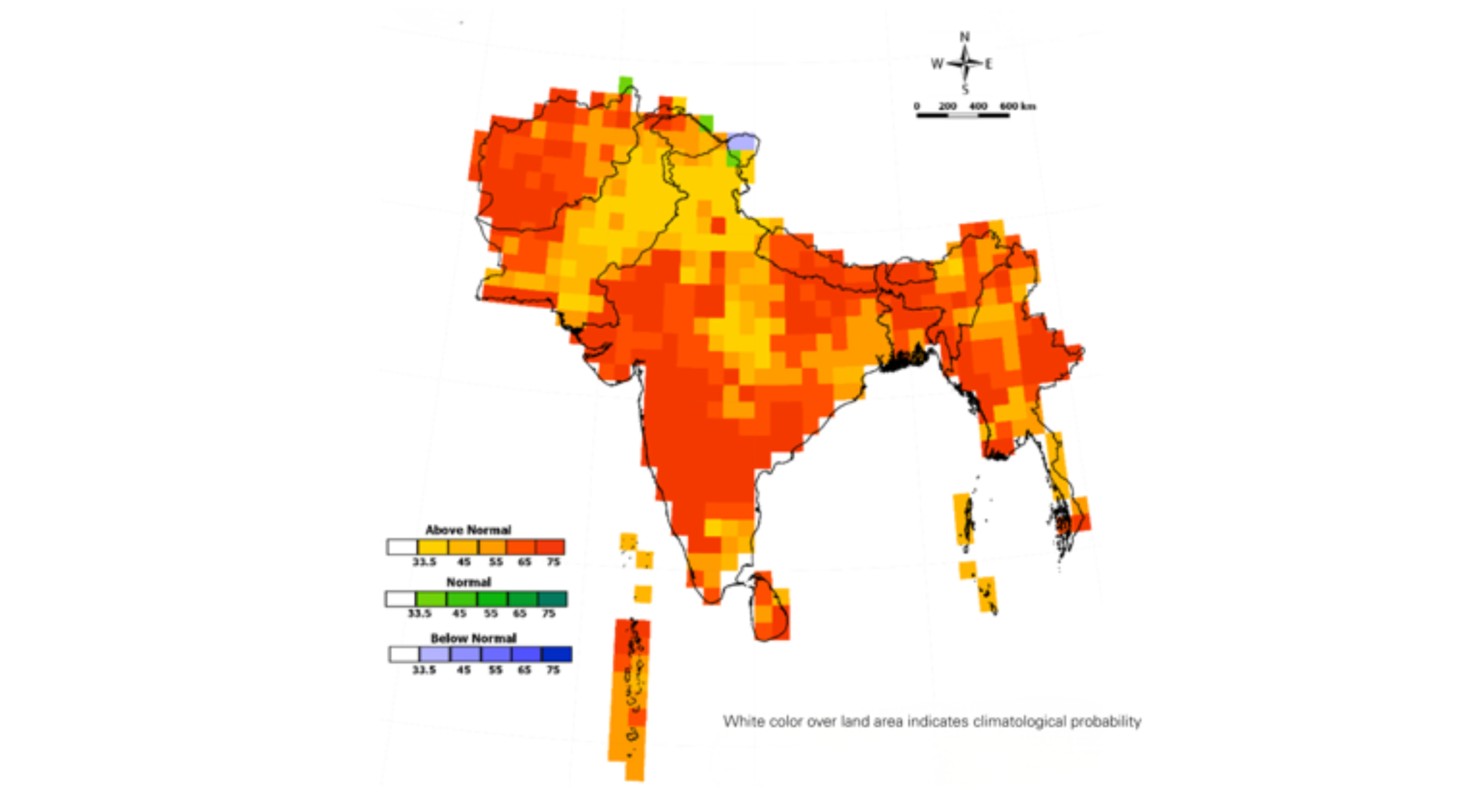
Nepal’s eastern region, being close to the northeastern area, falls within the zone expected to receive normal or above-normal rainfall. However, much of Nepal’s central region is projected to have below-normal rainfall. Therefore, despite the likelihood of localized heavy rainfall, overall precipitation is expected to be below average.
Dr. Vinod Pokharel, Associate Professor at Tribhuvan University’s Department of Hydrology and Meteorology, stated that the monsoon is likely to be weak in its initial phase, with most parts of the country receiving below-average rainfall. He highlighted that the period from May 29 to August 1 (roughly the months of June and July) might be particularly dry.
This uncertainty in the monsoon forecast is likely to directly impact agriculture and hydropower sectors. Dr. Pokharel explained that due to a weak monsoon, only about 30 to 40 percent of the rice planting could be completed in the first half of the monsoon season.
Reasons for a weak monsoon
Experts attribute the weak monsoon primarily to two climatic phenomena – the influence of El Niño and the status of the Indian Ocean Dipole (IOD).
El Niño is characterized by higher-than-average sea surface temperatures in the Pacific Ocean and affects the South Asian monsoon. Although the current El Niño is moving toward a neutral phase, residual atmospheric changes may slow cloud formation during June and July.
Similarly, the IOD plays a significant role in Nepal’s monsoon. International models indicate that the Indian Ocean will remain in a neutral state during June and July, which could hinder moisture-bearing winds from reaching Nepal.
Climate and disaster expert Dr. Dharma Raj Upreti suggested that rainfall may be good until mid-June but could turn dry towards the end of June, with low rainfall expected in July, and a possible reactivation of the monsoon by late September.
Dr. Upreti explained, “Currently, the IOD is neutral, and there is a super El Niño condition in the Pacific Ocean. Super El Niño often results in severe dry conditions. If this persists from April to June, a different pattern is likely from July to September.”
Accordingly, while rainfall might occur until mid-June, dry conditions could develop by late June and continue into July. By late September, the IOD is expected to shift to a positive phase, possibly causing monsoon resurgence during the Dashain-Tihar festival period.
Agriculture, a cornerstone of Nepal’s economy, depends on 75 to 90 percent of its annual rainfall during the monsoon. Reduced rainfall risks affecting rice and other seasonal crops, increasing food insecurity concerns. Additionally, since most of Nepal’s hydropower plants rely on river flows, diminished rainfall could cause power shortages or load shedding during winter months.
What does the Department of Hydrology and Meteorology say?
The department forecasts that in addition to less rainfall this monsoon, daytime and nighttime temperatures (maximum and minimum) are expected to rise above average. Experts warn this could adversely affect public health, particularly impacting agriculture and daily life in the Terai region.
However, department spokesperson Bibhuti Pokharel cautioned that since many factors influence the monsoon in Nepal, a definitive conclusion cannot be drawn at this stage.
“El Niño is indeed present, but various factors affect the monsoon here, so it’s premature to say the monsoon will definitely behave in a certain way,” she said. “Updates on the monsoon will be provided periodically, requiring close monitoring.”
In recent years, climate change has caused substantial variations in weather patterns, with some regions experiencing excessive rain while others face drought conditions.
Experts recommend adopting suitable alternative crops for low rainfall conditions, conserving drinking and irrigation water, managing temperatures, and implementing other adaptive measures to cope with these changes.


