




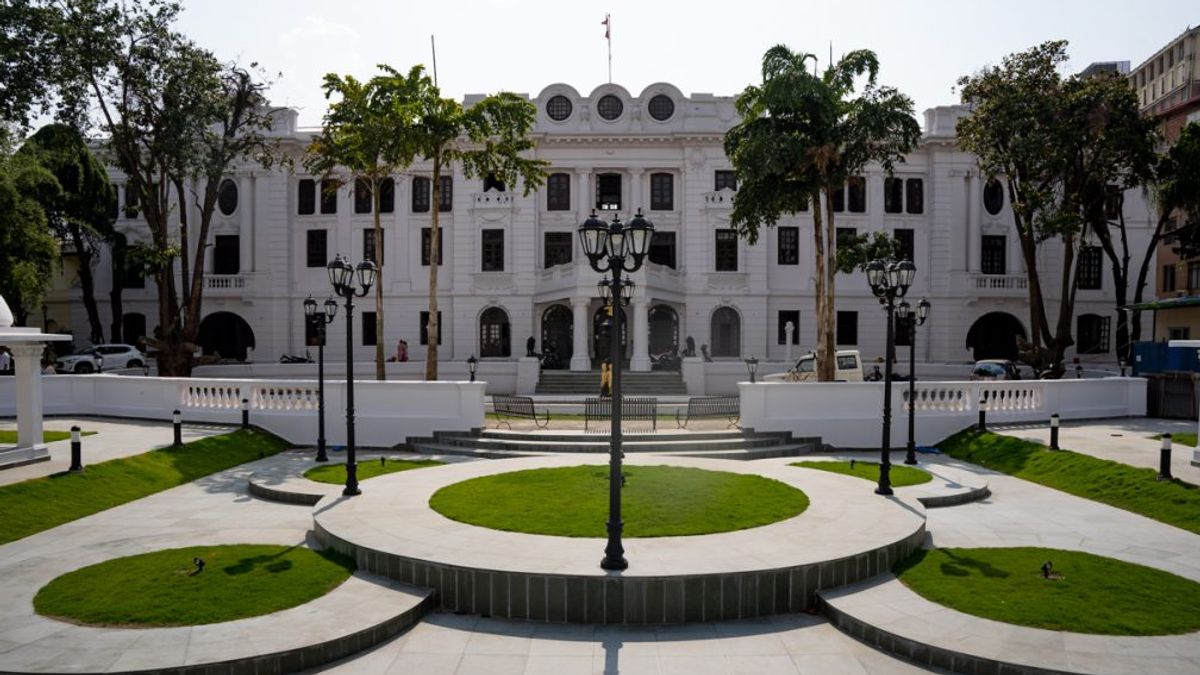
The Kesharmahal building housing the Asset Investigation Commission’s office.
News Summary
Reviewed by editorial team.
- The Asset Investigation Commission has established its office at Kesharmahal and is beginning to collect property details from employees up to the level of Deputy Secretary in the initial phase.
- The commission has prepared to collect these details via its official website.
- Commission Chair Rajendra Kumar Bhandari stated that if any discrepancies are found during investigation, the details will be forwarded to the government, and if necessary, recommended to the Commission for the Investigation of Abuse of Authority for further inquiry.
April 12 (29th Baishakh), Kathmandu – The Asset Investigation Commission, which established its office at Kesharmahal near the Narayanhiti Palace Museum, has started collecting property information from employees whose assets fall within the commission’s investigation scope. The commission is preparing to gather these details through its newly created website.
Rajendra Kumar Bhandari, former Supreme Court Justice and current commission chair, said, “Those under investigation can submit their property details via the commission’s website. We are arranging an official system for this.”
The commission has received a mandate to scrutinize the assets of officials up to the Deputy Secretary level, excluding the incumbent and former Presidents, Judges, and military officials. Initially, it is investigating the assets of public officials from 2026/27 BS to 2048 BS (2062/63 to 2083 BS).
Kesharmahal, once home to the Ministry of Education and its library, now houses the commission’s office in the space previously occupied by the Public Procurement Monitoring Office, after the Ministry of Education relocated.
Currently, five commission members regularly attend the office. The Prime Minister’s Office has assigned one Section Officer, one assistant-level officer, and support staff to assist them. The commission’s administrative head, a Secretary-level officer from the Judicial Service, has yet to be appointed. The commission is authorized to employ roughly 40 staff members according to its mandate.
Operating in two phases, the commission will first investigate assets of officials from 2062/63 BS to 2083 BS and then proceed with public officials’ assets from 2048 BS to 2062/63 BS. Chair Bhandari added that those accused or subject to legal proceedings related to corruption will also be scrutinized during this process.
“The commission will thoroughly review property declarations in a structured manner. If any irregularities are found, detailed reports will be submitted confidentially to the Nepalese government,” Chair Bhandari explained. “These reports remain highly confidential and will only be made public if cases proceed to investigations by the Commission for the Investigation of Abuse of Authority.”
To avoid the complications experienced with traditional form-based submissions, the commission officials planned to collect and analyze property data via their website. Although there is potential to develop specialized software for asset analysis, the commission sees short timelines as a challenge for such developments.
According to the gazetted rules, the commission intends to examine the assets not only of officials up to the Deputy Secretary level but also those of lower-ranked employees under office heads. Chair Bhandari noted, “If complaints arise, investigations can be conducted at any level. Even individuals not currently holding public office but found to have concealed assets through preliminary information might face investigations.”
As mentioned, asset investigations will cover two phases. After completing the initial one, the commission will proceed with examining assets of public officials from 2048 BS backward to earlier years, including those accused or facing legal cases. Chair Bhandari emphasized this would be done systematically.
He further stated that if assets exceeding declared amounts are discovered in ongoing cases, the commission will formally notify the government, which will then refer the cases to the Commission for the Investigation of Abuse of Authority for further investigation.
The government formed this five-member commission on April 14, 2026, under the chairmanship of former Supreme Court Justice Rajendra Kumar Bhandari. The commission includes former Chief Justice of the Appellate Court Purushottam Parajuli, former High Court Justice Chandiraj Dhakal, former Deputy Inspector General of Police Ganesh KC, and Chartered Accountant Prakash Lamsal.
With a one-year tenure, the commission is required to report any findings of asset irregularities to the government promptly. Upon completing its investigation, it will submit a final comprehensive report to the government.


