




News Summary
Editorially Reviewed.
- Farmers in South and Southeast Asia are struggling with farming due to fertilizer shortages and rising prices.
- Global fertilizer supply has been disrupted by world conflict and China’s export restrictions.
- In Nepal, fertilizer supply uncertainty and increased production costs are negatively impacting agriculture and the economy.
The planting season has now begun across fields in South and Southeast Asia, yet farmers face a severe shortage of fertilizer. In some areas, it has arrived late and become more expensive; in others, farmers may not receive any fertilizer at all this year. From Nepal to India, Bangladesh, Sri Lanka, Thailand, and Vietnam, farmers across Asia and the world are united by a pressing question: “How will we farm now?”
This problem transcends a mere temporary agricultural setback and points to a global crisis involving food systems, energy dependency, geopolitical tensions, and fundamental weaknesses within chemical-based agricultural systems. It is clear from current conditions that agriculture reliant on chemical fertilizers is neither safe, sustainable, nor self-reliant in the long term. However, within this crisis lies a significant opportunity: the transition to natural farming.
Current Global Context: Crisis in Agricultural Systems
The global agricultural system is under unprecedented pressure today. Conflict in the Middle East has disrupted supply chains in the Persian Gulf region, a major exporter of key fertilizers such as urea, ammonia, phosphate, and sulfur, accounting for 20-30% of global fertilizer exports via the Strait of Hormuz. This conflict has directly affected the world’s fertilizer supply.
Within weeks of the conflict’s onset, urea prices surged by more than 40%, with UN reports forecasting an increase up to 59.8% in the near future.
Additionally, China, which produces about 25% of the world’s fertilizer and exports over $1.3 billion annually, has imposed export restrictions to secure its domestic supply. This has further destabilized the international fertilizer market.
As a result, many Asian countries are facing a dual crisis of fertilizer shortages and skyrocketing prices amid uncertain supplies. Countries like Nepal, heavily reliant on imports, have farmers lining up to obtain fertilizer.
Rising fuel prices for diesel and petrol have escalated the costs associated with tractors, irrigation, transportation, and processing, continuously pushing up production expenses.
According to the World Food Programme, over 318 million people worldwide currently experience food insecurity, with another 45 million projected to face hunger risks by 2026, especially in Asia and the Pacific regions.
Agricultural systems dependent on external inputs are highly vulnerable. Climate change has intensified irregular rainfall, flooding, and droughts, while dependency on fertilizers, fuel, seeds, and other agricultural materials is increasing, further destabilizing the system.
Impacts in Nepal
Nepal has long been heavily dependent on imported chemical fertilizers, with the government spending considerable subsidies annually. Although the demand is approximately 600,000 to 800,000 tons annually, on average only about 63% of the demand is met. Currently, around 137,630 tons are in stock, 183,000 tons loaded for supply, and about 92,000 tons contracted, yet the uncertain global market threatens future supply.
The global crisis is beginning to manifest in Nepal. The Asian Development Bank projects Nepal’s economic growth rate to drop to 2.7% in fiscal year 2025/26, down sharply from 4.6% the previous year. All sectors are expected to weaken, with agricultural growth falling from 3.3% to 2.7%. Delayed monsoons and flooding in October 2025 have reduced rice production, exposing vulnerabilities within the agricultural system. The global crisis adds further pressure on supply, prices, and production costs, increasing risks to agriculture and the broader economy.
Rising production costs have continuously pushed up the prices of daily necessities such as rice, wheat, maize, vegetables, milk, meat, and eggs. Low-income households are especially affected as a large portion of their income is spent on food. Food price inflation poses risks to nutritional levels, increases debt, and reduces living standards.
Dependence on external inputs makes the agricultural system risky. Climate change is causing more irregular rainfall, floods, and droughts, while reliance on fertilizer, fuel, seeds, and other external inputs continues to rise, which destabilizes the system.
Chemical fertilizers, pesticides, intensive tillage, and mechanization have weakened soil structure. According to scientists, it takes 200 to 400 years to create just one centimeter of soil, yet we are destroying it within a few years. Approximately 40% of agricultural land has become acidic, directly affecting productivity. With over half of the large agricultural budget spent on chemical fertilizer subsidies, long-term solutions remain weak.
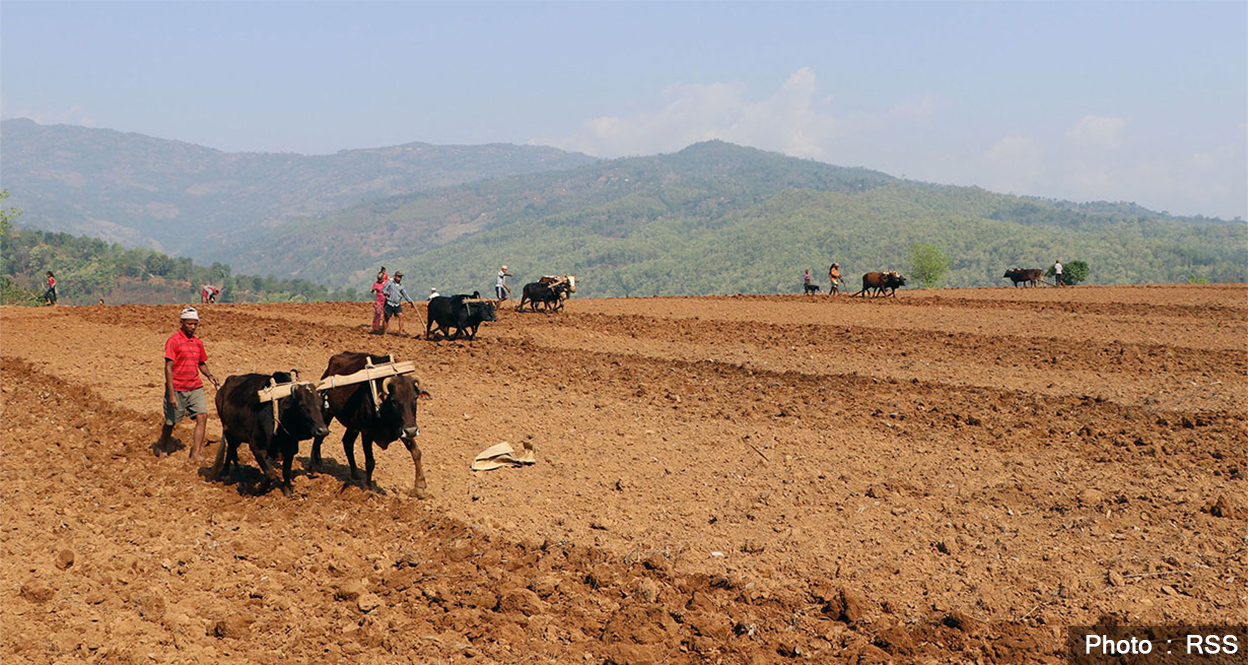
Even minor disruptions in the global market affect Nepalese farmers’ production systems. This highlights the urgent need to transition to self-reliant, climate-resilient, and sustainable agricultural systems.
Opportunity Ahead: Transition to Natural Farming
Today’s crisis is not just a challenge but a historic opportunity to transform agricultural systems. Amid rising global prices and supply uncertainties for fertilizers, fuel, and inputs, natural farming is emerging not just as an alternative but as a necessity. Locally-sourced farming systems are proving to be the most practical and sustainable path forward.
Natural farming liberates farmers from dependency and control by external markets. It utilizes cow dung, cow urine, compost, organic matter, plants, and local microorganisms. Techniques such as vermicompost, bio-slurry, fermented sprays, and green manure enhance soil fertility, improve plant growth, and reduce chemical fertilizer and pesticide usage. This approach not only lowers production costs but also empowers farmers to be self-sufficient.
Why is Natural Farming the Most Suitable Solution Now?
1. Direct Solution to Fertilizer Crisis: The biggest challenge for farmers today is fertilizer shortage. Natural farming addresses this root problem by naturally enriching the soil through preparations like fermented microbial solutions, compost, and green manure. The rapid-growing crops using green manure techniques improve soil structure and yield—significantly reducing reliance on imported chemical fertilizers.
2. Cost Reduction Strategy: With rising costs of diesel, fertilizer, pesticides, and transport, natural farming reduces costs by minimizing external inputs and mineral use. It also lowers labor costs in irrigation, hand weeding, and intercultural management. Reduced or no tillage further reduces expenses. Experiences from around 5,500 farmers indicate up to a 60% reduction in costs. This economic easing particularly benefits smallholder farmers and reduces debt risks.
3. Improved Soil Health: Chemical farming depletes organic matter in soil. Natural farming restores biological activity and natural balance, making soil healthy in the long term. Farmers report increases of 2–3% in organic matter. Healthy soil retains more water, helping mitigate drought and climate change effects.
4. Climate Change Adaptation: Natural farming is climate-friendly. Crop diversity, mulching, organic matter, and mixed cropping help cope with temperature rise, irregular rainfall, and drought. It also reduces greenhouse gas emissions.
5. Building a Healthy Food System: Consumer demand for safe and pesticide-free food is rising. Natural farming ensures healthier produce, improving public health and opening new market opportunities for farmers.
Thus, natural farming represents more than an agricultural technique; it is a significant transformation toward sustainable, self-reliant, and climate-adaptive farming systems.
Government, cooperatives, private sector, and development partners need to increase investment in natural farming education, organic material production, research, and market management.
A Special Opportunity for Countries Like Nepal
For countries like Nepal, natural farming is a vital opportunity. Traditional livestock rearing, seed varieties, local knowledge, and community farming practices form a strong foundation for natural agriculture. Particularly in hill and mountainous regions where chemical inputs are harder and costlier to deliver, natural farming offers a low-cost, practical, and sustainable alternative.
The government has recently moved towards result-based agricultural governance under its 100-point agenda, focusing on market reforms, digital price information, supply management, and pesticide control. This helps reduce chemical dependency, though a clear national policy on natural farming is still needed.
Despite large investments in fertilizer imports, rising costs, supply challenges, and international instability demand long-term solutions. Reliance solely on chemical fertilizer supply is no longer sufficient; structural changes are essential. Governments, cooperatives, private sector, and development partners must further invest in natural farming, education, organic input production, research, and market development.
Today’s global crisis clearly demonstrates the risks of chemical farming systems. For this reason, natural farming is no longer just a traditional practice but a strategic path toward sustainable development, healthy soil, food security, and farmer economic stability. The question is no longer when fertilizer will be available, but which kind of agricultural system we want to develop.
(Sharma Good Nevers, Natural Farming Promoter, serves as Head of Program Implementation and Operations at International Nepal.)


