111 Bighas of Land Encroached with 2,733 Structures in Sunsari-Morang Irrigation Project





Summary
- Over 111 bighas, 5 katthas, and 3 dhur of land in the Sunsari-Morang Irrigation Project has been encroached upon, with 2,733 unauthorized houses, buildings, temples, and ashrams constructed.
- The project administration has formally requested local authorities to remove the encroachments and take legal action while supporting the protection of government land.
- Although some land was cleared in 2015 (2072 BS), full eviction was not achieved. Recently, the project resumed efforts by notifying the district administrations to clear the encroached areas.
May 17, Sunsari – Over 111 bighas of land under Nepal’s oldest and largest Sunsari-Morang Irrigation Project has been encroached upon. According to the project, 2,733 unauthorized structures including houses, buildings, temples, ashrams, huts, and other shelters have been built on 111 bighas, 5 katthas, and 3 dhur of encroached land.
The project management has appealed to the local administration to dismantle the illegal constructions on its land and safeguard government property. Separate correspondences have been sent to the district administrations of Sunsari and Morang requesting removal of the unauthorized physical structures on project-owned land to protect the government land.
In these letters, signed by Senior Divisional Engineer Tej Rizal, the project has provided a detailed survey identifying the exact locations of encroachments including colony areas and canal systems. It also includes data on the encroachers, specifying names, addresses, and the extent of encroached land.
The encroachment spans from northern Sunsari at Barahakshetra Municipality (Koshi New Bridge) through Chhatra Intake in southern Sunsari to Budhnagar in Morang along the main canal which is 53 kilometers long. Additionally, there are 19 branch and sub-branch canals measuring 203 kilometers, and small branch canals totaling 234 kilometers. These canals provide irrigation facilities to lands ranging from 200 to 500 hectares. The project confirms unauthorized settlements and structures have encroached this entire network and adjacent land.
The letter requests enforcement of existing laws against those damaging the irrigation infrastructure through encroachment and seeks cooperation to protect the colony zones, main canal, and its branches.
Project Director Manohar Kumar Sah emphasized the importance of administrative support from the district offices of Sunsari and Morang for safeguarding and maintaining the irrigation system’s effectiveness. Copies of the correspondence have also been sent to the Department of Water Resources and Irrigation in Jawalakhel.
Breakdown of Encroachment Within the Project Area
Within Sunsari and Morang, 20 canal systems of the project have been encroached upon, resulting in 2,733 unauthorized residential and community structures. These structures occupy a total area of 111 bighas, 5 katthas, and 3 dhur.
According to recent data compiled by the project, unauthorized homes and various religious and communal buildings have notably proliferated along several canal systems and colonies in both districts.
In Sunsari alone, 1,774 such structures have been built across 11 irrigation canal systems, occupying more than 81 bighas, 4 katthas, and 15 dhur.
The most significant encroachment is seen in Chhatra main canal in Barahakshetra where over 51 bighas have been encroached, followed by Sitaganj branch canal with 2 bighas and 8 katthas. These lands have unauthorized structures built on them.
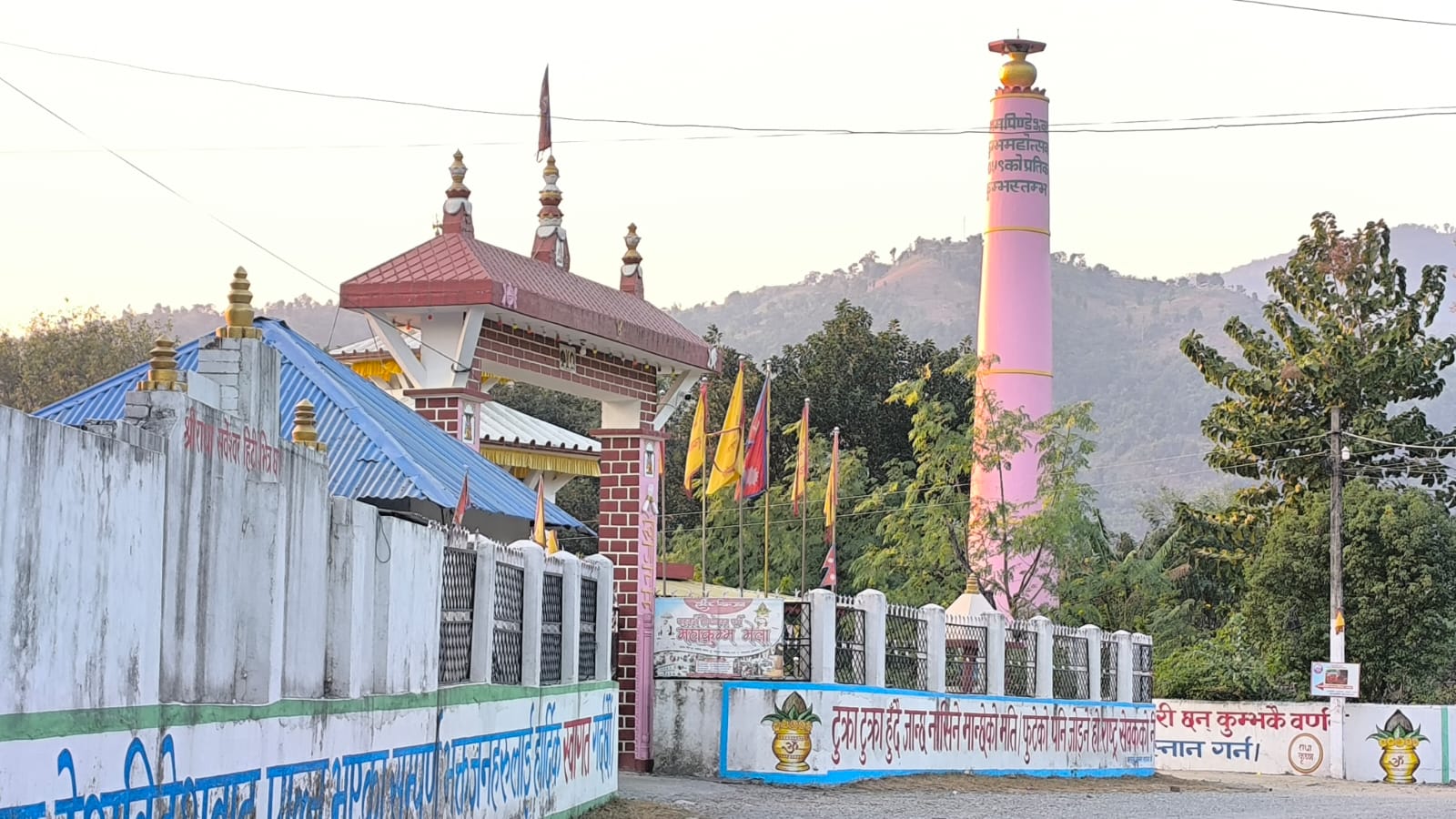
The project, which is advancing in various stages of development, has reserved certain lands in Barahakshetra’s Chhatra area for constructing physical infrastructure. However, religious leaders such as Balsant Devacharya and Krishna Bahadur Giri (known as Siddhababa) have built costly structures on these reserved “working site” lands.
Balsant Mohan Sharan Devacharya has encroached on 2 bighas and 4 katthas, constructing ashrams, temples, and dharmashalas under different names with specific portions amounting to 13 katthas 19 dhur for dharmashala, 3 katthas 4 dhur for temple, and 1 bigha 7 katthas 15 dhur for cottages.
Krishna Bahadur Giri alone has encroached on 8 bighas of project land, having constructed a 128-room, air-conditioned building valued at 80 million NPR about eight years ago. The encroachments are registered under various names such as Krishnadas Dharmashala (1 bigha 13 katthas 18 dhur), Siddhababa Godown (4 bighas 14 katthas 11 dhur), and Krishnadas Ashram (1 bigha 9 katthas 11 dhur).
Giri reportedly rented out rooms of this building to wealthy elderly people at high monthly and annual charges while also labeling it as “Modern Education with Ancient Wisdom” under the Jagadguru Shri Ramanandacharya Gurukul.
Below his building, three pipelines carrying sand from the Chhatra main canal were installed by machine despite the irregular expansion of these pipelines, which Giri was aware of yet proceeded with construction.
Near Giri and Balsant’s buildings is the Ramshanti Kunj Women’s Ashram, which has encroached on 14 katthas and 16 dhur. This ashram is managed by Mithila Pande, mother of former President Bidya Devi Bhandari.
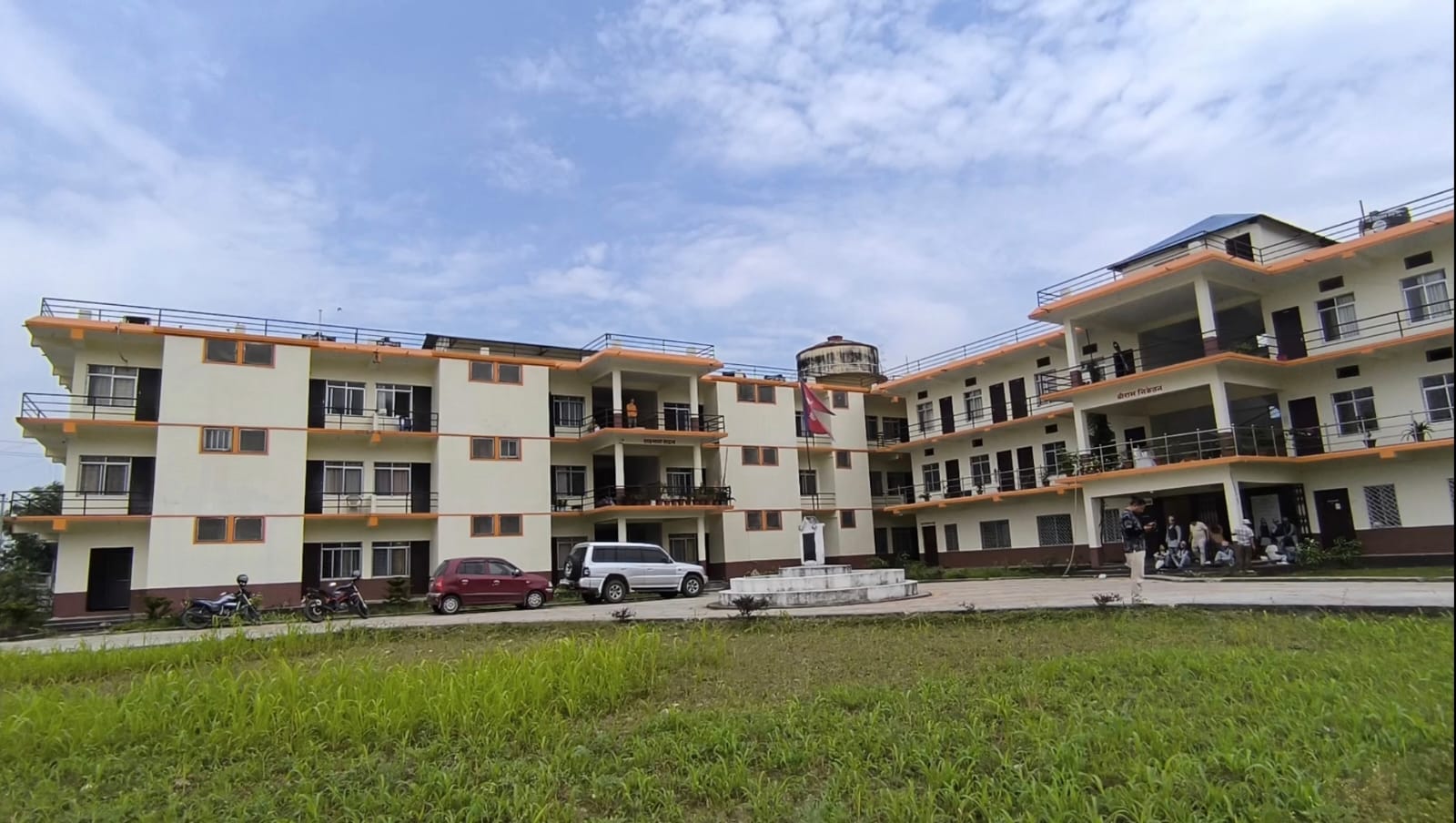
Within the project land, additional community buildings have been constructed, including the Durbasa Ghat Women’s Community Forest Consumer Committee building, Chewang Tasi Chyoling Monastery, Ghimire Bista Clan Center, Khaptadi Basnet Clan building, Ram Temple, Kumbh Stambha, Bhandari clan building, along with constructions under institutions such as Advaita Sanstha Sanrakshan Manch Nepal and Nepal Dashnam Sanyasi Adhi Jagadguru Shri Shankaracharya Math.
In Sunsari, 284 houses are built on 51 bighas, 8 katthas, and 1 dhur along the Chhatra main canal. Furthermore, on the Sukh Sena branch canal, 170 unauthorized houses occupy 3 bighas, 8 katthas, and 18 dhur.
Other canals with reported encroachments include Haripur branch canal with 22 houses on 1 bigha, 2 katthas, 1 dhur; Ramdhuni sub-branch canal with 26 houses on 7 katthas, 9 dhur; Manikchauri sub-branch with 20 houses on 5 katthas, 15 dhur; Singiya sub-branch with 93 houses on 3 bighas, 12 dhur; Shankarpur branch with 127 houses on 4 bighas, 4 katthas, 11 dhur, among others.
Similarly, in the SSJ Jhumka sub-branch canal, 52 houses stand on 18 katthas, 5 dhur; in Bishrampur minor on 5 katthas, 19 dhur 24 houses; Sitaganj branch canal with 209 houses on 2 bighas, 8 katthas, 1 dhur; Ramganj branch with 254 houses on 4 bighas, 19 katthas, 15 dhur; and Dhubhi minor with 180 houses on 1 bigha, 10 katthas, 18 dhur.
At the Chhatra main canal intake, several religious and community buildings such as Balsant’s Ashram, Kumbh Stambha, Radha Krishna Temple, Hanuman Temple, and large air-conditioned structures have been developed. In Chakraghatti Colony, a two-story building of Saptakoshi Multi-purpose Campus also exists on project land.
On the Morang side, there are nine canal systems where 959 houses have been constructed on 30 bighas and 5 dhur of land. The Chhatra main canal in Morang has 173 houses on 19 bighas, 18 katthas, and 9 dhur.
Viratnagar branch canal hosts 461 houses on 3 bighas, 8 katthas, and 13 dhur; Haringara-Mahadevkaul branch canal has 146 houses on 3 bighas, 18 katthas; Hurhuri Khakha canal with 13 houses on 1 kattha, 4 dhur; Bariyati branch with 18 houses on 16 katthas, 8 dhur; Naya Patti branch and Baitouna minor with 36 houses on 16 katthas, 16 dhur; Aamjhoda branch canal with 52 houses on 8 katthas, 10 dhur; Ranjani sub-branch canal holding 15 houses on 1 kattha, 2 dhur; and Jhamanpur branch canal with 45 houses on 11 katthas, 6 dhur.
Project Director Comments on the Land Clearance Effort
The Sunsari-Morang Irrigation Project’s land has been occupied by unauthorized structures for decades. These include private houses as well as public religious structures. Although the project removed unauthorized settlements from Keroun in Morang to 8RD in Chhatra, Sunsari in 2015, it was unable to clear all encroachments.
At that time, the project sought support from the administration for government land protection and deployed bulldozers. This led to protests from rights organizations representing the long-standing residents, and the eviction process was halted. Recently, the government has renewed the focus on protecting public land.
Following government instructions to implement item number 92 of the administrative reform agenda, the project resumed efforts to clear encroached land. Acting Project Director Manohar Kumar Sah stated, “While we tried to clear all land in 2015, it was not fully accomplished. Now, we have become active and have notified the administration to evict encroachments.”
He added that a formal letter was sent to the district administration offices of Sunsari and Morang on April 5, 2026 (Baisakh 22, 2083 BS), accompanied by a detailed inventory of the encroachments. Though the land ownership clearly belongs to the Sunsari-Morang Irrigation Project, others have been using these lands, hindering the project’s ability to upgrade the canal system for irrigation.
Sah also alleged that survey and land records offices have been uncooperative, causing difficulties in utilizing project lands and in the enforcement of directives as per official correspondence.
The project was constructed to channel water from the Koshi River through the Chhatra intake to irrigate arable lands across Sunsari and Morang. The construction began in 1964 under the Nepal-India Koshi Agreement of 1954, completed physically by 1970, and after a five-year testing period was handed over to the Nepal government by India in 1975.


