




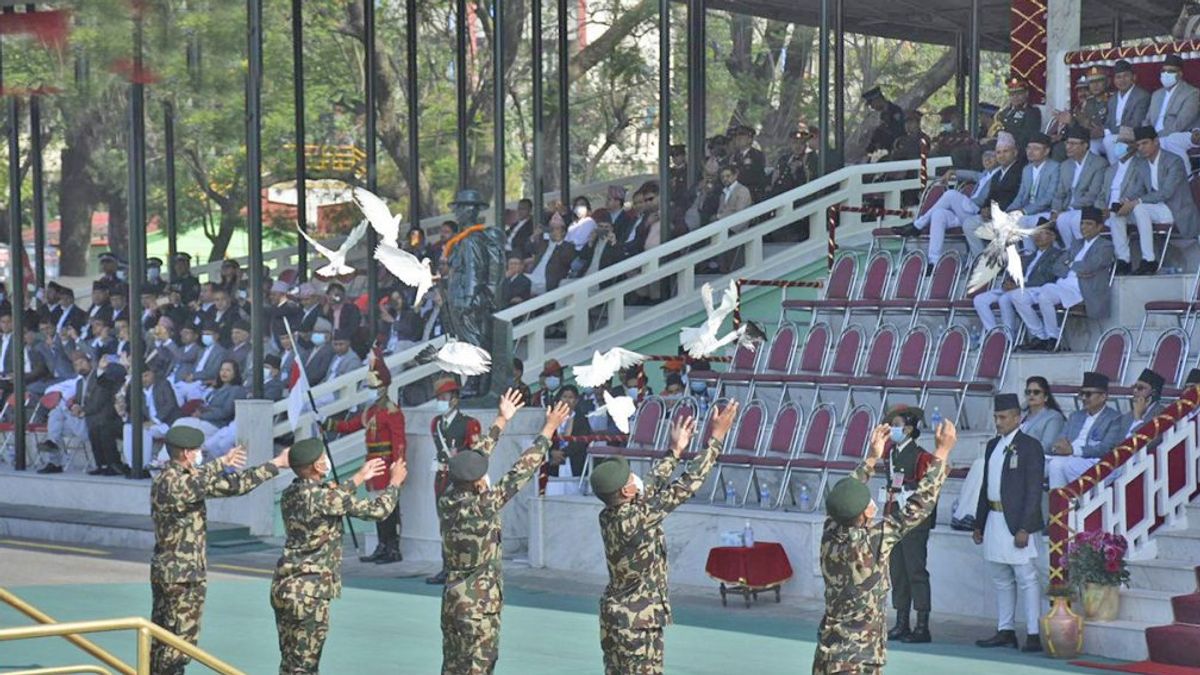
File Photo.
News Summary
- Today, Republic Day is being observed nationwide with various programs commemorating the establishment of the Federal Democratic Republic.
- At the special ceremony held at Tundikhel, the President will deliver the address this year upon the request of Prime Minister Balen.
- The first Constituent Assembly on 15th Jestha 2065 (Nepali calendar) declared the end of 240 years of monarchy and proclaimed Nepal a republic.
15th Jestha, Kathmandu – Republic Day is being celebrated across the country today through various programs. The government has also declared a public holiday on this occasion.
The day marks the first elected Constituent Assembly’s declaration on 15th Jestha 2065 to formally end the autocratic monarchy and establish Nepal as a federal democratic republic, which is commemorated as Republic Day.
A special ceremony is taking place this morning at the military stage in Tundikhel. Ahead of the event, the Nepal Army fired cannons to welcome the republic.
The ceremony at the military stage, which begins at 8 a.m., will see the presence of distinguished figures including the President and Prime Minister. The President is slated to deliver the address.
Prime Minister Balen Will Not Address the Tundikhel Ceremony
Although the President has participated in previous years, traditionally the Prime Minister gave the address. However, this year Prime Minister Balen will not address the ceremony.
He sent a letter to the President at Sheetal Niwas requesting that the President deliver the address, emphasizing the President’s central role as a symbol of the republic.
The Prime Minister’s Secretariat clarified that the Prime Minister will be present at the Tundikhel military stage event but will not speak.
Following King Gyanendra’s centralization of power on 19th Magh 2061, the seven-party alliance and the armed CPN-Maoist entered a 12-point agreement seeking the establishment of full democracy.
By Mangsir 2062, political forces, divided into three factions through that 12-point agreement, consolidated into two main blocs and intensified the movement. The decisive protests that started in Falgun gained further momentum in Chaitra, and millions rallied in the streets by the Nepali New Year.
Eventually, King Gyanendra was pressured to reinstate the dissolved parliament on 8th Jestha 2059 and convene sessions as demanded by the protesting parties.
On 4th Jestha 2063, the reinstated parliament reduced royal authority, suspended the monarchy, brought Maoists into the peace process, and passed a resolution to hold Constituent Assembly elections. This move is considered Nepal’s Magna Carta.
Following this process, the first Constituent Assembly elections were held on 28th Chaitra 2064. In its first meeting on 15th Jestha 2065, the assembly formally ended the 240-year monarchy.
Though the first Constituent Assembly was unable to promulgate the constitution, it accomplished several important milestones. The second Constituent Assembly, elected in Mangsir 2070, promulgated the Federal Democratic Republic of Nepal Constitution on 3rd Ashoj 2072.
In accordance with the constitution, elections to three levels of government have been conducted, and governance is being carried out by federal, provincial, and local governments established through the movement.
The Constituent Assembly declared Dr. Ram Baran Yadav as the first President of the Republic of Nepal. Bidhya Devi Bhandari became the second President and the first female head of state after the new constitution was promulgated. The current, third President is Ramchandra Paudel. Previously, Nepal had a monarchy with the King as the head of state.


