




News Summary
Editorially reviewed.
- A committee headed by Prakash Adhikari, Secretary of the Parliamentary Secretariat, has been formed to investigate MPs who behaved disorderly during the House of Representatives session, with a directive to submit the report within seven days.
- Following the committee’s report, the Speaker has the legal authority under the House Rules to suspend guilty MPs for up to 15 days.
- There are precedents where MPs engaging in unruly behavior and causing physical damage during parliamentary sessions faced suspensions and fines.
Kathmandu, June 17 – A committee has been established to investigate members of parliament who engaged in disorderly conduct during the House of Representatives meeting on Sunday.
Speaker Dol Prasad Aryal announced the formation of the committee, led by Parliamentary Secretary Prakash Adhikari, tasking it with submitting a report within seven days.
He further explained that once the report is received, necessary actions could be initiated under Rule 33, Sub-rule 4, of the House of Representatives’ Rules 2083.
According to this rule, MPs involved in activities such as chair-shifting, disorderly conduct, or engaging in altercations with the chairpersons of the sittings may be suspended by the Speaker.
Rule 33 grants the Speaker special authority to maintain order within Parliament.
The sub-rule states that even if the Speaker learns after the meeting that a member engaged in objectionable or destructive behavior or caused physical damage within the chamber, the Speaker may suspend the member for up to 15 days and order compensation for damaged property to be paid by the member.
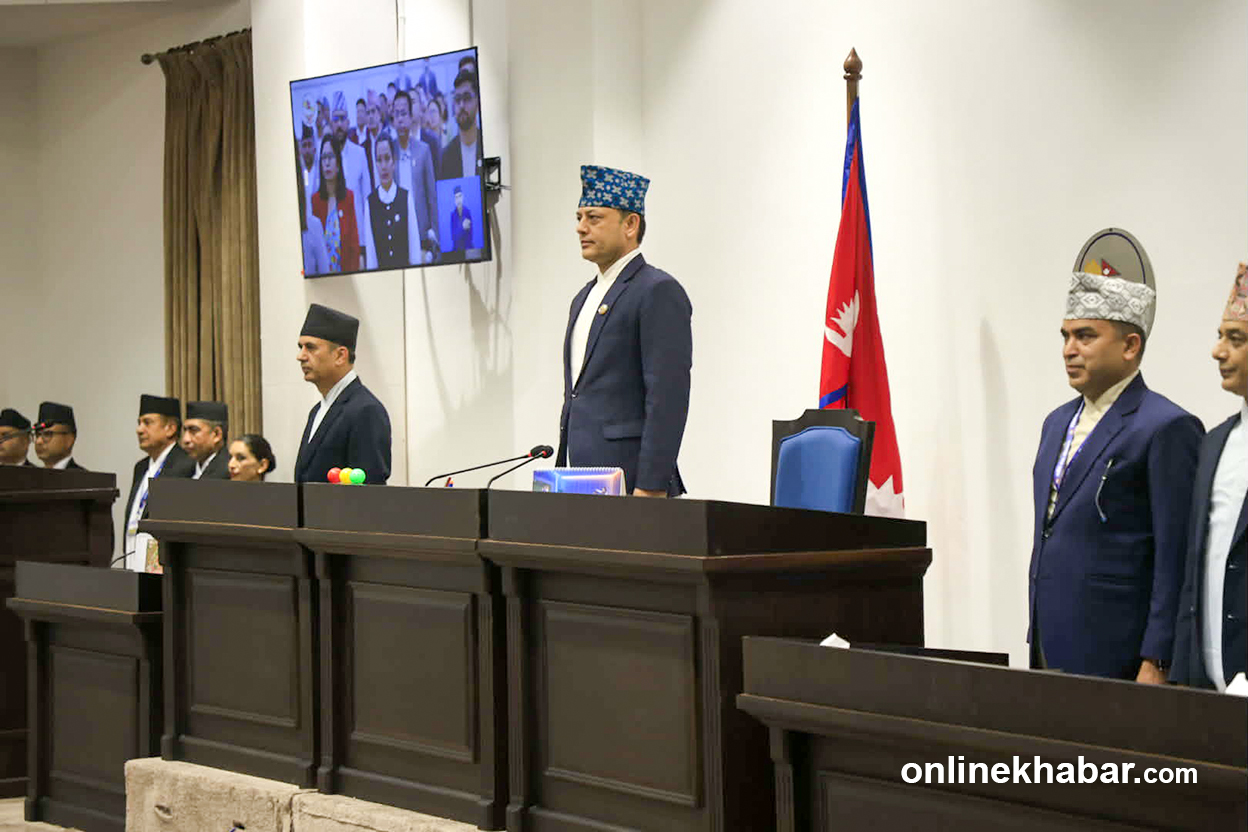
This means that MPs identified by the investigative committee for disorderly conduct in Sunday’s session could be suspended by the Speaker for up to 15 days following the committee’s report.
However, before taking such action, the Speaker must provide the concerned member an opportunity to explain their side. If the member offers a satisfactory explanation or apologizes, the Speaker may withdraw the disciplinary measures.
Prior to forming the investigative committee, Speaker Aryal consulted with officials of the Parliamentary Secretariat.
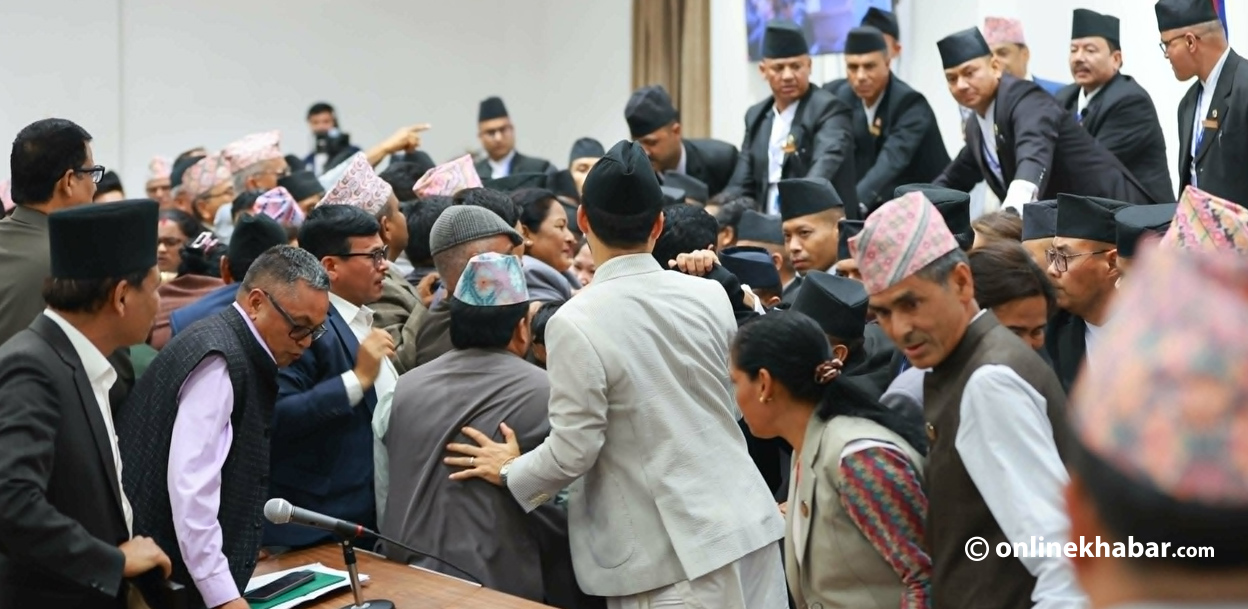
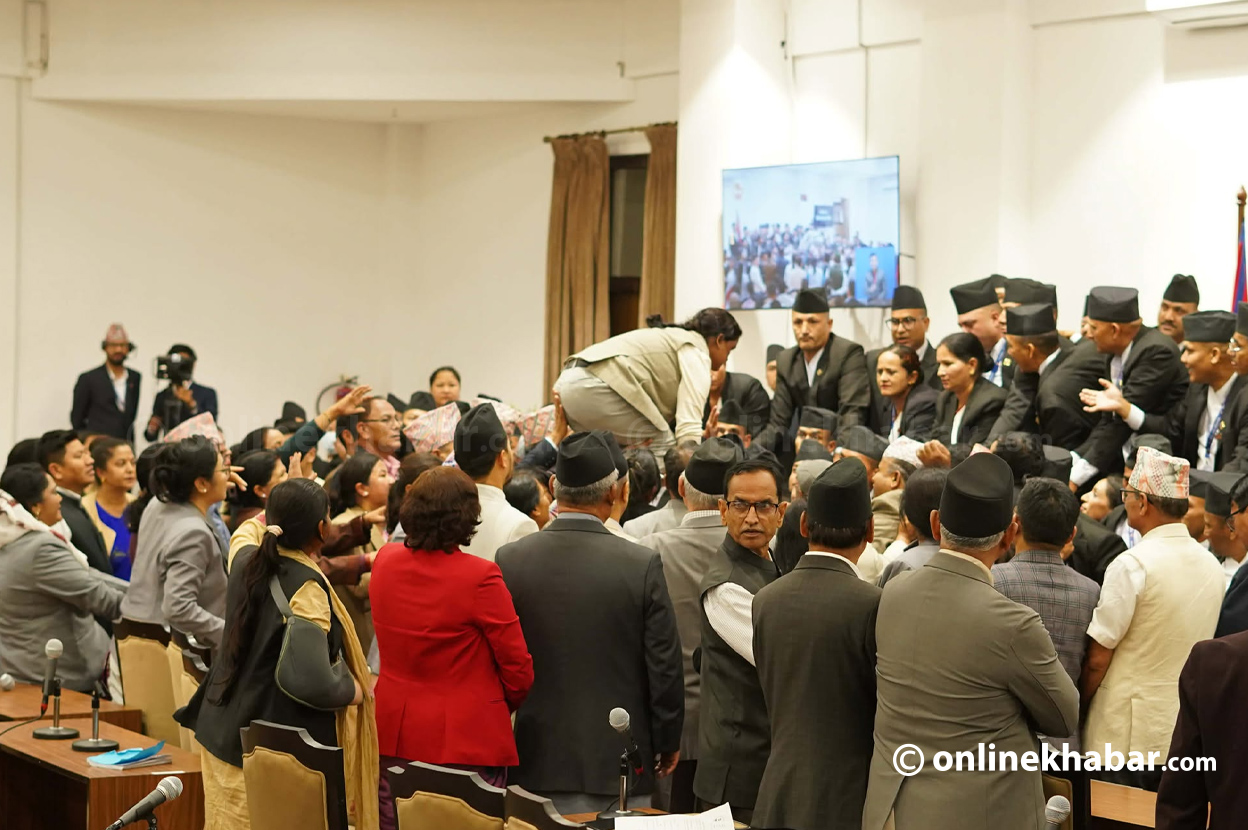
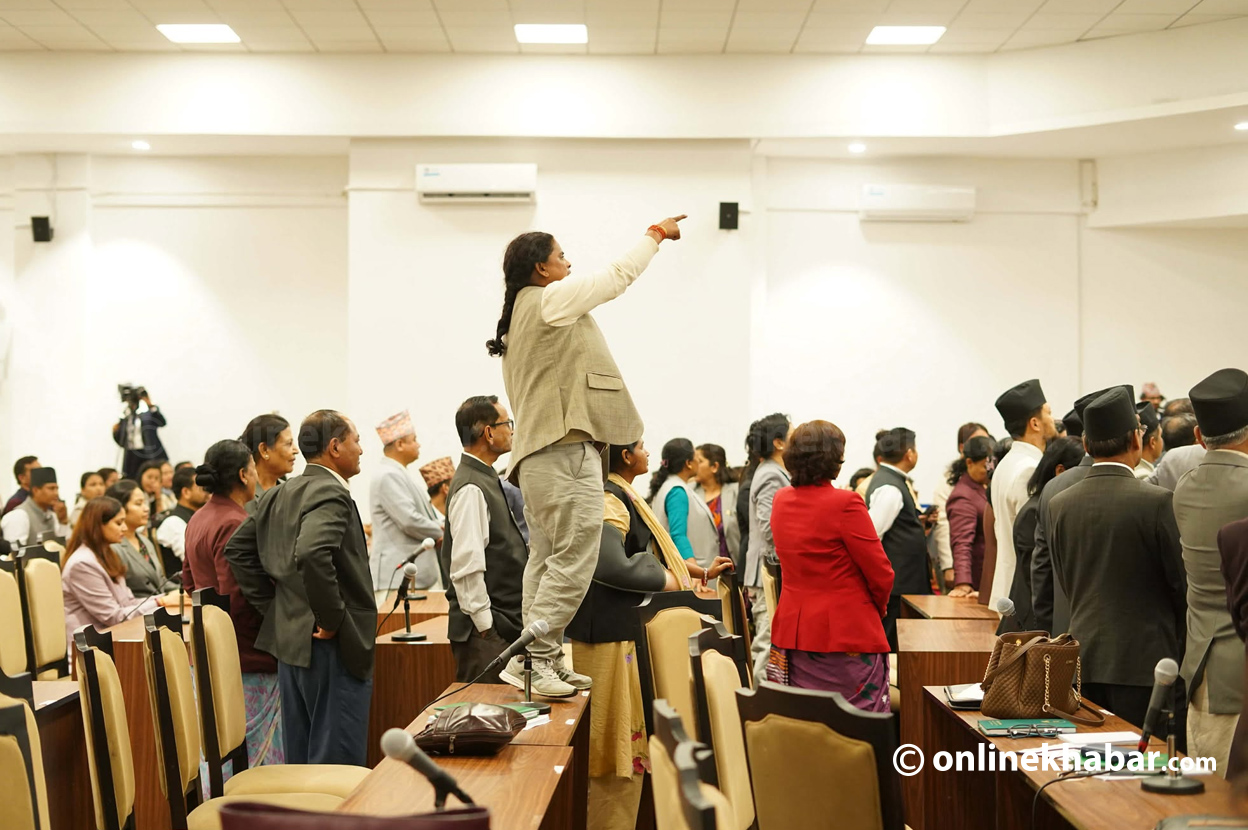
Opposition MPs had surrounded the chair during the Sunday sessions, leading to shouting and scuffles among members.
The House was in the process of adopting its Rules of Procedure. Opposition parties demanded sending the amendments for parliamentary committee review.
Since the detailed discussions were completed, the Speaker proceeded with the vote amid opposition on the proposed amendments.
During the resulting chaos, some chairpersons lost their benches and minor injuries were reported, according to Parliamentary Secretariat sources.
Several MPs were also reportedly injured, and some reportedly lifted chairs. The Speaker formed a committee to investigate the conduct of MPs involved in these activities.
What do the rules say?
Members must seek the Speaker’s permission to speak and speak only when recognized by name. Criticism is not allowed on matters other than the Speaker’s conduct.
Use of rude, obscene, insulting, or offensive language, including language that harms caste, religion, language, or gender, is prohibited.
In case of such misconduct, the Speaker may issue a warning. Under Rule 30, the Speaker has the authority to warn members for disorderly conduct, and warned members must immediately correct their behavior.
If a member fails to comply, the Speaker may order their removal from the chamber, and they cannot participate in the remainder of the meeting.
If a member refuses to leave after the Speaker’s order, marshals may assist in removing them. Suspended members are barred from attending any sessions or committee meetings for three days.
Additional suspension provisions are mentioned in Rule 32, which grants the Speaker the authority to publicly discipline members for various reasons.
The Speaker must immediately present a suspension proposal in the meeting, without allowance for amendments or postponements.
If approved, the member is barred from participating in meetings for up to 15 days.
Examples of Disciplinary Actions
Former Secretary of the Federal Parliamentary Secretariat, Som Bahadur Thapa, noted that although many instances of MPs’ disorderly conduct exist in Nepal’s parliament, disciplinary actions have often been limited.
He stated, “Before the multiparty system, MPs like Bhim Bahadur Shrestha, Jagrit Bhetwal, and Dronacharya were suspended during the National Panchayat era.”
Similar incidents have occurred post-multiparty democracy. For example, in 1996 (2053 BS), Speaker Ramchandra Paudel ordered MP Hridayesh Tripathi from the Nepal Sadbhavana Party to vacate his seat; Tripathi refused and remained on the rostrum.
After warnings, the Speaker employed marshals to remove him and suspended him for one day.
In the previous House, MP Amresh Kumar Singh sparked controversy by removing his shirt after being stopped during impromptu remarks.
Speaker Devaraj Ghimire warned Singh for violating Rule 21 (section ‘gh’) of the Rules of Procedure.
The rule prohibits rude and insulting language in the House. Following the warning, Singh put his shirt back on and left the meeting.
Similarly, during the second Constituent Assembly, former CPN-Maoist MPs forcibly disrupted parliamentary proceedings and caused damage.
In 2010 (2067 BS), during a Legislative Parliament session, sitting Finance Minister Surendra Pandey was interrupted and his papers torn by Maoist MPs, causing the session to start late and resulting in roughly 700,000 NPR worth of official damage.
A committee led by Secretary Mukunda Sharma was formed to investigate these incidents but failed to submit a report, and no action was taken.
Another example includes Constituent Assembly member Bishwendra Paswan, who threw a chair through a window, reflecting behavioral issues, though no disciplinary action followed.
He had left the chamber to stage a hunger strike and there were rumors of harassment against him.
Yet, there have also been instances where disciplinary measures were enforced.
In 2011 (2068 BS), when four MPs obstructed Minister Urmila Aryal en route to the rostrum to respond, Speaker Subash Chandra Nembang used marshals to eject them and suspended them for seven days.
Examples of Revoked Disciplinary Actions
Some disciplinary measures have been overturned by courts.
First Constituent Assembly member Sanjay Sah broke a microphone after being denied speaking time. In December 2011 (2068 Poush), the Legislative Parliament session was stalled in protest against the murder of Manveer Sunar.
The Speaker suspended Sah for 10 days and ordered deduction from his salary to cover the cost of the damaged microphone.
Recently, the Supreme Court ruled that fines cannot be imposed without legal provisions, leading to refund of previously paid fines.
Similarly, in 1993 (2050 BS), National Assembly MP Golche Sarki slapped Local Development Minister Ram Chandra Paudel.
Following this, National Assembly Chair Beni Bahadur Karki suspended Sarki for seven days.
Sarki later publicly stated that he had acted impulsively.


