




Summary
- The Ministry of Finance arbitrarily amended tax rates in the economic bill already registered in Parliament.
- Amendments included major tax exemptions and other benefits in sectors such as hydropower, cinemas, and private school fees.
- Finance Minister Dr. Swarnim Wagle claimed only technical errors were corrected in the budget presented to Parliament and criticized the media for exposing the discrepancies.
May 11, Kathmandu – On Wednesday morning at the Parliamentary Finance Committee, Finance Minister Dr. Swarnim Wagle said, “There were reports of 16 missing pages. Whether Nepali journalists can operate Microsoft Word or not, I don’t know. If you pull a document even by a millimeter, 15-20 pages can shift up or down. You can ask your children too. If you use Microsoft Word yourself, you would understand. …Even after explaining to you, no substantial changes have been made.”
After arbitrary amendments to tax rates in the budget tabled and registered in Parliament, the media brought these irregularities to public attention. However, the Finance Minister labeled the media exposing these errors as a ‘clique.’
Can the Ministry of Finance truly make even a ‘millimeter’ of change to the economic bill once it is registered in Parliament? The Finance Minister also submitted a list of amendments he claims were made in the parliamentary committee. But is it appropriate for the Ministry to unilaterally change a registered bill and inform the Parliamentary Secretariat?
To understand these issues, it is necessary to grasp the ongoing controversy and the budget process, which we will explore here.
Exemptions such as VAT relief for hydropower projects, tax breaks for electric vehicles (EVs), 10 years of income tax exemption for cinema hall operators, and tax deductions up to NPR 25,000 on student fees for parents were not initially part of the budget but were added later. These changes are not mere technical corrections but major amendments related to taxes, which are at the heart of the current controversy.
The central issue of debate focuses less on whether these budget provisions are pro-people or development-oriented and more on the arbitrary changes to tax rates.
There are four primary questions being examined:
1. The budget includes both the Finance Minister’s speech and the bill registered in Parliament. Can the Ministry make changes to the registered budget bill?
2. What are the differences between the budget presented by the Finance Minister in Parliament and the one posted on the Ministry’s website, and who benefits or is disadvantaged?
3. As the Finance Minister stated, were only minor technical errors corrected or was the core content actually altered?
4. Is this the first time such arbitrary amendments have occurred, or is it part of a recurring practice?
Let us begin with the current dispute.
What was in the budget presented to Parliament, and what changes did the Ministry make on its website?
On May 1, Finance Minister Wagle presented the budget and economic bill to Parliament, making it an official parliamentary document. The authority to amend it lies solely with Parliament.
However, the Ministry removed and re-uploaded budget files on its website at least four times, sometimes removing and then replacing them again. It was not only the files that changed; tax rates in seven categories were arbitrarily altered.
Here are a few key examples:
The Finance Minister has already briefed Parliament on the amendments, and our effort is to shed light on their impacts.
1. VAT Exemption in Electricity: From Small Consumers to Large Businesses
The bill registered with the Parliamentary Secretariat clearly stated in Schedule 1 that domestic consumers would receive VAT exemption for up to 50 units of electricity per month. However, all commercial users were to pay VAT.
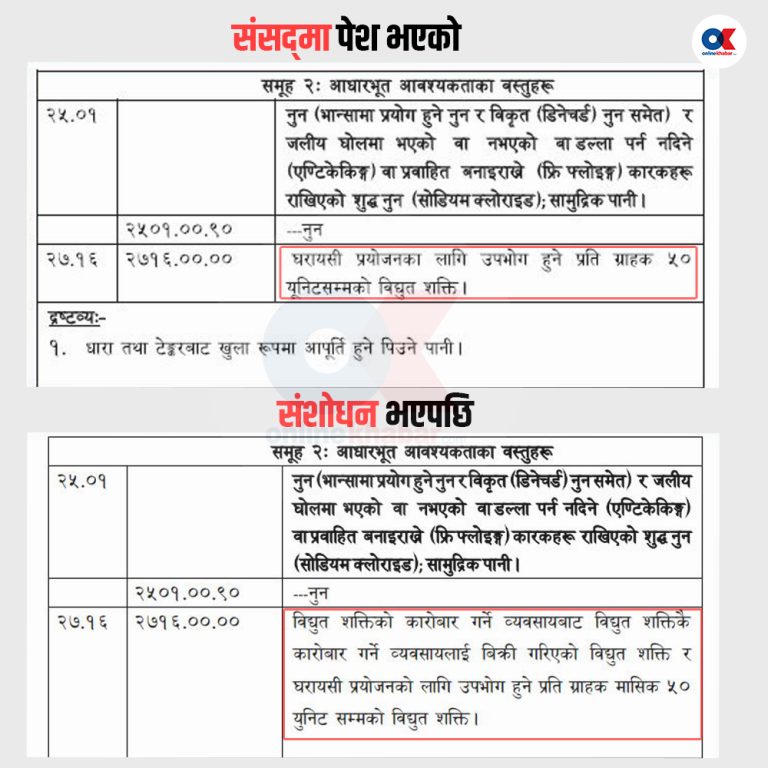
This arrangement was visible in the initial bill posted on the website.
But after the third round of amendments, the provision changed noticeably on the website.
Amended Provision:
“VAT exemption will apply on electricity sold from one electricity business to another.” In other words, producers of hydropower will not pay VAT on electricity sold to Nepal Electricity Authority, while domestic consumers must pay VAT on electricity usage beyond 50 units.
This provoked opposition, as producers wanted VAT exemption to reduce production costs, but now only the public would bear VAT on electricity.
2. Ten-Year Income Tax Exemption for New Cinema Halls
This provision was not part of the budget originally submitted in Parliament but was later added on the Ministry’s website. Cinema halls opened outside metropolitan areas and agricultural lands would receive ten years of income tax exemption.
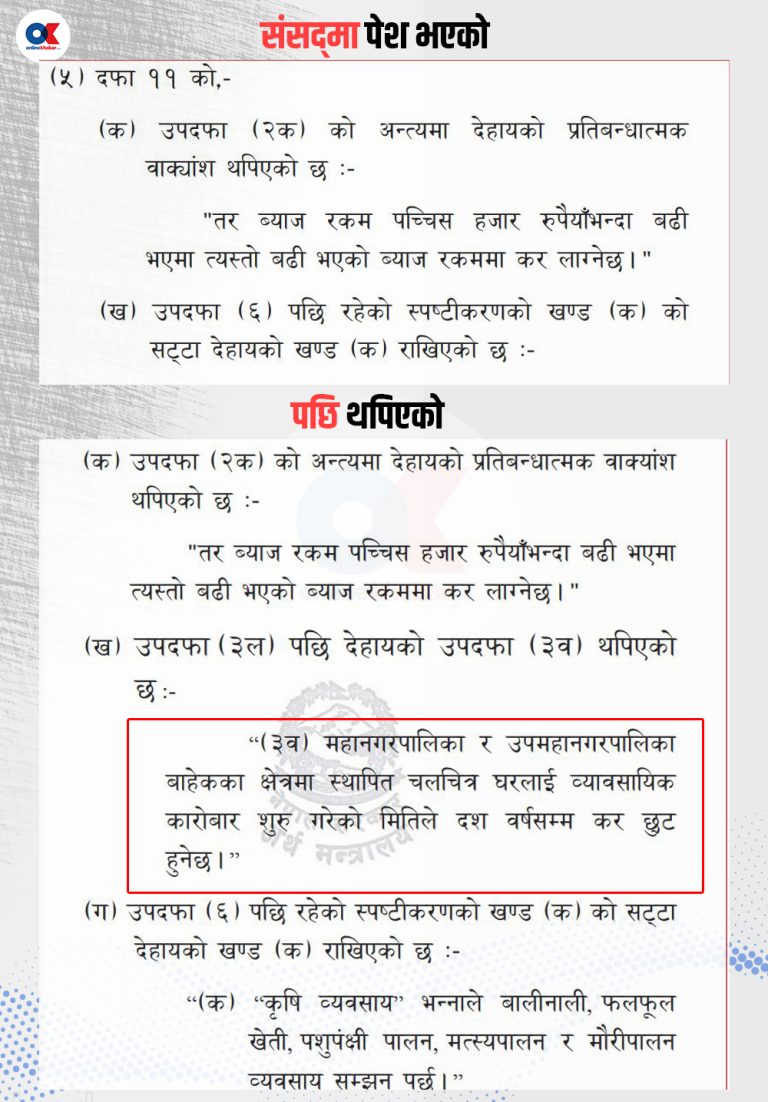
While this appears to promote the film industry in rural and suburban areas, critics argue that a government that levies taxes on education and health sectors giving such a long tax exemption to the entertainment industry is policy-wise questionable.
The Finance Minister said many subjects mentioned in his budget speech are missing from the economic bill; why then focus so much on cinema halls?
3. Income Tax Deduction on Private School Fees
Not included in the registered bill, the Ministry amended the tax schedule to permit parents to deduct 25% or up to NPR 25,000 of tuition fees paid annually from taxable income, while the remainder is taxable.
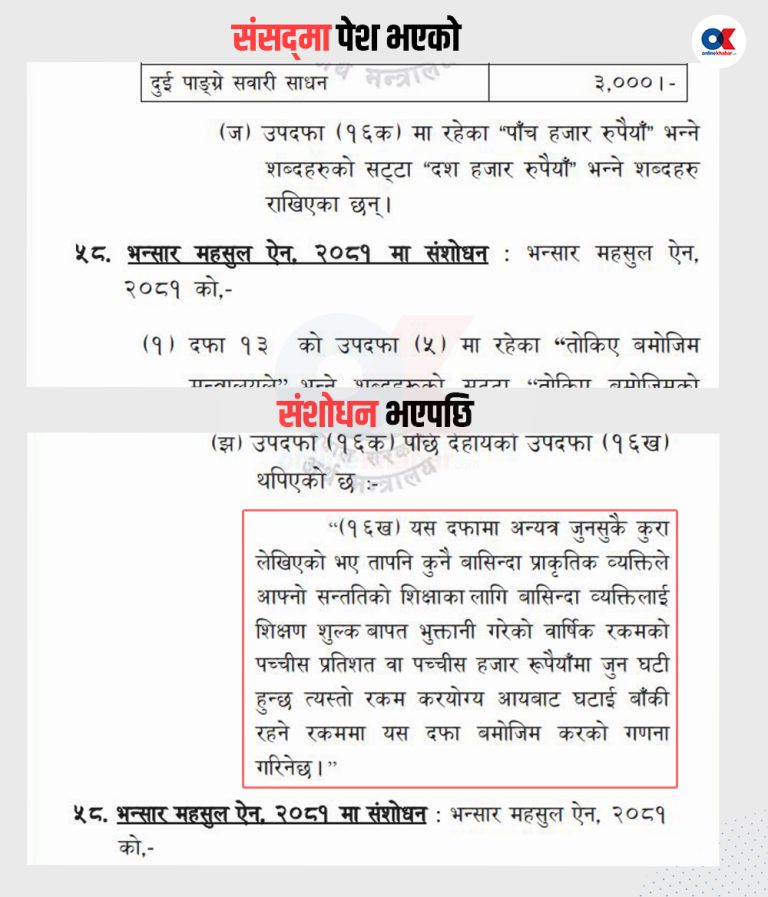
Simply put, parents may reduce up to NPR 25,000 in school fees from their taxable income.
This was added through a revised file, not in the original budget.
4. Doubling Customs Duty on Briefcases, Wallets, and Suitcases
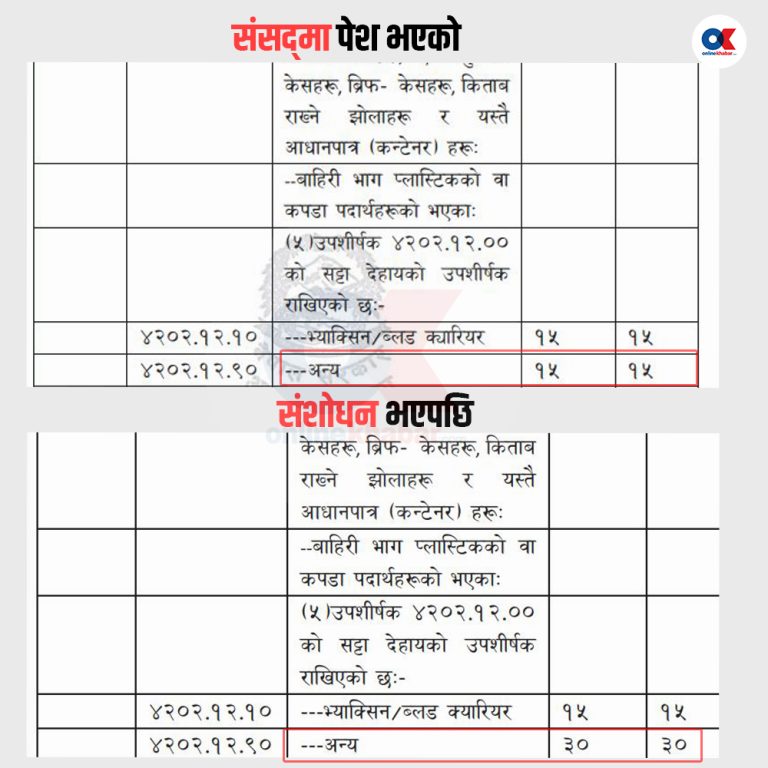
Previously, these items attracted a 15% customs duty; now, the Ministry increased it to 30%. Again, this amendment was added on the website, not in the original bill.
5. Different Road Construction Fee for Electric Vehicles (EVs)
The economic bill initially set a 5% fee on all electric vehicles, but later the fee for EVs up to NPR 20 million in value was reduced to 2.5% through amendments.
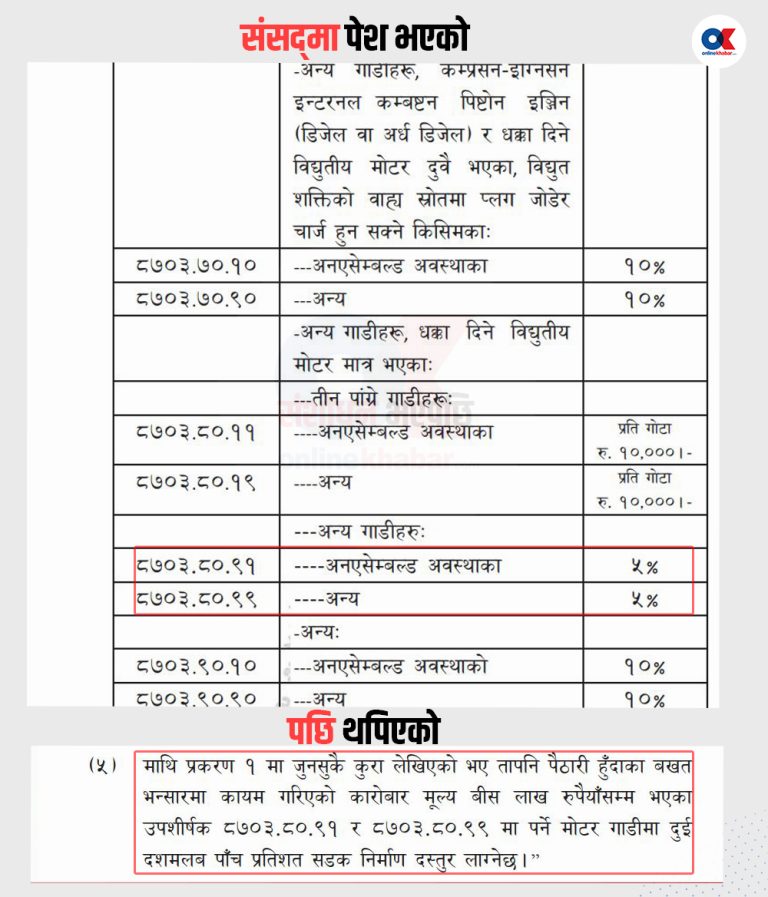
This grants significant discounts on higher-value imports. Yet, the Finance Minister claims no changes were made to the full budget report.
6. Exemption of Clean Infrastructure Investment Fee
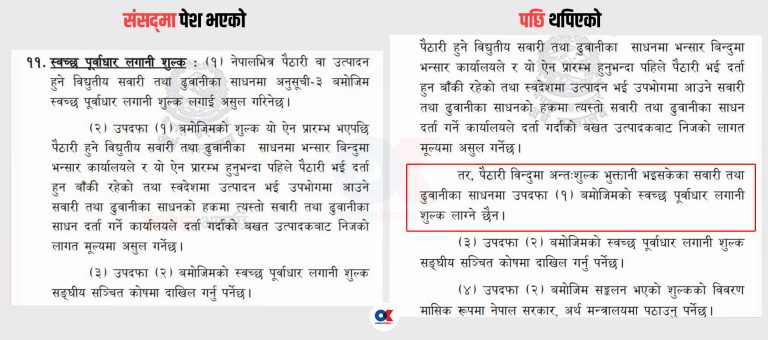
A new exemption for clean infrastructure investment fee was included by scrapping the internal fee for EVs. Such matters should be addressed through legislation.
7. Petrol Tax: Fixed Amount or Percentage?
The economic bill imposed a 10% green tax on petrol and diesel, but the amendment changed it to a fixed NPR 10 per litre tax. This shift is not a minor technical correction.
Can the Finance Minister amend the budget after it is tabled in Parliament?
A budget is not merely the Finance Minister’s speech; it is law once registered in Parliament. It binds the country’s financial regulations, including the government itself. It is neither Microsoft Word text nor an Excel formula where edits can be easily made. The Finance Minister cannot change even a comma or a full stop in the bill once tabled in Parliament. However, Minister Wagle’s seven major changes have sparked controversy.
He argues, “Previous Finance Ministers have done the same.” Yet history shows that when the media questioned such actions, some ministers resigned and parliamentary investigation committees were formed.
From Dr. Ram Sharan Mahat to Dr. Yubaraj Khatiwada, Bharat Mohan Adhikari, Vishnu Poudel, and others, ministers have been held accountable through continual media scrutiny. There is no evidence that any journalist is a member of a mafia.
It is also important to acknowledge that senior journalist and lawmaker Sumnima Udas, from a political party, has actively questioned and ensured public accountability.
In Nepali society, being educated and being aware are different. A sharp grandmother who never attended school can manage a large household, while PhD holders sometimes cause family disputes. The Finance Minister needs to truly understand his role.


