




News Summary
- Based on fake letters from Valmiki Vidyapith, the Ministry of Education recommended study visas for 10 foreign nationals.
- The Immigration Department has arrested Subodh Shukla, who fabricated the fake letters, and a Chinese woman, initiating an investigation.
- Visas for eight foreign nationals who have already received visas based on the ministry’s recommendation are being revoked, with further investigations ongoing.
May 11 (Jesth 28), Kathmandu – It has been uncovered that the Ministry of Education recommended visa issuance on the basis of fake letters from a college.
The Ministry of Education recommended the immigration department to issue study visas for 10 foreign nationals based on forged letters purportedly from Valmiki Vidyapith campus located on Exhibition Road.
Following the ministry’s recommendation, the Immigration Department had issued visas to some applicants. However, during the process of issuing visas to others, suspicions arose leading to verification, which revealed that the college letter was fake.
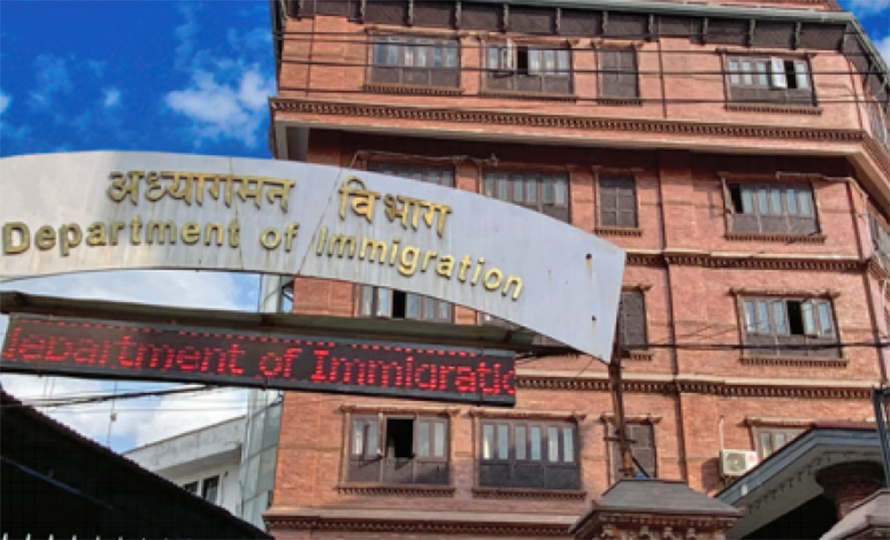
The Immigration Department has arrested two individuals in connection with this case and initiated an investigation. According to the department’s Director General Ramchandra Tiwari, those arrested include the person who created the fake letters and submitted visa documents to the ministry, along with a Chinese woman.
The arrested individuals are Subodh Shukla, who claims to be a PhD doctor from Birgunj, and Chinese citizen Chu Chiyao. Both were taken into custody by the Immigration Department on Wednesday as the investigation began.
Visa Recommendation for 10 Foreign Nationals Based on Fake Letters
On May 20 (Jesth 6), a letter purportedly from Valmiki Vidyapith’s letterhead was sent to the Ministry of Education recommending visas for 10 foreign nationals for academic study.
The letter stated, “Foreign students who passed the internal entrance exam conducted by the Department of Sanskrit Literature at Nepal Sanskrit University and have been regularly enrolled in a two-year Acharya level program in Sanskrit Literature at Valmiki Vidyapith campus starting March 2026,” and attached necessary documents requesting academic study visas.
The letter was signed by Principal Achyutam Prasad Lamichhane and listed the names and passport numbers of 10 foreign students.
Based on this recommendation, the Ministry of Education directed the Immigration Department to issue visas to these 10 foreign nationals. It is reported that the undersecretary also reviewed and authorized the order.
On May 34 (Jesth 21), the ministry officially communicated the visa recommendation to the Immigration Department.
After receiving the ministry’s recommendation, the Immigration Department issued visas to eight foreigners, including Koreans, Russians, and six Chinese nationals. Visas for the remaining two, Wang Li-san and Ha Xing Yu Hsin, are still pending.
…Then the Fraud was Exposed
Suspicion arose when visas were issued to two of the recommended foreigners, leading the Immigration Department to verify documents. It was then revealed that the letter from the college was forged.
While the ministry’s letter was verified as authentic, the letter from Valmiki Vidyapith was found to be fake upon further scrutiny.
“Our jurisdiction covers verification of the ministry’s recommendation. It is the ministry’s responsibility to verify which college has sent the recommendation. However, when we investigated the document that was outside our jurisdiction, i.e., the letter from the college, it was found to be forged,” explained an official from the Immigration Department.
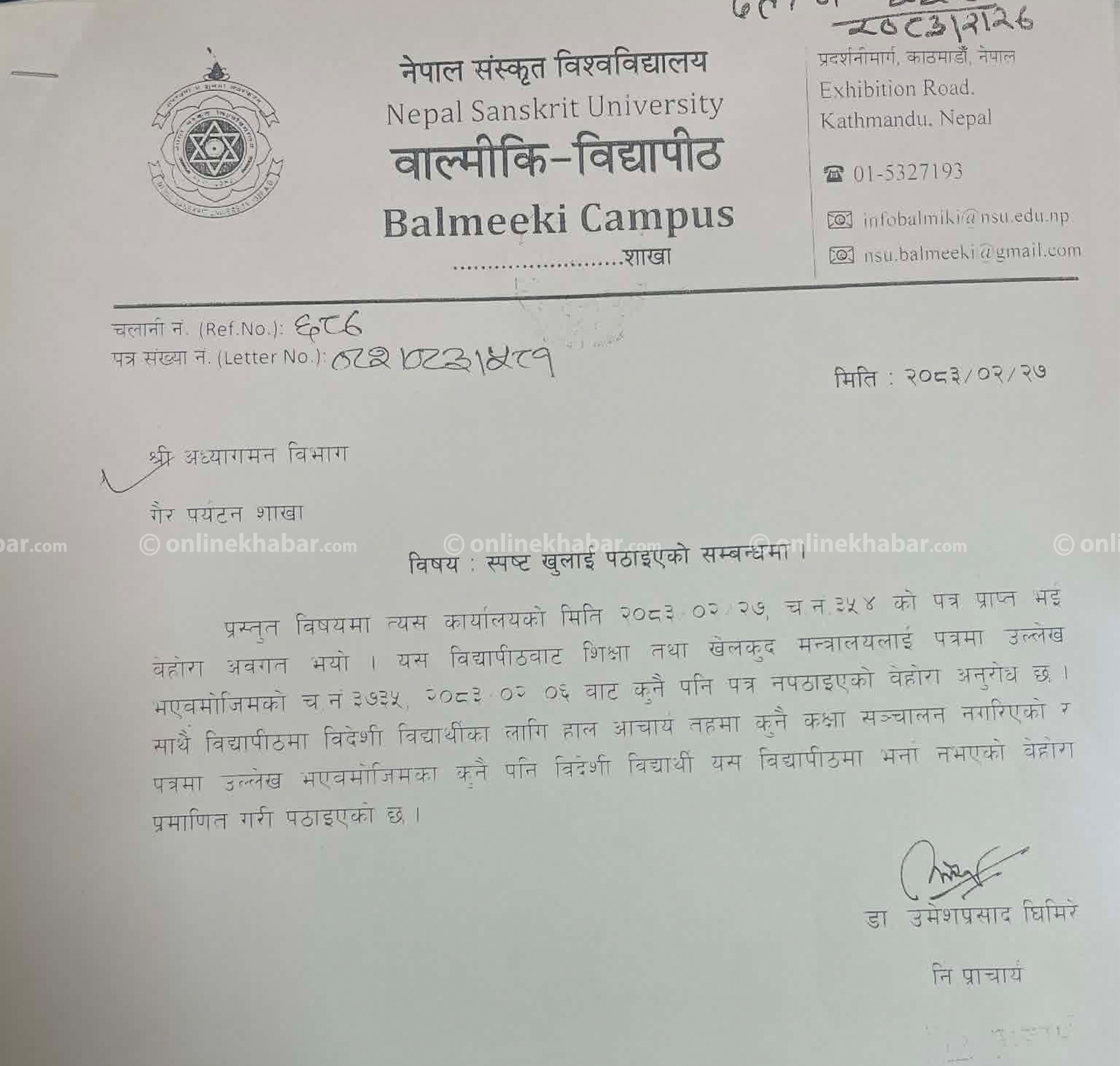
The school confirmed that the 10 foreigners listed in the letter did not receive any visa recommendations from Valmiki Vidyapith and that there is no two-year Acharya course in Sanskrit Literature offered there. Director General Tiwari confirmed this information.
Valmiki Vidyapith has also officially informed the Immigration Department that it has not sent any letters to the Ministry of Education and Sports since Jesth 6, 2083 (Nepali calendar) and that no classes or enrollment of foreign students for the Acharya level have taken place. This was documented in a letter signed by Principal Umesh Prasad Ghimire.
After confirming that the foreign nationals recommended had not enrolled at Valmiki Vidyapith and that no related courses exist, it became evident that visas were recommended and issued based on counterfeit documents.
The Immigration Department disclosed that Subodh Shukla, the person who fabricated the fake documents and submitted them for visa issuance, has been arrested.
What Happens Next?
Among those who received visas, one individual is currently in Immigration custody, while the rest are untraceable. However, records show they have entered Nepal. Those who entered Nepal with fake documents on study visas may be detained for investigation and face legal action according to department sources.
Director General Tiwari stated that the process of visa cancellation has already begun. “Visas will be revoked, and subsequent arrest and investigations will proceed,” he said.
If further criminal activities are discovered during investigations, other agencies or the police will take necessary measures, including deportation. The department has authority to impose fines and restrict future entry into Nepal for a specified period.
Threat to National Security
Previous incidents have revealed foreign nationals enrolling in colleges but not attending classes and engaging in other activities. This led the Immigration Department to issue a public notice mandating that those entering on study visas must compulsorily attend studies.
However, it has now been exposed that individuals have entered Nepal on study visas using forged documents. Security experts warn there is a risk that such individuals could engage in criminal or terrorist activities.
Officials highlight that this scenario poses a potential threat to national security. Former Nepal Police Assistant Inspector General Bam Bahadur Bhandari emphasized that this issue is extremely sensitive as a national security matter.
“Entering Nepal with fake documents is unacceptable. This implies that such individuals might engage in crimes, terrorism, or anti-national activities by any means,” said AIG Bhandari. “This is a serious issue that demands an in-depth investigation.”
He added that arriving in Nepal on student visas with fraudulent documents indicates an intention to stay in the country for an extended period. Given the possibility of organized criminal activities, thorough investigation is crucial.
Security experts have also noted that cases of individuals concealing identities to gather intelligence upon entry into Nepal have occurred previously, and that their entries were not transparent.


