




News Summary
Editorially Reviewed.
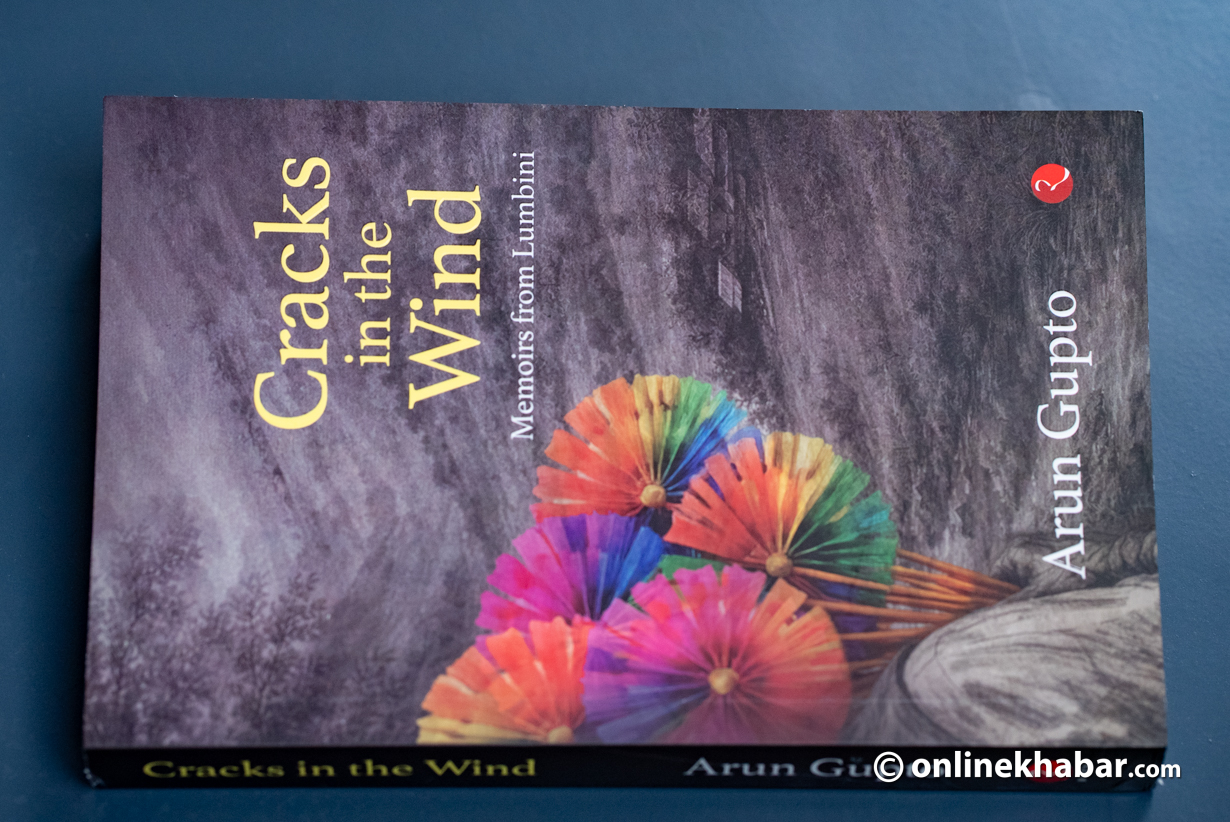
- English literature professor Arun Gupto has released his new book, ‘Cracks in the Wind,’ set against the backdrop of Kapilvastu and Lumbini regions.
- The work is not just a memoir but a blend of fact and fiction, vividly portraying the multicultural society of the Terai-Madhesh region, according to the author.
- Professor Gupto also revealed that he is currently working on two more books centered on art in Florence and Kathmandu, as well as on Palestine.
Arun Gupto, a teacher of English literature, criticism, and cultural theory, possesses a notably distinct intellectual identity.
His books on culture and critical theory have been published by prestigious international publishers such as Routledge and Rupa. However, this time, he has ventured into a different style.
His new book ‘Cracks in the Wind: Memoirs from Lumbini,’ recently published by Rupa Publications, does not engage in theoretical discourse but offers a lively depiction of his childhood, adolescence, and the life of a marginalized society in the Terai-Madhesh area.
Set in Bahadurganj, Kapilvastu, and the Lumbini region, this work is not merely a memoir; it is a blend of fact and imagination. Here, we present an interview with Arun Gupto about this book and its unique characters:
Your new book ‘Cracks in the Wind: Memoirs from Lumbini’ has just been released. From an academic perspective, how do you define a memoir?
This book is not just an autobiography. According to English literature, it is a memoir. In my understanding, there is a difference between autobiography and memoir. Autobiographies are factual, while memoirs incorporate some level of fiction. This tells my story of childhood and adolescence from the Kapilvastu and Lumbini region, but it is not merely my personal tale; it reflects societal changes of that time.
Due to proximity to the Indian border, this area includes Awadhi, Bhojpuri, and hill communities, with people speaking Hindi and Nepali. It is the story of this multicultural place and its people.
When mixing fact and fiction in your ‘fact and fiction’ writing, was there a risk that reality would be lost or readers might find it unbelievable?
That was indeed a significant concern. But since the story is set in Bahadurganj, Kapilvastu—that is, Buddha’s place—I did not attempt to reconstruct Buddha’s character but created characters who hold sacred, non-political, and pure thoughts similar to those of Buddha. That’s why I have used magical realism here and there. Creating concepts like Buddhahood requires a bit of fiction, but I leaned towards fact-based fiction.
For example, I created the character of Bhikkhuni ‘Khema,’ who was left by an Indian monk at our village high school when he went on pilgrimage. Khema grew up in my classroom, and seeing how a patriarchal society denied friends education and participation in sports, she became disgruntled and moved towards the forest. To create an ‘image’ of Buddha there, I had to use magic or fiction.
Previously, you wrote mainly on literary criticism, theory, art, culture, and archaeology. Why have you chosen to look back at the past and society now?
There are two reasons. First, there were unique characters around my village about whom I felt compelled to use my imagination to write. Second, senior professor Sridhar Lohani commented on my book, “You always taught theory, but in this book, you have given theory a tangible form.”
I also think theoretical writing does not impede creative writing, but how well it is materialized depends on the author’s ability.
When I took this book to the Indian market, local publishers found it hard to believe. They said, “You teach theory, how did you write such a novel?” But after reading the manuscript, they published it within three to four months.
Why did it take you 12 years to write this novel or memoir?
I always say creative books need time. Kiran Desai also took 9–10 years to write ‘The Inheritance of Loss.’ Hastily created characters do not turn out well. I write theoretical books quickly. The memoir took 12 years because time helps develop detailed characters and their inner dialogues. Hemingway took a long time to express characters’ inner feelings in ‘The Old Man and The Sea.’
Do you write a single book at a time, or do you work across multiple genres simultaneously?
I recall Rabindranath Tagore’s saying, “Change of profession brings peace.” Sometimes, writing in the same genre long-term tires me, and I don’t write for months. Later, reviewing my work helps me identify mistakes, making editing easier. While writing novels, I shift to theoretical writing and thus showcase both styles. It’s why I am often working on two to three books in different genres at once.
You seem to constantly seek truth between fact and fiction, right?
Yes, that’s what I enjoy. I am not religious, but I have a deep attachment to Kathmandu’s deities and myths. Kathmandu has 15–20 different goddesses. If we only view these deities through religious rules without fictionalizing them, we can’t understand the ancient valley’s mythology. Fact and fiction must always go together. Fiction is not false; it highlights deeper truths. I try to blend both.
What genre will your upcoming books be in?
I am currently working on two books. One explores similarities between art and culture in Florence and Kathmandu, which I am co-writing with my daughter, titled ‘Dimensions of Art: From Florence to Kathmandu.’
The other is a magical realist story based on the war and tragic events in Palestine, echoing the style of Gabriel García Márquez.
Photos and video—Shankar Giri


