‘One Week Passed Since the Settlement of Reserve Victims Was Flooded; We Are in Distress’





News Summary
Prepared by OK AI, editorial review completed.
- Among 2,473 families displaced from Shuklaphanta National Park in 2002, 500 families are currently affected by flooding in Bhimdatta Municipality, Kanchanpur.
- Jay Bahadur Rokaya, chairman of the Reserve Victims District Struggle Committee, expressed frustration that despite repeated government agreements, a fully empowered commission to resolve the issues has not been formed.
- The protesting victims demand that the government provide alternative arrangements to ensure permanent resettlement and immediate provision of safe shelter and food amid their current hardships.
Since the government failed to manage the displaced persons from Shuklaphanta National Park (now Shuklaphanta Wildlife Reserve) in 2002, they have been living in 17 camps across various locations since 2007.
Although 33 commissions have been formed, their issues remain unresolved. Despite repeated government agreements, lack of implementation has led the victims to protest continuously.
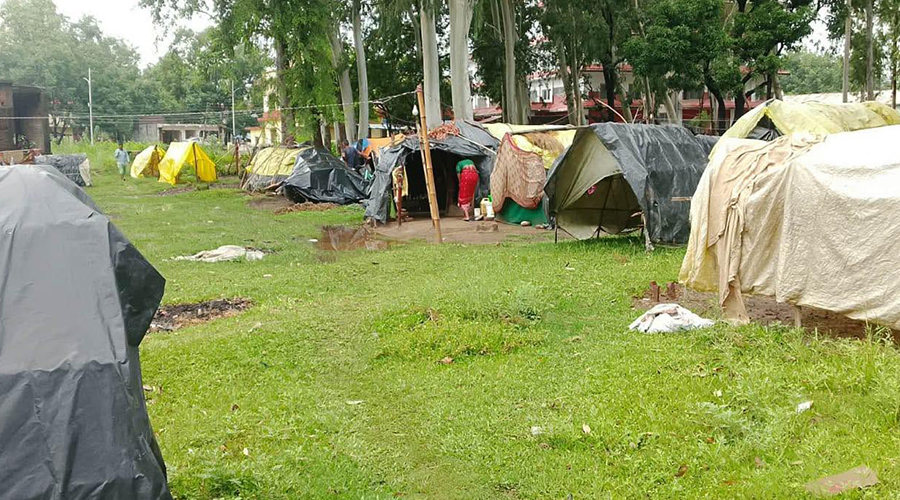
During the protests, about 500 families living in Ward No. 4, Bhimdatta Municipality – Bhagatpur in Kanchanpur have been affected by flooding. Jay Bahadur Rokaya, chairman of the Shuklaphanta Reserve Victims District Struggle Committee, Kanchanpur, describes how they are distressed after their settlement was inundated. The following is an interview with him:
What is the current situation in Bhimdatta Municipality – 4, Bhagatpur, where Shuklaphanta National Park victims reside?
It has been almost a week since we got caught in flooding. The area is now waterlogged. We are facing difficulties in food and drinking water. Around 500 families in the vicinity are in great distress.
Have you informed the local ward office, municipality, district administration, or other organizations about this?
We have notified everyone. Since Monday, party leaders and various activists have been visiting us. The Chief District Officer also visited our camp on foot on Monday.
Our main demand has been the formation of a fully empowered commission. Since their displacement in 2002, the victims have made every effort to seek justice.
So far, 34 commissions have been formed but none have resolved our issues. That is why we are currently protesting in front of the Forest Division Office located in Bhimdatta Municipality–4.
Where and how are you living amid the floods?
We are residing in dilapidated buildings in front of the old Forest Division Office. Plants and trees have grown there, and the walls are broken. We are managing to survive in these deteriorated structures. These buildings originally belonged to the Forest Division but were later leased to another organization.
The government has provided alternative land to some displaced families from Shuklaphanta Reserve. Why have these 500 families not received any alternative arrangements?
We have received nothing. In 2002, a commission was formed when Sher Bahadur Deuba was prime minister, but at that time the Maoist insurgency was ongoing and human rights were suspended. We were forcibly evicted with elephants, armed forces, threats, and beatings, dispersing us violently.
Where were you residing before coming to Bhimdatta–4?
Some of us lived in a place called Dhakka until January 2008, where elephants used to terrorize us.
After five people died due to elephant attacks, we realized we could no longer stay there and commenced protests.
Last year in June, I also went on a 19-day hunger strike at Maitighar Mandal and took part in rice planting on National Rice Day.
Back then, during the Maoist conflict, the then ruling Nepali Congress and CPN-UML governments, along with the Forest Minister, Forest Secretary, and former Foreign Minister NP Saud, promised to resolve the issue and form a commission.
At that press conference, I declared, ‘If the commission is not formed within one and a half months, I will stage a hunger strike in front of the Chief District Officer’s office in my home district.’
When the problem persisted, I went on a 12-day hunger strike without water at Madan Chowk. The Ministry of Forests sent a team that convinced me to stop, promising a solution, but nothing changed. Subsequently, the protests intensified and we all gathered to continue the movement.
Since the protests began in late August to September, you have been residing there. Was the Forest Office’s permission granted?
After the protests started towards the end of August, we stayed in community forests. When the Forest Division Office and the Chief District Officer’s office jointly evicted us, we staged a sit-in in front of the Kanchanpur District Administration Office.
Following oral agreement from the Chief District Officer and District Forest Office chief, we were allowed to stay in front of the Forest Division Office. However, now that place is flooded. Although it is above the road, the area where we are sitting is a pit that has filled with water.
What are your main demands from the government?
During the expansion of the Shuklaphanta Wildlife Reserve in 2002, 2,473 families were displaced. The government pledged compensation during the displacement, including permanent resettlement arrangements.
Permanent resettlement must be arranged accordingly. Meanwhile, secure temporary shelter should be provided. Currently, the Forest Division has permitted us to stay in Bhagatpur, but this is no longer a suitable place.
Necessary items like tarpaulins, food supplies, hammocks, and mattresses need to be supplied urgently.


