




Summary
- The government has proposed increasing the development tax rate on lands adjacent to public roads from 20 percent to a maximum of 25 percent in the draft Public Roads Bill.
- The new bill classifies public roads into seven categories and strictly prohibits construction of structures, mining, and unauthorized access within road boundaries.
- Penalties for violations have been significantly increased; up to NPR 500,000 fine for permanent structures and up to NPR 1,000,000 for unauthorized installation of wires or pipes.
July 5, Kathmandu – The government has advanced plans to increase the development tax applied on lands located to the right and left of the federal, provincial, and local road networks.
Where the maximum tax rate was previously 20 percent, the government has drafted the Public Roads Bill aiming to raise this rate to 25 percent.
According to the draft bill prepared by the Ministry of Infrastructure Development, when purchasing land, a one-time development tax of up to 25 percent above the acquisition price will be imposed, and the government will issue details accordingly.
Under the current Public Roads Act, lands up to 125 meters from the road are classified as ‘Category A’ with a 20 percent development tax, while lands between 125 and 150 meters fall under ‘Category B’ with a 10 percent tax.
The new bill states that the classification of lands and tax rates will be determined by the Government of Nepal through notification in the official gazette.
Additionally, lands within restricted distances where permanent pavements or buildings are prohibited will not be subject to the development tax.
If development tax is not paid within the prescribed period, the respective road office may notify the local government to halt transactions on the land and restrict its sale or transfer operations.
Moreover, the bill updates existing provisions for collecting unpaid development taxes from defaulters through the land revenue system.
It states, “If development tax is not paid within the stipulated deadline, action will be taken in accordance with prevailing laws to collect the dues through the land revenue system.”
Furthermore, provisions have been introduced for utility corridors within expressways and national highways for installation and operation of electric, drinking water, sewage, telephone cables, pipes, or other infrastructure, with associated service fees applicable to poles or structures within road boundaries.
Seven Categories of Public Roads
The government has classified public roads into seven categories. The current law also identifies seven categories but does not include expressways.
The federal road network will now comprise expressways, national highways, and other roads of strategic importance. Provincial roads will be categorized as provincial highways and provincial roads, while local roads will include urban and rural roads. Bicycle and pedestrian-friendly infrastructures will be mandatory for roads constructed within urban and residential areas.
Road Boundary Dimensions
According to the proposed bill, expressways will have boundaries extending 50 meters on both sides from the centerline, 50 meters vertically above and below, and a structural boundary of 6 meters on either side.
National highways will have boundaries of 25 meters horizontally and vertically from the center, with a 6-meter structural boundary.
Provincial roads will have 25 meters horizontally on each side from the center and a 3-meter structural boundary, while local roads will have 25 meters horizontally with a structural boundary of 1.25 meters.
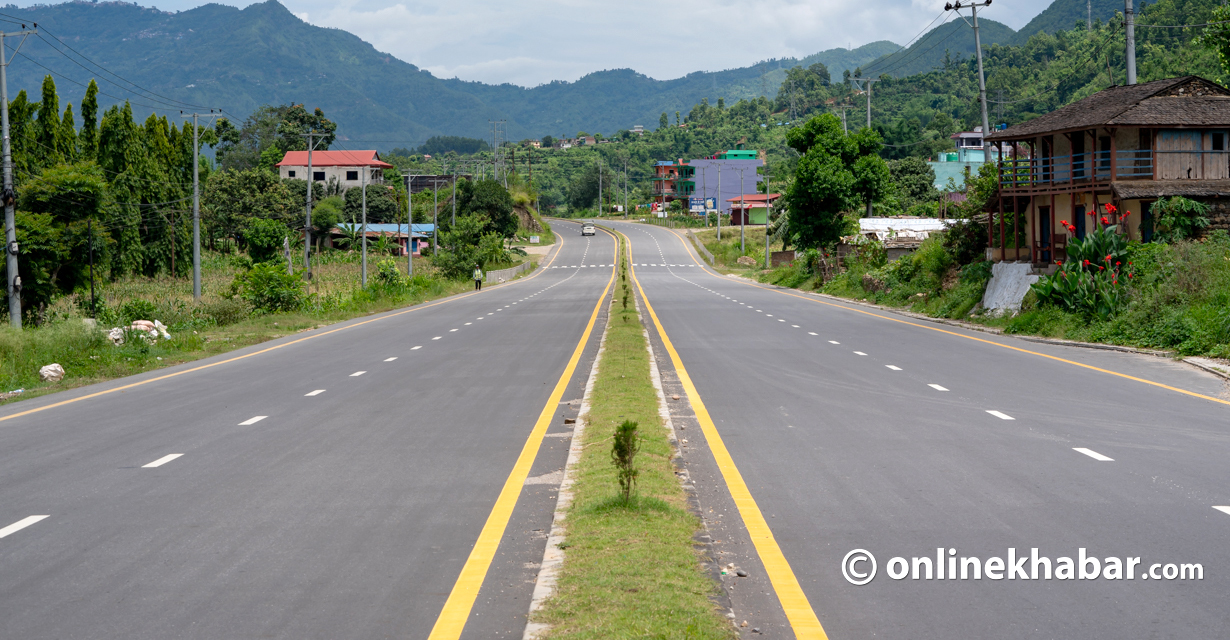
The current law sets a maximum road boundary of 31 meters from the centerline: 25 meters for main highways, 15 meters for auxiliary highways, and 10 meters for district and urban roads. However, the government may set different boundaries based on local geography, settlements, and bridges.
The government prohibits construction of buildings or permanent structures within the designated road boundary or unlimited road area, except for temporary walls. This regulation also exists under current law.
Mining, excavation, or processing activities are also banned within these restricted zones. Outside these zones, construction can be banned if it poses a threat to road safety.
There are provisions to set limits on vehicle weight, and vehicles exceeding the prescribed limit may be prohibited from operating.
Tree planting and protection along roads will continue to be prioritized.
Domestic animals are prohibited from roaming on roads. Removal of soil, stones, sand, or other materials from roads requires prior approval from the road office and must not cause damage to the road.
Storing goods that obstruct traffic on public roads, unauthorized infrastructure development, land use, or road digging is forbidden.
Establishing petrol pumps, gas filling stations, charging stations, toll plazas, hotels, motels, restrooms, refreshment centers, garages, industries, mines, or factories near roads will require approval by the road office. Unauthorized construction of access routes joining road boundaries is not permitted.
Increased Penalties and Fines
The government has proposed substantial increases in fines and penalties compared to existing law. For example, unauthorized permanent structures or buildings within road boundaries could now incur fines up to NPR 500,000, compared to the previous NPR 5,000.
Causing disturbances during land acquisition or posting notices can result in fines up to NPR 50,000, and illegal tree cutting or damage up to NPR 100,000. Damage to roads and bridges will be fined up to NPR 100,000 as well.
Releasing domestic animals on roads may lead to fines of up to NPR 5,000. Unauthorized installation of wires, pipes, electric poles, and similar infrastructure may attract fines up to NPR 1,000,000.
Strikes, shutdowns, mass gatherings, or protests obstructing service on expressways and national highways will be prohibited.
The bill also defines standards for national highways and publicly discloses the official names of highways.


