




News Summary
Created by OK AI, editorially reviewed.
- At least 132 people have died and more than 570 injured in Colombia due to a powerful 7.4 magnitude earthquake.
- President Abelardo de la Espriella has declared a state of emergency in the country and emphasized government priority on rescuing those trapped under debris.
- Considered the strongest earthquake in the 21st century in Colombia, several countries including the US, Israel, and France have pledged support to the affected areas.
August 12, Kathmandu – A powerful 7.4 magnitude earthquake struck Colombia, resulting in at least 132 fatalities and leaving hundreds still missing.
Initially, the government reported 111 deaths and 87 injuries, but the Colombian Association of Capital Cities has confirmed that the death toll has risen to 132 with over 570 injured.
According to the Colombian Geological Service, Monday’s earthquake is the most powerful in Colombia this century. It severely damaged cities across western Colombia, including Cali, Pereira, Quibdó, and Manizales. The tremors were felt as far as neighboring Ecuador and Panama.
The U.S. Geological Survey (USGS) pinpointed the epicenter approximately 400 kilometers west of the capital Bogotá, in the San José del Palmar municipality of the Chocó region, at a depth of 107 kilometers.
Within hours of the quake, at least 21 aftershocks were recorded.
State of emergency declared; search and rescue ongoing
In the aftermath, rescue teams continue to search through rubble for survivors, manually clearing large concrete fragments and debris.
Local officials report that in Cali alone, at least 20 buildings were completely destroyed and 380 others damaged. Many people are believed to be trapped within collapsed structures.
President Abelardo de la Espriella declared a nationwide state of emergency in a national address on Monday afternoon. “The national government has mobilized all its resources to save lives, assist affected communities, and deliver necessary aid,” he said.
President Espriella had just recently sworn into office, and this earthquake poses the first major crisis for his administration.
The rescue of individuals trapped in debris remains the government’s top priority, the president stressed.
In Risaralda, a key coffee-producing region, at least 40 deaths have been confirmed by local authorities. The regional capital, Pereira, also suffered significant damage.
In the Valle del Cauca region, at least 27 deaths have been reported, including three children.
Communications have been disrupted in Chocó, near the earthquake’s epicenter, preventing a full assessment of damage. Certain areas have lacked mobile service for years.
Chocó’s governor, Nubia Carolina Córdoba, estimated 12 deaths and 84 injuries in the region, noting that many people remain missing according to local leaders.
Number of missing persons increasing
By Monday afternoon, people began submitting reports of missing relatives to an online database. One such digital record listed over 1,400 people as missing, most from Cali and Pereira.
Footage from Pereira airport showed parts of the terminal’s roof collapsing. Passengers were seen fleeing to safety, and a four-story building was also reported to have collapsed.
Pereira’s mayor, Mauricio Salazar, notified that at least 15 buildings have collapsed in the city, with fears that people remain trapped inside.
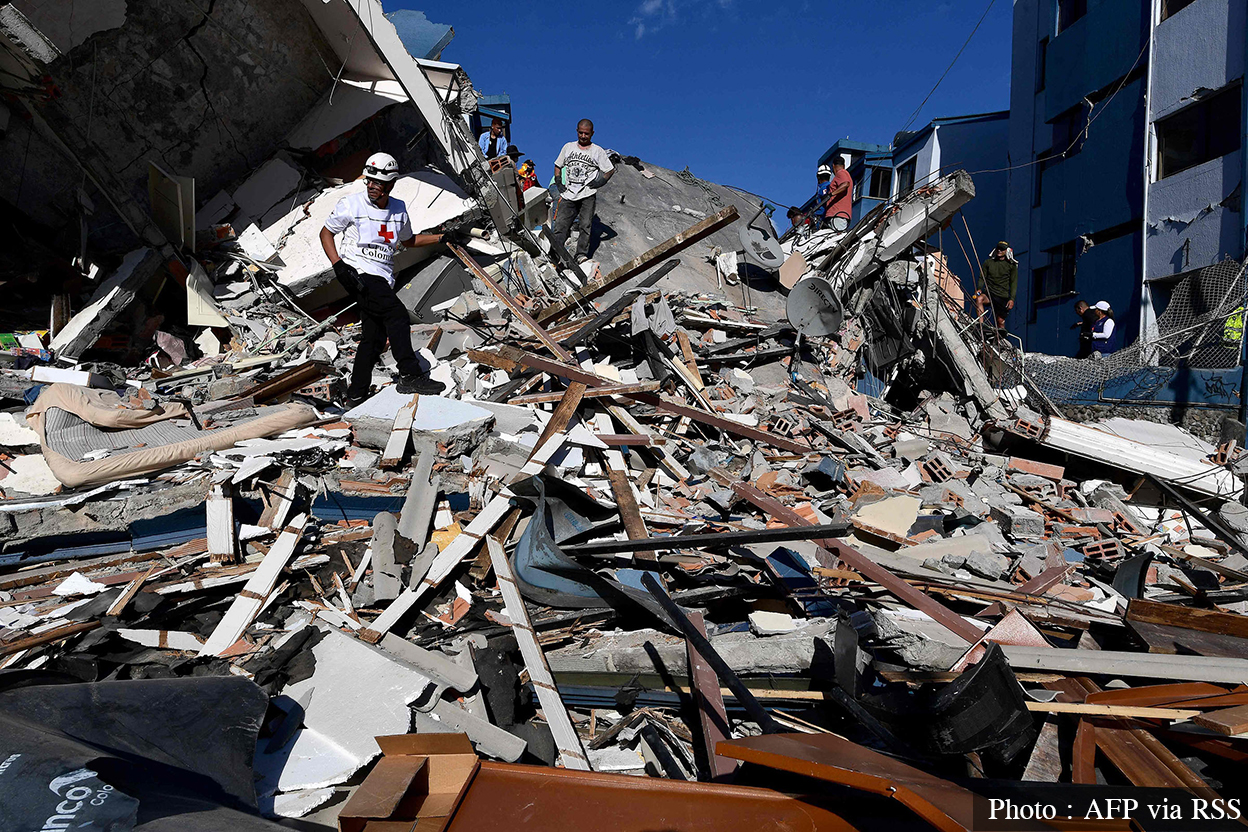
In nearby Manizales, part of the city’s iconic neo-Gothic cathedral tower collapsed, with debris falling onto the streets, local media reported.
Following the earthquake, Colombia’s Civil Aviation Authority suspended flights at several airports in western regions, including Pereira, Manizales, Quibdó, Armenia, Cartagena, and Buenaventura, pending structural inspections.
The strongest earthquake this century
Colombia, located in a seismically active zone around the Pacific Ring of Fire, normally experiences small earthquakes, while those above magnitude 6 are rare.
In 1999, a 6.2 magnitude earthquake near Armenia city killed over 1,100 people.
According to the Colombian Geological Service, Monday’s quake is the strongest recorded in the country this century.
Seismologist Sujan Bhan der Lika from Northwestern University explained that the earthquake’s high magnitude, depth underground, and strike-slip nature contributed to amplified damage in densely populated areas.
“The earthquake occurred very deep beneath the Earth’s surface. Normally, this depth reduces the shaking felt, but its magnitude caused very strong tremors,” she told Reuters.
International aid pledged from the US and others
Following the earthquake, the United States announced emergency assistance to Colombia, pledging $15.5 million for shelter, food, and rescue efforts.
US Secretary of State Mark Rubio stated on social media platform X that the US is closely monitoring the situation and ready to assist the Colombian people.
Several Latin American countries have also committed support. El Salvador’s President Nayib Bukele and Mexico’s President Claudia Sheinbaum have expressed readiness to provide immediate aid.
Chile’s President José Antonio Kast pledged assistance to Colombia, sharing empathy given Chile’s own experience with earthquakes and related challenges.
Israel, Ecuador, and France have also offered to support rescue and relief operations in Colombia.


