69 Billion NPR Allocated for Road Repairs Over 5 Years, Only Half Spent, Problems Persist





Summary
Reviewed with verified statistics.
- According to the Auditor General’s report, only about NPR 3.79 billion out of the NPR 6.874 billion allocated for road repairs in the last five years was spent.
- Out of NPR 5.636 billion allocated for strategic road maintenance, only NPR 3.014 billion was utilized, while periodic maintenance and reconstruction progress remains low.
- The Auditor General has recommended that the government improve legal enforcement, coordination, and manpower regarding road repairs, budgeting, load management, bridge protection, and road safety.
September 20, Kathmandu – Despite significant annual budget allocations for road repairs in Nepal, the quality and progress have not met expectations.
According to the audit report by the Office of the Auditor General (OAG), over the past five years, the Road Board allocated a total of NPR 6.874 billion for strategic and local road maintenance.
Of this amount, NPR 5.596 billion was released, but only about NPR 3.79 billion was actually spent.
This means that while 81.4 percent of the budget was released to the Road Board, only 67.72 percent was expended.
The OAG states that budget deficits due to expanding road networks and unspent allocated budgets remain major issues.
The report cites lack of coordination among related agencies, insufficient budgets, delays in plan approval, contracting procedures, and payments as factors hindering targeted budget expenditure.
Furthermore, regular maintenance is often neglected, leading to road deterioration and increasing reconstruction burdens, which heightens accident risks.
The Auditor General has directed the government to allocate budgets effectively and improve interagency coordination for efficient implementation of maintenance plans.
In the last five years, the government collected NPR 7.533 billion from road usage and maintenance fees, but only half of it was spent on maintenance, highlighting underutilization.
Poor Expenditure on Strategic Roads
The government divides road maintenance into strategic and local categories. The Department of Roads allocated NPR 5.636 billion over the past five years for strategic road repairs.
Of this, NPR 4.974 billion was released, but only NPR 3.014 billion (60.59%) was spent.
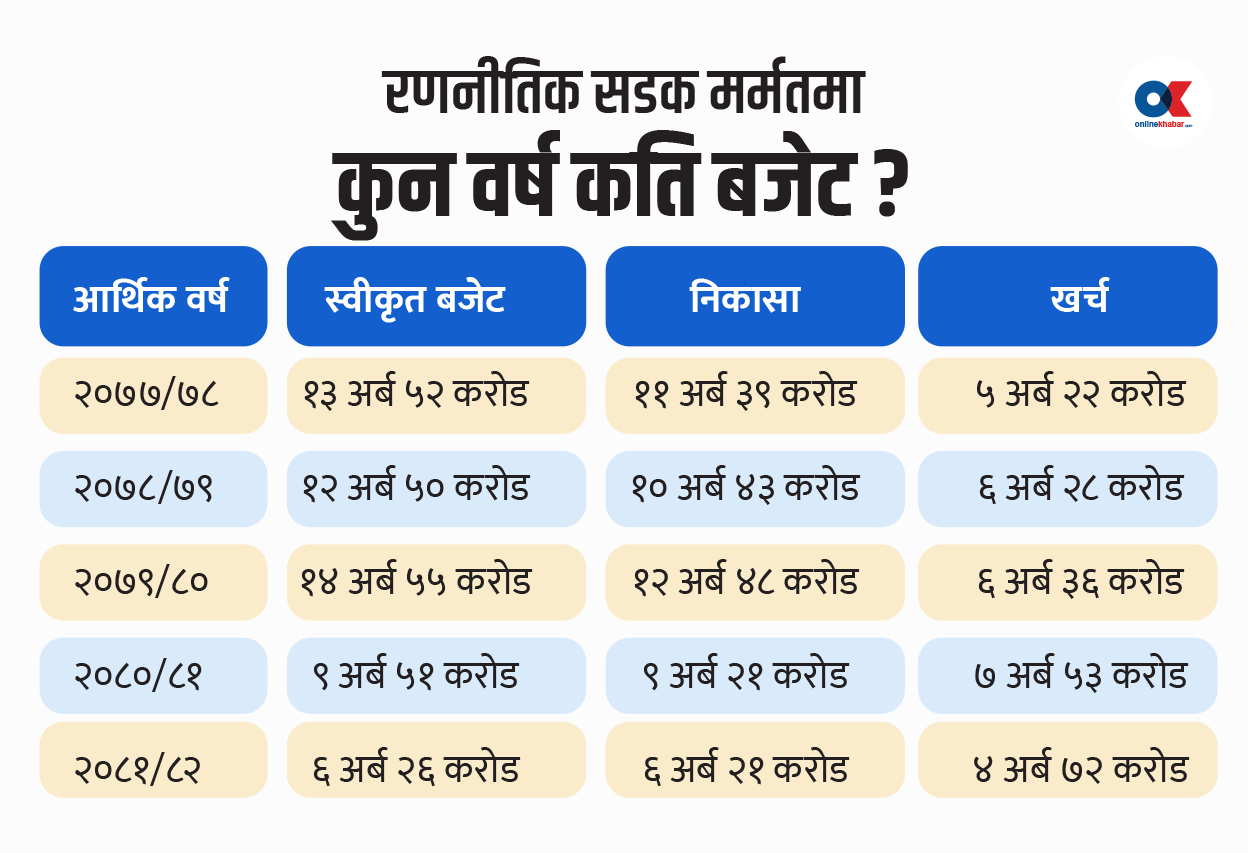
The Department of Roads and its subdivisions—including the Federal Road Monitoring and Supervision Office, Road Division Office, Heavy Equipment Division, and Mechanical Office—received this budget through the Road Board.
Although 63 offices conduct strategic road maintenance, the low expenditure compared to the budgeted amount has raised concerns.
The Auditor General has suggested reviewing budget adequacy based on the actual condition and needs of roads, recommending increased budgets and improved spending.
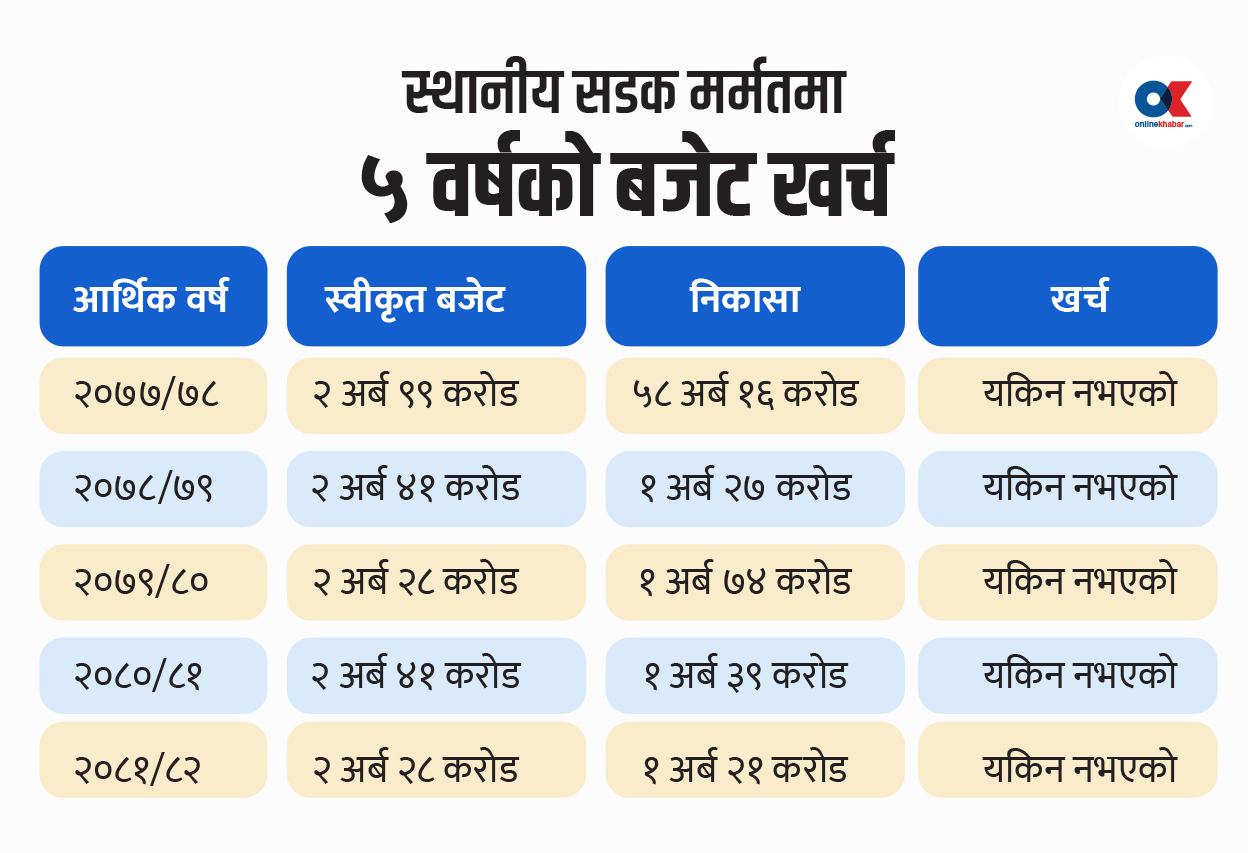
According to the Auditor General, the Road Board has not provided details on expenditures related to local road maintenance, though the condition remains poor due to irregular maintenance.
This adversely affects transportation services and public safety, and demonstrates ineffective use of public resources.
The office advises making plans and budgets realistic, prioritizing completed preparatory projects, simplifying procurement and fund release procedures, and increasing the capacity of implementing agencies to enhance budget implementation.
Low Priority for Periodic Maintenance and Reconstruction
In Nepal, road maintenance is categorized into regular, patchwork, periodic, restoration, reconstruction, special, emergency, and road safety maintenance, of which periodic and reconstruction are vital for enlarging road lifespan.
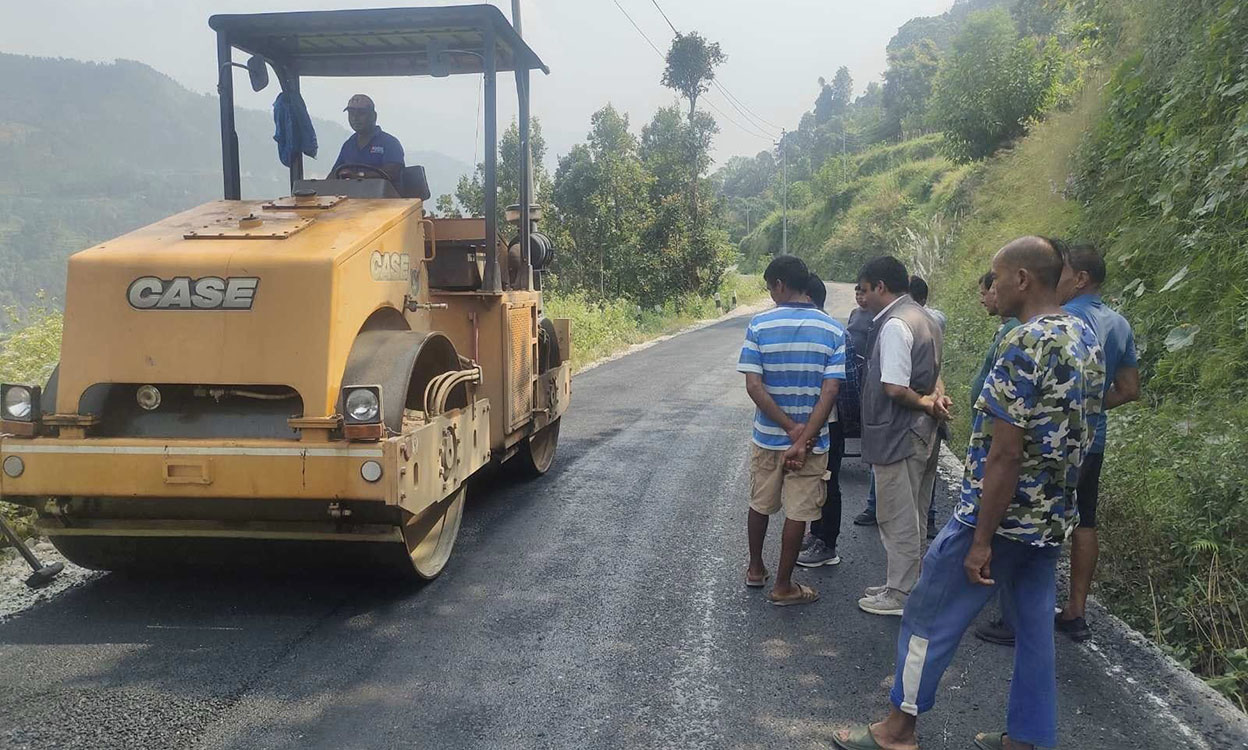
However, progress in these areas remains weak. Over the past five years, regular and patchwork maintenance targets have generally been met.
Yet, periodic maintenance has only achieved between 42% and 73%, while restoration and reconstruction stood at just 21% to 75% progress.
The Auditor General has instructed to prioritize periodic maintenance and improve effectiveness of projects.
In the fiscal year 2081/82 (2024/25), 7,938 km of roads received regular maintenance, 3,929 km underwent patchwork repairs, while only 369 km of the target 550 km was achieved for periodic maintenance, and 39 km out of 75 km for reconstruction.
Weak Enforcement of Legal Frameworks
The study points out that effective enforcement of laws related to road maintenance is the weakest aspect.
Measures such as budgeting to reduce maintenance costs, prioritizing road safety funds, vehicle load measurement, research, and penalties for violations are not adequately implemented.
Manpower Shortage
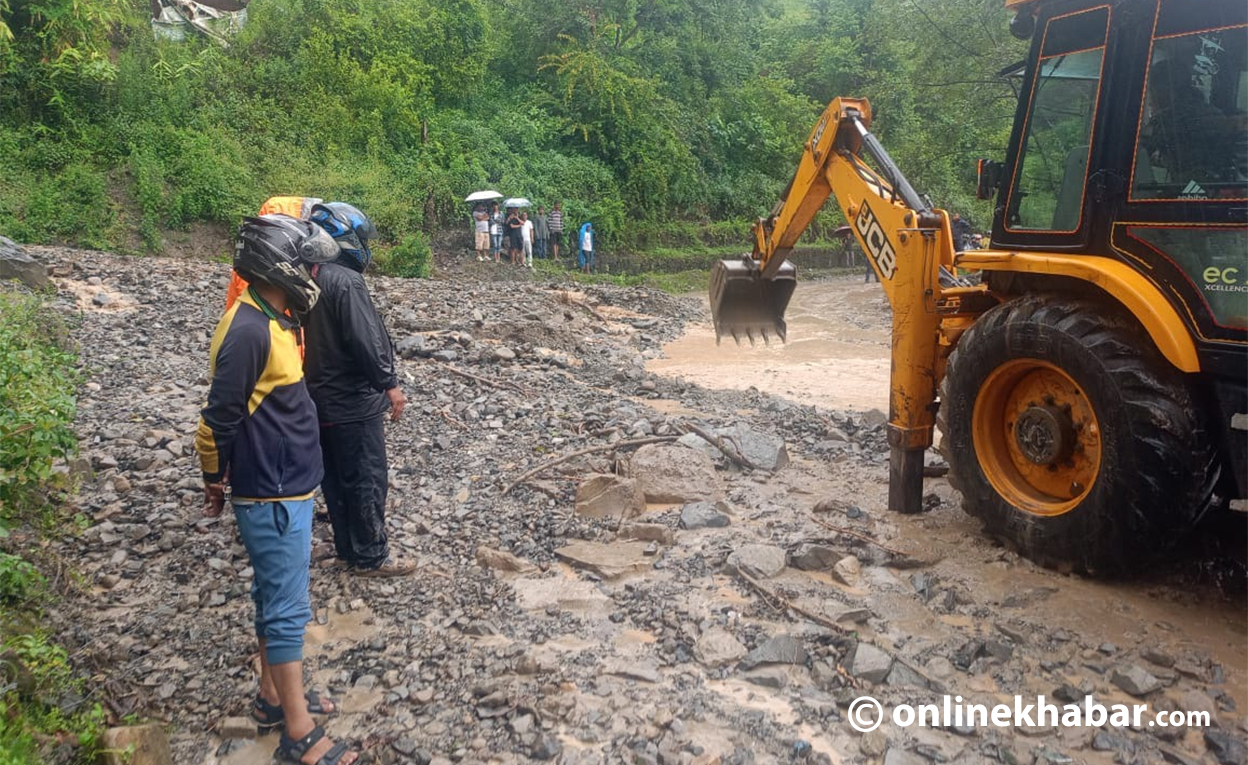
The Road Board has only 27 permanent positions. Although the number of local governments has increased due to federalism, staff numbers have not grown accordingly.
This has led to overburdened staff and insufficient performance.
The Auditor General suggested implementing an integrated annual planning system with an automated online platform to improve project selection for road repairs.
Weak Load Regulation on Roads
The Auditor General noted that heavy load vehicles are operating on main highways like the Tribhuvan Rajpath and Mahendra Highway, accelerating road damage.
Heavy vehicles cause cracks, subsidence, and potholes on road surfaces.
It urged for effective weighbridge operations and better coordination among agencies to measure and enforce load limits rigorously.
Neglect in Bridge Protection
According to Road Board regulations, separate programs for bridge maintenance should exist, but none have been implemented.
Division offices do not receive regular budgets, preventing timely bridge repairs.
Neglected bridges suffer structural damage, reduced lifespan, increased safety risks for vehicles and passengers, traffic disruptions, economic losses, and weakened disaster resilience.
Low Budget Allocation for Road Safety
Only a small portion of the annual road maintenance budget is allocated to road safety.
Ineffective use of allocated budgets has increased road accident risks, the Auditor General highlighted.
Recommendations to Address Road Maintenance Challenges
· Amend existing laws to address weaknesses and ensure constitutional compliance; prepare specific legislation for road maintenance.
· Define clear mandates for the board, manage personnel and budget disbursements effectively, reduce expenses, and increase effectiveness.
· Prioritize implementation of all categories of maintenance: regular, patchwork, emergency, and periodic.
· Clarify roles and responsibilities to improve inter-agency coordination and streamline procedures.
· Adopt automated online systems for periodic maintenance procedures as per regulations.
· Allocate sufficient budget emphasizing road safety and quality, select projects based on technical assessments, and strengthen monitoring and coordination.
· Extend project timeframes with impact evaluations and improve contract management.
· Develop clear plans to reduce costs and ensure effective implementation, monitoring, and coordination.


