




Summary
- The Bhotekoshi flood damaged 41 motorable bridges in Rasuwa, completely washing away 35 of them.
- The road from Betrawati in Rasuwa through Mailung connecting Syafru Besi–Rasuwa Gadhi is fully damaged, severing district road connectivity.
- Experts emphasize revisiting bridge standards, strategic bridge construction, and infrastructure planning based on river basin geography following the flood.
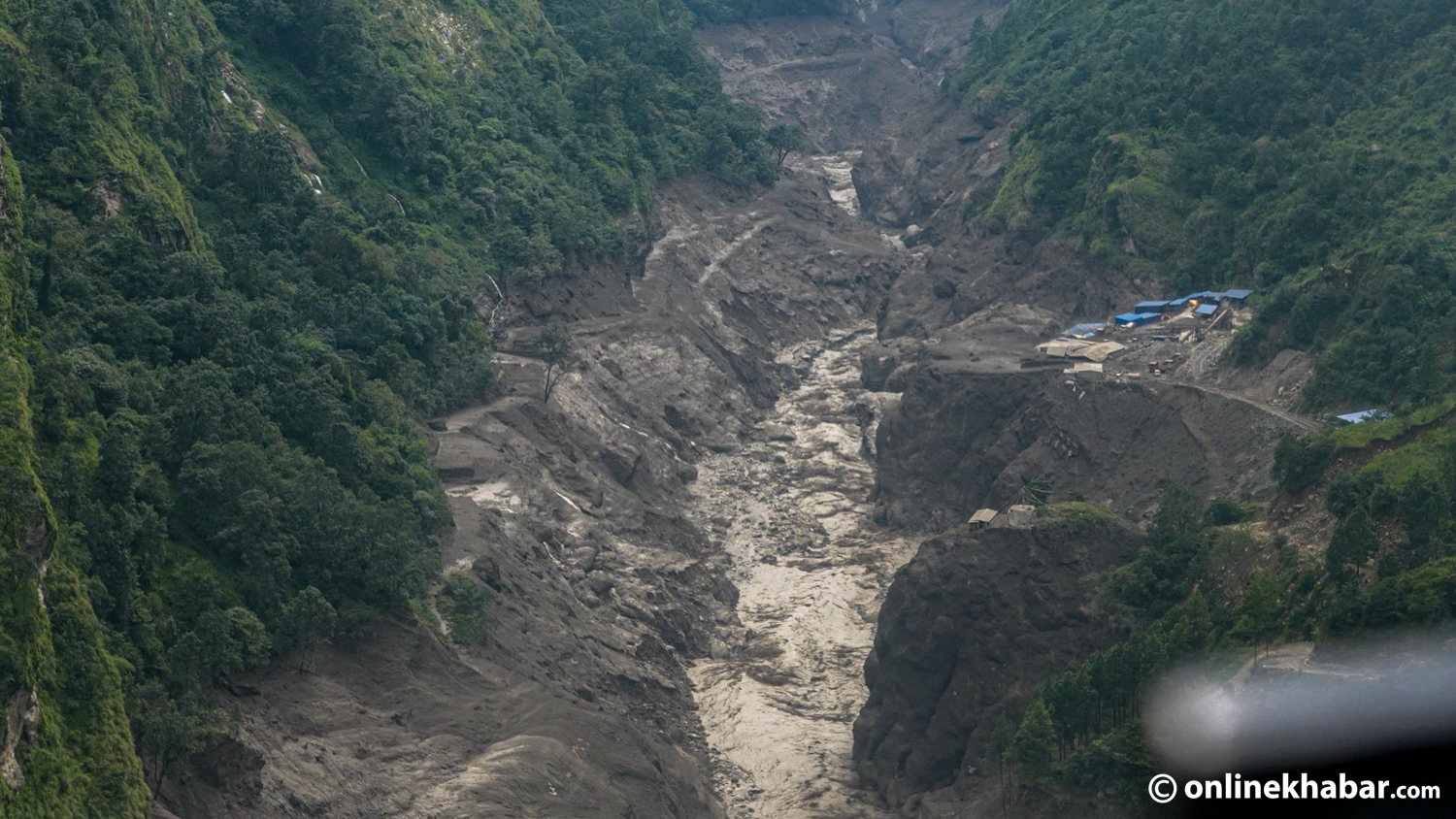
September 3, Kathmandu – The devastating flood on the Bhotekoshi River, which entered Nepal from the Rasuwagadhi border on August 26, caused damage to at least 41 motorable bridges as it reached the lower regions, completely washing away 35 of them.
The road connecting Betrawati to Syafru Besi–Rasuwa Gadhi via Mailung in Rasuwa is completely destroyed. With 40 kilometers of road wiped out in Rasuwa alone, the district is entirely cut off from road connectivity.
Although alternative routes have been opened, they are not efficient. Nuwakot, across the Trishuli River, currently lacks direct road access.
On the 85-kilometer Ghalchi-Rasuwagadhi road section, about three dozen bridges were constructed. Former Secretary Keshav Sharma notes that the flood teaches a vital lesson: constructing many small and weak bridges is inadequate.
The flood also underlines the importance of infrastructure development planned beyond political or local boundaries, focusing instead on the geography of the entire river basin.
He advised that new bridge projects be planned at specific intervals. The bridges should be designed to withstand river flows, be climate resilient, and incorporate appropriate engineering features. Instead of many small bridges, strategic bridge construction that connects to settlements and surrounding roads is preferable.
Anil Pokharel, former Executive Chief of the National Disaster Risk Reduction and Management Authority, stated the flood sends a clear message to revise existing bridge construction standards.
“The current permanent bridges we have built cannot withstand floods in this terrain,” he said, “so we need to rethink the standards.”
Among the bridges from Miteri Bridge in Rasuwagadhi to Muglin, the relatively new Muglin arch bridge was the safest and survived the recent flood. It was specifically designed to withstand floodwaters and debris flow.
“Now, we must consider not only water flow but also the flow of other materials like large debris,” he added. “Since the nature of Himalayan floods is different, infrastructure must be built accordingly.”
Pokharel explained that the flood in Bhotekoshi carried significantly more debris than water alone, which exerted strong forces that conventional infrastructure could not endure.
Observing that destroyed bridges were floating at high elevations rather than submerged confirms that debris pose a greater threat than water volume alone. He emphasized that bridge construction should not be influenced by political agendas.
Flood Beyond Existing Bridge Standards
According to the Department of Roads, no existing infrastructure standards considered a flood of the magnitude witnessed in the Bhotekoshi River.
Dr. Vijay Jaisi, Director General of the Department, said that while there are defined standards for bridge construction, such an extreme flood was not anticipated.
“It remains to be studied how rare this flood was, possibly occurring once in several centuries,” he explained. “Our current standards do not mandate infrastructure designed to endure this flood’s scale. Further studies are needed to understand how the surviving bridges managed to withstand it.”
Opportunity to Build Taller and Longer Bridges
Director General Jaisi noted that the flood clearly signals the need for the government to invest adequately in strategic bridge construction. Larger and longer bridges can be designed, though at a higher cost.
He stressed the importance of prioritizing infrastructure effectiveness and designing bridges based on their grade and strategic importance. Bridges on highways connecting district headquarters should be particularly tall and long.
He confirmed that the department plans to revise standards accordingly. “Such events could recur in other rivers, so revising the standards is essential,” he said.
Experts explain that with ongoing climate change, Himalayan countries must adapt their infrastructure accordingly and prioritize risk reduction.
Director Jaisi added that designs like the Muglin arch bridge will not be replicated on strategic roads. Future bridge reconstruction projects on the Bhotekoshi and Trishuli rivers will be determined after further studies.
To quickly reopen roads, the government is preparing to install suspension bridges at three locations.
At Devi Ghat, a suspension bridge will replace the washed-away Tadi Khola bridge over the Trishuli River. A second bridge will be constructed at the old bridge site in Trishuli Bazaar. The third will link Betrawati, connecting Nuwakot and Rasuwa.
“Once these three suspension bridges are in place, the main highway will resume operations,” he said. “Permanent bridges will then be constructed based on technical studies and needs assessment.”
Former Secretary Sharma asserts that it is no longer sufficient to design infrastructure using standards and expertise from one’s own region when building along riverbanks or steep terrains.
He emphasized the necessity of multidisciplinary studies integrating structural engineering, geography, geomorphology, hydrology, river morphology, and glacial river behavior, and advised following consultations with experts in related fields.
Currently, Nepal’s riverbank road alignments, bridges, and dams are designed based on flood history averaged over the past 100 years, a standard implemented only from the fiscal year 2018/19 onward. Previous standards were based on just 50 years of flood history.
Considering climate change effects—like abnormal heavy rainfall (cloudburst), debris flow, and shifting weather patterns—he suggests raising the flood design level and revising impact index standards to address these new trends.


