




As Russian soldiers prepare for another winter on the frontlines in eastern Ukraine, they have received an unusual form of ‘support’—the relics of a warrior prince who died over 600 years ago.
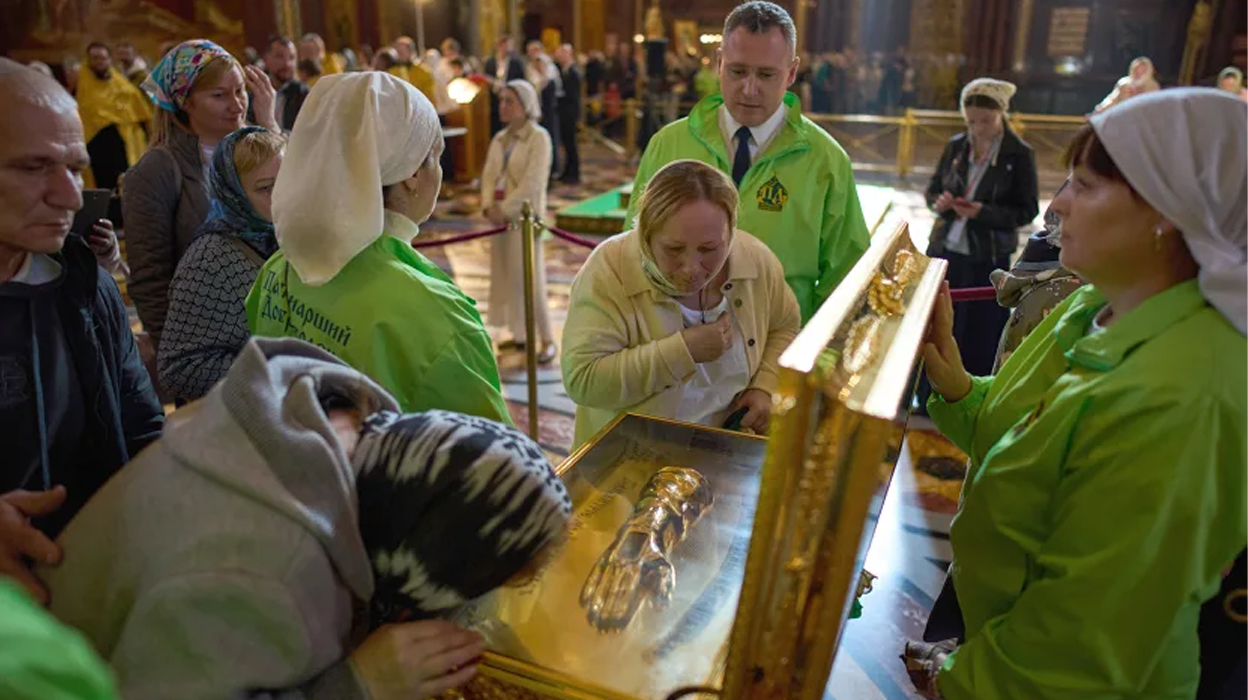
Russia has sent a fragment of the remains of medieval warrior Prince Dmitry Donskoy, who fought for Moscow, to the battlefield in Ukraine. Donskoy, celebrated for his victory in the 1380 Battle of Kulikovo, is revered in Russia as an important military symbol.
A piece of his right hand relic was deployed to the front lines in early September. Currently, this relic is being distributed among various Russian-controlled military camps in Ukraine.
The military department of the Moscow Patriarchate of the Russian Orthodox Church has stated that the ‘holy commander’ Donskoy stands ‘shoulder to shoulder’ invisibly with Russian soldiers. According to the Church, this right hand relic wielded a sword during the Kulikovo battle and has been brought to the soldiers for spiritual support.
Sending religious relics to the battlefield might seem unusual, but since Russia’s full-scale invasion of Ukraine in 2022, the Kremlin has increasingly leveraged religious symbolism in the war.
This has been interpreted as an attempt to portray the conflict as religiously justified and divinely supported. Experts note that the relationship between the Kremlin and the Russian Orthodox Church has grown closer in this context.
Sergei Chapnin, a religious scholar at Fordham University’s Orthodox Christian Studies Center, has noted the fusion between church and state as being so close that it is difficult to distinguish between the two.
‘Mythmaking to Mobilize Public Opinion for War’
The Orthodox Christian tradition includes venerating religious relics among soldiers, a practice with deep historical roots. However, Chapnin explains that combining sacred and physical objects can be used as effective propaganda to capture public attention.
Experts also emphasize that Donskoy’s relics carry contemporary political messages.
Chapnin states that Donskoy is portrayed not as an invader but as a defender of his homeland, and through their use, the Russian government seeks to convey the message that Russia is not the aggressor but is protecting its own territory.
He calls this a ‘myth created to mobilize public opinion for war.’
Such narratives, established in Russia, connect different historical periods and can deeply influence public consciousness. Religious relics are sometimes presented as possessing ‘magical properties.’
Orthodox religious leader Metropolitan Vladimir from the Russian-controlled parts of Donetsk and Mariupol has said that the relics of Donskoy help both soldiers and civilians to ‘mobilize spiritual and physical strength’ and aid in ‘achieving victory over the enemy.’
Donskoy is not the first “military saint” whose relics Russia has used in the Ukraine conflict. Previously, remains of the medieval ruler and symbol of Russian military glory, Alexander Nevsky, were also brought to soldiers on the frontlines.
The timing of sending Donskoy’s relics to the battlefield is also significant. His relics were discovered during restoration work at Moscow’s Archangel Cathedral in August. This discovery came just weeks after unconfirmed reports surfaced about the loss of Nevsky’s relics.
President Vladimir Putin called the finding ‘extremely unique’ and a ‘remarkable discovery.’ Patriarch Kirill, head of the Russian Orthodox Church, described it as a ‘special sign from God.’
However, Alexander Zanemonts, an Orthodox priest and historian born in Moscow, argues that the discovery should not be equated with Christianity itself.
He views it as using Christianity and the Church for patriotic purposes. Although the Church receives strong state support, he claims the number of active worshippers remains relatively low, and the Church pursues interests aligned with the state.
‘We Are Russian, God Is With Us’
While some see the use of religious relics as politically motivated, many soldiers on the frontlines are turning to faith out of necessity and hardship.
A former Russian soldier who fought in Ukraine remarked, ‘When things are good, not all of us talk to God, but in bad times, everyone does.’
Soldiers have been building makeshift chapels from available materials, praying before every military operation, and priests regularly meet with military units and hospitals.
A currently active Russian soldier in the Zaporizhzhia region commented that opportunities to speak with priests, pray, or touch holy objects provide ‘serious moral support.’
As the war enters its fifth year, soldiers report increasing stress. A Russian commander in Donbas told CNN that overall, the situation remains tense and has worsened over time.
They spoke anonymously about their religious beliefs.
According to a 2026 telephone survey by the Russian state-operated VTsIOM, about two-thirds of Russians identify as Orthodox Christians, down from about 80 percent fifteen years ago.
However, some priests and religious scholars estimate that only around 2 percent of Russian Orthodox Christians regularly practice their faith.
Relationship Between Church and State
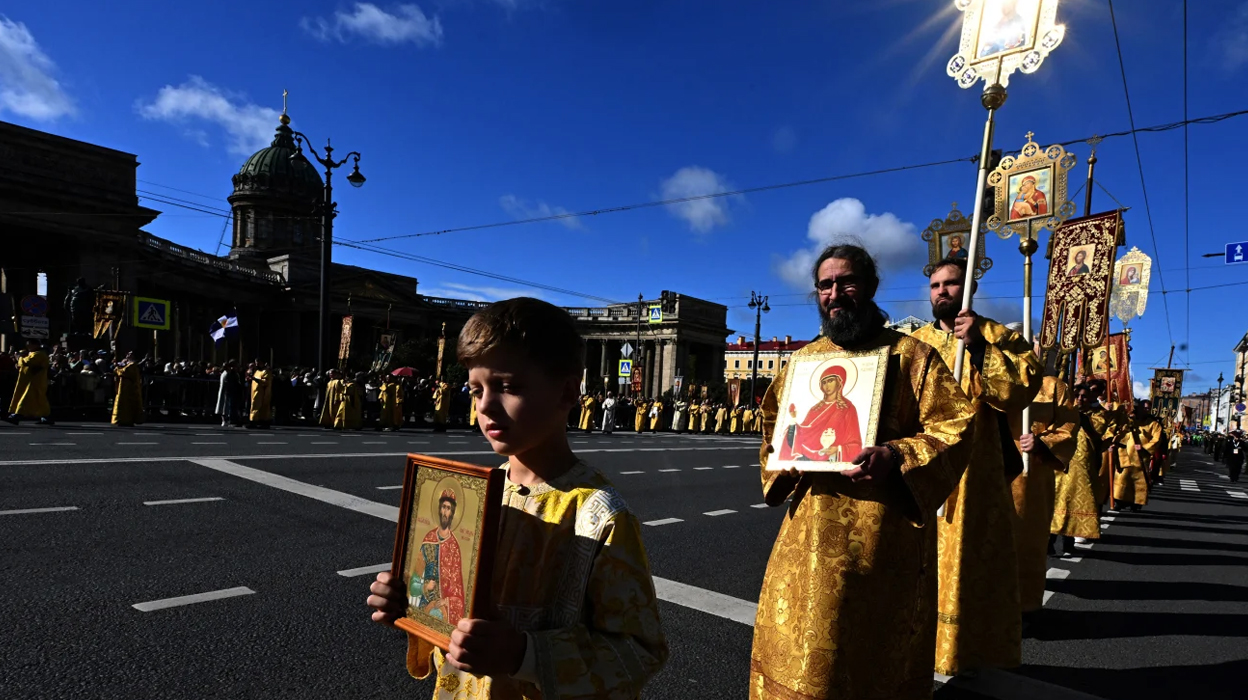
In September, religious processions organized with support from right-wing and nationalist groups were held in four Russian cities, drawing large crowds. Official figures note more than 100,000 participants in Moscow alone.
During the procession led by Patriarch Kirill in Moscow, a relic of Donskoy was also carried.
Historian and religious scholar Konstantin Mikhailov described such participation in a country of over 145 million people as ‘a drop in the ocean.’ He argues that despite state and church efforts, Russian society remains largely secular.
Mikhailov explains that the Church receives financial and political support from the Kremlin to expand its influence, and in return, the Church legitimizes Kremlin narratives, creating a mutually reinforcing cycle.
In this environment, the presence of military chaplains on the frontlines has also increased.
Critics within the Church have raised questions about the kind of support chaplains should provide to soldiers.
Russian priest Grigory Mikhnov-Whitepenko asserts that while all soldiers in uniform need spiritual support, they should not be misled.
The Church’s Doctrine: ‘All Sins Washed Away if a Soldier Dies’
The Russian Orthodox Church holds a unique belief regarding the deaths of soldiers in war.
Shortly after Putin announced a partial mobilization in 2022, Patriarch Kirill declared that soldiers who die fulfilling their military duty have made such a sacrifice that it ‘washes away all sins.’
In 2019, Ukraine established an independent Orthodox Church, breaking from the Russian Orthodox Church. The Ecumenical Patriarch of Constantinople, Bartholomew I, recognized Ukraine’s independent Orthodox Church.
Russian priest Mikhnov-Whitepenko left the Russian Orthodox Church after Moscow’s annexation of Crimea in 2014. He notes that both Russia and Ukraine have large Orthodox Christian populations, but he criticizes the institutional Church for appearing to ‘bless its own children to kill each other.’
Chapnin from Fordham University points out that this stance deviates from Orthodox tradition’s millennia-old understanding of martyrdom. He argues that the political propaganda overshadows the Gospel’s significance.
Not all soldiers interviewed view the religious relics as a meaningful source of support.
A Russian soldier operating in eastern Donbas called the relics ‘an unusual solution to a 21st-century problem.’
He added, ‘In my opinion, these relics are more needed by the mothers of soldiers who have lost their lives in the war.’ –CNN


