Prime Minister Walendra Shah has instructed security agencies to remove individuals residing in areas occupied by Bahuns.
The government plans to complete an integrated digital asset survey within 60 days for landless people, Bahuns, and those living in informal settlements.
The Rastriya Swatantra Party (RSP) has committed to establishing a high-level National Land Rights Authority to address issues related to Bahuns.
April 23, Kathmandu – The issue concerning Bahuns has resurfaced following Prime Minister Walendra Shah’s directive to security agencies to clear areas occupied by Bahuns. During a meeting with heads of security agencies on Wednesday, Prime Minister Shah ordered the removal of Bahuns from those regions.
Specifically, none of the 100 points in the government’s administrative reform agenda includes a policy to evict landless individuals, Bahuns, or those living in informal settlements. Instead, point 90 of the reform agenda commits to conducting an integrated survey of landless people, Bahuns, and residents of informal settlements. The government aims to complete a nationwide integrated digital survey and verification of these groups within 60 days.
The Shah-led government has set a goal to resolve issues related to landlessness, Bahuns, and unplanned settlements within 1,000 days. During this period, the government plans to collaborate with local bodies to conduct household surveys and apply clear criteria to identify genuine beneficiaries. Additionally, preparations are underway to update records, measure public, government, and trust lands, and develop a GIS-based digital database.
What does the government’s administrative reform plan say about Bahuns?
The government has expressed a commitment to gradually provide land to genuine Bahuns. The reform plan includes developing integrated housing options for landless Bahuns and residents of unplanned settlements in urban areas. This also encompasses resettlement programs, with a pledge to ensure full transparency in land distribution and rehabilitation processes.
Before the election, the Rastriya Swatantra Party (RSP) committed to establishing a high-level land rights authority to address Bahun-related issues. The RSP promised that this “high-level National Land Rights Authority” would differentiate genuine Bahuns from fraudulent claimants using satellite land mapping and digital biometric authentication. Their manifesto states, “Learning from past failures, the high-level National Land Rights Authority will scientifically distinguish genuine landless individuals from fake Bahuns grabbing government land through satellite mapping and digital biometric verification. Under this initiative, a reliable, convenient, and production-linked integrated model settlement will be developed, guaranteeing permanent housing and land ownership (red book titles) for genuine landless people.”
April 23, Kathmandu – Three days after assuming office, Home Minister Sudhan Gurung inspected the Police Headquarters on March 30 and declared, “We will arrange for the newly appointed Inspector General of Police (IGP) to be garlanded by the Prime Minister. I will take the initiative to make this happen.” Police officials present at the auditorium hall in Naxal Headquarters responded with applause.
The following day, Gurung visited the Armed Police Force Headquarters in Halchok and addressed those present in a similar manner. He expressed his commitment to boosting the morale of the Armed Police. Visiting two police offices within two days and announcing the system of the Prime Minister garlanding the IGP has been received positively by police officers.
Nearly a month has passed since the Home Minister’s promise, and preparations are underway to appoint a new IGP in the Armed Police within the next eight days. The four-year tenure of Armed Police Inspector General Raju Aryal is ending, and he will take mandatory retirement on April 30. The government is expected to make the decision on the new IGP this week, with the new IGP to be garlanded eight days later.
Following Minister Gurung’s commitment to facilitate the Prime Minister’s role in the garlanding ceremony, discussions are ongoing within security circles about who will garland the next IGP. According to the Home Ministry, preparations are progressing according to the former minister’s statement to have the IGP garlanded by the Prime Minister, although no final decision has been made. A ministry official said, “Based on current preparations, the garlanding will be done by the Prime Minister’s hands. If nothing changes at the last moment, the IGP appointed about a week from now will be garlanded by the Prime Minister.”
However, since Minister Sudhan Gurung has resigned from his post, it is uncertain whether this effort will be successful, and clarity will only come after the new IGP is appointed. Although the Police Act does not specify any rule about garlanding, traditionally, the outgoing IGP garlands the newly-appointed IGP.
Historically, the first Nepal Police IGP Toran Shamsher Rana used to garland himself. Subsequently, some events show there was no fixed rule and these practices were guided by traditional administrative decisions.
In 1961, after Pahal Singh Lama became IGP and modernization began in the police force, the historic traditions of garlanding started. According to former AIG Amar Singh Shah, after Lama’s tenure, it became customary for the outgoing IGP to garland the incoming IGP. Yet, over the years, interruptions and controversies arose, with political decisions by prime ministers and home ministers sometimes involving the Home Secretary in the garlanding ceremony.
A change in 1992 disrupted the tradition when Ratna Shamsher and some other IGPs were removed after reaching a 30-year service limit under the Police Act. Since then, various changes occurred. It remains a tradition for the Home Secretary to garland IGPs. According to former Home Minister Umesh Mainali, when the police organization was under the Home Ministry, the family, formal, and administrative custom was established where the Home Secretary garlanded IGPs. The tradition of garlanding the IGP in the Armed Police Force is somewhat irregular. The Armed Police Force was formed in 2000 after the Maoist insurgency, and the first IGP Krishna Mohan Shrestha was garlanded by then Home Minister Ramchandra Paudel. However, no set administrative or legal rule exists for garlanding a new IGP in the Armed Police Force, resulting in a disorganized and voluntary process.
The question now is who will garland the new IGP appointed on April 30. If the Prime Minister does the garlanding, it will be a historic first. Although the Police Act and regulations do not clearly mention the history or importance of this tradition, it remains a social and historical custom. A book titled History of Nepal Police refers to a ceremony at promotion occasions where senior officials adorn badges and offer fruits and colored powders as symbols of good wishes.
Former IGP Motilal Bohora said, “It would be a good tradition for the Prime Minister to garland the IGP. In the Nepal Army, the Chief of Army Staff is garlanded by the Head of State, and similarly, having the head of government garland the police sends a positive message. The act of garlanding symbolizes a parallel relationship and mutual respect between the police and the Home Secretary.” However, he also noted that currently, the Home Secretary appears to hold extensive authority over police leadership. Former Home Secretary Umesh Mainali emphasized that garlanding the IGP by the Prime Minister would be ideal, and it would have been preferable if the outgoing police chief had garlanded the successor, as in the past.
Former AIG Amar Singh Shah also advocates respecting the tradition where the outgoing IGP garlands the incoming IGP, fostering a spirit of camaraderie and fraternity. Former SP Ravindra Nath Regmi pointed out that the outgoing IGP should take at least a month’s leave to coordinate work and facilitate leadership training for the new IGP during the transition.
(Photos: Nepal Police, Armed Police, Former AIG Narayan Babu Thapa, and Pujan Baral)
April 23, Kathmandu – Harkraj Rai (Sampang), Chairman of the Labor Culture Party, has urged the government not to evict squatters from their homes. On Thursday evening, he expressed his willingness to offer assistance on managing the situation if consultation is needed, via a Facebook post.
“Government, do not carry out eviction of squatters. If you need advice or suggestions for management, feel free to ask,” Harkraj stated. “Also, do not display batons, boots, or guns in front of the people.”
Revised news summary. Over the past 15 years, 158 families have relocated from villages connected to Patan, Baitadi, due to a lack of drinking water, roads, and education. Despite 15 years passing since Patan was declared a model town, infrastructure and development plans remain stalled, with most structures in dilapidated condition. The main land pooling plan for the new town project has not been implemented and the office was merged into the intensive urban planning department.
April 23, Baitadi. Flat fields and large settlements on the agricultural terraces. These are the scenes where the government has declared 10 model towns across the country, including the villages surrounding Patan in Baitadi. Villages such as Paripatan, Lorkha, Meltdaa, Tunegair, Dobra, Paudi, and Bedauti fall under Ward No. 6 of the Model Town Patan Municipality, connected to Patan Market. As 15 years pass since the model town declaration, these villages are gradually depopulating.
The model town status was announced during fiscal year 2066–067 (2009-10). As expected development failed to materialize, the lack of road infrastructure, irrigation, drinking water, education, and health services has led these villages to consistently lose population. Meltdaa village previously had 35 families, now only 14 remain. According to local resident Dan Bahadur Chand, nearly 20 families have relocated to the Terai region. Chand states, “There are no roads here, there is no drinking water, there is a canal for irrigation but no water. Why would people stay?”
More than half of the houses in Meltdaa are now empty and paddy fields lie fallow. According to local Shanti Chand, there are virtually no households left to participate in funeral processions, and hundreds of ropani of land remain uncultivated. Similarly, in Bedauti village, where roughly 20 families once lived, only six remain currently. Local resident Labdev Chand reports that dozens of families have moved away and the village is almost deserted.
Ram Bahadur Chand, a teacher at Meltdaa, notes that if drinking water, irrigation, and infrastructure facilities were improved, migration would decrease. However, the new town project office has failed to perform as expected. “No significant work has been done in drinking water, infrastructure, education, or health sectors. Construction projects have been stalled for years — how can we feel any real development?” Chand questions.
According to Ward Secretary Navin Bisht of Patan Municipality–6, 158 families have relocated in the last 10 years, with 134 families moving out in just the past five years. Ward Chairperson Rajendra Bisht attributes the steady outflow of youth to lack of employment and inadequate development. The new town project office has yet to implement the critical land pooling plan, which has prevented locals from experiencing tangible development.
Fifteen years on, the various model town plans remain unimplemented. Former Chairperson Keshav Bahadur Chand explains budget shortages have left many projects in limbo. Most of the 10 towns previously announced have faced delays even before proper implementation. The land pooling plan remains unfinished and unable to acquire necessary land.
Development of new infrastructure and progress as a model town have been sluggish. Plans included roadway infrastructure, drainage, waste management, drinking water, electrification, and hospital construction. The government had targeted settling approximately 100,000 residents in the 10 model towns. In Patan, however, there is little evidence of model town progress beyond limited infrastructure like a solar streetlight and open ground.
Former Chairperson of the Municipal Development Committee, Jaysingh Bisht, says, “There are only fragmented plans, with no concrete measures to prevent the exodus from mountain settlements. Coordination between the office and local representatives is needed to move plans forward.”
Many structures built under the Patan new town project have fallen into disrepair. The model bus park initiated in fiscal year 2071/72 (2014/15) never opened and is now dilapidated. Hirapur recreational park has also degraded without development. An integrated waste management center has yet to be established, worsening rubbish management in the market area.
Land pooling, a key element of the new town implementation, has not progressed. Discussions are ongoing in Nangadi Batama near Patan Market with locals. The land pooling process involves surveying all plots in a designated area, developing wide roads, drainage, open spaces, and community facilities, and returning a portion of land to owners as homestead plots. Financing requires selling a small portion of land from each plot. This approach enables provision of roads, electricity, water, communication networks, playgrounds, health institutions, banks, and shopping complexes.
The new town development office has been integrated into the Intensive Urban and Building Construction Planning department since last December. Only three million rupees have been allocated this fiscal year for the intensive urban project, according to project chief Jhank Bahadur Thapa. “This year, the new town project plans to construct an integrated auditorium, but work has stalled due to lack of budget for open contracts,” he noted.
April 23, Kathmandu – The government has decided to transfer 25 undersecretaries to new positions. According to the cabinet decision made on Thursday, the transfers pertain to undersecretaries currently serving in federal ministries. Among these 25 officials, 21 have been assigned as secretaries in provincial government ministries, while the remaining 4 have been transferred as undersecretaries to the Chief Minister and Council of Ministers’ offices. The detailed list of transfers is as follows:
Police conducted a nighttime raid in the Sukumvasi settlement located in Thapathali, Kathmandu. The government has instructed security chiefs to clear the illegally occupied Sukumvasi settlements on Saturday and Sunday. Residents of the settlement have expressed that their lives are at risk and have demanded that the issues be classified properly before any resolution is sought. (April 23, Kathmandu)
At around 10:30 pm on Wednesday, Geeta Lama was preparing to cook food at the Sukumvasi settlement in Thapathali. Children in the neighborhood were getting ready to sleep, while others were cooking. Suddenly, the sound of boots echoed through the narrow lanes of the settlement. “One after another…” the voices came in groups, leaving everyone surprised. Soon, a police team led by a DSP entered the settlement simultaneously from two sides. The beam of flashlights began to sweep over the walls of the houses. Doors were knocked on, flashlights illuminated the interiors, and searches were conducted room by room.
The police stated that the search was conducted based on information that a criminal was hiding within the settlement. However, the residents were skeptical of the police explanation, as they believed the raid was conducted with officers carrying firearms. The directive to clear the illegally occupied settlements was issued by Prime Minister Balen Shah on Wednesday evening, tasked for implementation by security chiefs on Saturday and Sunday.
Meenakumar Rana Magar, chairman of the Sukumvasi Committee, referenced the government’s 100-day action plan, specifically item 91, in response to news regarding the settlement’s eviction. He remarked, “The Prime Minister has openly written about it, but where is the implementation? Not a single government official has visited the door of even one of the 146 families. Hearing about sudden eviction is a wrong path for this government.” Leaders of the Sukumvasi community have also engaged in discussions with leaders of the Citizen Movement on Thursday.
The Government of India has clarified that the imposition of customs duties on goods valued over NPR 100 brought from India to Nepal is a measure aimed at controlling informal trade. Ranvijay Jaswal, spokesperson for the Indian Ministry of External Affairs, stated that there will be no hindrance for Nepali citizens bringing goods for household use. The Indian government is maintaining continuous dialogue with Nepal on this matter, and Nepali authorities have reportedly implemented the existing regulations, according to spokesperson Jaswal. Kathmandu, April 23.
It has been understood that India’s decision to levy customs duties on goods exceeding NPR 100 in value brought into Nepal aims to curb smuggling and informal trade. Ranvijay Jaswal provided this information at the regular press briefing held on Thursday by India’s Ministry of External Affairs. “We are aware that Nepali authorities have already been enforcing the existing regulations. Reports indicate that customs duties are being collected from travelers carrying goods from India valued over NPR 100,” he stated. “Our understanding is that the Nepalese government has undertaken this measure mainly to control informal trade and smuggling.” However, the spokesperson also emphasized that there will be no obstruction for Nepali citizens importing goods for personal household use. He noted that Nepali officials have informed him that ordinary citizens carrying household goods for personal needs will not face impediments. Jaswal further confirmed that India continues to engage in ongoing communication with Nepal regarding this issue.
April 23, Kathmandu – On September 24, 2022, then-Kathmandu Metropolitan City Mayor Balen Shah and Land Problems Resolution Commission Chair Keshav Niraula reached an agreement to identify, survey, and certify landless Dalits, landless squatters, and residents of unauthorized settlements. However, the implementation of this agreement was delayed. On December 28, 2022, the Kathmandu Metropolitan City deployed bulldozers in the Thapathali area, leading to clashes between security personnel and local residents. The dispute has since escalated to the courts. The landless communities have expressed complaints that the municipality has breached the agreement by failing to follow through.
The number of applicants submitting requests to the Land Problems Resolution Commission from Kathmandu Metropolitan remains very low, with only 56 applications received to date. According to a report prepared three years ago by the Bagmati Civilization Integrated Development Committee, the total number of landless Dalits, landless squatters, and residents of unauthorized settlements in Kathmandu stands at 2,245.
Since assuming office as Prime Minister, Balen Shah has begun focusing special attention on the unique issues faced by landless Dalits, landless squatters, and those living in unauthorized settlements. The cabinet has decided to conduct an integrated digital survey and certification of these groups nationwide within 60 days. Furthermore, the government has announced plans to provide land to genuine landless individuals or rehabilitate them through integrated housing solutions within 1,000 days.
Since taking charge of the Ministry of Home Affairs, Prime Minister Shah has issued directives to deploy bulldozers in landless and unauthorized settlements. Pawan Gurung, Vice President of the United National Squatters Front, stated, “We advocate for peaceful legal resolution through dialogue; however, the government has repeatedly broken agreements and deceived us.”
Stakeholders have welcomed the government’s decision to address land-related issues. The Nepali Women’s Unity Society commented, “The initiative to manage the landless, squatters, and unauthorized settlements is a positive step.” Nonetheless, legal professionals have expressed skepticism, labeling the government’s expectations as unrealistic.
In July 2023, the High Court of Patan directed authorities to develop a plan within six months and ordered the collection and certification of land surveys. The Accountability Monitoring Committee warned, “Forcibly evicting settlements under the direct order of the Prime Minister and deploying security forces in this manner violates Government Work Program No. 91 and flagrantly breaches the constitutional, legal, and human rights obligations toward landless and squatter communities.”
To facilitate land distribution to landless Dalits and squatters and to manage unauthorized settlements, the government established the Land Problems Resolution Commission under the Land Related Act. To date, 1,209,059 applicants have registered with the commission.
Senior Advocate Rajup Prasad Chapagain emphasized, “Human rights must not be seriously violated under the guise of protection and beautification.” Kathmandu Metropolitan City spokesperson Naveen Manandhar stated that discussions with the Chief District Officer will determine the final decision regarding settlement evacuations.
April 23, Kathmandu – Gajendra Kumar Thakur, the Director General of the Department of Money Laundering Investigation, has been transferred to the Ministry of Finance. A reliable source confirmed that on Thursday, the Finance Minister signed a high-level decision to move him from the department to the ministry. The transfer of Director General Thakur has drawn serious attention, especially as investigations involving the controversial businessman Deepak Bhatt remain ongoing. Thakur was originally appointed to lead the Department of Money Laundering Investigation during the tenure of the previous government headed by Prime Minister Sushila Karki.
Summary: After careful review and editorial evaluation, the Cabinet has decided not to allocate the Maharajgunj Police Academy land to the President’s Office. Instead, the land will continue to be used by the Nepal Police Training Academy as before. The Police Academy’s relocation attempt to Panauti was stalled due to forged land documents leading to lawsuits and government intervention to nationalize the land. Though the existing Maharajgunj Academy will remain, a new training facility is under construction in Panauti.
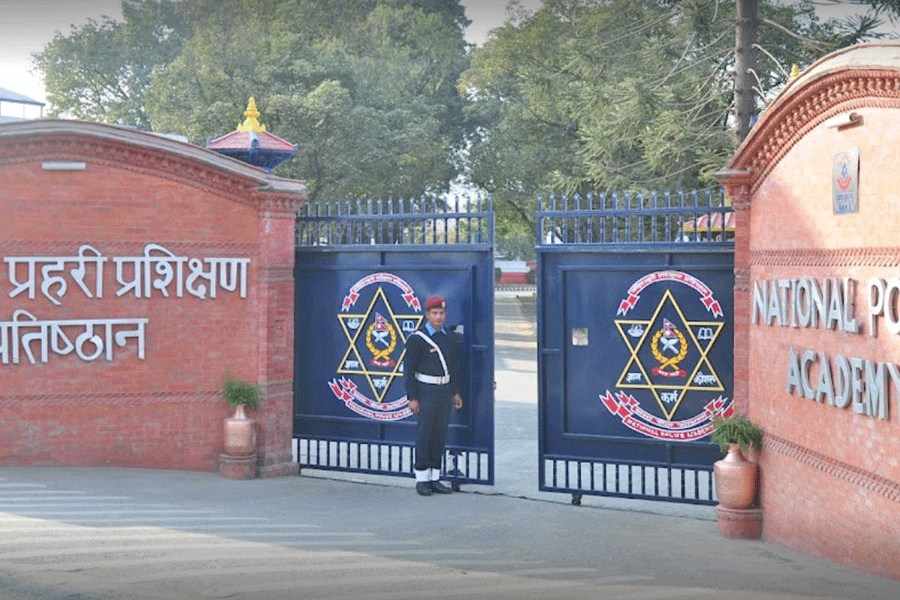
Kathmandu, April 23: Efforts to relocate the Nepal Police Training Academy from Maharajgunj to Panauti in Kavre, to provide additional facilities for the President’s Office, have failed. In a Cabinet meeting on Thursday, the government reversed its earlier decision to transfer the Maharajgunj Police Academy land to the President’s Office. Previously, on September 6, 2018 (21 Bhadra 2075 BS), the Cabinet had resolved to hand over the 114 ropani 3 anna land to the President’s Office. However, the latest resolution states that instead of transferring the land to the President’s name, the entire property will continue to be used by the Police Training Academy.
The initial plan to move the Police Academy to Panauti with helicopter facilities was devised due to the limited space and accessibility constraints at the President’s residence, Sheetal Niwas. However, following objections from former police officials stressing the historic significance of the Maharajgunj site, the decision was postponed for a long time until the government recently finalized the reversal.
A new Police Academy is currently being constructed in Panauti. However, the relocation stalled because forged documentation related to government land in Panauti surfaced. Some locals had allegedly transferred the land in their name illegally, causing the project to be held up. Subsequently, the government launched an investigation, nationalized the land, and filed cases against those involved in the forgery.
Initially, the government had decided on July 31, 1995 (15 Shrawan 2052 BS) to allocate forest land in Kavre’s Sunthan area to the Nepal Police Training Academy. Since name registration had not been completed, the land was allowed only for usufruct use. Later, when local resident Puskar Bahadur Basnet attempted to register the land in his name, a case was filed against him. He was charged on December 12, 2023 (27 Mangsir 2080 BS), found guilty in January 2025 (Magh 2081 BS), but the Supreme Court quashed the case against him on January 6, 2024 (23 Magh 2080 BS).
An additional lawsuit was filed by seven individuals, including Santosh Sapkota from Panauti-11, claiming they had sold their share of land to the Police Training Academy without receiving payment. While district and appellate courts ruled in their favor, the Supreme Court ultimately declared on September 26, 2023 (9 Aswin 2080 BS) that the land belongs to the Police Training Academy.
Due to the nationalization of the Panauti land registered under individuals’ names, the earlier government decided to relocate the Maharajgunj Police Academy to Panauti and hand over the Maharajgunj land to the President’s Office. Despite this, the Maharajgunj Academy has not yet been shifted. Meanwhile, new structures and facilities are being built at the Panauti training institute.
The latest Cabinet decision confirms that the Nepal Police Training Academy will remain operational in Maharajgunj, while a new Police Training Academy will be established in Panauti.
From Vaisakh 15 to 19, Nepal will host the ‘Tour de Lumbini: Pedal for Peace 2026’ cycling rally, travelling from Kathmandu to Lumbini. This campaign aims to spread a message of peace, coexistence, and reconstruction across the world. Founder Megh Ale emphasized, ‘The ongoing Russia-Ukraine war and the US-Iran tensions have heightened the importance of peace initiatives.’ (April 28, Kathmandu)
With the goal of promoting peace throughout Nepal, the ‘Tour de Lumbini: Pedal for Peace 2026’ has been organized. According to founder Megh Ale, the cycling journey from Kathmandu to Lumbini will take place from Vaisakh 15 to 19. The event will see active participation from cyclists both local and international, youth, representatives from the corporate sector, and media professionals.
Since its inception in 2012, this campaign has continuously worked to convey messages of peace, coexistence, and reconstruction to the public. Aiming to broadcast the message of peace globally from Lumbini, the birthplace of Lord Gautama Buddha, the campaign holds a long-term goal of establishing Nepal as an international ‘Center of Peace’.
Ale highlighted Nepal’s strategic location between two major economies, India and China, which presents a significant opportunity for the country to play a vital role in global peace efforts. This year’s edition will particularly focus on the active involvement of youth. During a press conference, Ale noted, ‘In the context of increasing instability caused by conflicts such as the Russia-Ukraine war and US-Iran tensions, peace campaigns like this have become even more crucial.’
The government has decided to evict landless Dalit–sukumvasi and informal settlers from their settlements. In opposition to this decision, a rally and protest are scheduled for 10 a.m. on Baishakh 10, starting from Thapathali and proceeding to Maitighar Mandal. Prime Minister Balen Shah had instructed the security chiefs on Baishakh 9 to clear the sukumvasi settlements.
To protest the government’s resolution to remove landless Dalit–sukumvasi and informal residents from the settlements, a rally is planned. It will commence from Thapathali settlement at 10 a.m. on Friday, moving towards Maitighar Mandal. The government has already begun public announcements since Thursday evening, urging residents to vacate settlements in Thapathali, Shankhamul, Shantinagar, and Manohara areas.
Reports indicate that bulldozers are expected to be deployed starting the morning of Baishakh 12. On Baishakh 9, Prime Minister Balen Shah convened security agency leaders and gave directives to clear the sukumvasi settlements. Approximately 1.2 million landless Dalit, landless sukumvasi, and informal settlers reside across the country. The government’s eviction efforts have caused fear and anxiety among the local inhabitants of these settlements.
April 23, Kathmandu – Assembly elections are currently underway in Assam, Kerala, West Bengal, Tamil Nadu, and the Union Territory of Puducherry. Voting is taking place today, April 23, with the final phase scheduled for April 29.
Among these four states, the most attention is focused on West Bengal this time around. Historically, elections in West Bengal have been conducted in 6 to 8 phases. By comparison, this election’s schedule is notably brief.
In West Bengal, the contest is intensely competitive between Mamata Banerjee-led Trinamool Congress (TMC), which ended the Communist stronghold after 15 years, and Indian Prime Minister Narendra Modi’s Bharatiya Janata Party (BJP). This election is widely regarded as the most compelling. Indian newspapers, television channels, and other media outlets are extensively covering the electoral process.
Election Environment
Voting in the first phase began at 7 a.m. on Thursday and, according to Indian media reports, nearly 90 percent of eligible voters cast their ballots by 5 p.m.
This phase covers 152 constituencies across 16 districts where 36 million voters will participate. Out of 1,478 candidates, 167 are women. The Election Commission has deployed substantial security measures to ensure a free and fair process, including 2,450 companies of central paramilitary forces.
Women voters lining up to cast their votes in Raninagar. Photo courtesy: The Indian Express
Incidents of Violence
There have been reports of violent incidents in some areas during voting. Tensions rose in Naoda, Murshidabad, following the arrival of Humayun Kabir from the Aam Janata Unnayan Party, leading to protests by TMC supporters. In Domkal, Murshidabad, some voters alleged threats and intimidation.
Stone-pelting targeted BJP candidate Agnimitra Paul’s vehicle in Asansol South. BJP candidate Suvendu Adhikari claimed that TMC workers attacked him in Kumargram. These incidents reflect the continuation of a legacy of electoral violence in the region.
Political violence is a common sight in West Bengal before, during, and after elections. Statistics reveal that the most lives lost to political attacks during elections are reported from West Bengal. In rural areas, it is common for supporters and workers of losing parties to be chased from their homes, forcing them to seek refuge elsewhere for months.
Why Is This Election Important?
This election is regarded as a decisive turning point in Indian politics. From a national perspective, it is a critical test of BJP’s long-term strategy to expand into South and East India. BJP has long aimed to make West Bengal a key political base, and this election will determine the extent of that success.
Mamata Banerjee
This election is not merely about a win or loss but represents a profound struggle between regional and national parties. Mamata Banerjee’s TMC presents itself as the sole protector of Bengali culture and regional identity. In contrast, BJP advocates a platform of national unity, Hindutva, and development, striving to break Banerjee’s regional political fortress.
Political analysts in India are calling this election the ‘semifinal’ ahead of the 2029 Lok Sabha elections. West Bengal has 42 Lok Sabha seats, which significantly impact the national power dynamics. Thus, this election has become a prestige battle for the government in Delhi.
For Banerjee, who has governed West Bengal for 15 years, this election will affirm whether her stronghold remains intact. TMC has retained power thrice in a row. Should they sustain their grip for a fourth term, Banerjee will become the longest-serving chief minister in West Bengal’s history.
The Contest Landscape
Chief Minister Banerjee’s TMC has centered its campaign around its traditional slogan, ‘Ma, Mati, Manush’ (Mother, Soil, People).
The party emphasizes key initiatives such as direct cash transfer schemes for women, youth employment programs, and social security projects as main electoral agendas.
Banerjee’s influence is so entrenched that despite years of efforts, BJP has not been able to field a credible alternative candidate in West Bengal. Although the TMC government has faced allegations of administrative failures and corruption, Banerjee’s personal popularity remains largely unaffected.
Modi’s BJP pitches itself as the agent of change. Modi has claimed during rallies that the people of Bengal will give a mandate for change this time. BJP has fielded formidable leaders such as Suvendu Adhikari, Dilip Ghosh, and Agnimitra Paul, focusing its campaign on good governance, law and order improvements, and curbing illegal immigration.
Despite forming the majority government at the center since 2014, BJP has not yet made significant inroads in West Bengal against Banerjee’s popularity. In the 2021 assembly elections, Amit Shah aimed to win over 200 seats but secured just 77.
Meanwhile, leftist parties and the Indian National Congress, which had no seats in 2021, are striving to regain their lost standing. Congress leader Adhir Ranjan Chowdhury is contesting from Baharampur, while the Left Front promises permanent jobs for every family.
Election History
After India’s independence, West Bengal was chiefly governed by the Indian National Congress government for about 30 years, except for some weak coalition governments. In 1977, West Bengal fell under the control of the Left Front for the first time.
The Communists maintained their stronghold for 34 years until 2011 when Mamata Banerjee, campaigning on a platform of change and in alliance with the Congress, toppled the Communist bastion. The TMC-Congress coalition won 225 of 294 seats, while the Left Front was limited to 62 and BJP just 2 seats.
In the 2016 polls, TMC won a commanding 211 seats independently, retaining power despite accusations of corruption, with the public still backing Banerjee. BJP increased its vote share to 10.17 percent.
In 2021, despite BJP’s slogan ‘Abki Bar, 200 Par’ (This time, 200+ seats), they did not succeed. TMC won 215 seats while BJP increased its vote share to 38.13 percent but secured only 77 seats.
One notable 2021 result was the complete wipeout of the Congress and leftist parties, which had led the state government for many years.
What Do Surveys Indicate?
Current surveys show a fierce contest between TMC and BJP. Most polls have TMC slightly ahead.
According to ‘Matrigrowth’, TMC is projected to receive 43 percent of the vote, with the BJP alliance close behind at 41 percent. The ‘C-Voter’ poll projects 44 percent for TMC and 40 percent for BJP.
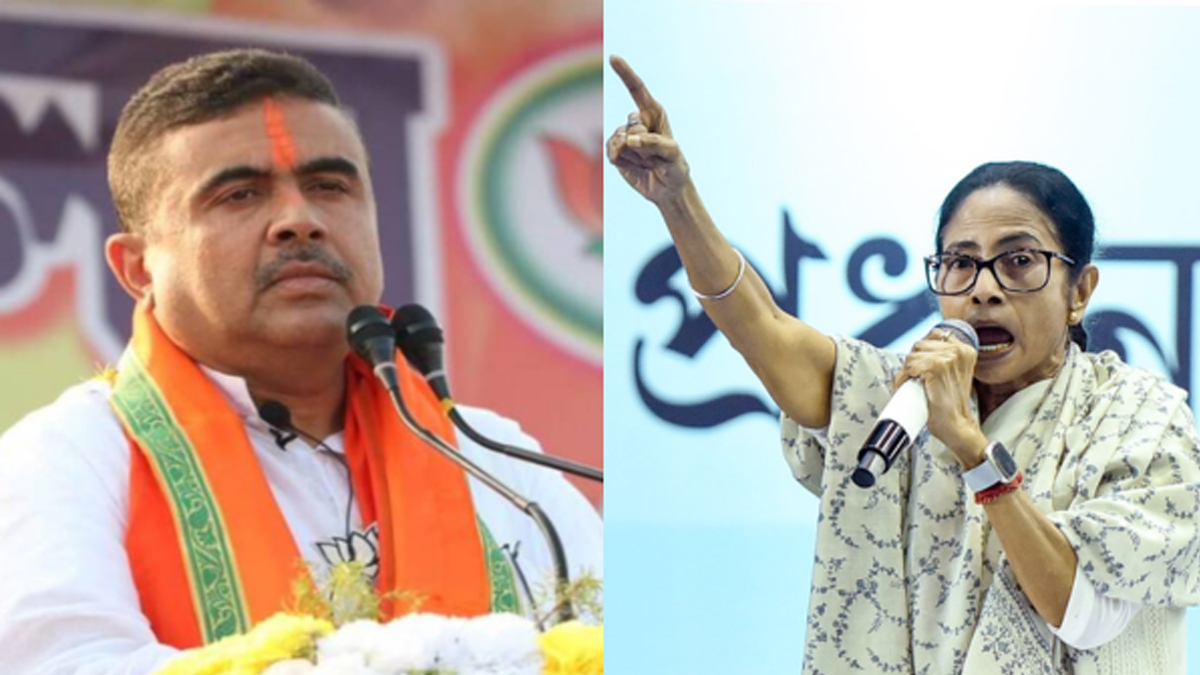
BJP leader Suvendu Adhikari and TMC leader and Chief Minister Mamata Banerjee
Regarding seat projections, the surveys conducted by ‘Vote Vibe’ and ‘CNN-News18’ estimate that TMC could win between 184 and 194 seats, comfortably securing a majority, while BJP is expected to capture between 98 and 108 seats.
Surveys also indicate Mamata Banerjee remains the preferred candidate for Chief Minister, with about 48.5 percent of voters choosing her compared to 33.4 percent favoring BJP’s Suvendu Adhikari, underscoring her continued popularity in the state.
Chennai Super Kings defeated Mumbai Indians by 103 runs in an IPL cricket match. Sanju Samson played an unbeaten century, scoring 101 runs, while Akil Hossain took four wickets to dismantle Mumbai’s innings on April 23, in Kathmandu.
Thanks to Sanju Samson’s outstanding batting and Akil Hossain’s impressive bowling, Chennai Super Kings secured a commanding victory over Mumbai Indians in the Indian Premier League (IPL). The match, held at Wankhede Stadium, saw Chennai restrict Mumbai to just 104 runs, leading to a 103-run win. Mumbai were bowled out in the 19th over while chasing a target of 208.
Mumbai’s Tilak Varma top-scored with 37 runs, closely followed by Suryakumar Yadav’s 36. Other batsmen failed to reach double figures. Akil Hossain was the major threat, taking 4 wickets for just 17 runs in 4 overs to weaken Mumbai’s innings. Noor Ahmad claimed 2 wickets, while Mukesh Choudhary, Anshul Kamboj, Jamie Overton, and Gurjpanith Singh took one wicket each.
After losing the toss, Chennai chose to bat first and posted a total of 207 for 6 wickets. Opener Sanju Samson smashed 101* runs off 54 balls, including 10 fours and 6 sixes. He reached his century with a boundary on the last ball of his innings. This marks Samson’s second century of the season, having previously scored one against Delhi Capitals. Captain Ruturaj Gaikwad contributed 22 runs, Dewald Brevis 21, Karthik Sharma 18, and Jamie Overton 15. For Mumbai, Allahaz Gajanfar and Ashwani Kumar took 2 wickets each, while Jasprit Bumrah and Mitchell Santner picked up one each. With this victory, Chennai earned their third win in seven matches and climbed to fifth place with 6 points, while Mumbai suffered their eighth defeat of the season.
Recently appointed Deputy Governor of Nepal Rastra Bank, Kiran Pandit, has purchased land valued at approximately NPR 33.5 million. He disclosed that the investment for this land purchase came from his and his wife’s earnings, supplemented by bank loans. The central bank published the asset details, which are required to be submitted within 60 days. (April 23, Kathmandu)
According to the asset declaration filed by Pandit, both his and his wife’s incomes along with loan sources contributed to the land acquisition. He specified that a plot in Tokha Municipality, Kathmandu, was acquired in his wife’s name for NPR 22 million. He further noted that the funding included bank loans alongside their personal incomes.
The declaration also reveals that the Deputy Governor’s wife holds land valued at around NPR 6.9 million in Tarkeshwor, Kathmandu, while Pandit owns land worth approximately NPR 1 million in Dhangadhi, Kailali. Additionally, they jointly invested with his brother in land valued at NPR 4 million in Rupandehi. In terms of family assets, land measuring 11 ropanis is registered in his father’s name in Tanahun, Damauli, and 6 aana of land in Kathmandu is under his mother’s name.
Deputy Governor Pandit possesses 20 tolas of gold, 250 tolas of silver, and diamonds valued at around NPR 200,000. The asset declaration states these were accumulated through marriage, traditional ceremonies, and personal earnings. He also holds savings exceeding NPR 22 million in Nepal Rastra Bank, Employees Provident Fund, and various other banks. Furthermore, he has investments exceeding 700 shares across several companies, as disclosed in his asset report.