Author: space4knews

महिलाको सहभागिता बढ्यो, नेतृत्व प्रभावकारिता बढेन

Increased Female Participation Yet Leadership Effectiveness Remains Limited

Summary: The decade of the 1990s Vikram Samvat marked the beginning of non-governmental party politics in Nepal, with intellectuals and political figures laying the foundation for the democratic movement. During the Maoist insurgency (V.S. 2052–2063), women played active roles as soldiers, leaders, and strategic decision-makers, paving the way for a quota system for female participation. Nepal’s 2072 Constitution ensured at least one-third female representation in parliament and local levels, and since 2074, women’s political participation has risen to over 40 percent.

Non-governmental multi-party politics in Nepal is generally recognized to have started in the 1990s V.S. During this period, the political and social environment was complex, characterized by the autocratic Rana regime and restricted civil liberties. Nonetheless, various intellectual and political personalities organized efforts that laid the groundwork for democratic movements. The Nepal Praja Parishad, established in V.S. 1993, is one of the country’s oldest political institutions and played a key role in spreading political awareness. Subsequently, the Nepali National Congress (NEKA) was founded to institutionalize the political movement; its first national convention was held on January 25–26, 1947, in Kolkata, India (Basnet, 2065). The convention not only called for political change but also recognized gender inequality and discrimination against women, passing a proposal advocating equal rights for women.

The prevailing social structure at the time was largely patriarchal, with women deprived of education, property rights, participation in decision-making processes, and involvement in public life. Education for women was considered a foundation for social change and political awareness, which later provided a platform for women to assume leadership roles. The Maoist party placed special emphasis on female participation in its early phase. During the armed conflict from V.S. 2052 to 2063, women were actively engaged as soldiers, political trainers, leaders, and strategic decision-makers. The party committed to leadership development, organizational training, and proportional representation for female members. These experiences opened pathways for systems such as quota representation, proportional inclusion, and adequate participation of women in the constituent assembly in Nepal. Aligning with global debates on gender equality and Nepal’s political evolution, the CPN (UML) at its second National Council meeting in V.S. 2053 decided to include at least one woman in every committee (CPN-UML, 2053). This is considered Nepal’s first formal party-level quota decision institutionalizing women’s representation within political parties.

Since 2074, women’s political representation in Nepal has surpassed approximately 40 percent, signaling progress toward inclusivity. However, challenges remain, including limited opportunities in direct elections, dependency on the quota system, entrenched patriarchal attitudes, and minimal influence in decision-making processes. Throughout Nepal’s history, courageous and influential women have made significant contributions. In various periods, women have exhibited bravery in safeguarding the nation, society, and communities. For example, during the Anglo-Nepalese War (1814–1816), women played vital roles in warrior support, treating injured soldiers, and resistance activities in battles like Nalapani (Kunwar, 2065). Yogmaya Neupane, regarded as the founder of modern Nepal, raised voices against child marriage and opposed Rana regime injustices.

Women actively participated in the labor movement of 1956 (2003 BS) and the civil movement of 1957 (2004 BS), leading to the establishment of the Nepal Women’s Association under the leadership of Mangala Devi Singh in the same year. Although the Rana regime ended and multi-party democracy began in 1957 (2007 BS), the women’s movement continuously advanced education, employment, and political participation. Despite ongoing challenges, gender consciousness and women’s roles in society have steadily increased. Women’s involvement in the 2006 (2062/63 BS) democratic movement was especially notable. Acknowledging that women’s issues differ by class, caste, language, region, and religion, inclusivity and equality were ensured during the constitution drafting process. The Interim Constitution promulgated on Magh 1, 2063, secured one-third women candidates and equal rights. The new Constitution of 2072 introduced stricter provisions against violence targeting women and institutional recognition. Especially significant was ensuring more than 40 percent female participation at the local level. However, effective leadership remains limited. Article 38 of the Constitution guarantees equal hereditary rights for women, proportional participation, reproductive rights, and punishment for perpetrators of violence along with victim compensation. At least one-third female representation is ensured in both federal and provincial parliaments. In the 2074 federal elections, women constituted about 33 percent in the House of Representatives, though the number elected through direct vote was low. By the 2079 elections, female representation reached 33.8 percent. Women’s participation in provincial assemblies increased from 34.36 percent in 2074 to 36.4 percent in 2079. In local governments, women accounted for 40.95 percent of representatives in 2074, rising to 41.21 percent in 2079. Nonetheless, the number of women in leadership positions remains limited. Overall, while women’s political participation has significantly increased, limited direct electoral opportunities, quota system dependence, leadership constraints, party structural inequalities, and patriarchal mindsets persist.

From 2048 to 2015 BS, women’s participation in elections was limited. In the 2015 election, only one woman MP was elected. After the constituent assembly elections, the proportional representation system increased women’s participation, with approximately 197 female members in the first assembly and 176 in the second. Political development between 2074 and 2079 saw a substantial rise in female representation, but leadership and effectiveness gaps remain. In recent years, Nepal’s younger generations born after 1997 have become increasingly politically and socially conscious, raising their voices actively through digital platforms. The Gen Z Movement, which began on Bhadra 23, 2082, marked a significant event in political and social dissatisfaction, with 76 deaths recorded. The government provided financial relief to the families of the deceased. Subsequently, Nepal appointed its first female Prime Minister, inaugurating a new chapter in women’s leadership history. Prime Minister Sushila Karki demonstrated exemplary leadership and sent a positive message that women can hold the highest office. Her main challenges included addressing youth demands, managing economic crises, and maintaining political stability. Re-establishing trust among parties and introducing a shared agenda for upcoming elections or constitutional amendments were urgent priorities.

The Fagun 21, 2082 House of Representatives elections posed challenges for women’s political participation. While Nepal’s Constitution mandates a minimum of 33 percent women in the House, the number of female direct candidates remained low, and many parties fulfilled representation primarily through proportional lists, perpetuating structural inequalities. Women’s political participation in Nepal’s history has been arduous, influential, and continuously evolving. Initially limited to small roles, women’s positions strengthened through the Maoist movement, formation of women’s associations, and proportional representation systems. Although the Constitution guarantees adequate female representation, limited direct election opportunities, restricted leadership access, party structure inequalities, and patriarchal attitudes remain. Improvements in female representation from 2074 to 2079 are evident, but deeper introspection and structural reforms are needed for proportional leadership and effective influence. Ultimately, women’s political participation in Nepal must focus not only on numerical growth but also on impactful roles in leadership, decision-making, and policy formulation. From history to the present, women’s leadership and contributions under challenging circumstances clearly indicate progress toward gender equality.

Tomorrow’s Foreign Currency Exchange Rates Announced

Kathmandu, 15 Chaitra – The Nepal Rastra Bank has set the foreign currency exchange rates for Sunday. According to the established rates, the buying rate for the US dollar is NPR 151.41 and the selling rate is NPR 152.01. The buying rate for the Euro is NPR 174.32 and the selling rate NPR 175.01; for the British Pound Sterling, the buying rate is NPR 201.41 and the selling rate NPR 202.20; and for the Swiss Franc, the buying rate is NPR 189.92 and the selling rate NPR 190.67.

The Australian Dollar’s buying rate is NPR 104.37 with a selling rate of NPR 104.79; the Canadian Dollar’s buying rate is NPR 109.32 and selling rate NPR 109.75; the Singapore Dollar’s buying rate is NPR 117.64 and selling rate NPR 118.10. For Japanese Yen (10 units), the buying rate is NPR 9.47 and the selling rate NPR 9.51; Chinese Yuan’s buying rate is NPR 21.91 and selling rate NPR 21.99; Saudi Arabian Riyal’s buying rate is NPR 40.35 and selling rate NPR 40.51; and Qatari Riyal’s buying rate is NPR 41.44 with a selling rate of NPR 41.61.

According to the central bank, the Thai Baht’s buying rate is NPR 4.60 and the selling rate NPR 4.62; UAE Dirham’s buying rate is NPR 41.23 and selling rate NPR 41.39; Malaysian Ringgit’s buying rate is NPR 37.73 with a selling rate of NPR 37.88; South Korean Won (100 units) buying rate is NPR 10.03 and selling rate NPR 10.07; Swedish Krona’s buying rate is NPR 16.05 and selling rate NPR 16.11; Danish Kroner’s buying rate is NPR 23.33 and selling rate NPR 23.42.

The Rastra Bank also reported that the Hong Kong Dollar’s buying rate is NPR 19.33 and selling rate NPR 19.40; Kuwaiti Dinar’s buying rate is NPR 493.76 and selling rate NPR 495.71; Bahraini Dinar’s buying rate is NPR 401.57 and selling rate NPR 403.16; Omani Riyal’s buying rate is NPR 393.28 and selling rate NPR 394.84. The Indian Rupee (per 100 units) has a buying rate of NPR 160.00 and a selling rate of NPR 160.15. The Rastra Bank has stated that these exchange rates may be revised at any time as necessary. It also noted that commercial banks may set different exchange rates, and the updated rates will be available on the central bank’s website.

Owners of the Six Teams for Nepal Kabaddi League Season 2 Announced

The owners of the teams for Nepal Kabaddi League Season 2 have been announced. Bhawani Rana of National Investment Holding has acquired ownership of the Biratnagar Bahubali team. Through a 10-year agreement with Astronics Management, the aim is to professionally develop kabaddi in Nepal. Kathmandu, 15 Chaitra.

The six team owners of Nepal Kabaddi League (NKL) Season 2, set to commence from Jestha 22, have been made public. At an event hosted by Astronics Management at Hotel Yak & Yeti on Saturday, the owners of the six franchise teams competing in NKL Season 2 were introduced. Bhawani Rana, former president of the Federation of Nepalese Chambers of Commerce and Industry, has entered the league with her company National Investment Holding taking ownership of the Biratnagar team. The team’s name has been changed from Biratnagar Bandits to Biratnagar Bahubali.

The defending champions, Janakpur Knights, remain owned by Neco Insurance Limited. The runner-up team, Kathmandu Mavericks, is owned by Kathmandu Mavericks Pvt. Ltd. Similarly, Pokhara Lakers are owned by Fewa Construction, while Butwal Bulls are owned by Morai Corporation. The team previously known as Himalayan Riders has been renamed Butwal Bulls. Dhangadhi Wildcats Pvt. Ltd. owns the Dhangadhi Wildcats, the representative team from the Sudurpashchim Province.

Expressing satisfaction with the growing popularity of NKL nationally and its commercial and business prospects, Amitkumar Begani, head of Astronics Management, stated, “We organized the first edition on a grand scale. The second edition will be even better. The participation of corporate houses will elevate the league’s quality. We aim to make Nepalese kabaddi world-class.” The event was attended by Sri Lankan Ambassador to Nepal Ruwanthi Delpitia and Arvindkumar Jhal, General Secretary of the All Nepal Kabaddi Federation. Jhal announced that Astronics Management has signed a 10-year agreement for the Nepal Kabaddi League, which will play a significant role in the development of kabaddi in Nepal. The NKL is organized with the objective of professionalizing kabaddi in Nepal. The player draft for NKL Season 2, starting from Jestha 22, has been completed with domestic players selected. Organizers also reported that over 100 foreign players from 15 countries have registered their names for the draft.

प्रश्नैप्रश्न माथि उभिएका बालेनको अभिभारा

Balen Faces Challenges as a Leader

Balen is no longer just an interviewer or a partisan of Raswapa. Individuals who have transformed into the ruling political power with nearly two-thirds of the votes may try to hold themselves accountable as much as possible, but their relevance will still be confirmed.

Nepal National Football Team Announced After Departure to Laos; Anjan Bista Excluded

The Nepal national football team has departed for Laos on Saturday to play against Laos in the AFC Asian Cup qualifiers. Following the suspension of the All Nepal Football Association (ANFA) by the National Sports Council, ANFA dispatched the team to Laos under the prevailing circumstances. The new head coach, Guglielmo Arena, has announced a squad featuring five new players for his debut match.

After arriving in Laos, ANFA officially revealed the Nepal squad on its Facebook page Sunday morning. Led by captain and goalkeeper Kiran Chemjong, the squad notably does not include Anjan Bista, who is Nepal’s joint top scorer with 13 international goals. Coach Arena has introduced five fresh faces for his first game in charge.

The new additions to the squad include goalkeeper Yogesh Dhimal, midfielders Pemba Dorje Lama and Milan Rai, and forwards Yuvraj Khadka and Roman Bhujel. Yogesh Dhimal and Roman Bhujel currently play for Planning Boys United in the National League, while Milan Rai represents Church Boys and Yuvraj Khadka plays for APF.

Originally, Nepal was set to host the match against Laos at their home stadium; however, the Dashrath Rangasala stadium was recently declared unfit for international matches, preventing the home game from taking place there. The suspension of ANFA by the sports administrative body, the National Sports Council (RAKHEP), has cast uncertainty over the future of Nepalese football. Positioned in Group F, Nepal has already been eliminated from contention to qualify for the Asian Cup.

Millions Protest Against Trump at Over 3,000 Locations Across the US

Massive protests against President Trump and his policies have taken place at over 3,000 locations throughout the United States. In Saint Paul, Minnesota, a large rally was held opposing Trump’s immigration policies. American citizens in various cities across Europe also demonstrated against the Trump administration. Kathmandu, March 29. From major cities to small towns, there have been widespread protests against President Donald Trump and his administration’s policies, with millions taking to the streets in a third edition of the nationwide “Kingsno Kingskings” campaign, which translates to “No Kings”. Previous demonstrations have already seen millions expressing dissatisfaction. On Saturday alone, rallies of varying sizes were held in more than 3,000 locations nationwide. Protesters primarily targeted Trump administration policies, including the possible war with Iran, stringent federal immigration policies, and the growing cost of living across the country. Organizers described the movement as a peaceful civil uprising defending democracy and opposing authoritarian rule. “KingTrump wants to remain as an autocratic ruler over us, but this is America, and power belongs to the people, not to any king or his wealthy aides,” read a statement from the organizers.

Meanwhile, the White House dismissed the protests, referring to the opposition as “KingTrump Derangement Therapy,” implying that protesters need treatment to free themselves from blind opposition to Trump. A spokesperson remarked that the only people concerned about this matter are journalists who are paid to write such stories.

Main Hub of the Movement – Minnesota
Saturday’s “Kingsno Kingskings” movement’s largest and most significant event took place outside the State Capitol building in Saint Paul, Minnesota. Following the deaths of two American citizens, Renee Nicole Good and Alex Pretty, during federal immigration agency operations in January, this state has become a focal point of opposition to Trump’s immigration policy. Their deaths sparked nationwide outrage and coordinated protests. Thousands marched with placards, and prominent Democratic leaders were notably present at the rally. Minnesota Governor Tim Walz sharply criticized Trump’s immigration policies. Senator Bernie Sanders honored Minnesota residents by describing the moment as an unprecedented and dangerous chapter in American history. Congresswoman Ilhan Omar stated, “We Minnesotans have a different perspective” and raised her voice in favor of civil rights. Renowned rock musician Bruce Springsteen energized the crowd by performing his new protest song, “Streets of Minneapolis,” calling Minnesota a source of inspiration for the entire nation. Actress and progressive activist Jane Fonda read a message from Renee Good’s widow, Becca Good, as she was unable to attend the event.

Masses in Washington, D.C. and New York
On Saturday afternoon, streets in Washington, D.C., the US capital, were flooded with demonstrators. Thousands gathered at the National Mall and the steps of the Lincoln Memorial. As in previous protests, effigies of President Donald Trump, Vice President J.D. Vance, and other senior administration officials were carried by protesters who chanted for the removal and arrest of the current administration. A large group entered the capital crossing a bridge from Arlington, Virginia. Similarly, thousands marched in various locations including Times Square and Midtown Manhattan in New York. The crowds became so large that police had to temporarily close busy streets. According to the New York Police Department, more than 100,000 people had participated in five major locations during last October’s protests. This time as well, banners opposing the war with Iran and harsh immigration policies were prominently displayed. Progressive influencers such as Twitch streamer Hasan Piker and TikTok star Harry Sison appealed to the younger generation to defend democracy.

High Enthusiasm in Western Cities
Protest enthusiasm was similarly high in western cities like Los Angeles and Chicago. Thousands gathered at the Gloria Molina Grand Park in Los Angeles where the atmosphere was more festive and creative, featuring salsa music and a 20-foot inflatable balloon named “Baby Trump.” Some participants wore inflatable flamingo and shark costumes while holding banners calling for the abolition of the immigration agency. However, the Los Angeles police reported clashes between protesters and law enforcement outside the federal building downtown, resulting in some arrests. Thousands also marched in Grant Park in Chicago and in Portland, accompanied by live music bands. Former soldier Chris Holly said, “This is the first time I have come to the streets after witnessing injustice in the country. I am deeply dissatisfied with the Trump administration’s policies.”

Dissatisfaction in Republican Strongholds and Small Towns
Another significant aspect of this “Kingsno Kingskings” protest movement is that it is not confined to large, predominantly Democratic cities. According to organizers, about half of the protests took place in states traditionally regarded as Republican strongholds. Dozens of rallies were held in states such as Texas (Dallas, Fort Worth), Florida, Georgia, Idaho, Utah, and Alaska. Even small towns like Havely, Michigan, and Shelbyville, Kentucky, saw people carrying placards opposing war with Iran and rising costs. One protester commented, “We want to show that our problems are the same; if we stand together, change is possible.”

International Solidarity
American citizens residing in Europe also protested against the Trump administration. Demonstrators gathered in Paris, France; London, United Kingdom; and Lisbon, Portugal, depicting the president as a fascist and war criminal, demanding his removal from office.

What Is Trump Saying?
Since returning to the White House in January 2025, Donald Trump has extensively expanded presidential powers. He has attempted to dismantle various branches of the federal government through executive orders and deployed the National Guard in American cities despite opposition from state governors. He has also been accused of directing top officials in the Department of Justice to file charges against political opponents. Critics view these moves as unconstitutional and a severe threat to American democracy. However, Trump maintains that his actions are necessary to rebuild the country from crisis. He rejects accusations of being a dictator as hysterical. In an October interview with Fox News, he stated, “They are calling me a king, but I am no king.” Approximately 7 million people participated in last October’s rallies, and this time the protesters’ energy and enthusiasm remain strong. Organizers are preparing for the annual “KingsMay Day” demonstrations on May 1, focusing on workers’ rights, immigrant communities, and public schools, aiming to mobilize broad public participation. Growing public dissatisfaction due to war, high living costs, and strict immigration policies is drawing considerable attention on its potential political impact in the upcoming midterm elections. “We are on the streets not just for our future, but to save democracy,” said a Manhattan protester. This wave of civic voices in defense of democracy shows no immediate signs of stopping.

Communications Minister Directs Staff to Deliver Tangible Results Amid High Public Expectations

March 27, Kathmandu – Dr. Bikram Timilsina, Minister for Communications and Information Technology, has instructed ministry employees to work in a manner that the public can quickly experience the benefits of their efforts.

During a review of the ministry’s operations on Saturday, Minister Timilsina emphasized that the Communications Ministry serves as the government’s face and maintains direct contact with citizens. He urged the staff to ensure that benefits and outcomes reach the public promptly.

“A new political environment has emerged in the country. The election has given us an unprecedented mandate. Public expectations are high,” he stated. “Therefore, the government must deliver work that the people can swiftly feel and recognize.”

The minister stressed the importance of aligning with the newly formed government’s spirit by placing citizens at the center and ensuring that services are simple, fast, and efficient. “Services must be prompt and streamlined. No controversial issues should arise,” he added.

He highlighted the need to resolve issues before service users even perceive a problem. “Respecting public sentiment, everyone must contribute to advancing the country along the path it seeks,” he further remarked.

Minister Timilsina called on the Communications Ministry to move forward with immediate reforms and long-term strategic plans alongside senior officials, emphasizing the goal of making the ministry a model institution.

निजी र सरकारी अस्पतालमा १० प्रतिशत शय्याबाट विपन्नको उपचार नि:शुल्क

Government Mandates 10% Free Beds for Underprivileged Patients in Private and Public Hospitals

The government has decided to strictly implement a plan to provide at least 10 percent of hospital beds free of charge for underprivileged, helpless, and unclaimed patients in both public and private hospitals. To facilitate effective implementation, the government announced the launch of a nationwide ‘Free Health Portal’ within the next 30 days, which will monitor the details and usage of free services.

Within 30 days, hospitals in the provinces will initiate the establishment of ‘Burn Wards’ specifically for burn treatment. Additionally, a plan to maintain stand-by air ambulances for hilly regions has been proposed. On Chaitra 14, during an event held in Kathmandu, the government presented a 100-day agenda inclusive of various health sector improvement initiatives.

This government initiative aims to deliver healthcare services to individuals who have been denied treatment due to financial constraints. A digital and integrated ‘Patient Record System’ will be developed within three months to monitor real-time details and utilization of free services provided by hospitals.

To curb the tendency of unnecessary referrals in private hospitals, a clear referral protocol will be enforced. Furthermore, in public hospitals, measures such as ‘Attendance Monitoring,’ ‘Conduct Review,’ and ‘Cleanliness Audit’ will be made mandatory within a week to ensure the presence, behavior, hygiene, and service delivery by healthcare workers.

Youth Union Affiliated with UML Holds Torch Rally in Kathmandu

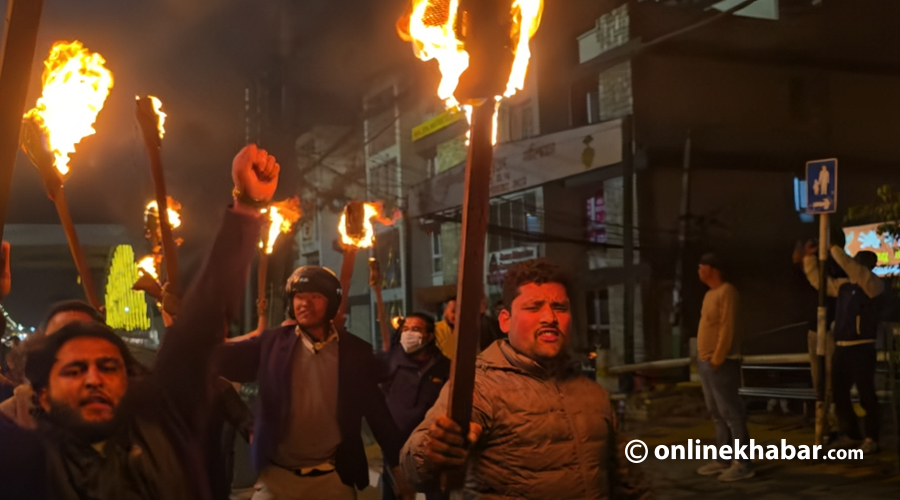
14 Chaitra, Kathmandu – The Youth Union, a mass organization linked to the Communist Party of Nepal (Unified Marxist-Leninist), organized a torch rally in Kathmandu.

The rally was held in the Bijulibazar area of Kathmandu, led by the Youth Union’s leaders and activists.

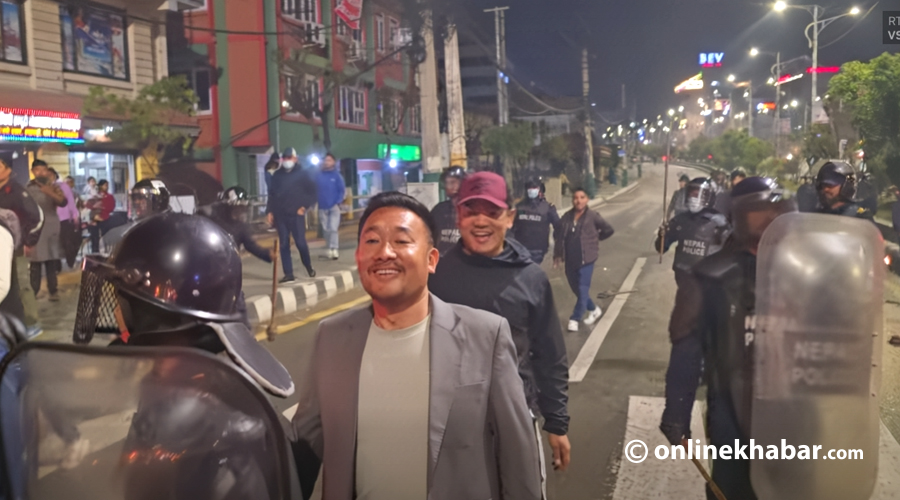
On Saturday afternoon, various organizations affiliated with UML protested the arrest of party chairman KP Sharma Oli. UML activists also demonstrated in the Maiti Ghar-Babar Mahal area and announced plans to continue the protests tomorrow.

Leaders of the Youth Union have stated that the demonstrations starting tomorrow will be even more aggressive.

The Genji movement took place on 23rd and 24th Bhadra last year and was suppressed.

At that time, KP Sharma Oli was the prime minister and Congress leader Ramesh Lekhak was the home minister. These protests were initiated by UML in response to their arrests.

कोहली र पडिक्कलको अर्धशतकमा बेंगलुरुको शानदार विजयी सुरुवात

Kohli and Padikkal’s Half-Centuries Propel Bangalore to a Spectacular Winning Start

News Summary

Compiled and Edited.

  • In the opening match of IPL 2026, Royal Challengers Bangalore defeated Sunrisers Hyderabad by 7 wickets.
  • Bangalore chased down a target of 202 runs in just 15.4 overs, registering the fastest chase of over 200 runs in IPL history.
  • Virat Kohli remained unbeaten on 69, while Devdutt Padikkal scored 61 and captain Rajat Patidar contributed an aggressive 31 runs.

Kathmandu, Chaitra 14 – Opening the Indian Premier League (IPL) 2026 on Saturday, defending champions Royal Challengers Bangalore made a victorious start, thanks to half-centuries by Devdutt Padikkal and Virat Kohli along with an aggressive innings from captain Rajat Patidar.

At their home ground, M. Chinnaswamy Stadium, Bangalore defeated Sunrisers Hyderabad by 7 wickets. They successfully chased down the robust target of 202 runs in just 15.4 overs, marking the fastest IPL chase over 200 runs.

Virat Kohli anchored the chase with an unbeaten 69 runs off 38 balls, displaying 5 fours and 5 sixes. Padikkal contributed 61 runs from 26 balls, including 7 fours and 4 sixes. Captain Rajat Patidar played an attacking cameo, scoring 31 runs off 12 balls.

For Hyderabad, David Payne took 2 wickets, while Jaddu Unadkat and Hrush Dubey claimed one wicket each.

Having lost the toss, Hyderabad elected to bat first and posted 201 runs for 9 wickets in 20 overs. Captain Ishan Kishan was the top scorer with 80 runs off 38 balls, while Aniket Verma made 43 runs from 21 balls. Heinrich Klaasen contributed 31 runs.

At one stage, Hyderabad was struggling at 29 for 3, but Kishan and Klaasen rebuilt the innings with a 97-run partnership. Klaasen was dismissed by a stunning catch from Phil Salt, who also took the catch to send the set batsman Kishan back to the pavilion.

For RCB, Jacob Duffy was the most successful bowler, taking 3 wickets for 22 runs in 4 overs. Romario Shepherd also took 3 wickets but was expensive, conceding 54 runs in 4 overs. Bhuvneshwar Kumar, Abhinandan Singh, and Suyash Sharma chipped in with one wicket each.

Discussion Held on Expanding Capacity of Dashrath Chand Health Science University


Chaitra 14, Kathmandu – A discussion was held regarding the expansion of capacity at Dashrath Chand Health Science University.

The meeting included Education, Science and Technology Minister Sashmit Pokharel, Member of Parliament KP Khanal, the university’s Vice Chancellor, Registrar, and other team members, concluding with a focus on elevating the university’s overall standards.

It was decided to enhance the hospital’s capacity by increasing the number of beds from 100 to 300, aiming to provide more effective services.

A plan was developed to secure a necessary budget of NPR 2.58 billion for launching new academic programs. Preparations are underway to run 50 seats for the MBBS program, 30 for Nursing, 20 for BSc MLT, and 20 for Ophthalmology starting from the upcoming academic session.

Since the approved budget of NPR 430 million is currently stalled due to the Senate meeting not being convened, there was an agreement to coordinate with the Ministry of Education to hold the meeting soon and facilitate the prompt use of these funds.

संघीय मन्त्रालयको संख्या घटाएर १७ वटा बनाउने – Online Khabar

Number of Federal Ministries to be Reduced to 17


Chaitra 14, Kathmandu – The government is preparing to reduce the number of federal ministries to 17.

This plan to downsize ministries has been introduced as part of the government’s announced administrative reform program.

“Due to the excessive number of ministries leading to an increase in operational costs, a decision will be taken within 30 days to reduce the number of ministries. The current Nepal Government (Work Division) Rules will be amended to maintain 17 federal ministries,” the government’s agenda stated.

This agenda was approved during the first cabinet meeting led by Prime Minister Balendra Shah.

Additionally, the agenda mentioned that during the review of the number of ministries, if there is a need to manage existing posts, promotions will be handled in a manner that does not affect service delivery.

Federal Civil Service Bill to Be Drafted Within 45 Days, Aiming to Depoliticize Teachers and Employees


March 28, Kathmandu – The government led by Balendra Shah has announced a 100-point agenda for administrative reform that includes drafting the Federal Civil Service Bill within 45 days. The agenda, released on Saturday, emphasizes making employees, teachers, professors, and all civil servants free from party affiliations, with the bill to be formulated within this timeframe.

“Public administration will be completely freed from political interference to become impartial, neutral, and accountable to citizens,” the agenda states. “To achieve this, civil servants including administrators, teachers, and professors will be required to have no direct or indirect associations with any political party, group, or interest center. Any violations will be subject to strict departmental action in accordance with existing laws.”

The agenda also highlights abolishing partisan trade unions within public administration to eliminate unwanted interference and informal pressure, thereby enhancing decision-making and service delivery effectiveness. “Legal arrangements necessary for this, particularly the Federal Civil Service Bill, will be drafted within 45 days,” the agenda notes.

Further, addressing existing issues such as corruption, delays, and disrespectful behavior towards service recipients, the agenda commits to transforming the bureaucracy into a responsible, service-oriented, citizen-focused, and exemplary institution through the rigorous implementation of the employee code of conduct.

“Employees will be expected to uphold professional dignity and work in a manner that is impartial, neutral, and dedicated to effectively implementing government decisions, ensuring a conducive work environment,” the agenda adds.

सरकारले सार्वजनिक गर्‍यो शासकीय सुधारका सय कार्यसूची (पूर्णपाठ)

Government Releases 100-Point Agenda for Administrative Reforms (Full Text)


March 27, Kathmandu – The new government led by Balendra Shah (Balen) has unveiled a 100-point agenda aimed at administrative reform.

The cabinet’s first meeting, held yesterday, approved these action points.

However, these agendas had not been made public until now. They were released on Saturday evening.

What do the 100 points of administrative reform include?