Advertisement1200×100-inside-1

Author: space4knews

Home Minister Sudhan Gurung Resigns, Hands Over Ministry to Prime Minister

Home Minister Sudhan Gurung has resigned from his position on “moral grounds” amidst questions regarding the source of his assets. Elected as a member of the House of Representatives from Gorkha 1, Gurung stated on social media that he resigned “to ensure an impartial investigation related to issues concerning me and to avoid any conflict of interest while holding the position.”

Prime Minister Badendra Shah’s Press and Research Officer Deepa Dahal confirmed that Gurung met the Prime Minister on Wednesday to submit his resignation letter. According to her, the Prime Minister has temporarily taken charge of the Home Ministry. Gurung was appointed Home Minister on the very day the cabinet under Shah’s leadership was formed.

Following the public disclosure of his asset details, various questions arose about the sources of his income and investments. Gurung tendered his resignation on the 27th day after becoming a minister. He is the second person to resign from the current cabinet; Dipak Kumar Sah resigned within two weeks amid controversy over his wife’s appointment.

In a Facebook post, Gurung expressed, “Questions, comments, and public expectations raised from the citizens’ level regarding my shares and related matters have deeply concerned me. Morality is greater than any position for me, and there is no power greater than public trust.” Clarifying his resignation for an impartial investigation, he added, “If we truly seek change, everyone must stand on the path of truth, integrity, and self-purification.”

गृहमन्त्रालयको जिम्मेवारी प्रधानमन्त्री बालेनले सम्हाल्ने

Prime Minister Balen Shah Assumes Responsibility for the Ministry of Home Affairs

April 22, Kathmandu – Prime Minister Balen Shah has temporarily assumed responsibility for the Ministry of Home Affairs. This follows the resignation of Sudhan Gurung from the Home Minister position earlier today. The Prime Minister’s Secretariat announced that the responsibilities of the ministry will now be under the direct supervision of the Prime Minister.

Sudhan Gurung became embroiled in controversy after revelations surfaced about his business partnership with the contentious businessman Deepak Bhatt. Amid these allegations, Gurung demanded a fair investigation into the matter and subsequently tendered his resignation. This resignation comes just 26 days after the formation of the current government.

Questions regarding Gurung’s assets prompted him to meet the Prime Minister and submit his resignation. Earlier, he had disclosed his asset details publicly. However, concerns were raised over the unnatural nature of the disclosures, which led to additional examination of his investments, including those in microinsurance and other sectors.

Further scrutiny emerged when transactions involving donations received by the social organization ‘Hami Nepal,’ run by Gurung, were reportedly conducted through his personal accounts. This revelation increased pressure from various quarters to remove Gurung from his position. In the midst of this mounting pressure, Gurung resigned from his post on Wednesday.

Carlsberg Prioritizes Water Resource Conservation with a NPR 1 Billion Investment Plan in Nepal

Carlsberg Group, in partnership with WWF Denmark, is strengthening its focus on water resource conservation and sustainable water management in Nepal. The three-year plan, set to run from 2026 to 2028, aims to restore wetland areas and improve water availability. The company has committed to investing NPR 1 billion in Nepal, considering it a priority market, with an emphasis on sustainable development and strengthening local production.

Carlsberg has deepened its commitment to water resource conservation. Through collaboration with WWF Denmark, the company prioritizes sustainable water management, recognizing water as a crucial resource for the brewing industry. It is actively working on efficient water use, groundwater recharge, and wetland restoration. These initiatives are part of a strategic plan designed to ensure long-term environmental sustainability.

Under the 2026-2028 plan, Carlsberg aims to restore degraded wetlands and improve water supply across various regions of Nepal. This effort will contribute to maintaining long-term balance of water levels in rivers and streams. The program operates under the guidance of the WWF Water Risk Filter, which helps the company adopt a data-driven approach to identifying and managing water-related risks in its operations and supply chain. Nepal is strategically prioritized by Carlsberg as a key market. Recently, the company pledged an investment of NPR 1 billion, focusing on sustainable development, enhancing local production, and expanding long-term partnerships.

Congress Urges Release of Nepal Student Union Leaders Arrested During Protest at Singha Durbar

9 Baishakh, Kathmandu – The Nepali Congress has expressed concern over the arrest of Nepal Student Union (NSU) leaders who were detained while protesting inside Singha Durbar against the government.

Congress spokesperson Devaraj Chalise issued a statement highlighting the arrests made on Tuesday of NSU leaders Bhuvan Bhatt, Kumbharaj Deuba, Navin Bisht, Akash Devkota, Sushil Aidi, and Bishal B.C. He described the incident as a serious matter of concern.

“In a democratic system, freedom of speech and expression, the right to peaceful assembly, and the freedom to express dissent are fundamental rights of citizens,” the statement said. “Arresting and detaining citizens for exercising these rights raises significant questions about the core values of democracy, the rule of law, and the guarantee of civil liberties. The government’s approach of suppressing dissent through control and repression contradicts democratic principles and the spirit of the constitution.”

Congress has demanded the immediate and unconditional release of the arrested Nepal Student Union leaders.

Carex Plans Up to 30% Price Increase in Condom Production Amid Raw Material Shortages

Carex, the world’s largest condom manufacturer, is preparing to raise production prices by 30 percent or more due to raw material shortages caused by the Iran conflict. Carex CEO Go Mia Kiat stated that since the war began, production costs have significantly increased, and rising transportation expenses and delays have intensified market shortages.

The company reported that the war with Iran has exerted pressure on energy markets and the prices of daily consumer goods, while condom demand has surged by approximately 30 percent during this period of economic uncertainty. In an interview with Reuters and Bloomberg, Malaysia-based CEO Go Mia Kiat highlighted the notable increase in production costs since the conflict began.

Carex, which produces over 500 million condoms annually—including for globally renowned brands like ‘Durex’ and ‘Trojan’—has been affected by disruptions to oil supply caused by Iran’s threats to block shipments through the Strait of Hormuz following U.S. and Israeli airstrikes.

The company explained that lubricants, which are ammonia and silicone-based and essential for condom production, rely heavily on oil-derived materials, making prices vulnerable to the war’s impact. Specifically, condom demand rises by nearly 30 percent during times of economic crisis or uncertainty. CEO Kiat noted that individuals tend to use family planning methods more actively when facing fears of increased financial burdens amid uncertain futures and employment situations.

ट्रम्पले किन बढाए इरानसँगको युद्धविराम?  – Online Khabar

Why Did Trump Extend the Ceasefire with Iran?

News Summary

  • U.S. President Donald Trump has extended the ceasefire period with Iran, though no new deadline has been announced.
  • The Trump administration remains uncertain amid a lack of response from Iran, with indications of divisions within Iranian leadership.
  • Iran has demanded the lifting of the blockade, but Trump stated the Strait of Hormuz won’t reopen until a final agreement is reached.

April 21, Kathmandu – On Tuesday afternoon, U.S. President Donald Trump held a key meeting with his national security advisors at the White House to decide the next course of action regarding Iran.

The ceasefire period declared by Trump was about to expire, and Vice President JD Vance was on Air Force Two at Joint Base Andrews preparing to depart for Pakistan for the next round of talks. However, there was significant uncertainty within the Trump administration as no response had been received from the Iranian side.

Earlier, the U.S. had sent key points to Iran ahead of the next phase of negotiations. According to three officials, after several days without any reply, doubts grew about what progress could be achieved when Vice President Vance’s delegation departed for Pakistan.

During Tuesday’s White House meeting, Trump met with Vance, Secretary of State Marco Rubio, Secretary of Defense Pete Hegseth, Joint Chiefs Chairman Dan Keen, and CIA Director John Ratcliffe, but no communication was received from Iran. Officials had asked Pakistan’s chief mediator, Field Marshal Asim Munir, to deliver a response before Vance boarded the plane.

However, hours passed without any reply from Iran.

According to the three officials, Trump’s White House advisors believe the primary reason for the lack of response is internal disagreement within the Iranian leadership. This assessment is partially based on reports from the Pakistani mediators. The Trump administration suspects that there is no consensus among Iranian officials on complicated issues like uranium enrichment and stockpiles.

U.S. intelligence suggests that Iran’s new Supreme Leader, Mojtaba Khamenei, has not provided clear directives to his officials, who are left guessing. Mojtaba’s attempts to remain behind the scenes have complicated internal discussions.

Despite these challenges, one official indicated that a meeting between U.S. and Iranian negotiators could happen soon, though the timing and manner remain uncertain.

Without resuming military strikes, Trump decided to extend the ceasefire but did not set a new precise deadline. He noted on “Truth Social” that Iranian officials are “deeply divided.” He appears willing to continue seeking a diplomatic resolution to the conflict.

The failure of talks so far makes clear that Trump faces significant challenges in the negotiation process.

Iran has demanded the blockade be lifted before negotiations proceed, particularly the sanctions imposed on Iranian ports along the Strait of Hormuz by Trump. However, Trump has declared that the Strait of Hormuz will not reopen until a final agreement is reached.

During Tuesday afternoon’s meeting, Trump and his team decided to extend the ceasefire, which Pakistani mediators say was about to expire within hours. Trump expressed confidence that it would last until Wednesday evening. This extension provides Iran additional time, though guarantees of progress remain slim.

Officials say arrangements for immediate visits could be made if Iran reengages at the negotiating table. The closure of the Strait of Hormuz causes economic damage for both sides, which is expected to motivate a quicker resolution.

Pakistani mediators encouraged Trump to prolong the ceasefire. Trump extended it until a renewed negotiation proposal is received and a conclusion reached to the talks.

However, Iranian officials do not seem significantly influenced by this move.

Mehdi Mohammadi, a member of the Iranian negotiation team, said, “There is no point in Trump’s extension of the ceasefire. The losing side cannot impose conditions. Maintaining the blockade is like bombing, and resistance must be through military means.”

Trump’s announcement to maintain the ceasefire brought an end to an uncertain day, during which he had initially expressed hopes to bomb Iran again in the near future.

By not setting a new ceasefire deadline, pressures are reduced and Iran is given more time, though Trump’s advisors have privately warned this risks prolonging negotiations. Negotiators had anticipated a preliminary understanding to be reached this week, followed by discussions on finer points.

Critics warn that prolonging the talks could be a strategic maneuver allowing Iran more time to develop missile systems that would otherwise need to be disclosed.

Key issues such as uranium enrichment, stockpiling of highly enriched uranium, and the lifting of sanctions remain unresolved with Iran.

The feasibility of an agreement ultimately depends on the flexibility of conditions by both parties. Trump insists on no agreement comparable to the old ‘Joint Comprehensive Plan of Action’ (JCPOA), from which he withdrew in 2018, labeling it as a weak deal.

Trump has expressed great confidence in his negotiation skills and on Tuesday even claimed that if he were still president at that time, he could have won the war.

“I believe we will ultimately reach the best deal,” he said. “Fundamentally, they have no option. We have destroyed their navy and air force and targeted their leaders, which has made the situation complex.”

A few hours later, while honoring players in the ‘State Dining Room’, Trump maintained unusual silence regarding the war topic and avoided questions from reporters.


Top 8 Causes of Inferiority Complex in Children and How to Overcome Them

A child’s mental development largely depends on their social, familial, and school environments, with negative thinking often leading to feelings of inferiority. To prevent these feelings, parents, teachers, and society must create a positive environment and encourage the child.

The mental growth of a child is entirely influenced by their social, family, and school-related circumstances. If, at a young age, a child develops negative thoughts about themselves due to certain situations, they may suffer from an inferiority complex. This significantly impacts their self-confidence and can lead to future mental issues such as depression, anxiety, social isolation, and difficulties concentrating on studies. Helping a child overcome an inferiority complex can be challenging; therefore, it is crucial to maintain an environment around the child that is positive, trustworthy, and supportive, enabling them to retain their self-confidence.

While inferiority feelings may begin in early childhood, they can persist into adulthood, making it vital for parents, teachers, and society to recognize and address them promptly. The main causes of inferiority complex in children include high pressure from competition, improper evaluation methods, feelings of pressure, lack of equality, negative remarks and criticism, insecurity, unrealistic expectations, and physical weaknesses.

To free children from these feelings, collaboration among parents, teachers, and society is necessary. This is not an instant process but an ongoing one. Spending at least 20–30 minutes daily in quality time with the child, maintaining open communication, encouraging them to share their experiences, appreciating their efforts, identifying and nurturing their strengths, creating a positive environment, granting freedom and responsibility, and avoiding negative comparisons are all essential steps.

When children are raised in a positive and encouraging environment, their self-confidence and mental health improve significantly.

‘Witnesses of Time’ Photo Exhibition Set to Open in Nepalgunj

Journalist and photographer Jaynarayan Shah is set to hold a solo photo exhibition titled ‘Witnesses of Time’ on Jestha 11 and 12 in Nepalgunj. The exhibition will showcase significant moments of time, society, nature, and daily life through photography, aiming to highlight Nepali society and cultural heritage. The organizer, Antaral, invites the entire community, including artists, students, and the general public, with the goal of inspiring a new generation’s interest in photography and portraying a vivid image of society.

Organized and managed by Antaral, the ‘Witnesses of Time’ solo photography exhibition presents important snapshots of time, society, nature, and everyday life captured by Jaynarayan Shah. Scheduled for Jestha 11 and 12 in Nepalgunj, the exhibition intends to reveal scenes, characters, traditional clothing, culture, daily life, and nature within Nepali society through evocative images. The photographs on display are expected to offer viewers an immersive experience of the diverse dimensions of human civilization and natural environments.

‘Sometimes certain moments do not remain just memories; they become history,’ says journalist and photographer Jaynarayan Shah. ‘This exhibition is an effort to keep those moments alive.’ Over the past decade and a half, the country has witnessed various political events, shifting landscapes, numerous protests and conflicts, as well as hardships caused by earthquakes, blockades, the COVID-19 pandemic, and lockdowns. Photographer Shah has captured glimpses of all these periods.

‘During my travels, wherever I went, I preserved images of the local people’s lives, customs, traditional attire, settlements, nature, flowers, captivating scenes, and people I met along the way through my camera,’ Shah explains. ‘Now, I am sharing these photos through this exhibition.’ Antaral notes that the exhibition aims to foster greater interest in photography among the younger generation and present a lively portrayal of society’s realities. The organization warmly invites artists, students, media professionals, and the general public to experience these photographs, which tell stories of time, society, and memory.

US Imposes Sanctions on 14 Individuals and Companies to Pressure Iran

The US Department of the Treasury has imposed sanctions on 14 individuals and companies based in Iran, Turkey, and the United Arab Emirates. They are accused of involvement in the purchase and supply of arms and weapons parts to the Iranian government. Any assets found in the US or related to US citizens will be frozen, officials said.

April 22, Kathmandu – The US Treasury has sanctioned 14 individuals, companies, and aircraft located in Iran, Turkey, and the UAE. They are charged with facilitating the acquisition and delivery of weapons and weapon components to the Iranian government. This move by the US precedes President Donald Trump’s announcement to strengthen the ceasefire with Iran. Through these sanctions, the US aims to maintain economic pressure on the Iranian government. Assets linked to the sanctioned parties that are found within US jurisdiction will be immediately frozen, according to reports.

खाद्य वस्तुको गुणस्तर र स्वच्छता अनुगमन अब प्रदेश र पालिकाले गर्ने

Provincial and Local Governments to Oversee Food Quality and Hygiene Monitoring

The responsibility for directly monitoring the quality and hygiene of food products has now been assigned to provincial and local governments. The Ministry of Agriculture and Livestock Development is activating provincial and local bodies based on the Food Hygiene and Quality Act, 2081. The ministry has instructed local governments to appoint food inspectors according to their own laws and to establish systems for quality inspection.

From now on, provincial and local governments will be responsible for directly monitoring and regulating the quality and hygiene of food products. The Ministry of Agriculture and Livestock Development is mobilizing these bodies to actively oversee markets in line with the Food Hygiene and Quality Act, 2081. Provinces will inspect and regulate food products distributed within their territories, while local governments will supervise those sold within their own municipalities.

This decision by the ministry aims to effectively implement the provisions of the Act and ensure consumers’ health rights at the local level. To enforce this right, local governments are now authorized to appoint food inspectors according to their own laws. The ministry has also directed arrangements to appoint qualified individuals as food inspectors.

22-Year-Old Sanshri Shrestha Dies from Electric Shock in Tarkeshwar

In Tarkeshwar Municipality-10, Manmaiju Shivnagar Tole, 22-year-old Sanshri Shrestha died after suffering an electric shock. On Tuesday night, she was critically injured while checking a geyser at her home. She was taken to Shubham Hospital for treatment, but her condition worsened and she passed away, police reported. The incident occurred on the 9th of Baishakh in Kathmandu. Authorities are conducting the necessary investigation regarding the case.

How to Get Accurate Sleep Tracking from Your Apple Watch: 6 Essential Settings to Know

Editorial Review Summary. To use the Apple Watch as your primary sleep tracker, you must enable the ‘Track Sleep with Apple Watch’ setting in the iPhone’s Watch app. For accurate sensor readings, the watch needs to be properly fitted on your wrist with space for two fingers between the wrist and the watch. Enabling ‘Charging Reminders’ in the Watch app’s ‘Sleep’ section will alert you to charge your watch before bedtime. Kathmandu, April 21 — The Apple Watch offers many features, including workout tracking and walkie-talkie functionality. One of its key capabilities is monitoring your sleep schedule. If you want precise insights about your sleeping habits, health, and recovery, these six settings are crucial:

  1. Enable Sleep Tracking. The first and foremost step is to ensure your Apple Watch is set as your main sleep tracker. Open the Watch app on your iPhone, go to the ‘My Watch’ tab, tap on ‘Sleep,’ and turn on ‘Track Sleep with Apple Watch.’
  2. Proper Watch Fit. The watch should neither be too loose nor too tight on your wrist. The sensor needs good skin contact to provide accurate results. Ideally, there should be space for two fingers between your wrist and the watch.
  3. Turn On Wrist Detection. If this setting is off, the watch will not record your heart rate during sleep, making it impossible to accurately detect sleep stages.
  4. Check for Sleep Apnea and Oxygen Levels. This feature is particularly useful for individuals experiencing breathing issues during sleep. It alerts you if your blood oxygen levels drop significantly.
  5. Set Charging Reminders. To track sleep through the night, your Apple Watch needs at least 30% battery. Enable charging reminders to ensure your watch charges and sleep tracking is not interrupted by battery depletion.
  6. Enable Temperature Tracking. Apple Watch Series 8 and later models include sensors to measure body temperature. This helps monitor your health and sleep patterns. To view the data, open the ‘Health’ app on your iPhone, go to ‘Body Measurements,’ and check the ‘Wrist Temperature’ section.

Additionally, use the ‘Sleep Focus’ mode to promote better and more consistent sleep. This mode silences unnecessary notifications during sleep hours, helping you enjoy a peaceful and restful night.

Impact of the Iran Conflict: Condom Prices Surge Amid Raw Material Shortage, Says World’s Largest Manufacturer

Carrex company CEO Go Mia Kiatt holding a condom

Image source, Reuters

The CEO of Carrex, the world’s largest condom manufacturer, has announced that due to disruptions in raw material supply caused by the Iran conflict, the prices of their products are expected to rise by at least 30 percent.

Go Mia Kiatt, Chief Executive Officer of Carrex, told the media that production costs have surged abruptly since the onset of the conflict.

Based in Malaysia, Carrex produces over 500 million condoms annually.

The company supplies condoms to renowned brands such as ‘Durex’ and ‘Trojan’, as well as to the UK’s National Health Service (NHS).

Kiatt shared insights on potential condom price increases during interviews with Reuters and Bloomberg. Further communication has been established with Carrex.

वैदेशिक रोजगार व्यवसायी संघमा विवाद चर्किँदै, अध्यक्षलाई सोधियो स्पष्टीकरण

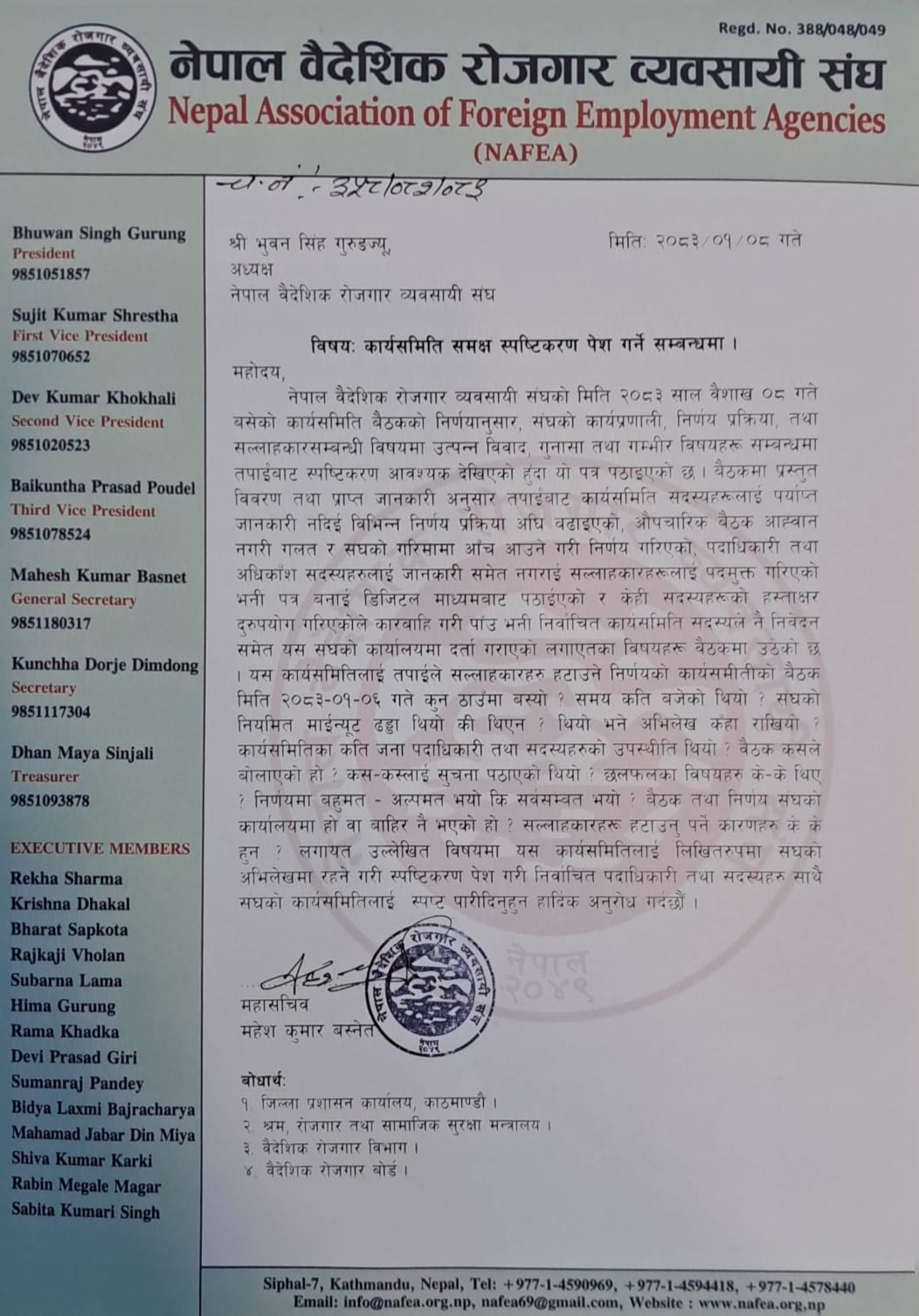
Dispute Escalates in Foreign Employment Entrepreneurs Association; Chairman Asked for Clarification

News Summary

After editorial review.

  • Dispute intensifies between Chairman Bhuvan Singh Gurung and General Secretary Mahesh Basnet at the Nepal Foreign Employment Entrepreneurs Association.
  • General Secretary Basnet and executive committee members have sought clarification regarding the decision to remove the chairman’s advisors.
  • Chairman Gurung has denied the allegations as baseless and misleading, stating the association is operating according to its rules and regulations.

April 21, Kathmandu – Tensions within the Nepal Foreign Employment Entrepreneurs Association are escalating rapidly. A dispute between the chairman and key officials, including the general secretary, has taken on a critical tone. General Secretary Mahesh Basnet along with some executive committee members have formally requested clarification from Chairman Bhuvan Singh Gurung.

Earlier, Chairman Gurung removed two advisory members from their positions. This move has divided the association members into two factions, each accusing the other of misconduct.

At a meeting held on Wednesday, the group led by General Secretary Basnet demanded an explanation from Chairman Gurung. The clarification sought pertains to the association’s work procedures, decision-making processes, and controversies surrounding the advisors, as well as complaints and serious questions that have arisen.

The chairman faces accusations of advancing decisions without informing the executive committee members, bypassing formal meetings by making informal decisions, and disregarding notifying all officials and members about certain decisions.

The dismissal of the advisors has become a focal point of the controversy. The executive committee particularly requested detailed clarification regarding the meeting reportedly held on April 19, 2026 (Baisakh 6, 2083 BS): the location, timing, how the meeting was conducted, official records, number of attendees, notification procedures, topics discussed, and whether the decisions were made by majority vote or unanimous consent.

Furthermore, the committee asked for explanations on why and how the advisors were removed and the rationale behind this decision. They have formally asked Chairman Gurung to submit comprehensive written responses on all these matters.

General Secretary Basnet criticized Chairman Gurung for removing the two advisors without any prior information, asserting that this action contravenes legal provisions. Basnet said, “Members of the association have repeatedly warned that he has been working solely for his personal and institutional interests. The chairman’s arbitrary approach is why this clarification was demanded.”

On the other hand, Chairman Gurung dismissed the allegations as unfounded, misleading, and orchestrated deliberately. He urged entrepreneurs not to fall for such rumors.

Affirming that the association functions fully in accordance with its laws, regulations, and institutional procedures, he stressed, “The clear majority of the executive committee supports our position, so these activities will have no impact on the organization.”

Gurung emphasized that his leadership has always been focused on protecting the rights and interests of foreign employment entrepreneurs, upholding the dignity of the profession, and developing transparent systems.

Pedestrian Killed in Gaindakot After Being Hit by Government Vehicle

A pedestrian lost his life after being struck by a government-registered vehicle in Gaindakot, located on the East-West Highway in Eastern Nawalparasi. The incident involved a Tata Sumo vehicle with license plate number Ba 2 Jh 3854, which hit 47-year-old Shyam Bahadur Bhujel from Bharatpur Metropolitan City–25 late last night. The vehicle and its driver have been taken into police custody as authorities conduct a thorough investigation.

The vehicle was traveling from Gaindakot towards Kawasoti when it struck Shyam Bahadur Bhujel of Bharatpur Metropolitan City–25 in Chitwan. According to Deputy Superintendent of Police Yuvraj Khadka from Eastern Nawalparasi, Bhujel sustained serious injuries and later died during treatment.

Police have confirmed that the vehicle and driver involved in the accident remain in custody as the investigation continues. The vehicle was reportedly moving at high speed, and a carton of beer was found inside. Authorities have identified the vehicle as belonging to the Controller and Auditor General’s Office (COANIK).

Eyewitnesses reported that the vehicle was traveling at high speed, traveling in one lane and only coming to a stop about 100 meters ahead in another lane. Upon receiving information about the accident, the Armed Police Force, Nepal Police, and local residents promptly carried out rescue efforts. The injured were immediately transported to Bharatpur in Chitwan for medical treatment. It remains unclear whether there were other occupants in the vehicle at the time of the crash.