Author: space4knews

Iran’s Cluster Bomb Attacks Devastate Israeli Cities; Israel Retaliates with Missile Strikes in Tehran


March 23, Kathmandu – On Sunday night, Iran launched cluster bomb attacks on multiple cities in Israel.

On the 24th day of the ongoing conflict between the United States, Israel, and Iran, Iran targeted various cities including Israel’s capital, Tel Aviv, with cluster bombs.

Approximately 15 people were injured in the attacks, with one individual in critical condition. Additionally, numerous homes and roads sustained damage.

In immediate response on Monday, Israel conducted missile strikes in Tehran, the capital of Iran.

Meanwhile, Israeli Ambassador to the United States, Yechiel Leiter, stated that Israel will continue its military operations against Iran “until they are brought to their knees.” He emphasized, “Israel cannot coexist with a country that continuously attacks it.”

Conversely, Iranian President Masoud Pezeshkian declared that any attacks will be met with battlefield retaliation. He warned that if Iran’s nuclear facilities are targeted, the Strait of Hormuz will be closed, a move that would significantly impact global oil supplies.

Simultaneously, according to a report published by Axios, a team associated with former U.S. President Donald Trump is seeking to negotiate a ceasefire with Iran. Senior advisors Jared Kushner and Steve Wittkoff are actively involved in these efforts.

However, Iran has stipulated conditions for negotiations: a halt to the war, reparations for incurred damages, and clear guarantees against any future attacks.

On the other hand, Trump has indicated he is not yet prepared to agree to all of Iran’s terms, particularly expressing opposition to the demand for reparations. Direct negotiations between the U.S. and Iran have not occurred, but nations such as Egypt, Qatar, and the United Kingdom are playing mediating roles.

The United States is seeking Iran to temporarily suspend its missile program, cease uranium enrichment, and close nuclear facilities. Additionally, Trump insists that Iran cut off financial support to Hezbollah and Hamas as part of the conditions.

Congress General Secretary Paudel Demands Public Release of Investigation Report on Janajati Movement

News Summary

  • Pradip Paudel, General Secretary of Nepali Congress, has demanded the government publicly release the investigation report on the Janajati movement incidents.
  • The commission led by Gauribahadur Karki submitted the report to the government on February 7 but it has not yet been made public.
  • Paudel described the secrecy surrounding the report as ironic and said it has raised numerous suspicions.

March 22, Kathmandu – Pradip Paudel, General Secretary of the Nepali Congress, has urged the government to publicly release the investigation report on the Janajati (JENJI) movement incidents. He made the appeal on Monday morning via his Facebook account.

“The Nepali Congress has already demanded the release of the report at the Central Working Committee meeting,” Paudel wrote. “I again request this outgoing government to fulfill its responsibility by releasing the report as soon as possible.” The Nepali Congress Central Working Committee, at its meeting on March 21, had decided to demand the report’s disclosure.

The commission headed by Gauribahadur Karki investigated the events that took place during the Janajati youth movement on September 8 and 9. The commission submitted its report to the government on February 7 this year. On the same day, commission member and spokesperson Bijanraj Sharma told the media that this report would not suffer the same fate as the earlier Mallik and Rayamajhi commission reports.

The Cabinet meeting held on March 14 accepted the report. Following the meeting, Home Minister Om Prakash Aryal told reporters, “The report will come out tomorrow,” but as of now, it remains unpublished. Leaders of the Janajati movement and the Accountability Monitoring Group have been pressuring the government to make the report public.

“Secrecy is an irony”

Although demands for the report’s disclosure have been growing, it remains unpublished—an irony highlighted by General Secretary Paudel. He pointed out that the interim government’s tenure is ending, and failing to release the report before leaving office reflects a neglect of responsibility. He stated, “Publishing the report submitted by the commission is the government’s duty and responsibility. Keeping it secret like previous commissions’ reports is an irony.”

Paudel also noted that the interim government’s failure to publicize the investigation report has raised numerous questions. “What issues have prevented the release of the Karki commission’s report? Why is it not being made public? These are pressing questions,” he wrote.

तोलामा साढे ६ हजार रुपैयाँ घट्यो सुन, एक सातामै ३४ हजार सस्तियो

Gold Price Drops by Rs 6,500 Per Tola; Falls by Rs 34,000 in One Week

News Summary

Editorially Reviewed.

  • The Nepal Gold and Silver Traders Association has set the gold price at Rs 275,500 per tola for Monday.
  • The gold price has dropped by Rs 34,000 within a week; it reached Rs 339,300 per tola on Magh 15 (January 29).
  • The conflict in West Asia has led to a rise in oil and US dollar prices, causing a decline in gold and silver prices.

9 Chaitra, Kathmandu – On Monday, the price of gold declined by Rs 6,500 per tola. It had dropped by Rs 12,500 the previous day.

The Nepal Gold and Silver Traders Association fixed the gold price at Rs 275,500 per tola for Monday.

The previous day’s price stood at Rs 282,000 per tola. Over the span of one week, gold has lost Rs 34,000 in value.

Last Monday, gold was traded at Rs 309,500 per tola, and on Magh 15 (January 29), it reached an all-time high of Rs 339,300 per tola.

The escalating conflict in West Asian countries has caused oil prices to soar, leading countries to require more US dollars for purchases. This increase in dollar demand has driven the US dollar’s value higher. International media report that the greater amount of dollars collected through gold sales has caused a significant drop in gold prices.

Globally, the spike in oil prices has triggered inflationary pressures, prompting calls for interest rate hikes worldwide. This has put additional downward pressure on gold and silver prices.

On Monday, silver prices dropped by Rs 115 per tola. The previous day, silver traded at Rs 4,540 per tola but slipped to Rs 4,425 per tola on Monday.

Over the week, silver prices declined by Rs 840 per tola. Last Monday, silver was traded at Rs 5,265 per tola, while on Magh 15 it had peaked at Rs 7,505 per tola.

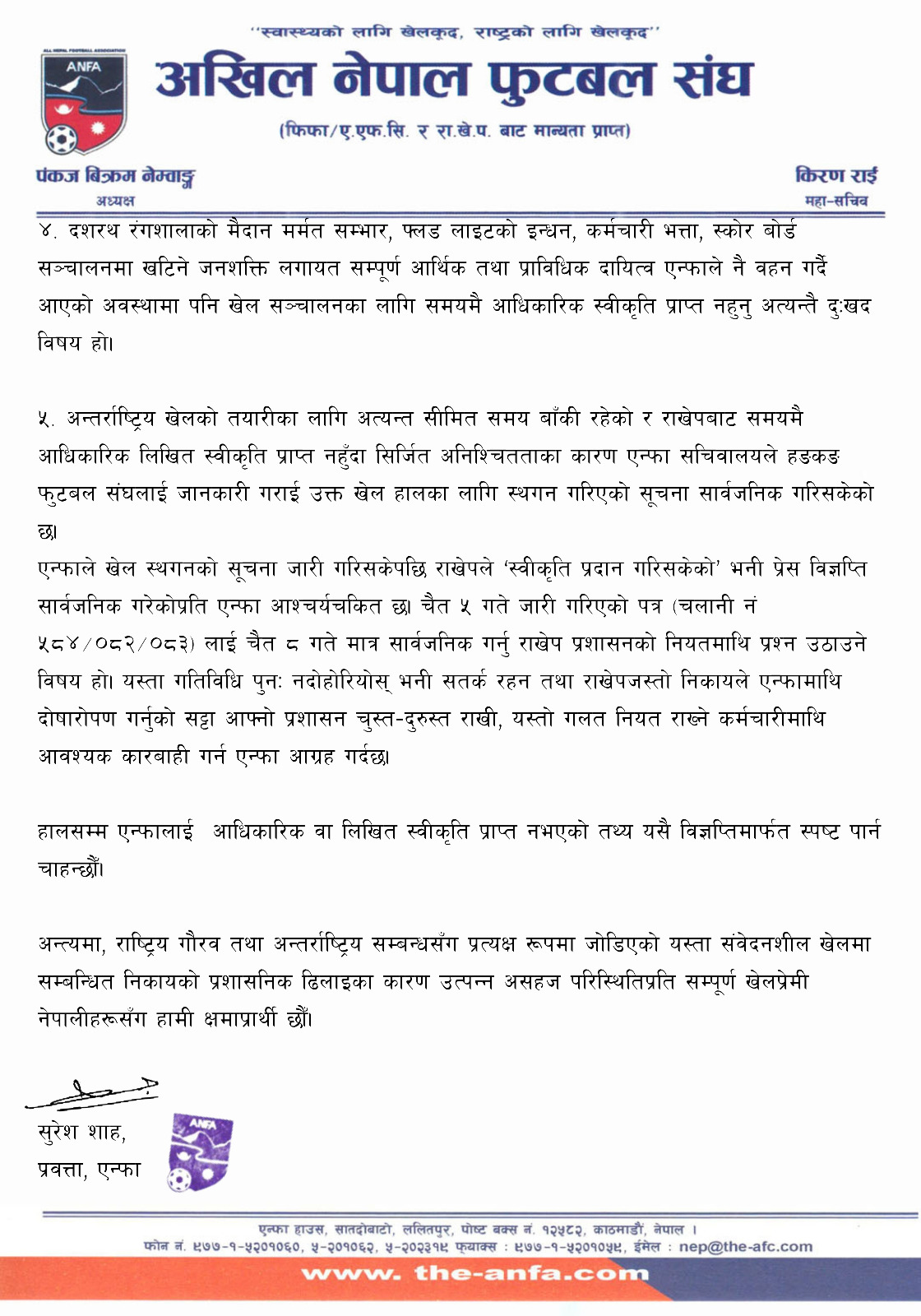
ANFA States No Approval Received from RAKHEP for Nepal-Hong Kong Match

Despite ANFA officials being present at the RAKHEP office from the morning until afternoon of Chaitra 5, no written approval was granted, according to ANFA.

Chaitra 9, Kathmandu – The All Nepal Football Association (ANFA) has clarified that it has not received any official approval from the National Sports Council (RAKHEP) for the international friendly football match scheduled between Nepal and Hong Kong on Chaitra 12.

In a statement released Monday morning, ANFA asserted that it failed to secure timely approval for the maintenance of Dashrath Rangasala Stadium and other necessary clearances.

Earlier, on Sunday afternoon, ANFA had announced that the match between Nepal and Hong Kong was canceled due to RAKHEP not making the Dashrath Rangasala available.

Furthermore, Nepal had informed the Hong Kong Football Association through a letter that the game was canceled due to political tensions in Nepal. However, on Sunday evening, RAKHEP refuted ANFA’s claims, stating that approval for the use of Dashrath Rangasala had been granted on time and accused ANFA of spreading misinformation. The following day, ANFA issued another statement countering RAKHEP’s letter.

According to ANFA, a request for the necessary approvals and use of Dashrath Rangasala was sent to RAKHEP on Magh 10, which was officially registered on Magh 11. Yet, no written permission was received for a prolonged period.

Despite repeatedly seeking clarification from relevant RAKHEP officials, ANFA claims they received no clear response. Even on Chaitra 5, with ANFA staff present at the RAKHEP office from morning till afternoon, written approval was not provided.

ANFA stated that it has been solely bearing all financial and technical responsibilities related to the maintenance of Dashrath Rangasala, including floodlight fuel, staffing, and other arrangements, making the lack of timely approval a regrettable incident.

Following ANFA’s announcement to postpone the match, it expressed surprise over RAKHEP’s subsequent press release claiming to have granted approval. ANFA also questioned RAKHEP’s intentions, noting that the letter dated Chaitra 5 was only made public on Chaitra 8.

ANFA reiterated that it has yet to receive any official or written approval and apologized to football fans nationwide for the circumstances caused by administrative delays.

The conflict between RAKHEP, the executive body for sports, and ANFA, Nepal’s largest sports organization, has intensified after RAKHEP refused to grant approval for ANFA’s early elections scheduled on Chaitra 13 in Jhapa.

The standoff between the two organizations, which began on Sunday, continued into Monday. While opposing teams compete to score goals on the football field, a contrasting confrontation is unfolding outside between RAKHEP and ANFA.


US Issues New Security Alert for Citizens Worldwide Amid Middle East Tensions


March 23, Kathmandu – In light of the ongoing tensions in the Middle East, the US Department of State has issued a new security alert for its citizens residing around the world.

The State Department appealed on the social media platform X, stating, “We urge our citizens worldwide, especially those living in the Middle East, to remain extra vigilant.”

The alert notes, “There may be intermittent closures of air routes, potentially disrupting travel. Additionally, US embassies outside the Middle East have also been targeted.”

The Department further warned, “Groups supported by Iran might target locations abroad associated with the US and its citizens.”

Three Possible Ways the Universe Could End

Video caption begins,

How Might Our Universe Come to an End?

What will happen to the universe in the future? This remains one of the most challenging and mysterious questions in science. Experts acknowledge that there are far more questions than answers on this topic.

Possibly, long after humanity has become extinct, the universe itself may one day come to an end.

Scientists have not yet reached a definitive conclusion on how the universe will end. However, several theories have been proposed on the subject.

Watch this video to learn more.

We also offer science-related content on our YouTube channel. To watch our latest videos and subscribe to the channel, click here. You can also follow us on Facebook, Instagram, and Twitter. Additionally, the Nepali service programs can be heard on the radio from Monday to Friday at 8:45 PM.

How Will Nepal Communist Party Discipline Unrecognized Central Members?

News Summary

Reviewed.

  • Pushpa Kamal Dahal Prachanda, Coordinator of the Nepal Communist Party, has issued a warning to central members who voted for Rastriya Swatantra Party (Raswapa) during the elections, threatening disciplinary action.
  • Although the Nepal Communist Party contested the election by uniting 25 groups, it secured only 17 seats.
  • The party is preparing to hold a review meeting and reorganize its structure in the near future.

March 23, Kathmandu – The latest remarks by Nepal Communist Party Coordinator Pushpa Kamal Dahal Prachanda regarding the election results have drawn considerable attention both within the party ranks and across the national political landscape.

At an event held last Friday at the party’s central headquarters in Parisdanda, Prachanda issued a strong warning, threatening disciplinary action against central members who reportedly voted for the Rastriya Swatantra Party (Raswapa).

The event, attended by leaders from affiliated organizations, also saw the former Prime Minister Prachanda presenting the party’s future roadmap. Yet the main focus of concern was his threat of disciplinary measures against those central members who allegedly supported Raswapa.

“Action will begin, starting right from the central members. Reports have surfaced that some central members voted for Raswapa,” Prachanda stated, “Bring us concrete evidence—who did not campaign in their area? Who was seen voting for Raswapa? We will take decisive action against them.”

Given the election outcome where the party, formed through the unification of 25 parties or groups, won only 17 seats, many leaders naturally focus on Prachanda’s warning. “The unity campaign was run with a clear objective, and many leaders were aligned under it. The results, however, were not as expected,” a senior leader commented. “Without serious review, moving forward is not feasible. The message from the party coordinator must be taken seriously.”

The Nepal Communist Party, which united roughly two dozen groups including the CPN (Maoist Centre) and CPN (Unified Socialist), boasts an array of top leaders. Former Prime Ministers Prachanda, Madhav Nepal, and Jhalnath Khanal are part of the leadership, alongside numerous former Deputy Prime Ministers, Home Ministers, and Cabinet members.

These leaders, based on their unity, had indicated intentions to lead or actively participate in government formation after the elections. However, the Rastriya Swatantra Party won close to a two-thirds majority independently.

Preparations Underway for a Review Meeting

This election result almost certainly marks the end of Prachanda’s continuous presence in power since participating in the interim government of 2006 (2063 BS).

With the party limited to 17 seats—eight in the direct election and nine proportional—the Nepal Communist Party now faces a difficult situation. Even if Raswapa faces internal crises, seeking to lead government formation could prove a major challenge.

“The expected result did not materialize. Now, we will move forward with a review and organizational restructuring plan,” stated leader Dr. Beduram Bhusal. “A review meeting will likely convene soon.”

However, leaders remain unclear about which specific committee will hold the meeting. “It could be the coordination committee or the secretariat,” Bhusal added. Yet, membership for both committees has yet to be finalized.

Only Prachanda and Madhav Nepal have confirmed leadership roles within the Nepal Communist Party. As coordinator and co-coordinator respectively, they have been central decision-makers. For the February 21 election, the party submitted a list of 138 central members to the Election Commission, but leaders clarify this was a technical list only.

Uncertainty Surrounds Central Members’ Identities

During the party formation process, a proposal existed to create a secretariat of 125 members, alongside a coordination committee comprising top leaders. However, decisions regarding the individual members have yet to be made.

“As the unification drive dragged on and more leaders joined, no clear designation or committee assignments were established,” a former official explained. “The coordinators and co-coordinators lose track of some group leaders.”

This means the party has not finalized even the executive leadership composition, which explains why Prachanda issued the disciplinary warning. Yet many within the party tend to interpret his threat as a political statement rather than a concrete measure. “If there is proof of someone responsible for the election campaign supporting another candidate, then that person should reconsider their party responsibilities. But it is unlikely there will be a witch-hunt to find out exactly who voted for Raswapa,” another leader remarked.

A major issue remains the lack of clear identification of central members within the party. Although plans were set to enroll 2,500 members as central leaders, many remain unfamiliar even among themselves. During the unification of eight groups, central member oaths were taken virtually since not all could be present at the Parisdanda headquarters.

Thus, rather than hunting down individuals for discipline, leaders emphasize the need for a comprehensive review of the election defeat. “It is not about who voted or did not vote, but fundamentally why the party lost,” they said. “We must assess why we failed to effectively educate society.”

Leadership Must Take Responsibility for Party’s Defeat

Leaders believe that disciplining some members based on suspicion or proof will not break the party. Instead, the root cause of defeat should be found within the leadership ranks. “Comrade Prachanda himself confused workers by making contradictory remarks during the election,” one leader said. “Statements about possible alliances with Congress, CPN-UML, or Raswapa left workers baffled.”

One candidate from the party noted that Prachanda’s comments did not create a conducive environment for unity. “When Prachanda said it might be possible to join forces with Balen tomorrow, many undecided voters may have cast their ballots for Raswapa—or at least that is what happened,” he added.

Ashesh Ghimire, candidate from Jhapa-1, urged focusing on party-level issues rather than blaming individual setbacks for the electoral defeat. “Communists have enjoyed majority support for decades, but landless peasants have not benefited materially. Only the party has changed; the leadership rhetoric is the same,” Ghimire remarked. “The Communist Party needs a serious introspection to understand why the election outcome was unfavorable.”

According to his analysis, the election marked a defeat for Marxism, with postmodernist ideologies prevailing. “When Communist parties distance themselves from class-based ideology, it opens the door to postmodernist attacks,” Ghimire said. “This weakens organizational and collective power, elevates individual glorification, and ultimately impacts election results.” He suggested that failing to understand the attacks from forces who formed parties in opposition to traditional parties may be at the core of this problem and must be investigated.

Iran Threatens Full Closure of Hormuz Strait Following Attack on Energy Facilities

The Islamic Revolutionary Guard Corps (IRGC) of Iran has warned that the Strait of Hormuz will be completely closed if there is an attack from the United States. Iranian Foreign Minister Abbas Araghchi stated that the Strait of Hormuz is not currently closed, but the behavior of the US and Israel has disrupted maritime traffic in the route.

Earlier, US President Donald Trump had issued a warning on March 21 that if the Strait of Hormuz was not reopened within 48 hours, power plants would be destroyed.

According to a statement released by Iranian media, the IRGC declared, “If there is an attack on Iran’s energy facilities, the Strait of Hormuz will be closed until the destroyed power plants are rebuilt.” The Strait of Hormuz, which connects Iran to the Persian Gulf, the Gulf of Oman, and the Arabian Sea, is the only maritime route linking these bodies of water. About 20 percent of the world’s petroleum products pass through this vital passage. Following attacks by the US and Israel, Iran has effectively blocked this route, causing supply disruptions and increasing global oil prices.

The IRGC also stated, “We will target power plants, energy sites, and IT infrastructure in Israel extensively. All American companies will be targeted.” Iranian Foreign Minister Abbas Araghchi emphasized, “The Strait of Hormuz is not closed. Insurance companies that cover oil tankers have become fearful of the so-called ‘war of choice,’ which was initiated by the US and Israel, not Iran.”

Araghchi further added, “Respect this. Without freedom of trade, freedom of passage through maritime routes has no meaning. Both sides must show respect; otherwise, no one should expect anything in return.” More than 160 people were injured near Israel’s nuclear facility at Dimona due to Iranian missile strikes. Since the Israeli air force launched an attack on Iran on February 28 with US support, Iran has reportedly launched around 400 missiles in retaliation.

Iran Conflict: Tehran’s Firm Response as Trump’s Deadline to Reopen Strait of Hormuz Nears

Strait of Hormuz

Photo source, Getty Images

Reading time: 3 minutes

US President Donald Trump has issued a 48-hour ultimatum to Iran to reopen the Strait of Hormuz, warning of severe military action if ignored; Tehran has responded with a firm stance.

Following Trump’s threat last weekend to target Iranian energy facilities, Tehran warned it will fully close the vital waterway should the United States follow through on its threats.

A senior Iranian commander declared that energy, oil, technology, and water treatment centers in the Gulf region are legitimate targets.

Iranian President Masoud Pezheshkian characterized the US threats as “desperation,” asserting they will strengthen national unity.

“Threats and terrorism only fortify our unity. Except for those who violate our land, the Strait of Hormuz remains open to all. We face dangers on the battlefield with unwavering resolve.”

Army Maintains Solo Lead with a Resounding Victory

News Summary

With Editorial Review.

  • In the Himalayan Java National Basketball League 2026, Army defeated Solo 103-68, securing their sixth win in seven games.
  • Army leads the standings with 13 points from 6 wins and 1 loss, followed by Times International, KVC Hounds, and Goldengate each with 11 points.
  • Eight teams are competing in the tournament, with the winner receiving a cash prize of 400,000 NPR, the runner-up 200,000 NPR, and the third-place team 100,000 NPR.

March 22, Kathmandu – In the Himalayan Java National Basketball League (HJNBL) 2026 game held on Sunday night, departmental team Army secured a commanding 103-68 victory over Solo Basketball Club.

This marks Army’s sixth win in seven games, which has helped them establish a solo lead at the top of the standings. Army has accumulated 13 points from 6 wins and 1 loss.

Following Army are Times International Club, KVC Hounds, and Goldengate, each with 11 points. Times and Goldengate have each played one game fewer.

Solo has suffered their fifth defeat in seven games and currently stands fifth with 9 points.

The match took place at the covered hall of Dashrath Rangashala in Tripureshwor, where Army dominated Solo. Army led the first quarter 24-15 and dominated the second quarter 33-11, establishing a commanding 57-26 lead by halftime.

In the third quarter, Army extended their lead to 83-45 with a 26-19 score. Although Solo performed better in the final quarter, outscoring Army 23-20, it was not enough to affect the outcome.

Army’s Nischal Maharjan scored the highest with 20 points, while Nukesh Jugjali was named Man of the Match.

Organized by the Nepal Basketball Association (NEBA), this is the second edition of the HJNBL featuring eight teams competing.

The league follows a double round-robin format with a total of 56 games. The top four teams after the league stage will qualify for the playoffs.

In the playoffs, the first and second place teams will compete in the first qualifier, while the third and fourth place teams will face off in an eliminator match.

The loser of the first qualifier and the winner of the eliminator will compete in the second qualifier. The final match will be between the winners of the first and second qualifiers.

The tournament winner will receive a cash prize of NPR 400,000, the runner-up NPR 200,000, and the third-place team NPR 100,000.

Additionally, the best player of the tournament will be awarded the Most Valuable Player (MVP) award along with attractive prizes, as announced by NEBA.

मनाइँदै विश्व मौसम दिवस, बढ्दो तापमानले बढ्दो संकट

World Meteorological Day Observed Amid Rising Crisis Due to Increasing Temperatures

News Summary

Prepared with editorial review.

  • Today, 9th Chaitra, the 76th World Meteorological Day is being observed worldwide including Nepal under the theme ‘Observation Today, Safety Tomorrow’.
  • According to ICIMOD’s report, the rate of snow and ice melt in the Hindu Kush Himalaya has increased by 65 percent, with a risk of losing 30 to 50 percent of snow by the end of this century.
  • The Ministry of Home Affairs of Nepal has released data showing that climate-induced disasters cause an average of 250 deaths and approximately NPR 2.9 billion in economic losses annually.

9 Chaitra, Kathmandu – Under the theme ‘Observation Today, Safety Tomorrow,’ the 76th World Meteorological Day is being observed globally, including in Nepal. Celebrated on the founding day of the World Meteorological Organization (WMO), this year’s event emphasizes the growing risks posed by climate change and the critical need for accurate early warning systems.

The day is given special significance due to the changing climate and its severe impacts on lives and property.

Unprecedented Crisis in the Himalayas

A recent report from the International Centre for Integrated Mountain Development (ICIMOD), based in Nepal, reveals alarming rates of snow melt in the Hindu Kush Himalayan region. Between 2011 and 2020, the rate of snow and ice melt increased by 65 percent compared to the previous decade, according to ICIMOD.

Experts warn that if this trend continues, by the end of the century, 30 to 50 percent of the snow in the mountains may disappear, threatening the river systems known as Asia’s water towers with drying up.

ICIMOD also highlights that rapid glacier melting places Nepal’s glacial lakes at high risk of bursting. Such events could endanger millions residing in downstream areas and pose threats to hydropower facilities at any time.

Data from Nepal’s Ministry of Home Affairs and the National Disaster Risk Reduction and Management Authority indicates that climate-related disasters cause enormous loss of life and property annually in Nepal. Floods, landslides, and lightning strikes lead to an average of 250 deaths each year. Over the last decade alone, more than 5,600 people have lost their lives.

Between 2012 and 2024, over 44,000 disaster events, both major and minor, have been recorded. These incidents have damaged more than 42,000 physical infrastructures including houses, schools, and bridges.

Nepal suffers an average annual economic loss of approximately NPR 2.9 billion due to these disasters, amounting to about 0.25 percent of the country’s Gross Domestic Product (GDP).

Extreme Weather Events

According to the World Meteorological Organization, 2025 has been the third warmest year on record. The Earth’s temperature has risen by 1.48 degrees Celsius compared to pre-industrial times. This has resulted in changes to monsoon patterns, with instances of both excessive rainfall and drought occurring. The Terai region faces heatwaves (locally called “Loo”), rising sea levels, and increased risks of major cyclones.

Therefore, the year’s theme underscores that effective early warning systems, which are accessible to all, are a key strategy for disaster risk reduction. Nepal has set a goal to provide “early warning for all” by 2027.

Officials from Nepal’s Department of Hydrology and Meteorology state that precise information provided through advanced radar and weather stations will assist farmers and the general public in staying safe. However, experts from organizations like ICIMOD emphasize that to curb rising temperatures, immediate action is required from major nations to reduce greenhouse gas emissions.

US Dollar Steady, Euro, Pound Sterling, and Australian Dollar Weaken


Chaitra 9, Kathmandu: According to the foreign exchange rates set by Nepal Rastra Bank for today, the US dollar remains stable while the Euro, Pound Sterling, and Australian dollar have depreciated slightly.

Similar to Sunday, the US dollar’s buying rate is NPR 149.64 and selling rate is NPR 150.24.

The Euro has seen a minor decline compared to yesterday. Today, the European Euro’s buying rate is NPR 173.12 and selling rate NPR 173.81, down from yesterday’s NPR 173.15 and NPR 173.84 respectively.

Likewise, the UK Pound Sterling’s buying rate today is NPR 199.66 and selling rate NPR 200.46, decreasing from yesterday’s NPR 200.38 and NPR 201.19 respectively.

Today’s rates also show a decline for the Swiss Franc and Australian Dollar.

The Swiss Franc’s buying rate is NPR 189.90 and selling rate NPR 190.66, slightly down from yesterday’s NPR 190.01 and NPR 190.77.

For the Australian Dollar, the buying rate is NPR 105.10 with the selling rate at NPR 105.52, both lower than yesterday’s NPR 105.89 and NPR 106.31.

Canadian Dollar Stable, Singapore Dollar Declines

The Canadian Dollar remains stable today with a buying rate of NPR 109.04 and selling rate of NPR 109.48, unchanged from yesterday.

The Singapore Dollar has decreased, with today’s buying rate at NPR 116.70 and selling rate NPR 117.16, down from yesterday’s NPR 117.01 and NPR 117.48.

Other rates are as follows: Japanese Yen (10 units) buying rate NPR 9.40 and selling rate NPR 9.44, Chinese Yuan buying rate NPR 21.73 and selling rate NPR 21.82, Saudi Arabian Riyal buying rate NPR 39.85 and selling rate NPR 40.01, and Qatari Riyal buying rate NPR 40.94 and selling rate NPR 41.11.

According to the central bank, rates for Thai Baht are NPR 4.55 (buying) and NPR 4.57 (selling), UAE Dirham NPR 40.74 and NPR 40.90, Malaysian Ringgit NPR 37.98 and NPR 38.14, South Korean Won (100 units) NPR 9.94 and NPR 9.98, Swedish Krona NPR 16.02 and NPR 16.08, and Danish Krona NPR 23.17 and NPR 23.27 respectively.

Additionally, the rates set by the Rastra Bank include Hong Kong Dollar buying rate NPR 19.10 and selling rate NPR 19.18, Kuwaiti Dinar buying NPR 488.06 and selling NPR 490.02, Bahraini Dinar buying NPR 396.34 and selling NPR 397.93, and Omani Riyal buying NPR 388.68 and selling NPR 390.23. Indian Rupees at 100 units have a buying rate of NPR 160 and selling rate NPR 160.15.

The Rastra Bank has noted that these exchange rates can be revised at any time if necessary. Commercial banks may offer different rates, and updated exchange rates are available on the central bank’s official website.

Bahrain, UAE, and Kuwait Issue Alerts Over New Missile and Drone Attacks


March 22, Kathmandu – Amid ongoing conflicts in the Middle East, several Gulf countries have issued warnings about missile and drone attacks.

According to reports, Bahrain, the United Arab Emirates (UAE), and Kuwait have all issued alerts concerning missile and drone threats originating from Iran.

Bahrain’s Ministry of Interior announced on social media, “Alarm sirens have been activated. We urge citizens to remain calm and proceed to the nearest safe location.”

The Ministry also requested that the public follow information provided by official sources.

Similarly, the UAE’s Ministry of Defense recently stated that the country’s air defense systems have been intercepting missiles and drones coming from Iran.

The Ministry claimed that the sounds reported could have been caused by efforts to intercept these missile and drone threats.

Kuwait’s military also confirmed that its air defense systems have recently engaged hostile missile and drone attacks.

The General Staff clarified that the explosion noises were a result of air defense actions to prevent enemy attacks.

Kuwait’s military has urged citizens to adhere to safety instructions issued by relevant authorities.

Strait of Hormuz: What Are the Alternatives to This War-Affected Maritime Route?

Is there an alternative to the Strait of Hormuz?

Amid the ongoing war in the Middle East, what are the alternatives to the Strait of Hormuz, which has been blocked?

To watch news updates and subscribe to our YouTube channel, please click here. You can also follow our content on Facebook, Instagram, and Twitter. Additionally, you can listen to the Nepali service program on the radio from Monday to Friday at 8:45 PM.