US President Donald Trump has claimed that Russia and Ukraine have agreed to a ‘fuel ceasefire,’ agreeing not to attack fuel and energy infrastructure. Ukrainian President Volodymyr Zelensky responded that he had no prior knowledge of such an agreement but that if Russia has consented, Ukraine is prepared to accept the ceasefire as well.
On Sunday, Trump posted on the social media platform Truth Social, stating, “An immediate and effective ‘fuel ceasefire’ (energy ceasefire) has been reached in the war between Russia and Ukraine. Both sides have agreed. No one should break this!” Following Trump’s sudden announcement, Zelensky replied, “This announcement is completely new to me. However, if President Trump has secured such an agreement with Moscow, please inform us when this ceasefire will commence. We are fully prepared to accept it if the Russians agree.”
Earlier, in an interview on ABC’s This Week, Zelensky had clearly stated that if Russia halted attacks on Ukrainian energy infrastructure, Ukraine would stop attacking Russian oil refineries. Trump’s claim comes amid rising diplomatic tensions between Ukraine and the Trump administration in recent days. On Friday, Trump announced easing restrictions on Russian diesel exports to reduce soaring global fuel prices, a move that drew strong objections from Ukraine.
This year’s Nobel Prize in Economics has been awarded to Robert Hall and Michael Woodford.
The Nobel Prize Committee announced that both economists are being honored for their groundbreaking research on the “microeconomic foundations of macroeconomic stability” and for developing new macroeconomic models.
According to the committee, the new macroeconomic models developed by them have significantly improved the effectiveness of policies aimed at stabilizing the economy.
“These models allow the smoothing out of economic fluctuations through financial and monetary policies,” the committee stated.
The Nobel Prizes are awarded annually in six different categories.
The announcements for winners in various categories began last Monday, and the full list of laureates is now complete.
Since 1969, the Nobel Committee has awarded the Economics Prize 58 times to individuals and institutions in recognition of their significant contributions.
The youngest laureate to receive the prize was Esther Duflo in 2019, who was 46 at the time.
Leonid Hurwicz holds the record as the oldest laureate in this category, receiving the award in 2007 at the age of 90.
Other Winners This Year
Image source, Getty Images
Caption, Nawantam Navi Pille is the 21st woman to receive the Nobel Peace Prize
Medicine: American psychologist and neuroscientist Karl Deisseroth along with his German colleagues Peter Hegemann and Georg Nagel were honored for their significant contributions in the field of optogenetics.
Physics: Francis Halzen, born in Belgium and teaching in the United States, was recognized for founding the ‘IceCube Neutrino Observatory’ and discovering high-energy neutrinos in space.
Chemistry: French scientist Henri B. Kagan and Japanese scientist Kenso Soai were honored for uncovering the mysteries of chemical asymmetry in living organisms.
Literature: Canadian N. Carson was recognized for their “bold and innovative work creating new forms of contemporary literature through engaging dialogue with classical traditions.”
Peace: South African Nawantam Navi Pille was honored for her contributions to peace and international law promotion.
2023: Claudia Goldin received the prize for distinctive studies on women’s roles in the labor market.
2022: Ben Bernanke, Douglas Diamond, and Philip Dybvig were recognized for their research on banking and financial crises.
2021: David Card was honored for contributions to labor economics, and D. Angrist along with Guido W. Imbens for work on causal relationships.
2020: Paul Milgrom and Robert B. Wilson received the award for improvements to auction theory and the development of new auction formats.
2019: Abhijit Banerjee, Esther Duflo, and Michael Kremer were awarded for their experimental approach to alleviating global poverty.
2018: William D. Nordhaus was recognized for integrating long-term economic analysis of climate change, and Paul Romer for technical advances in long-term macroeconomic analysis.
2017: Richard Thaler received the prize for contributions to behavioral economics.
2016: Oliver Hart and Bengt Holmström for contributions to contract theory.
2015: Angus Deaton was honored for analysis of consumption, poverty, and welfare.
The Nobel Prize Decision Process
Image source, Getty Images
Caption, The Nobel Prizes are awarded on December 10 in a special ceremony, which is also the anniversary of Alfred Nobel’s death.
The prizes in Physics, Chemistry, Medicine, Literature, and Economics are awarded in Stockholm, Sweden.
The Nobel Peace Prize selection takes place in Norway and is overseen by a five-member committee appointed by the Norwegian Parliament. The Peace Prize is awarded in Oslo.
Each laureate receives an original Nobel diploma, a Nobel medal, and a cash award of 11 million Swedish kronor.
In cases where multiple laureates are honored, the prize money is divided among them, and each winner is expected to give a speech.
The Nobel Prizes are presented on December 10, in a ceremony marking the anniversary of Alfred Nobel’s passing.
Due to a powerful El Niño, sea surface temperatures in the Pacific Ocean’s ‘Niño 3.4’ region reached 29.70 degrees Celsius in September, according to Copernicus.
Copernicus reported that last September, the global average surface temperature was 16.27 degrees Celsius, 1.63 degrees above pre-industrial levels.
Carlo Buontempo warned that due to the strong El Niño, monthly temperatures could remain more than 1.5 degrees Celsius above pre-industrial levels through 2027.
October 13 (Paris) – The European Union’s climate monitoring service announced that powerful El Niño conditions have driven Pacific Ocean sea surface temperatures in a key monitoring region to record highs last September. Scientists caution that global temperatures may set new records by 2027.
According to the EU’s Copernicus Climate Change Service, sea surface temperatures in the “Niño 3.4” region reached 29.70 degrees Celsius. This exceeds levels observed during the strong El Niño events of 1982–83, 1997–98, and 2015–16. However, Copernicus noted that ongoing climate change has already elevated ocean temperatures, making it impossible yet to conclude that this is the strongest El Niño to date.
In September, the global average sea surface temperature was 21.05 degrees Celsius, while the global average surface air temperature was 16.27 degrees Celsius—1.63 degrees above pre-industrial averages.
Carlo Buontempo, director of Copernicus, stated that due to the powerful El Niño, monthly temperatures through 2027 could remain more than 1.5 degrees Celsius above pre-industrial levels. Scientists emphasize the urgent need to reduce greenhouse gas emissions from fossil fuels to curb temperature rise.
El Niño is a phase of a natural climate cycle that raises temperatures. It increases Pacific Ocean surface temperatures, influencing global wind and rainfall patterns, which can escalate the risks of drought and flooding in various regions. Typically, El Niño events occur every two to seven years and last nine to twelve months.
Image source: Centre of Hydrology and Water Resources Research
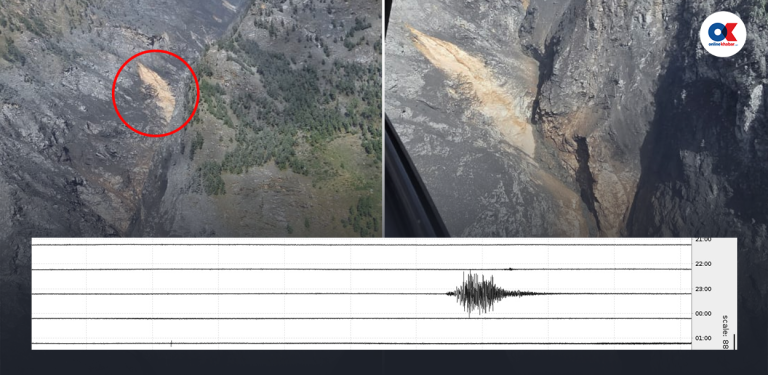
Image caption: The image included in the Centre of Hydrology and Water Resources Research’s report compares the situation before and after the landslideArticle Information
Officials from the Centre of Hydrology and Water Resources Research reported tremors in the ground surrounding the Budhigandaki River in Chumnubri, Gorkha, when a landslide blocked the river’s flow.
According to Rajan Bhattarai, the centre’s Deputy Executive Director and spokesperson, seismic vibrations were recorded in the area on Sunday morning.
“Around 4:30 a.m., a signal measuring approximately 4.2 on the Richter scale was detected. Observations suggest that a landslide occurred roughly at that time,” he said. “Although it initially seemed like minor tremors, we have not emphasized them significantly.”
He noted that further investigation is required to confirm the exact cause of this event.
About one and a half months ago, during flooding in the Bhote Koshi-Trishuli region, seismic activity was also detected in the Langtang Lirung area. Initially, it was suspected that the earthquakes caused landslides, but later scientific analysis confirmed that the tremors were caused by landslides.
A situation report issued by the centre on Saturday night shows that a landslide had occurred near Tumje in Chumnubri, a tributary area of Budhigandaki in Gorkha.
“Preliminary information and satellite image observations indicate that the landslide blocked the river’s flow, causing water to accumulate and leading to sudden releases as the blockage weakened or collapsed,” the report stated, calling for further studies.
The National Disaster Risk Reduction and Management Authority confirmed that the landslide from Siringe Himal, located between Lokpa of Chumnubri-6 and Chumdeling, has blocked the local Uingulung Khola stream.
Several media outlets have also reported the occurrence of an avalanche in Chumnubri.
“We have only confirmed a landslide and the satellite images analyzed clearly show a landslide,” said spokesperson Bhattarai. “Due to extensive cloud cover in satellite images, it is unclear whether some parts of the glacier above also fell.”
Rescue Operation Underway
Image source: Nepal Army
Image caption: The Nepal Army rescued 95 people, including local residents and foreign tourists, on Sunday
Officials have confirmed that search and rescue efforts continued on Monday in the affected area.
Ram KC, head of the Disaster Response Branch at the authority, explained that people stranded by flood-blocked routes are being evacuated to safer locations.
According to KC, the flood has impacted three local administrative areas in Gorkha: Chumnubri, Dharche, and Arughat. Although road access was cut off in certain places due to collapsed bridges, eight truckloads of relief supplies were delivered to Arughat by Sunday evening.
“Approximately 300 people in Gorkha and Dhading have been affected and the first phase of relief has already reached them.”
“In remote areas where road networks are disconnected, relief materials are being delivered by Nepal Army helicopters as of Monday,” KC added.
He highlighted travel difficulties in Arughat and Chumnubri due to the collapse of permanent bridges.
Preparations are underway to install a 22-meter-long Bailey bridge in Arughat to temporarily restore traffic, with work expected to begin shortly.
Seven people, including two women and five men from Chumnubri, remain unaccounted for due to the flooding. On Sunday, the Nepal Army evacuated 95 individuals, including nine foreign nationals, from the affected region.
Continuous Monitoring
Image source: NDRRMA
Image caption: Officials report that 45 houses have been completely destroyed due to the sudden flooding from Budhigandaki
Deputy Executive Director and spokesperson Bhattarai of the Centre of Hydrology and Water Resources Research noted that the landslide area on Sunday was identified as a zone with high seismic risk.
“The loose soil made the area susceptible to landslides,” he explained.
Some analysts suggest that the soil in the mountainous and hilly regions has weakened since the 2015 earthquake, raising fears that similar events may recur.
The epicenter of that earthquake was near Barpak, Gorkha.
Regarding the ongoing risk, Bhattarai stated, “It cannot be ruled out. The area was already at risk. However, in this particular incident, the danger appears to have decreased.”
KC from the disaster authority also noted that the risk is lower on Monday compared to Sunday.
“On Sunday, the river was blocked causing water to accumulate. On Monday, that condition is not present,” he said.
“Yet, we continue to monitor the situation closely.”
Our news is also available on YouTube. To subscribe to our channel and watch published videos, click here. You can also find our content on Facebook, Instagram, and Twitter. Additionally, the BBC Nepali Service program airs on radio from Monday to Friday at 8:45 PM.
In South Australia, assaults on police officers on duty have risen from 635 to 793 incidents over the 12 months leading up to August 2026. Meanwhile, robbery cases have decreased by 13 percent, falling from 501 to 438. However, unauthorized home intrusions and burglaries have increased, going from 5,584 to 5,947 cases. Sexual offenses have also seen a slight rise, increasing from 2,704 to 2,718. (October 13, Sydney)
According to data released by South Australia Police, there has been a 25 percent increase in assaults against police officers. Attacks on police have been steadily rising throughout the year. Robberies have dropped by 16 percent, while homicides and related offenses have declined by 21 percent.
Shoplifting and theft from commercial establishments have decreased by 3 percent, but burglaries in residential homes have notably increased. Theft incidents have also risen in non-residential buildings and premises. Sexual offenses experienced a modest increase. Assistant Commissioner David O’Donovan of South Australia Police stated that targeted law enforcement actions against repeat offenders have contributed to the ongoing reduction in robberies. He added, “We will continue to make persistent efforts to reduce such crimes in the coming days.”
A CCTV footage has captured the moment a person in Ukraine swiftly fled to save their life upon witnessing a Russian drone attack. Last week, a massive explosion occurred near a park and playground in the village of Svyatotriyske during the drone strike. The video highlights the individual’s quick reaction and bravery in escaping the danger.
Summary: On October 11, two oil tankers were attacked in the Strait of Hormuz, resulting in two Indian sailors going missing. Out of 11 Indians aboard the Nicaragua-flagged ‘MT Petro Dolphin,’ two are missing, while all 11 Indians on the ‘MT Valthera’ were safely rescued. The Indian Ministry of External Affairs strongly condemned the attacks on commercial vessels and urged resolution of the dispute through dialogue and diplomatic channels. October 12, Kathmandu.
Two oil tankers in the Strait of Hormuz were attacked with drones and unidentified projectiles, causing two Indian sailors to go missing. All 11 Indians aboard the other tanker were safely rescued. According to India’s Ministry of External Affairs, two separate attacks occurred on October 11. The Nicaragua-flagged ‘MT Petro Dolphin’ was directly attacked by a drone. Of the 11 Indians aboard, two remain missing. Meanwhile, the Marshall Islands-flagged tanker ‘MT Valthera’ was set on fire following an attack, but all 11 Indian sailors on board were rescued safely, the Ministry confirmed.
Search efforts for the missing Indian sailors are ongoing. The Indian Embassy in Muscat, Oman, is coordinating with local authorities and the ship management company to locate and rescue the two missing sailors. The embassy has provided constant monitoring updates on the condition of ‘MT Petro Dolphin’ via social media platform X and is also ensuring support is extended to the other Indian sailors affected on the vessel.
India’s plea to stop attacks on ships: The Ministry of External Affairs expressed serious concern over these attacks on commercial vessels in international waters and condemned them strongly. Emphasizing the safety of Indian seafarers abroad as a top government priority, the ministry warned that such attacks could further escalate regional tensions. It called on all parties involved to resolve disputes through dialogue and diplomacy. Additionally, the ministry stressed the need to uphold freedom of maritime trade and navigation under international law and urged an immediate halt to attacks targeting ships, sailors, and civilian infrastructure.
Saudi officials have reported multiple casualties in the airstrike at Riyadh International Airport in Saudi Arabia. According to a Saudi military spokesperson, a missile attack on Sunday at the airport resulted in one fatality and 11 injuries. The strike also caused a fire in the passenger waiting area. The deceased was identified as a Pakistani national.
The previous day, the same airport experienced an attack that killed 13 people and injured over 300. The Yemeni Houthi rebel group has claimed responsibility for these attacks. The group also urged passengers to avoid using Saudi airports and air routes. The Houthis stated that they have launched ballistic missiles, cruise missiles, and drone attacks against Saudi Arabia. This video was recorded at the airport following Saturday’s airstrike.
Youth protests in India have expanded beyond issues of employment and examinations to encompass concerns about voter rolls and the Election Commission itself. Why are young people taking to the streets? Is their demand for fairness in jobs and exams now intertwined with hopes for trust and justice within institutions? Or is there an attempt to portray diverse protests as a single issue when the situation is more complex? Is it sufficient for the government to dismiss every protest as merely a political ploy or opposition strategy? As millions of young people question the credibility of the system, what steps will the government take to restore public trust? Prime Minister Narendra Modi and the Bharatiya Janata Party (BJP) also face a critical question – is the foundation of popular support building for decades beginning to shift? For the BJP, attracting newly emerging young voters poses an increasing challenge.
According to analyst Sanjay Kumar, surveys conducted over the past 30 to 35 years have consistently identified unemployment as a major problem, with youth repeatedly citing it as their chief concern. Thus, it is wise not to view current protests solely as a direct consequence of recent events. Not only youth but also professionals and the general public have begun feeling unheard by the government. This dissatisfaction has manifested as street demonstrations in Delhi and other cities. Professor Gaurav Vallabh notes that the government is acknowledging dissent and addressing some key demands raised by students.
Political analyst Neerja Chaudhary interprets this as a shifting political landscape. She explains that the middle class was a steadfast supporter of the BJP since Atal Bihari Vajpayee’s tenure, but now signs of discontent are emerging within this group. She also highlights concerns related to the voter list and voting rights as significant. A government style that ignores public voices has fueled unrest. Within this context, youth from the Kakkroach Janata Party have taken to the streets expressing concern for the future and calling for a struggle for fair elections.
Although the heavy rainfall in recent weeks has created favorable conditions for rice cultivation, agricultural officials and experts advise farmers to remain cautious as the harvest period is still ahead. While adequate water is essential for the growth and development of rice crops, excessive rainfall, floods, and waterlogging can cause damage. Farmers are urged to stay vigilant about future weather conditions.
In the past few weeks, various regions across Nepal have experienced heavy to very heavy rainfall. According to Rajendra Koirala, spokesperson of the Department of Agriculture, this has raised water levels in rivers and streams nationwide. Floods and landslides have impacted farmland along riverbanks, particularly those adjacent to rivers and streams, where fields have been eroded, crops submerged, and sand and gravel deposits have accumulated in the fields. “However, overall the rainfall has not had a detrimental effect on cultivation or potential production; rather, it has facilitated farming,” he stated.
Currently, rice cultivation is underway in irrigated areas of the Terai and hills, while millet is being grown in upper regions lacking irrigation. “In many locations, transplanting was completed from late Ashad to mid Shrawan. This period marks the first flowering and grain-filling stages of rice varieties, both of which require adequate water,” Koirala explained. Additionally, various particles in the atmosphere brought down by the rains act like natural fertilizer, benefiting the crops.
The recent rains have improved rice crops in upper dry areas. Regions with good drainage in the lower plains have not experienced adverse effects from the rainfall,” he added. Nationwide, approximately 1.35 million hectares are under rice cultivation, with a majority in the Terai region. Registrar Shribhagwan Thakur from Madhesh Agricultural University also noted the recent rains positively impacted rice production in the Terai. “Farmers were initially concerned about continuous rainfall damaging their crops, but this rain has actually supported the growth and development of rice crops,” Thakur said.
On flight 6E 6115 from Delhi to Chennai, a passenger’s power bank caught fire, forcing the Indigo aircraft to divert and make an emergency landing in Hyderabad.
The crew managed to control the fire onboard, and all passengers and crew members are safe.
Indigo has arranged another aircraft to transport passengers to Chennai, and authorities have initiated an investigation.
October 12, Kathmandu – An Indigo Airlines flight en route from Delhi to Chennai was forced to make an emergency landing at Hyderabad’s Rajiv Gandhi International Airport after a passenger’s power bank caught fire onboard.
The fire, which originated from the power bank during the flight on Sunday, was promptly brought under control by the flight crew, ensuring the safety of all aboard.
According to Indigo, the flight crew of flight number 6E 6115 successfully extinguished the fire inside the aircraft. All passengers and crew members are reported to be unharmed.
“As per established safety protocols, the pilots diverted the flight to Hyderabad where they executed a safe landing at Rajiv Gandhi International Airport,” a spokesperson for Indigo stated.
Passengers aboard the aircraft have been arranged transportation to their original destination of Chennai via another flight. Relevant authorities have commenced an investigation into the incident.
Emergency Landing Indigo Airlines Power Bank
How did this news make you feel?
Happy
Sad
Surprised
Excited
Angry
Comments
NewestOldestMost Popular
Login to comment
Remember me
Forgot password?
Don’t have an account? Sign up
Or login with Email/Social Media
GoogleTwitter
Forgot Password?
Back
+
Comments 4
Comment
Hot Properties
Satungal
House for Sale in Satungal
Rs. 4.15 Cr Total Amount
Shital Height
House for Sale at Shital Height
Rs. 3.25 Cr Total Amount
Dhapasi
House for Sale at Dhapasi
Rs. 4 Cr Total Amount
Related News
Foreign Currency Exchange Rates Today
Both Teams from Fikkal Advance to U-17 National Rugby Semifinals
Pushpa Bhusal’s Political Leap
Were Vibrations Measured Before Budhigandaki Flood?
Black Mountains Above, Budhigandaki River Runs Dark Below
Congress Vote Counting: Ramhari Leads Open Joint General Secretary, Followed by Dilliram and Ajaybabu
Tilottama – Charange Youth Club Devdah emerged victorious in the 38th Jharna Running Shield Knockout Football Tournament held in Kunjalapur. In the final played on Sunday at Uma Basic School’s playground, Charange defeated Gorkha Boys Club Butwal by a score of 3–1.
Along with the championship title, Charange received a cash prize of NPR 400,000, a shield, and a certificate. The runner-up Gorkha Boys received NPR 200,000, a shield, and a certificate as well.
In the tournament, Gorkha Boys’ foreign player Silla was declared the Best Defender. Charange’s Krishna Ale was named Best Midfielder, Bhim Pun was awarded Best Goalkeeper, and Abhinas was honored as Best Player. Deep son Sapkota of the organizing Jharna Sports Club was recognized as the Most Promising Player.
The awards and certificates for the winning and runner-up teams were presented by Ramkrishna Khan, Mayor of Tilottama Municipality; Dhanendra Paudel, President of Jharna Sports Club; and Lok Pun, Coordinator of Tilottama Municipal Sports Development Committee.
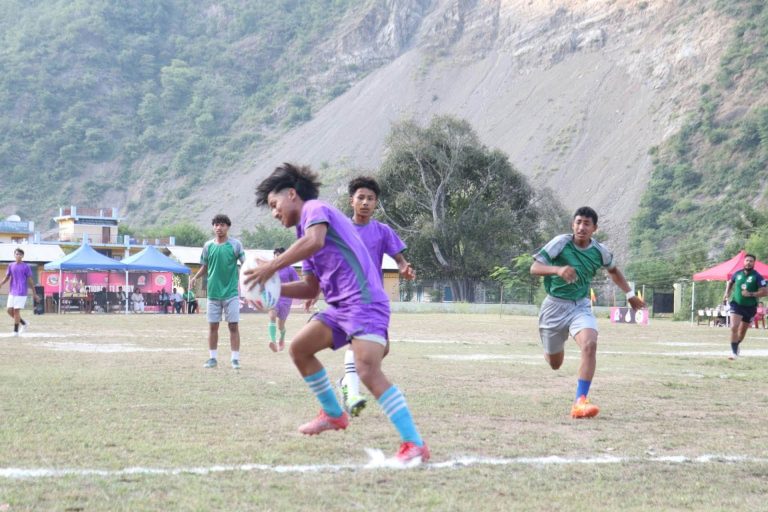
According to reports, both the women’s and men’s teams from the host, Fikkal Rural Municipality, have successfully secured their spots in the semifinals of the Second Shikhar Dhakal Memorial U-17 T-7 Rugby tournament. In the men’s category, Golbazar Municipality and Budhanilkantha Municipality advanced as group winners, setting up a semifinal clash between Fikkal and Katari. On the women’s side, Budhanilkantha Municipality and Katari Municipality won their groups, while Fikkal and Tokha, as runners-up, also qualified for the semifinals. (October 12, Kathmandu)
The Second Shikhar Dhakal Memorial U-17 T-7 Men’s and Women’s National Rugby Tournament, organized by Fikkal Rural Municipality in Sindhuli, saw two teams from Fikkal advance to the semifinals. After the league stage matches concluded on Sunday at Khangsang, Sindhuli, the semifinalists were finalized. In the men’s Group A, Golbazar Municipality topped the group with Fikkal as the runner-up. Golbazar defeated Tokha 1–0, Fikkal drew 1–1 against Golbazar, and Fikkal secured a 2–1 victory over Tokha.
In women’s Group A, Budhanilkantha Municipality emerged as group winners and Tokha Municipality as runners-up. Budhanilkantha achieved one win and one draw, while Tokha drew both matches. In Group B, Katari Municipality topped the group with Fikkal as runner-up. Both teams registered one win and one draw; Katari defeated Lumbini Municipality 6–0, whereas Fikkal won 2–0 against Lumbini.
The semifinals, third-place playoff, and final matches are scheduled for the coming Monday. This tournament, organized by Fikkal Rural Municipality and managed by the Nepal Rugby Association, began on Sunday. Prize money includes NPR 30,000 for the champions, NPR 20,000 for runners-up, and NPR 10,000 for the third-place team, along with trophies, medals, and certificates. Outstanding players from both categories will also receive trophies and cash awards, as stated by the organizers. The opening ceremony featured a joint ball handover to referees by Nepal Rugby Association President Deepak Devkota and Fikkal Rural Municipality Chairperson Parvati Sunuwar.
At the inauguration, Fikkal Rural Municipality Deputy Chief Raju Baral expressed commitment to consistently support the development of sports, including rugby, in the local area. He highlighted that despite Fikkal being referred to as the ‘Karnali’ of the district in terms of geography and development, continuous assistance will be provided for sports advancement. Nepal Rugby Association President Devkota thanked Fikkal Rural Municipality for hosting the event and expressed confidence that such tournaments will be regularly held. The tournament features participation from five men’s teams and six women’s teams.
The head of Iran’s atomic energy organization has declared that the country’s nuclear technology remains secure against external disruptions and cannot be halted by threats, pressure, or attacks. Mohammad Eslami highlighted the progress made in Iran’s nuclear sector as a national achievement, attributing it to the tireless efforts of Iranian scientists working around the clock.
According to Iran’s semi-official news agency Tasnim, Eslami stated, “The open threats by US officials at the United Nations to use strategic weapons against Iran’s nuclear facilities and to destroy its ancient civilization only expose their own weakness in front of a nation that has historically been a center of science, knowledge, and technology.”
Following the failure of diplomatic efforts aimed at limiting Iran’s nuclear activities, US officials have repeatedly threatened the possibility of attacking Iran’s nuclear sites.
Caption, The Nepali Army reported rescuing more than 90 people after the floodArticle Information
A sudden devastating flood in the Budhigandaki River has caused a new wave of anxiety among residents living along the lower banks.
A local representative from Arughat Bazaar in Gorkha district, which was affected by the flood that struck early Sunday morning, said the disaster has changed people’s perceptions about flooding.
Tek Bahadur Adhikari, chairman of Arughat Ward No. 3, stated, “Earlier, we thought floods only come when there’s heavy rainfall. But now it’s clear that for floods to happen, it doesn’t necessarily require heavy rain. Even when it hasn’t rained much, such floods can occur.”
“We have learned now that floods can come any time, whether in winter or monsoon, whenever the river bursts. That means people can’t sleep peacefully at home anymore.”
Adhikari further explained that downstream roads near Soti Bazaar in Arughat-3 have been obstructed by sediment and debris carried in by the Budhigandaki River, and authorities were working on clearing the roads through the evening. Efforts are underway to relocate nearly two dozen people from flood-affected homes to safer places.
According to Adhikari, these families will be temporarily sheltered in neighbors’ homes or school buildings.
What We Know About the Damage
Photo credit, NDRRMA
Caption, Officials have confirmed total destruction of 45 homes after the sudden Budhigandaki flood
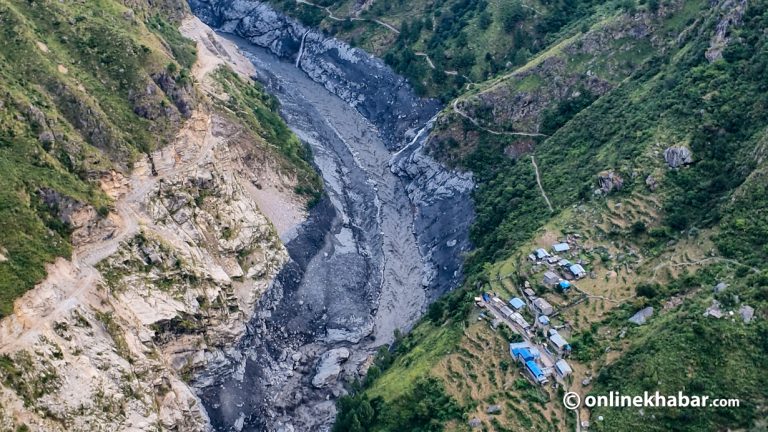
The National Disaster Risk Reduction and Management Authority (NDRRMA) reported that a massive landslide in Ward No. 6 of Chumanuwri Rural Municipality in Gorkha blocked the Budhigandaki River, leading to the flood.
The International Centre for Integrated Mountain Development (ICIMOD), analyzing the government’s preliminary data, estimated that the Budhigandaki River was temporarily dammed near Chumchet and that the flood began around 4 a.m. Officials warned that the large influx of mud, rocks, and sand poses increased risks along the lower corridor of the Budhigandaki, urging caution.
Confirmed human casualties have not been reported; however, initial data identifies Chumanuwri, the permanent home of Home Minister Sudhan Gurung, as among the hardest-hit areas.
Nima Lama, chairperson of the rural municipality, stated, “Our phone surveys confirm no human casualties so far, but five herders remain uncontactable near the landslide area, and about 100 goats and cows are missing.”
She added, “Two permanent bridges, one motorable bridge, and several suspension bridges have been washed away by the flood. Significant damage has occurred to houses and agricultural land in Jagatko Bagar. Salleri village is completely devastated, and about half the area in Ghattikhola is affected.”
Lama also confirmed some damage near the village of Home Minister Gurung.
Photo credit, RSS
Extent of Damage Caused by the Flood
Photo credit, Nepali Army
Netra Prasad Sharma, Assistant Chief District Officer of Gorkha, reported that 43 houses were washed away in Chumanuwri, displacing 159 people; in Dharche, 39 houses were damaged, displacing 126; and in Arughat, 64 houses suffered complete damage with 130 displaced.
He added that helicopter search and rescue operations were suspended due to late afternoon and authorities are now focusing on managing the affected populations.
Chairman Adhikari of Arughat-3 remarked that this flood, arriving just before the Dashain festival, has raised fresh concerns.
“The roads have been blocked in three places due to accumulated sediment. The river has eroded land, which small excavators cannot remove. We plan to bring a chain-operated dozer tomorrow to clear the area,” he said.
He also noted, “Restrictions on travel during Dashain will severely impact people. Two to four hundred workers from hydropower projects are returning home, and tourists are leaving out of fear.”
Officials reported that the flood washed away the main camp area and some construction equipment of the 341 megawatt Budhigandaki Hydropower Project in Salleri. Three hydropower projects and three vehicles were also damaged.
Electricity poles and telephone towers were damaged as well, and in several locations, the flood caused damage to pigpens.
Hundreds of people remain temporarily stranded on both sides of the river. Chairman Adhikari also stated that damaged bridges and sediment deposits have made access difficult.
“Sediment deposits of 500 to 600 meters have accumulated in various locations,” he added.
Photo credit, NDRRMA
Dramatic video footage of the flood has circulated on social media since early morning, showing the Budhigandaki River sweeping away infrastructure and a large cliff face.
The Budhigandaki flood has been widely compared to the catastrophic floods that struck the Bhote Koshi River around one and a half months ago, which claimed nearly 1,500 lives and left over 5,000 people missing.
ICIMOD noted that in April 2024, a large glacier landslide from Manaslu glacial lake triggered this sudden flood in the Budhigandaki River.
We also deliver news in Nepali on YouTube. To subscribe to our channel and watch our latest videos,click here. You can also find us on Facebook,Facebook, Instagram, and Twitter. Additionally, BBC Nepali Service broadcasts a radio program each weekday at 8:45 PM.



















Comments 4