Wheelchair Destroyed and Attacked with Boots Following Rough Handling at Disability Federation Convention





News Summary
Reviewed by editorial team.
- In the 10th General Convention of the Federation of the Disabled Nepal, wheelchair users faced inhumane treatment.
- Controversies over leadership selection, including allegations of use of force during the election, were reported.
- Representatives are preparing to file complaints with the Human Rights Commission, alleging suppression of their voices using state mechanisms.
April 20, Pokhara – Hem Bahadur Gurung, who lost the use of both legs due to polio at 18 months old, spent 25 years on a wheelchair. Over these years, he has been actively working in the disability sector, advocating for rights and inclusion.
Until now, Hem Bahadur had never experienced mistreatment, but recently endured unprecedented inhumane behavior. Despite his physical discomfort and pain, the emotional distress caused by oppression from the leadership of a disability organization has deeply affected him.
He recounts being roughly handled, his wheelchair attacked with boots, and even denied permission to use the restroom. “The inhumanity crossed all limits. Brutal attacks on people with disabilities happened. I faced an insult in my 50th year of life that I had never suffered before. It deeply moves me and brings tears,” Hem Bahadur said emotionally.
This incident occurred on March 12 during the 10th General Convention and the 23rd Ordinary Session of the National Federation of the Disabled Nepal, held at Darbar Lawn Party Palace in Butwal, where 425 representatives from associated organizations participated.
Hem Bahadur, also the Gandaki Province President of the Federation, went to the convention to engage in policy debate, highlight rights and participation issues for disabled individuals, and advocate for institutional reform and capable leadership. Instead, he became a witness and victim of the most inhumane treatment in the institution’s 23-year history.
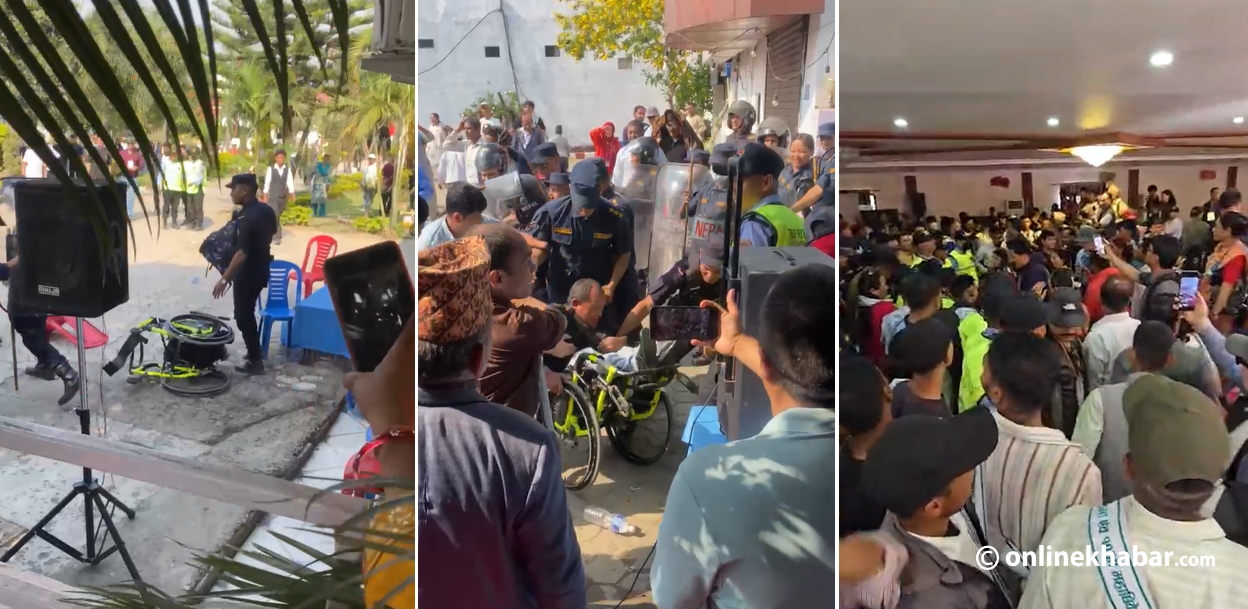
A viral video on social media shows security personnel roughly handling Hem Bahadur on his wheelchair and damaging it. Hem Bahadur is the person sitting in that wheelchair. The majority of disabled individuals attending the convention felt the leadership acted inhumanely, and that there was state-created intimidation. They allege that security personnel forcibly removed wheelchair users, using ‘bouncers.’
They reported that even blind women faced inhumane treatment, with abuses coming from security guards, volunteers, and police officers. Federation members such as visually impaired Birodh Khatri, Neun Drishti Virukamal Shrestha of Saksham Nepal, Bhojraj Shrestha, and Vimala Sadashankar criticized the use of state mechanisms to suppress voices when legal procedures were violated within the organization.
Despite complaints of leadership being unlawfully taken by force, their primary grievance is the state’s neglect. Since police and administration deny receiving complaints or repressing dissent, they are preparing to file complaints at the Human Rights Commission.
Details about how this situation arose in the Federation’s convention were gathered from Hem Bahadur, who is also the Gandaki Province president.
The opening session of the convention began on March 11 at the Darbar Lawn Party Palace in Butwal, with Gandaki Province Assembly Member Sunita Thapa as the chief guest. The Federation’s President, Devidatta Acharya, chaired the session.
“The venue and timing for the convention were not discussed within the executive committee; everything was unilaterally decided, leading to dissatisfaction from the start among representatives,” Hem Bahadur explained. “Devidatta wanted to retain his presidency.”
After the opening session, the closed session began. The reports were read from audio recordings. The General Secretary had been suspended a month earlier from presenting reports. Treasurer Kumar Regmi, who has a hearing disability, delivered the financial report via audio, according to Shrestha.
Representative Birodh Khatri protested, declaring the convention illegal due to procedural violations. He objected that the election officer was appointed unilaterally by the committee rather than through an alternative selection process.
Shrestha alleged that fake associations were registered with the Federation, hiding documents, and demanded corrections. There were claims that the leadership used votes from such fraudulent groups to plan the election.
When many began shouting slogans against the leadership, security personnel (bouncers), volunteers with hearing impairments, and police were deployed. Attendees were not allowed to speak and even had their microphones taken away. Viral videos show bouncers and police officers engaging in inhumane behavior.
There was shoving and pushing. Police detained Bhojraj, Virukamal, and others until they signed attendance in the evening before releasing them. The program was halted throughout March 13 due to fears the election might be disrupted, which caused further protests.
At 7pm on March 11, the election coordinator Shalikram Banjade and some officials resigned. The next day, a new election committee under Jok Bahadur Khatri was formed, but debates arose over the committee’s legitimacy. Committee officials responded to the controversy on-site.
“Claims that the new committee formed because the old one resigned have not been discussed in the hall and are incorrect,” Hem Bahadur said. “We were not allowed to discuss any agenda, so there was no legitimacy to the elected committee.”
Banjade stated, “There was a court case; I resigned because the committee was controversial, but then I learned that another committee was formed and leadership elected.”
Representatives began staging sit-ins in protest of the leadership amid heavy security. The venue had only one wheelchair-accessible restroom, but wheelchair users were denied access to it.
“Despite people claiming to help us move, when we said we’d wait at the gate to relieve ourselves, we weren’t allowed inside, citing higher orders,” Hem Bahadur recounted. “Our appeals to consider disability sensitivities were ignored, after which brutal attacks began.”
Wheelchair users were pushed and shoved; security personnel attacked wheelchairs with boots and caused damage.
Videos show security officers lifting and pushing wheelchairs near the security gate, dragging a chair close to the reception, and moving it to another area.
Hem Bahadur said, “This inhumane treatment left me in shock. I struggled to breathe and remained dazed for a while. Later, when I asked for another wheelchair, I wasn’t given one and had to crawl on it.”
With staff assistance, he reached the restroom, but felt pain in his head, body, and arms afterward.
“Seeing my unusual discomfort, a large security official ordered me to be placed in front of CCTV cameras. However, cameras were not nearby. They pushed my wheelchair to the entrance door of the hall where cameras were present,” Hem Bahadur tearfully recalled. “It felt as if the hall was closing on me under intense sunlight.”
A new executive committee was selected under Devidatta’s leadership at the Federation, but a majority boycotted it, claiming the leadership was seized by force. Many doubted the fairness of the leadership election, especially since complaints about violence and inhuman behavior were ignored.
“If the state has law, process, and justice, the incident must be investigated, and the guilty severely punished. The forcefully dissolved committee should be annulled, and a temporary committee formed to hold a clean election,” Hem Bahadur demanded. “Even the existing electoral committee would face consequences.”
Many delegates boycotted the convention, citing arbitrary leadership. Among 126 delegates from Gandaki, 84 signed the boycott with 8 absent. According to Hem Bahadur, only 44 votes were cast, and those were allegedly forged.
Meghnath Padhya, the Deputy Chief District Officer of Rupandehi, said no complaints had been filed regarding the incidents. Since the Federation is registered in Kathmandu, complaints should be lodged there, and police should collect evidence accordingly.
“We were only informed about permission and security for the convention. If injustice occurred, legal remedies can be sought,” Padhya said.
Legal Proceedings Will Determine Outcome: President Devidatta
Reelected Federation President Devidatta Acharya stated that this dispute should not be considered just a problem of this convention. After the 9th Convention in Nepalgunj, over 193 complaints were filed with administration, commission, and courts within 22 days, escalating the conflict.
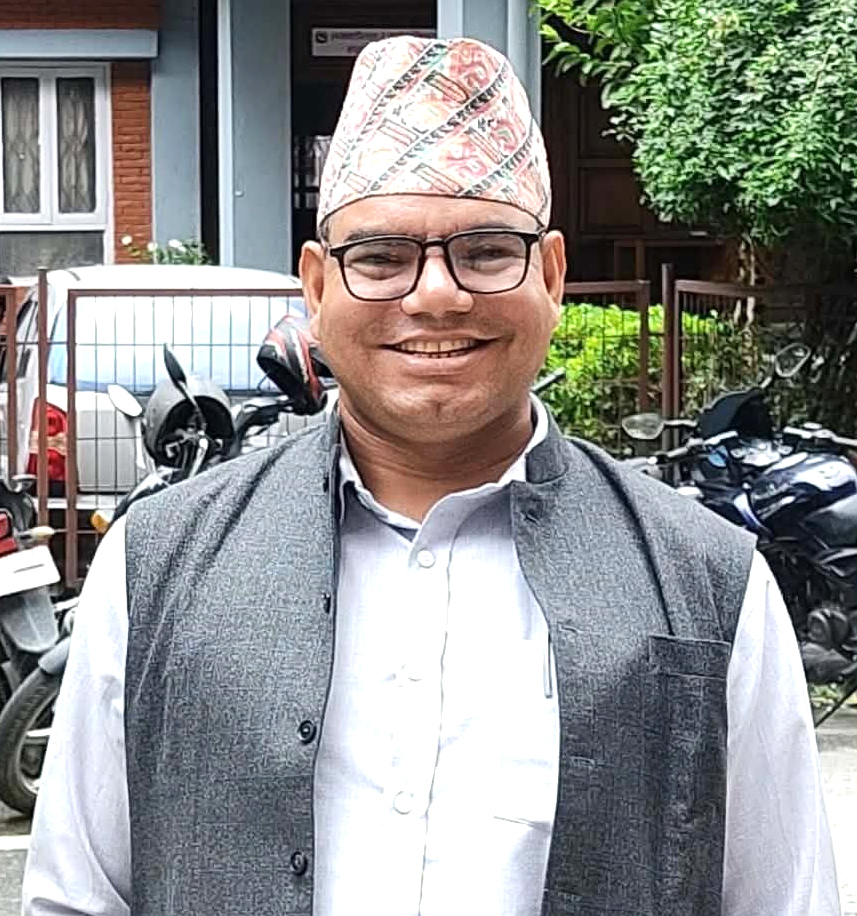
He explained that the 10th convention was originally planned for December 12-13 but was postponed to March 11-12 due to the Genji movement and loss of district administration documents.
Many registered associations failed to renew in time, leading to complaints; membership increased from 24 to 424. Later, controversy arose over registration of fake organizations. Security was tightened due to destruction and crowding during the general assembly.
“Volunteers and bouncers were deployed to maintain safety,” he added.
Despite protests from 30-40 delegates, the convention continued, arguing that possession of delegate cards invalidated the boycott.
“There are still three writ cases in court. They advise attendees to seek justice at the judiciary. The legal process will examine whether it was lawful or not,” he said.


