




Summary
- The draft of the House of Representatives Rules 2083 includes provisions that prevent suspension of MPs accused of corruption and money laundering.
- According to Rule 247(3), MPs facing criminal charges carrying three years or more imprisonment will be suspended only if they are actually imprisoned.
- The Rules establish their supremacy over existing laws, declaring themselves federal law and parliamentary privilege in case of any conflicts.
April 22, Kathmandu – The public uprising that began under the slogan of good governance initially led to the emergence of the Janakal movement. Subsequent general elections were also contested on the promise of good governance. Nearly two-thirds of the lawmakers from the Rastriya Swatantra Party (RSP), now members of the House of Representatives, had pledged to make ending corruption and malpractice their primary objective.
These lawmakers had accused traditional political parties of perpetuating malpractice and abusing parliamentary privileges. Many RSP leaders currently serving as MPs have accused Congress, UML, Maoist parties, and their leaders of enacting laws favoring themselves and exploiting coalition practices for policy-level corruption.
However, as soon as they secured a commanding majority in the House of Representatives, they took measures contrary to their earlier commitments. The Rastriya Swatantra Party drafted rules of procedure favoring their chairman, which contradict the country’s existing legal standards, as their first legislative act in parliament.
The draft rules include provisions exempting MPs accused of corruption and money laundering from suspension.
If these rules are enacted by the House, MPs facing or potentially facing corruption and money laundering charges will continue to perform their duties without suspension.
Among those benefiting most immediately from this arrangement will be RSP Chairperson Ravi Lamichhane.
Lamichhane, who is currently facing a money laundering case in the Kaski District Court, will be able to participate in parliamentary activities based on this new rules draft. In the future, MPs charged with corruption or money laundering will not be barred from performing their parliamentary roles.
Two Controversial Provisions
The draft rules prepared by the House of Representatives Rules Committee contain two significant provisions that legally facilitate MPs accused of abuses of power or economic crimes to remain in convenient positions.
Rule 247(3) of the draft differs from existing laws regarding suspension. It states that MPs will be suspended only if they are imprisoned in criminal cases punishable by three years or more, or where there is moral deterioration. The suspension lasts only during the period the MP is in prison.
This imposes two conditions: first, that the criminal offense carries a prison sentence of at least three years, and second, that the MP must actually be imprisoned. Suspension is limited to the imprisonment period only.
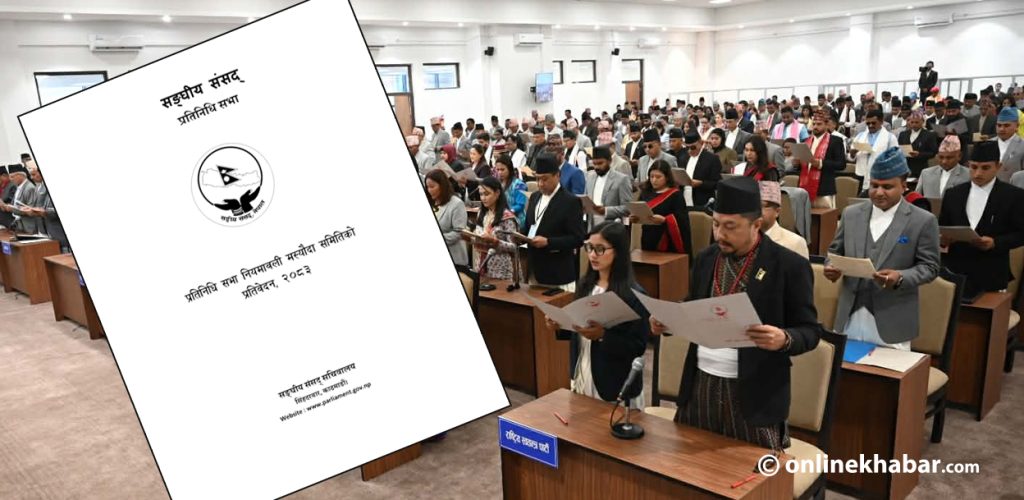
This provision contradicts several existing laws. Moreover, the draft declares that, in case of conflicts, these rules will take precedence as federal law and parliamentary privilege.
Rule 259 states, “Notwithstanding any provisions in existing law, these rules shall apply as federal law and remain as parliamentary privileges of the members.”
The rules also specify that MPs issued arrest warrants but who evade arrest and are absconding will be considered suspended. However, the judicial interpretation included in the draft covers cases from district courts up to the Supreme Court but excludes Special Courts.
Since Special Courts handle corruption and irregularity cases, excluding them potentially allows MPs convicted by Special Courts to evade suspension.
Conflicts With Three Existing Laws
If passed by the House, the rules draft is set to clash with at least three existing laws. Two of these have very similar provisions, while the third differs slightly.
The Anti-Corruption Act, 2059 (2002) Section 33(1) stipulates automatic suspension of persons accused of corruption, including public servants and MPs, either while imprisoned or until the case is resolved.
Similarly, Section 17 of the Commission for the Investigation of Abuse of Authority Act, 2048 (1991) provides for automatic suspension of public officials facing corruption charges, lasting the duration of imprisonment or until the case is adjudicated.
The Money Laundering (Offense and Punishment) Act also includes provisions for automatic suspension of public servants, including MPs, when cases are filed, as stated in Section 27.
These laws mean that public officials under prosecution or serving prison time should automatically be suspended.
Senior Advocate Tikaram Bhattarai argues that laws and rules contradicting the Constitution should not be made. All legal instruments must follow the principle of supremacy of the Constitution and legal hierarchy.
He explains, “If federal laws mandate automatic suspension of public officials, parliamentary rules cannot nullify that. Such provisions are constitutionally invalid.”
Impact of the Rules
Under the new draft rules, MPs who are not imprisoned will not be suspended, and even if convicted by Special Courts, suspension will not occur until the sentence is imprisonment.
This arrangement particularly benefits Rastriya Swatantra Party Chairperson Ravi Lamichhane, who is currently facing a money laundering case in Kaski District Court. The rules protect him from suspension.
Advocate Bhattarai comments that all citizens should be treated equally under the law, but these rules give special privileges to MPs, violating the principle of equality.
Law lecturer and Advocate Apoorva Khatri observes that MPs aim to portray themselves as persons of special status through these rules.
He adds, “If MPs want to avoid suspension, then relevant laws should be amended instead. The rules draft attempts to weaken existing laws.”
Given RSP’s large majority, these provisions are likely to pass easily, granting significant protection to MPs accused of corruption and money laundering in the future.
Two years ago, the Supreme Court ruled that Tek Bahadur Gurung, a Manang MP found guilty of corruption, would not be suspended, a decision met with widespread criticism.
The Anti-Corruption Commission has filed a review petition to reverse that decision, which remains under consideration in the Supreme Court.
Even before the Commission’s request, the draft rules have institutionalized protections preventing suspension of MPs facing corruption and money laundering charges, easing their engagement with anti-corruption laws and the Commission’s oversight.
Senior Advocate Dr. Bhimarjun Acharya emphasizes that the Constitution, laws, rules, and directives must maintain supremacy collectively.
He notes, “In parliament, representatives exercise the people’s rights. The rules were designed to limit the MPs’ rights as per the people’s will.”
However, he adds that the people should not grant any party carte blanche to act without limits. Such rule provisions are inconsistent with the Constitution and laws.
Dr. Acharya insists, “Democracy requires extensive debate and discussion on such matters. Attempts to restrict these through courts should be avoided.”


