




News Summary
Reviewed editorially.
- India’s Chief Justice Suryakant’s remark comparing unemployed youth to cockroaches sparked an online movement called ‘Cockroach Janata Party’ on social media.
- Political analyst Yogendra Yadav stated that the Cockroach Janata Party is not just a joke but a signal of restlessness and rebellion within the system.
- Yadav also pointed out that the ban on CJP reflects the government’s authoritarian tendencies and highlights a mix of disappointment and hope among young people.
May 22, Kathmandu – Indian politics has adopted a new symbol: the cockroach. This emerged last week after Chief Justice Suryakant made comments during a hearing in which he allegedly compared unemployed youth involved in journalism and social activism to cockroaches and parasites.
He later clarified that his remarks were directed at individuals holding fake or unverified degrees and not at all youth.
However, the comment quickly spread across social media, sparking anger and satire, and gave rise to a humorous political concept called the ‘Cockroach Janata Party’ (CJP). This party is not a formal political organization but an online movement rooted in political satire.
Membership criteria include being unemployed, lazy, constantly active online, and having a ‘professional ability to vent frustrations.’
Within five days, the Instagram account amassed over 17 million followers. The movement was created by political communication expert and Boston University student Abhijeet Deepak.
According to Abhijeet, it began purely as a joke, but political analyst Yogendra Yadav sees it as more than humor — a sign of deep social and political change.
‘Tyrannical governments fear jokes’
Yogendra Yadav states, “Although the Cockroach Janata Party started as a meme on social media, it is not merely laughter and fun. It represents the pent-up frustration and rebellion rising from below due to closed off established channels of the system.”
He added, “Jokes and satire are always rooted in some deep pain. The government’s ban on CJP is a serious political signal.”
Yadav explains that when a government tightens its grip on power, rebellion arises from unexpected places.
“After Indira Gandhi’s massive victory in 1971, the Jai Prakash movement emerged in 1974; following Rajiv Gandhi’s success in 1980, the Assam movement began in 1983; after 2009’s successes, the Anna movement started in 2011 and the farmers’ movement arose after 2019. When official channels close, people seek new paths.”
Following the ban on the CJP’s ex-handle, Yadav says, “Tyrannical governments fear jokes the most. Those who cannot take jokes often become the joke themselves. The ban reduced the likelihood of venting anger a bit, but this will go much further.”
He also issues a warning to the opposition, noting that since a large portion of youth follow the meme account, the opposition has failed to present itself as an attractive option. Leaders need to engage with young people directly.
But the question remains: Is this simply an outlet to vent frustrations on social media or is there a deeper change occurring beneath the surface? Yadav comments:
“It’s a new language of a changed era. In my time, people read manifestos. Today they watch YouTube. We used to make posters, now we create memes. Each generation has a new grammar we must learn.”
Yadav adds, “If the ban had not been imposed, the anger would have been expressed and dissipated, but when the outlet is closed off, it signals a more serious issue.”
“Previously jokes were among us, now even the government has become part of the joke. The government is pointing fingers at the jokes, and this matter could escalate significantly.”
A Language of a Changing Era
People are rapidly joining this account and serious political conversations are emerging. Its future course remains to be seen.
Yadav says, “There will be clamorous calls to lift the ban. This will not only be the voice from an account with millions of followers but the voice of tens of millions of people.”
He adds, “I’m curious how the government plans to justify this ban. Something is brewing beneath the surface. We don’t know how it will manifest, but the government is taking a significant risk.”
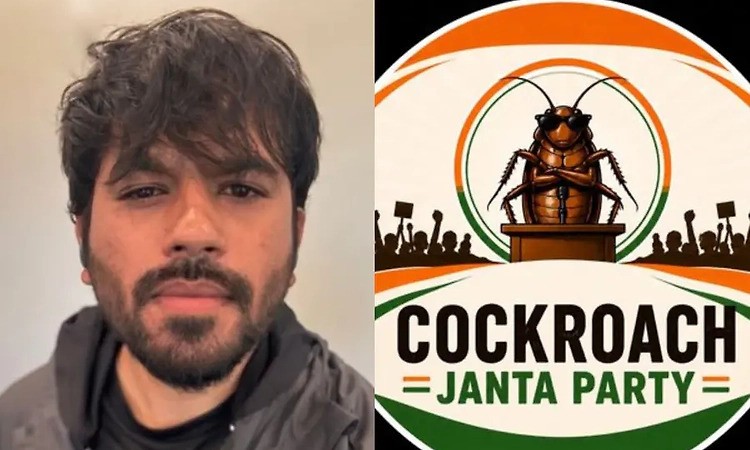
Many memes are being created about the CJP. Could memes be taking the place of manifestos or even becoming the youth manifesto itself? Yadav explains:
“This is a new language of a changed era. We used to read manifestos; now we watch YouTube. We used to make posters; now we create memes. Behind this satire is a profound political message. If both rulers and opposition fail to understand this, they will lose their base.”
If Indian youth identify themselves with the cockroach, is this just anger or also deep disillusionment with democracy? Yadav responds:
“Yes, there is anger and despair, but along with that, there is hope and aspiration. There is a desire for someone to come and hold their hand. This is not just negativity; it carries hope.”
(Adapted from BBC Hindi)


