




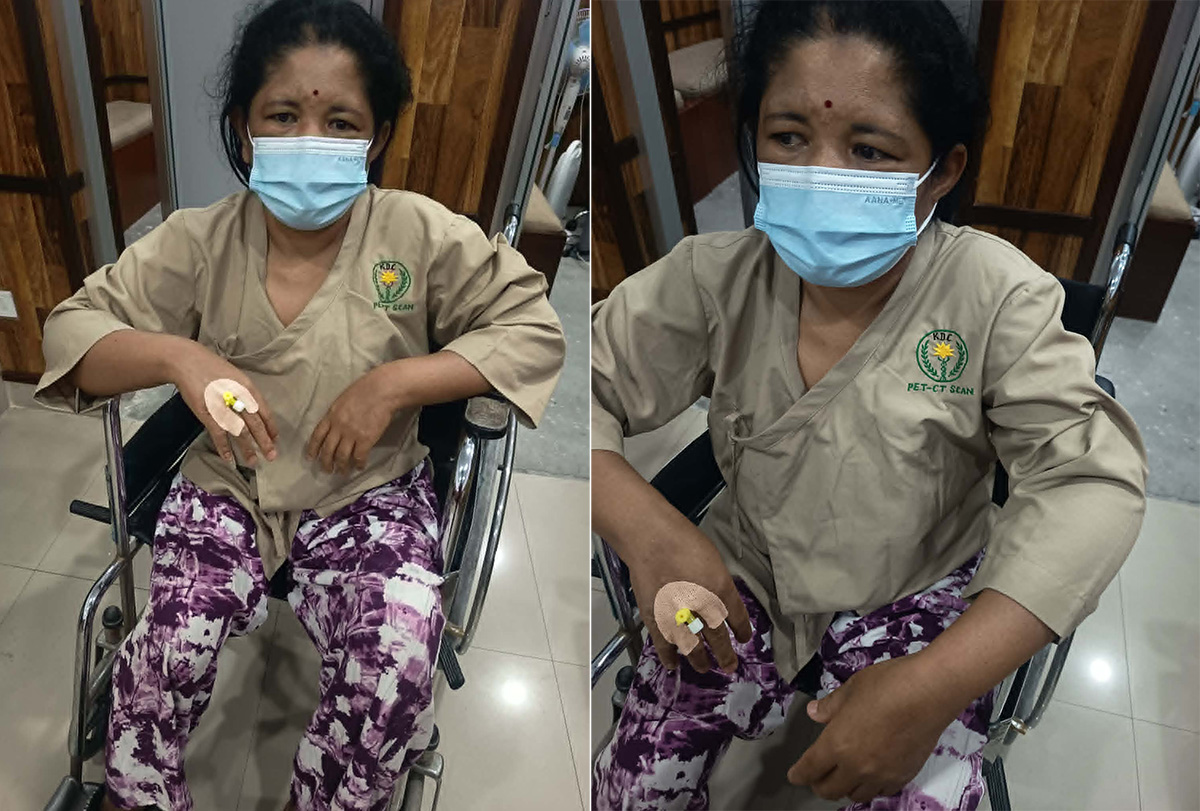
Shanti Thami has proven that mental strength surpasses physical pain, enduring five major surgeries, infections, and uncertainty with remarkable courage.
News Summary
Editorial review completed.
- Shanti Thami, a patient of rare melanoma cancer, has become cancer-free after four cycles of immunotherapy at Patan Hospital.
Shanti Thami’s daily life had been a constant battle as she struggled with thyroid issues, back pain, and other health problems over the years. Approximately one year ago, she noticed a small black spot on her ankle.
Initially, she thought it was a simple wound, allergy, or injury and tried home remedies. However, the spot grew larger, became an ulcer, turned numb, and started to hurt.
As the condition worsened, her family took her to Bir Hospital. From there, she was referred sequentially to thyroid specialists, dermatologists, and finally to the plastic surgery department. After numerous tests and consultations, her first biopsy was performed in late August.
She was admitted to the hospital the day after Dashain Tika in October 2025, undergoing five major surgeries within three months. Repeated wounds were cut from the ankle, knee, and other areas. Infections occurred, and her recovery was delayed. Her family spent over three hundred thousand Nepali rupees but did not receive a definitive diagnosis.
Only after the fifth surgery did doctors reveal to the family that she had melanoma, a rare and aggressive form of cancer.
This cancer spreads rapidly, attacks other organs, and is difficult to control with standard treatments. The family heard many discouraging statements such as “treatment is impossible” and “life expectancy is short.”
A New Ray of Hope: Immunotherapy
Disheartened after Bir Hospital, the family found renewed hope at Patan Hospital, where a cancer specialist team led by Dr. Arun Shahi decided on immunotherapy treatment for Shanti.
The therapy used medication produced in Bangladesh and approved in Nepal. Shanti has completed four cycles of immunotherapy, with the fourth cycle administered on April 27, 2026 (Baisakh 15). The treatment is administered in intervals of 21 days and is advised to continue for up to two years. PET scans are performed after every three cycles.
The latest PET scan brought joy to the family as no cancer was detected in Shanti’s body. Doctors declared her ‘cancer-free.’ The old wounds are healing, numbness has lessened, and her health is gradually improving.
Cancer specialist Dr. Arun Shahi described this outcome as a ‘medical miracle,’ noting that such a positive response in a rare and aggressive cancer within a short period is seldom seen.
Ongoing Financial Struggles
Shanti’s journey has been not only a medical challenge but also an economic and emotional ordeal. One cycle of immunotherapy costs between NPR 360,000 and NPR 400,000. The family’s monthly income is less than NPR 40,000.
Treatment has been possible through loans, help from relatives, and support from grandchildren living abroad. Due to the expenses, Shanti’s daughters have gone overseas for employment. A family member shared, “The pain of sisters leaving abroad is also a result of this treatment.”
Despite some relief, the family continues to worry about the costs of upcoming cycles.
An Inspirational Message
Shanti Thami’s story exemplifies resilience, hope, and continuous struggle, serving as an example for every Nepali facing adversity. This success bears two vital messages. First, advanced treatments are available within Nepal, and patients should consult local experts before seeking care abroad.
Second, delayed diagnosis and negative advice are major obstacles in cancer treatment. Medical professionals must provide hopeful and supportive counseling.
Shanti’s journey clearly shows that cancer is not an end, but can be a new beginning. With the right treatment at the right time, strong willpower, and family support, victory is possible. Late diagnosis exacerbates problems, but expert care and modern therapy can save lives.
One should not lose hope after hearing negative remarks, as medical science is unlocking new possibilities every day. Despite five surgeries, infections, and uncertainties, Shanti has displayed enormous mental strength.
A Call to Government and Society
Shanti’s struggle is not just that of a single family but a strong appeal to Nepali society and government. Dr. Arun Shahi has urged the government to provide tax exemptions, regulate prices, and integrate modern immunotherapy and cancer drugs into health insurance schemes.
He further recommends establishing special subsidy funds and affordable loan systems for costly medications, alongside promoting domestic production of cancer drugs by supporting Nepal’s pharmaceutical industry with technical assistance.
Such initiatives are expected to reduce drug costs, create employment, and prevent skilled professionals from leaving the country.
Dr. Shahi emphasizes the need to expand cancer treatment centers in all government hospitals, including rural areas, to make advanced treatments like immunotherapy more accessible and save more lives.
He notes that support is essential from all levels of society, and cancer patients and their families should not be unnecessarily frightened. Financially vulnerable families need support from individuals, communities, and organizations.
Shanti Thami is still undergoing treatment and dreams of the day she will be fully recovered and reunited with her family.


