Significant Improvement in Score: Over 4,600 Research Papers Published in Four Years





News Summary
Prepared after editorial review.
- Tribhuvan University’s global score rose from 23.05 in 2025 to 23.52 in 2026.
- According to Times Higher Education’s subject ranking, Tribhuvan University’s medical education ranks 601st globally.
- Tribhuvan University has published a total of 4,638 research papers over the last four years.
April 27, Kathmandu – Tribhuvan University has achieved a marked improvement in its global score. The score increased from 23.05 in 2025 to 23.52 in 2026.
While the university’s Times Higher Education (THE) global rank remains steady in the 1501+ group, the score enhancement reflects positive progress. A committee led by Professor Dr. Narayan Prasad Adhikari, head of the Central Department of Physics, was formed to facilitate this improvement.
Dr. Adhikari noted that consistent data entry by the committee contributed to the score boost. “Universities worldwide have existed for over five decades. Although Tribhuvan University’s rank remains unchanged, its score has improved,” he said, adding, “On a global scale, Tribhuvan University demonstrates a favorable standing. Our goal is to be among the top 1,000 universities.”
Until 2023, Tribhuvan University was ranked within the top 1,000 universities. Subsequently, its ranking dropped to 1,501. Despite the ranking plateau this year, the score has improved, and the university confidently expects future ranking advancements.
When asked how to bring the ranking within 1,000, Dr. Adhikari explained, “Improving ranking is straightforward. It requires excellent academic papers, bona fide students and faculty, and quality publications.”
The university claims the lack of research papers from its constituent campuses is a factor in the stagnant ranking. “Community colleges publish many research papers but do not mention ‘Tribhuvan University.’ Similarly, private colleges affiliated with Tribhuvan refrain from using its name. If these institutions reference Tribhuvan University, the ranking will improve.”
Only research papers that explicitly mention Tribhuvan University are counted towards the university’s tally. Certain data is directly provided to Times Higher Education by the university, while other information is gathered online by THE. Weightage is assigned to various parameters based on percentages.
According to Dr. Adhikari, 29.5% of priority is given to teaching, 29% to research environment, 30% to research quality, 4% to industry collaboration, and 7.5% to international faculty and students. “Presence of foreign faculty and students as well as international partnerships also holds significant importance.”
Tribhuvan University supplies teaching-related data to THE. “The number of faculty and students, especially undergraduates and PhD candidates, is crucial. The progression rate from undergraduate to PhD level is also evaluated.”
Regarding research, he said, “The university doesn’t just impart knowledge but actively promotes knowledge creation and dissemination through research. Research is primarily carried out at the PhD level; hence, PhD students play a key role in boosting rankings.”
University investment is also a ranking criterion. “Total income, government funding, university’s own investment, industry partnerships, and research grants are important,” he added. THE also collects data on research publication counts via platforms like Scopus.
“All research papers are available online, so we don’t need to provide separate statistics; THE verifies them directly. The government needs to increase the research budget; once funding rises, rankings will improve,” Dr. Adhikari emphasized.
Currently, Tribhuvan University has about 700 research staff. “Four research centers are operational. Faculty members engaged in PhD and higher-level studies are also counted.”
Increased graduate numbers have also contributed to the score rise. Approximately 57,000 students graduated with bachelor’s degrees in 2023, increasing to around 65,000 in 2024. Both years saw nearly 500 PhD graduates. “More graduates mean better scores,” Dr. Adhikari stated.
The university began systematic data management with a committee for the first time, providing data for 2023 as the initial submission. Since the data reflects information two years prior, significant improvements are expected in the coming years.
The committee collects and enters data annually. “Data is entered by March, and rankings based on 2024 data will be published in October 2026.”
Due to data lag, Nepal’s ranking improvement may take a few years since the process only began recently. “We expect a major leap within two years as data entry becomes more organized and reliable,” he added.

Tribhuvan University Publishes 4,638 Research Papers Over Four Years
Over the last four years, Tribhuvan University has published more than 4,000 research papers. Dr. Adhikari reported the following annual outputs: 1,113 papers in 2025, 1,256 in 2024, 1,136 in 2023, and 1,133 in 2022, totaling 4,638. While major global universities publish thousands of papers, this number is a significant achievement for the university. Currently, there are fewer than 1,000 PhD students. Research is ongoing in all faculties, but improvements are needed to develop stronger faculties. The highest volume of research has been conducted within the medical faculty under the Institute of Medicine.
Faculties with Outstanding Rankings
Several faculties in Nepal rank within the top 1,000 globally, which is considered excellent. Tribhuvan University competes across 11 subjects including engineering, computer science, life sciences, physics, social sciences, management, psychology, law, and education.
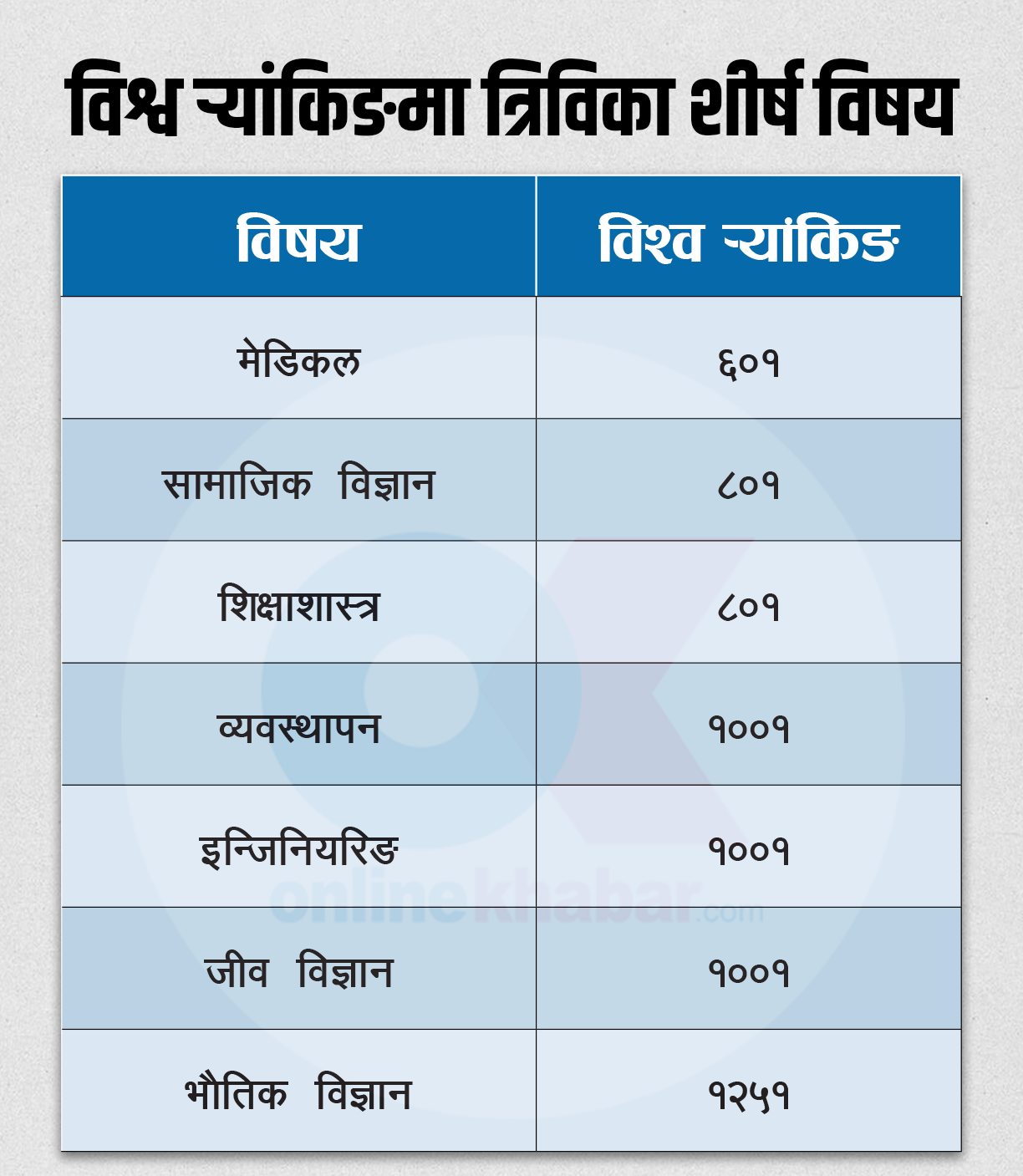
“Few universities globally compete in 11 subjects. Tribhuvan University participates fully in these categories within Times Higher Education rankings. In some subjects, we hold excellent positions. Medical education ranks 601st worldwide and is recognized as Nepal’s highest quality medical program.”
The rankings for other faculties are: Social Science at 801, Education at 801, Management at 1001, Engineering at 1001, Life Sciences at 1001, and Physics at 1251.
The primary strategy for improving rankings is to increase research output. This requires preventing budget constraints, introducing new subjects, boosting undergraduate numbers, balancing undergraduate and PhD student ratios, and attracting international faculty and students, Dr. Adhikari emphasized.


