




News Summary
- The government has allocated NPR 307.68 crore for railway, metro rail, and monorail development projects for the upcoming fiscal year 2083/84.
- The initial cost of the railway line project was NPR 7.062 billion, but the revised total cost has escalated to NPR 955.22 billion.
- Under the Nepal-China interregional Kerung-Kathmandu railway feasibility study, nearly 90% of the geological survey has been completed as of Falgun (mid-February).
May 12, Kathmandu – The government has allocated only NPR 3 billion for railway, metro rail, and monorail development projects in the fiscal year 2083/84.
According to the Ministry of Infrastructure Development’s annual development program, a total of NPR 307.68 crore has been earmarked for railway development next fiscal year.
Of this amount, NPR 279 crore is dedicated to the national pride projects of rail, metro rail, and monorail development in Kathmandu. The Railway Planning Office in Jhapa has been allocated NPR 5 crore and the office in Sarlahi has been granted NPR 23 crore.
The government had allocated NPR 269.36 crore to these projects in the current fiscal year and has made only a nominal increase in the upcoming budget.
During the budget speech, the government mentioned advancing the construction of the railway line from Bardibas to the starting point of the Kathmandu-Tarai-Madhes fast track. Additionally, it has set aside funds to complete ongoing works on the Bathnaha–Biratnagar and Janakpur–Jaynagar–Bardibas railway lines.
The policy of the upcoming fiscal year retains the continuation of the East-West railway line and includes studies on the investment modalities for the Kerung-Kathmandu and Raxaul-Kathmandu railway lines. However, substantial progress in railway projects in Nepal remains limited.
Nepal is marking a century since the inauguration of its first rail service. The 48-kilometer Amlekhgunj-Raxaul railway, launched in 1927, is regarded as Nepal’s first rail line. This service was discontinued in the 1960s. Later, in 1937, the second railway service began between Jaynagar, India, and Janakpur-Bijalpura, Nepal, stretching 51 kilometers and operated for a significant period.
According to plans started in 2021, the previously suspended rail service has been reconstructed and resumed. However, due to lack of efficient management, the service has not generated satisfactory revenue, and other railway projects are progressing slowly.
Recent Progress in Railway Development
According to the Economic Survey 2082/83, under the East-West electrified railway, by Falgun 2082, 68.6 kilometers of track bed and 16 railway bridges have been completed on the Bardibas–Nijgadh section (52 kilometers) of Bardibas-Chocha segment.
The Nepal-India interregional railway Jaynagar-Janakpur-Bardibas (69 kilometers) line currently operates 52 kilometers of passenger railway service.
Moreover, on the 17-kilometer Bhangaha (Bijalpura)-Bardibas section, land acquisition for the railway construction is nearing completion. The Bathnaha–Biratnagar railway (18 kilometers) has completed the Bathnaha–Biratnagar (10 kilometers) section, and cargo railway service is in its initial phase between Bathnaha, India, and the Nepal Customs Yard (8 kilometers).
Regarding the Nepal-China interregional Kerung-Kathmandu railway line, nearly 90% of the geological exploration under the feasibility study is completed as of this fiscal year’s Falgun.
Revised Cost of NPR 955 Billion But Budget Does Not Reflect Progress
The railway and metro development project is a national pride initiative that the government launched in 2008/09 and plans to complete by 2030/31 according to the National Planning Commission.
The initial project cost was NPR 7.062 billion but now the revised cost has soared to NPR 955.22 billion. According to the commission, the cost increase is mainly due to the expanded scope of the East-West electrified railway.
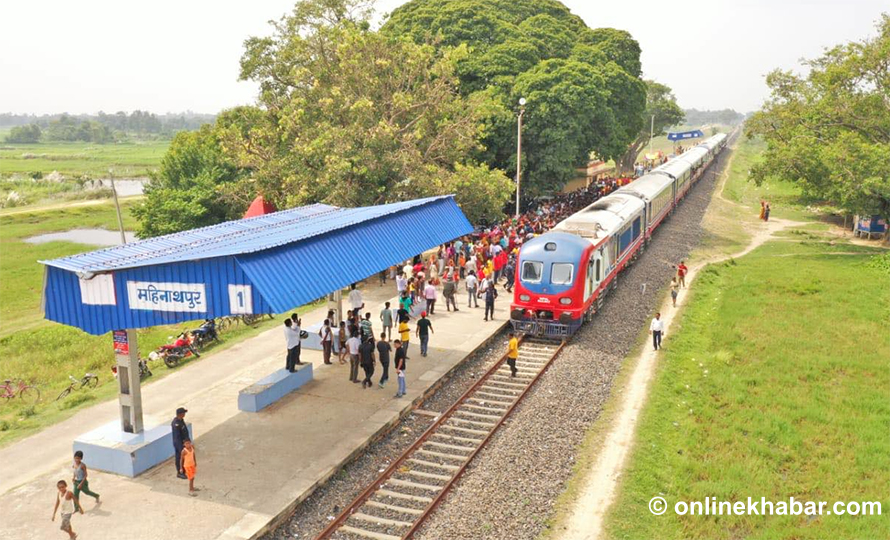
Despite the enormous cost estimates, the government’s annual budget allocations do not indicate the expected pace of progress in railway development.
The government is promoting this project with the aim of developing an environmentally friendly railway system across the Terai region from Mechi in the east to Mahakali in the west, powered by domestic hydropower-based electricity.
Rail transport is cost-effective, significantly reducing transportation expenses for cargo and passengers. Plans under the East-West railway include track beds, bridges, stations, and capacity enhancements.
However, delays in land acquisition, unresolved compensation disputes, difficulties constructing in forest areas, limited funds and resources, shortage of river sand and gravel, and issues with encroached or public land have hindered progress.
Update on Kerung–Kathmandu and Raxaul–Kathmandu Railways
Nepal prioritizes two interregional railway lines in its budgets and plans each year. The final feasibility report for the Kathmandu–Kerung (China) railway is still under preparation.
Fieldwork for this study is complete, and paperwork is ongoing. The report will finalize technical parameters such as distance, time, and cost. The preliminary cost estimate is approximately NPR 300 billion.
During Chinese Foreign Minister Wang Yi’s visit to Nepal in March 2022, the two countries agreed to conduct this feasibility study.
The detailed project report for the Raxaul–Kathmandu railway has been prepared by the Indian side. This 140-kilometer project was agreed upon by Nepal and India in 2018. Its cost estimate exceeds NPR 400 billion.


