Rastriya Swatantra Party Focuses Solely on Development, Neglecting Social Justice: Analysis with Tulanarayan Sah




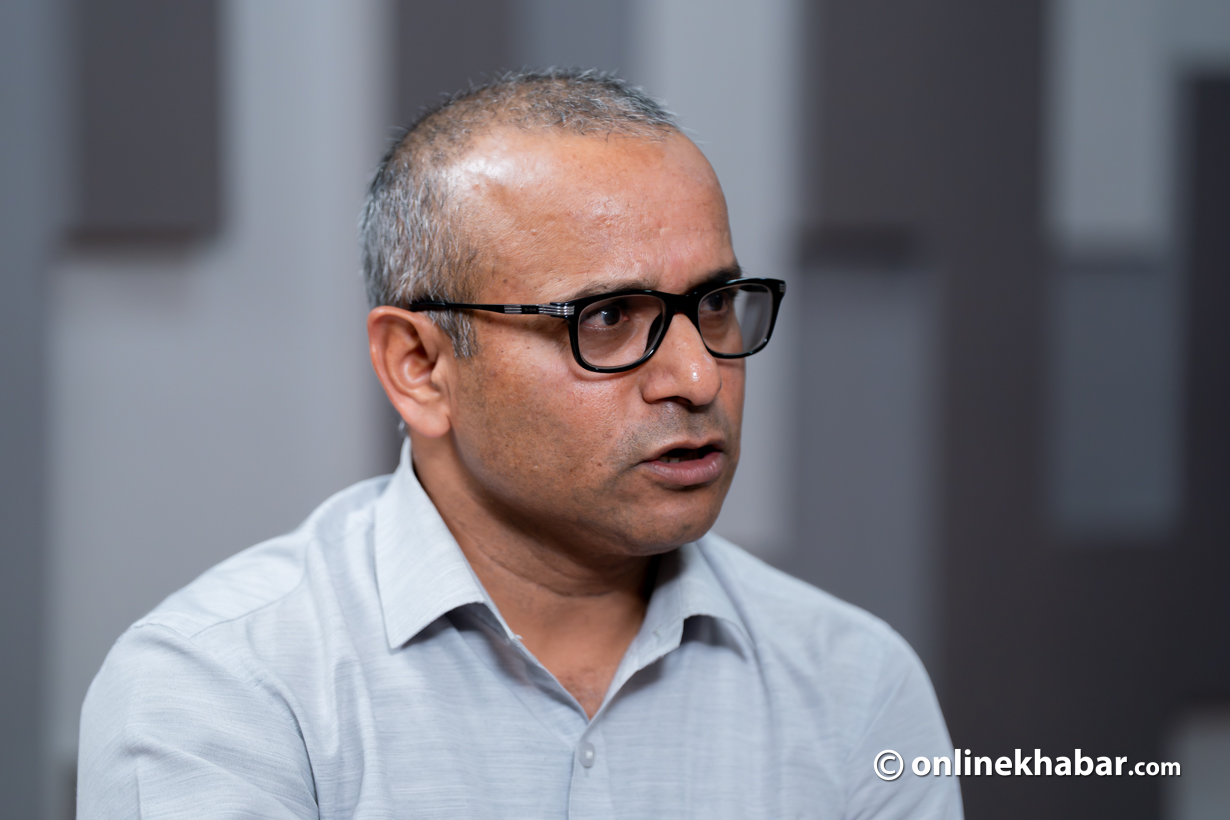
The Rastriya Swatantra Party (RSP) recently held its first general convention since its establishment four years ago. Nearly 4,000 delegates participated, and the party passed several significant political documents. However, delegates were not given the opportunity to debate or discuss these documents, as they were approved without deliberation. Since then, these three documents have sparked a national discussion. In this context, we spoke with political analyst Tulanarayan Sah:
The RSP held its maiden general convention after four years. There was curiosity about the political papers the ruling party would present and how these would shape the country’s political direction. Among the reports submitted was a proposal to ‘abolish provincial assemblies’. What is your perspective on this?
Firstly, the Rastriya Swatantra Party was established under circumstances where it garnered widespread public support within a short period, making both its convention and the approved documents highly significant. Dr. Swarnim Wagle’s proposal explicitly mentions this issue.
The document suggests several amendments, including introducing a directly elected executive chief and other changes. A major focus is the ‘abolition of provincial assemblies’, which has dominated media coverage.
However, upon reading the documents by Dr. Wagle and Ravi Lamichhane, I find other sensitive issues that have received little attention yet deserve more debate. The matter of abolishing provincial assemblies is only briefly addressed.
Understanding RSP’s true stance requires reviewing their past documents, interviews, and public speeches. Therefore, this proposal is neither new nor unexpected.
At the time of the first general election in 2022 (B.S. 2079), RSP had already raised this issue. Before that, the party rejected participation in provincial assemblies. The topic has been included in their documents since then. They argue they are not calling for the abolition of federalism per se, and the term ‘abolition of federalism’ does not appear in their declarations or interviews. Yet, their position does not seem supportive of federalism, which has caused public confusion. They propose replacing provincial assemblies with provincial councils.
This debate can be understood through three aspects:
1. What kind of federalism does the rapidly popular RSP envision?
2. What is the nature of federalism practiced over the past decade?
3. What kind of federalism do its proponents and protectors demand? The current debate arises from the mismatch among these three.
How do RSP’s federalism, the practiced federalism, and the demands of federalism proponents compare?
In practice, the provincial structure seems forcibly imposed. Provinces have geography, assemblies, chief ministers, and ministers but lack adequate powers. I believe governance could continue effectively with only central and local levels. The provincial system appears to have been implemented reluctantly and superficially.
RSP’s vision of provinces is even weaker—an administrative federalism. While current structures recognize some identity aspects, RSP envisions provinces without assemblies or elected representatives.
Currently, provincial assemblies legislate, approve budgets, and select governments, but RSP’s documents have none of these provisions. Their provinces would be weak and purely administrative.
Supporters of federalism demand stronger provinces. Mainly Madhesi parties, influenced by India’s federal system, call for robust provincial governments.
Federalism advocates want provincial governments to be powerful, not just legislative bodies but having authority to appoint officials and police. Without provincial police or administration, governance is impossible. Provincial oversight of local governments and employee transfers should rest within the province. They back strong provincial powers.
Hence, there is a fundamental disconnect between federalism proponents’ demands, existing practice, and RSP’s model. This is the core controversy.
You mentioned the need for stronger provinces. I recall Prime Minister Balendra Shah’s speech in Janakpur where he emphasized strengthening provinces. Does the RSP’s convention document reflect this sentiment?
No, the RSP’s official documents do not express this. That was Prime Minister Balendra’s personal view. Election-time statements can be strategic, so speeches and official documents may convey different messages.
Are the terms ‘abolishing provincial assemblies’ proposed by Dr. Swarnim Wagle and ‘restructuring provincial assemblies’ by Ravi Lamichhane the same or different?
The documents by Ravi Lamichhane, Dr. Wagle, and earlier RSP materials align on one point: envisioning a weaker federalism than currently exists.
Reading them reveals a contradictory message that may appear to support strong federalism. But the detailed analysis of Dr. Wagle’s eight-page and Lamichhane’s twenty-three-page documents clarify the intent. Both share the same intent, though this contrasts with the message conveyed in the Janakpur speech.
Does the document advocate a model where executive powers of provinces would be directed centrally after abolishing provincial assemblies?
Yes, that’s my interpretation. Other RSP documents suggest abolishing provincial assemblies due to high costs and member numbers. They propose forming smaller provincial councils composed of elected local representatives, empowered to legislate. The chief minister would be directly elected.
Understanding RSP’s political vision requires probing how the party emerged and what politics it practices.
Given power struggles and lack of provincial authority, is the argument for joining the Maoist movement stronger?
Perhaps, but RSP’s core ideology is ‘developmental’. Federalism’s primary aim is not rapid development or poverty alleviation projects.
Nepal’s federalism has two principal reasons that differ from RSP’s view.
First, Nepal is a diverse society, but this diversity lacked representation in the state and politics, causing many marginalized groups to become alienated. Federalism was introduced to integrate this diversity with the state.
Second, many communities believe they might never hold the prime minister’s office. Federalism ensures they can at least be chief minister in their provinces, guaranteeing representation.
Federalism’s core goal is not just development or corruption control but constitutional protection of social identity and representation.
Its purpose is to manage diversity and ensure self-governance and inclusion in political governance.
Development and poverty alleviation are components, but social justice and identity guarantee are paramount.

RSP’s political stance is purely developmental. From its 100-point manifesto to the recent documents, the main focus is “we will develop, reduce corruption, and create jobs.”
How does the document address social justice and inclusion? It also discusses fully proportional and directly elected executives.
Directly elected executives are to be introduced after constitutional amendments. RSP advocates for a ‘fully proportional electoral system’. But questions remain: who will be represented and on what criteria? The emphasis is mainly on youth representation by age and gender proportionality.
However, the documents do not clearly specify if full proportionality will extend to social groups and ethnicities.
The 2006-7 movements—the people’s war by Maoists and the Madhesi movement—demanded inclusion of social and ethnic groups in the state. The constitution accepted this with reservation and quota systems in political and government sectors.
But RSP’s documents lack clear commitment to social and ethnic proportional representation, focusing mainly on age and gender.
What is your assessment of the documents concerning social justice?
There are contradictions. From an analytical perspective, both Lamichhane’s 23-page and Wagle’s 8-page documents demonstrate limited clarity and conflicting stances on social justice.
Wagle’s document positively acknowledges structural discrimination in Nepal, calling it a stigma requiring reform. But later states they do not focus on equality in outcomes, which undermines social justice goals and weakens movements.
Lamichhane envisions an inclusive and welfare state but not in the sense understood by Nepal’s social movements. Society itself is diverse, but state structures lack inclusion.
Thus, these documents do not embrace or welcome the long-standing social justice movement but rather attempt to divert it into traditional frameworks.
Positive aspects of the RSP documents include institutionalizing party formation through the convention. How do you view this process and party’s direction?
Let’s discuss in two parts—first, RSP’s political ideology and what kind of politics it aims for; second, what kind of party it seeks to become. Nepal’s party formation history is important.
Older parties typically fall into three categories:

First, parties emphasizing democracy and nationalism with limited focus on social issues. Second, parties prioritizing identity and representation. Third, parties prioritizing development and prosperity.
RSP belongs to the third category, prioritizing development and prosperity. When others criticize RSP on identity and representation grounds, the party remains silent.
RSP emphasizes development, anti-corruption, and youth leadership. Its public support and youth representation in parliament and party create a conducive pathway for development.
However, there’s a risk of marginalizing groups who have long fought for identity and representation rights.
RSP may be less vocal on serious social justice and nationalism issues.
Next is the party structure. Globally, political scientists classify parties based on leadership selection into five types, as per Susan Scarrow:
First, parties where all members directly vote to elect leaders. Second, members select delegates to a convention who then choose leaders, like Nepali Congress and CPN UML. Third, parties formed by corporate or powerful centers. Fourth, parties established by small groups of familiar faces. Fifth, single-leader dominant parties.
RSP appears to be a mix of the first three models.
Nepalese parties historically emerge through struggle, during elections, or via splits from power holders. RSP is a party born in the election period.
It is a clear developmental party with signs of a one-man dominant structure. Since Ravi Lamichhane’s rise, the party’s popularity has increased, currently with two leaders wielding comparable influence.
You mentioned the risk of internal discord due to centralized leadership. How likely is party unity moving forward?
Formal documents generally present well, but political differences persist. RSP is a young party with underdeveloped internal democracy.
In Nepal, managing power-sharing between two top leaders within a major party is a significant challenge.
RSP features a similar situation with Ravi and Balendra, reminiscent of the Oliphant and Prachanda dynamics. History shows strong internal democracy is key to party longevity and stability.
Three bodies are essential for robust internal democracy:
1. Decision-making processes (candidate selection, disciplinary actions, managing finances) 2. Leadership selection 3. Policy formulation.
Currently, RSP lacks fully developed structures in these areas. Weak internal democracy makes sustaining the party and government challenging.
Given the present circumstances, if Ravi and Balendra cooperate to run the government for five years, it would benefit the country.
Past parties have found such cooperation difficult. Party stability depends largely on the strength of internal democracy.


