



Summary
Editorial review completed.
- Over the past decade, Nepal’s government social security expenditure has increased by 592%, reaching NPR 11.44 billion.
- The Auditor General’s report advises the government to manage rising financial burdens, driven by increased beneficiaries and changes in allowance rates.
- The government plans to promote voluntary waiver of benefits by financially capable citizens and implement a needs-based distribution system to ensure sustainability of social security.
Jestha 15, Kathmandu – In the last decade, Nepal’s government social security expenditure has surged by approximately 592 percent.
According to the Office of the Auditor General’s performance audit report, the social security expenditure was NPR 1.652 billion in fiscal year 2072/73 (2015/16).
By fiscal year 2080/81 (2023/24), this amount had risen to NPR 11.44 billion, marking an increase of NPR 9.788 billion over ten years, equivalent to a 592% growth.
In Nepal, social security allowances are provided to economically vulnerable groups, people with disabilities, single women, children, individuals unable to care for themselves, and communities in crisis.
The total number of beneficiaries increased from 2,265,535 in 2071/72 (2014/15) to 3,806,634 over the decade.
The government’s social security expenditure as a percentage of the total budget rose from 2.75% to 7.51%.
The Auditor General’s report highlights that including expenditures by provincial and local governments and related social security programs, total spending is even higher.
The report identifies the main challenges driving the rising financial burden as the annual increase in beneficiary numbers, demographic and group changes, adjustments in allowance rates, and difficulties in delivering social security benefits based on actual needs.
It recommends that the government conduct appropriate studies and analyses to sustainably manage this financial burden according to the state’s capacity.
90-Year History, Expansion since 1994
Nepal’s social security system has a history spanning nearly nine decades, formally starting in 1934 with a military fund. In 1944, the government established the Civil Service Pension Fund to provide financial support to retired government employees.
Social security benefits for the general public began with the 1994/95 budget, introduced by then Finance Minister Bharat Mohan Adhikari.
That year, monthly allowances of NPR 100 were first provided to citizens over 75 years of age.
The program expanded over time, and by fiscal year 2080/81 the number of beneficiaries reached approximately 380,000.
The Auditor General notes that various policies and budgets over the years increased allowances and lowered qualifying ages, boosting beneficiary numbers. However, revenue growth and economic expansion have not kept pace, creating challenges in resource management.
Development of Social Security Allowances in Nepal
The initial social security allowance in 1994/95 targeted citizens aged 75 and above. From 1996/97, widows and people with disabilities also became eligible for allowances. Starting 2008/09, single women, crisis-affected communities, Dalits, and elderly citizens aged 60+ in the Karnali region began receiving benefits. In 2009/10, children under child protection programs also qualified for allowances.
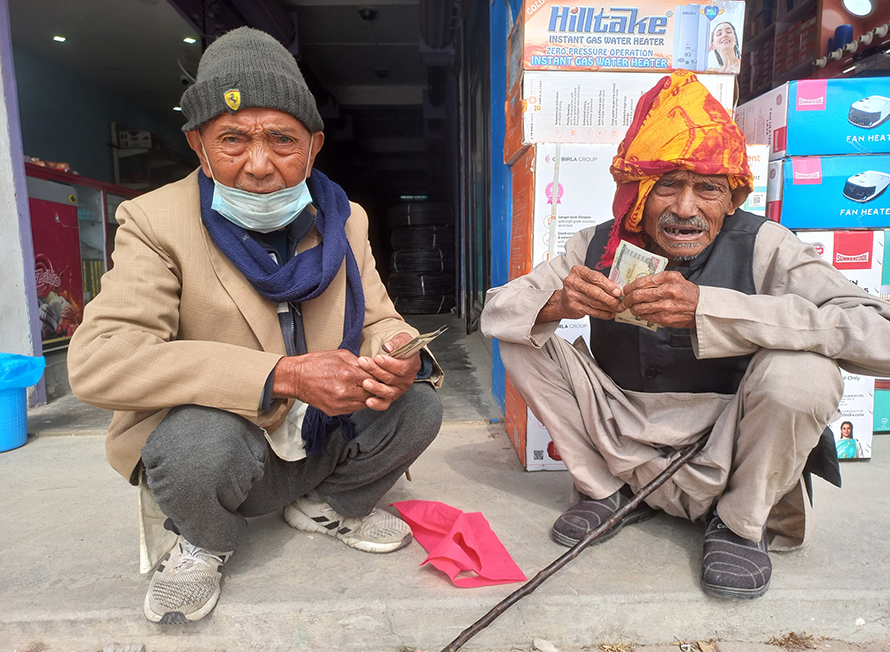
Currently, social security allowances are distributed across five districts in Karnali Province and 25 other designated districts. Initially, citizens over 75 received NPR 100 monthly, which rose to NPR 1,000 by fiscal year 2072/73.
Allowance rates increased gradually: NPR 150 in 1999/2000, NPR 175 in 2004/05, NPR 500 in 2008/09, and reaching NPR 4,000 per month since 2021/22.
In 2022/23, lowering the eligibility age from 70 to 68 added 305,000 beneficiaries, incurring an additional NPR 1.312 billion in expenditure.
Benefits Distribution by Beneficiary Group in Fiscal Year 2080/81
In the current fiscal year, 1,719,800 elderly citizens aged 68+ receive NPR 4,000 monthly, reflecting an annual responsibility of NPR 7.686 billion, accounting for 67.23% of total social security expenditure.
Senior Dalits aged 60+ receive NPR 2,660 monthly. With 157,887 beneficiaries, this group represents a financial responsibility of NPR 477 million.
Senior single women aged 60+ also receive NPR 2,660 monthly, with 159,310 beneficiaries and a responsibility of NPR 642 million.
Beneficiaries from designated senior citizen areas number 16,950, creating an annual financial responsibility of NPR 5.086 million. Widows of all ages receive NPR 2,660 monthly; with 416,687 beneficiaries, this equates to NPR 1.129 billion.
Citizens with full disability of any age receive NPR 3,990 monthly. There are 69,952 beneficiaries, amounting to a monthly responsibility of NPR 304 million.
Persons with serious ‘category B’ disabilities receive NPR 2,218 monthly. This group includes 150,883 beneficiaries with a responsibility of NPR 342 million.
Dalit children under five receive a nutrition allowance of NPR 532 per month, with 336,706 children benefiting and a responsibility of NPR 218 million.
Children under five in designated areas also receive NPR 532 monthly, totaling 756,409 beneficiaries and NPR 475 million in responsibilities.
Members of crisis-affected communities number 22,050 and receive NPR 3,990 monthly, amounting to NPR 105 million in responsibility.
Recommended Improvements
The Auditor General advised that social security allowances should be made needs-based, considering family expenses, assets, poverty level, family protection, social exclusion, and employment status to improve effectiveness.
A lack of clear criteria distinguishing between ‘category A’ and ‘category B’ disabilities has led to misclassification, administrative issues, and certification challenges. A needs assessment is also recommended for child nutrition allowances.
For widows and single women, inclusion in employment skill development and empowerment programs is suggested to promote economic and social progress.
Allowances have primarily assisted families in crisis-affected communities, but with declining populations, programs focused on education, health, employment, and market access are needed for empowerment.
It is recommended that allowance distribution contribute not just to subsistence but also to prosperity. The absence of clear criteria for poor and vulnerable beneficiaries has increased spending.
Eligibility should be based on age and area as well as assets, traditionally disadvantaged regions, caste, family income, and employment status.
The government currently designates five districts in Karnali Province—Kailali, Humla, Jumla, Mugu, and Dolpa—as backward. Nonetheless, beneficiaries residing outside these districts also receive benefits, highlighting the need for geographical and poverty-based criteria.
The report suggests regular monitoring and strengthening data systems to ensure benefits are distributed only within designated districts.
System to Honor Those Waiving Benefits
Section 12(ka) of the Social Security Act 2075 provides that beneficiaries voluntarily opting not to receive allowances should be honored with certificates of appreciation. However, no beneficiary has yet received this recognition.
Efforts to encourage beneficiaries to voluntarily waive allowances through alternate means have so far been ineffective and require improvement.
To make social security programs more effective and sustainable, the report recommends implementing health insurance, transportation fee discounts, public service benefits, and empowerment initiatives targeting economically secure elderly and active citizens.
What plans does the new government have for social security?
The government plans to make the social security system more equitable and targeted in the upcoming budget. A national campaign will encourage financially capable citizens to voluntarily forgo allowances under the slogan “Those who can leave, should leave; those in need should receive.”
Such participation will be honored as an example of intergenerational justice and national unity, although this provision already exists in the Social Security Act.
Monthly nutrition allowances for Dalit children nationwide have been increased from NPR 500 to NPR 1,000. Budget statements also confirm continuation of nutrition programs targeting children in 25 districts with moderate to severe poverty in Madhesh, Karnali, and Sudurpaschim regions.


