Author: space4knews

सांसदहरू, स्वकीय सचिव माग्न नधकाउनुहोस् – Online Khabar

Members of Parliament Should Not Hesitate to Request Personal Secretaries

Members of Parliament (MPs) need personal secretaries; however, no one is willing to openly discuss this within the context of good governance and frugality. The main reason for this reluctance is the fact that in the past, some MPs appointed their relatives as personal secretaries. Some MPs have made inappropriate appointments instead of hiring qualified individuals. Among these, some have employed people with education below the eighth grade in roles equivalent to officer-level jobs, thereby distorting the system. A few personal secretaries have even become intermediaries known locally. As MPs, who are responsible for lawmaking, started violating these laws, questions have been raised about the necessity and justification of the personal secretary system. Journalist Makar Shrestha had submitted an investigative report about the distortions caused by the personal secretary system one and a half years ago. Due to these distortions, the government led by Sushila Karki was compelled to abolish the personal secretary arrangement. The Karki administration amended the Federal Parliament Members’ Remuneration and Facilities Act of 2016 (2073 BS), removing the personal secretary benefits of MPs.

On October 22, 2025 (2082 Ashoj 5), the newly elected government faced dissatisfaction among federal parliamentary officials regarding this decision. The move was made to uphold frugality at all levels of government. While some provinces, including Sudurpaschim, were slow to implement the abolition of personal secretaries, a few days ago MPs from Koshi Province requested Prime Minister Balen Shah to reinstate the personal secretary arrangement. According to parliamentary representatives, operating MPs’ offices has become extremely difficult under current conditions. They are unable to answer phone calls or reply to messages, and lack sufficient time for personal work. During elections, MPs pledge to work 24/7 for public welfare, but practically this is not feasible.

MPs need to read draft bills and manage minor parliamentary tasks. With an increasing number of young MPs, workload and stress have also grown. Yet, MPs remain silent about requesting necessary support because many have previously abused the personal secretary position. Jobs were given to family, relatives, and friends, and salaries were misappropriated by the MPs themselves, leading to a poor image of this benefit. Some personal secretaries merely act as assistants to the party or leaders. However, this is a personal weakness of the MPs, not the system.

Personal secretaries can also be respected advisors to MPs. They can assist MPs by conducting thematic research. Some MPs regularly perform outstanding work in parliamentary meetings and committees, thanks to their teams. However, not all MPs have teams, which is why government support is necessary. To ensure personal secretaries’ investment is not wasted, regular attendance must be maintained. A deep understanding of subjects is essential to make bill discussions and performance effective. Personal secretaries are also responsible for handling constituency work and addressing voters’ expectations. Voters want to call MPs by name. The role of proportional representation MPs is even greater as they must deliver equitable service to the entire nation.

If necessary, the constitution can be amended to reduce the number of MPs. To have strong and effective MPs, minimum resources must be provided. Leaving MPs helpless renders election promises meaningless. Like former MPs such as Subas Nembang, Gagan Thapa, and Pradeep Giri, who maintained efficient personal secretariats and performed well, this approach facilitated the management of constituency and parliamentary work. It also enhanced public perception that their leaders were accessible.

Considering foreign examples, the United States federal parliament provides senators with a budget for facilities. In the United Kingdom, MPs receive staffing allowances to hire private secretaries. In Germany, MPs get allowances and resources for research and administrative assistance. The European Union and other organizations also allow MPs to employ private secretaries, but strict action is taken if relatives are appointed. In several countries, separate employees are appointed for parliamentary work and constituency duties. Some countries even have MPs functioning without personal secretaries. In India, MP Shashi Tharoor from Thiruvananthapuram has admirably balanced constituency work and writing. Eight years ago, I shared Tharoor’s time management example with former UML MP Pradeep Gyawali, who remarked, “Here, such harmony is impossible.” Tharoor actively writes on economics, history, geopolitics, literature, and governance policies, with influence not only in India but globally. Imagine what would happen if he did not have a personal secretariat team.

It is necessary to monitor the misuse or proper use of personal facilities. Mechanisms are needed to ensure that regular work is carried out. Neglect by MPs in parliamentary sessions may anger voters. What the future holds is awaited. Prime Minister Balen has already expressed commitment to reform the MPs’ personal appointment system. Instead of leaving MPs powerless, reestablishing the personal secretary system is essential to make them effective. It is time to create clear rules to control the distortions observed in this system.

Chamber Honors Nine Individuals Across Various Categories on Hirak Jayanti

On the occasion of its 75th Annual General Meeting, Nepal Chamber of Commerce honored individuals contributing significantly in nine categories, with the awards presented by President Ramchandra Paudel. President Paudel emphasized the need to recognize the private sector as an integral partner in nation-building and the engine of the country’s economy. Chamber President Kamlesh Kumar Agrawal highlighted the impact of political instability and policy uncertainty on the private sector and expressed readiness to collaborate with the new government. (27 Chaitra, Kathmandu).

During the 75th Annual General Meeting, Nepal Chamber of Commerce recognized outstanding contributors across nine fields. The honors were presented by President Ramchandra Paudel through memorial awards established in the names of former chamber presidents. Distinguished personalities from sectors including trade, industry, agriculture, tourism, social service, and trade logistics were felicitated by the President.

Ganesh Bahadur Shrestha, co-founder of Sujal Foods Pvt. Ltd., was awarded the Ishwarlal Shrestha Lifetime Achievement Award. Vinod Shankar Shrestha, Chairman and Managing Director of Hotel Shankar, received the Banwari Lal Mittal Memorial Award for tourism. The Juddha Bahadur Shrestha Memorial Award for trade was bestowed upon Nepal Wool House. Ganesh Eddie of Ganesh HEMs was honored with the Raj Bahadur Chipalu Memorial Award in agriculture. Rabindraman Singh Pradhan, Chairman of Everest D Cargo Pvt. Ltd., received the Biharilal Khetan Memorial Award for trade logistics.

In his speech, President Paudel stressed that the private sector should be viewed not only as a tax-paying entity but as a vital partner in nation-building and the economic engine of the country. He pointed out that only a strong private sector can strengthen the national economy and called for enhanced cooperation between the government and private sector. Furthermore, he emphasized that engaging youth in economic activities through entrepreneurship, technology, and creativity is an urgent priority today.

Government Led by Balen Shah Appoints Six Female Ministers

The 16-member cabinet under Prime Minister Balen Shah now includes six female ministers. Formed on Chaitra 13, the government has appointed women to the Ministries of Law, Agriculture, Women, Children, and Health. On the Prime Minister’s recommendation, Gaurikumari Yadav has been appointed as Minister for Industry, Commerce, and Supplies.

Kathmandu, Chaitra 27 – The cabinet led by Prime Minister Balen Shah has raised the number of women ministers to six. Upon the government’s formation on Chaitra 13, Sovita Gautam was appointed Minister of Law, Justice and Parliamentary Affairs; Geeta Chaudhary was named Minister for Agriculture and Livestock Development; Sita Wadi took the post of Minister for Women, Children and Senior Citizens; and Nisha Meheta was appointed Minister of Health and Population. Today, on the Prime Minister’s recommendation, Gaurikumari Yadav assumed the role of Minister for Industry, Commerce, and Supplies.

Nepal’s constitution mandates at least 33 percent female participation in state bodies. Currently, women represent over 37 percent of this government’s cabinet members.

यस्तो हुन्न के ‘राइट टु रिकल’ ! – Online Khabar

‘Right to Recall’ Does Not Work This Way!

News Summary

Editorial Reviewed.

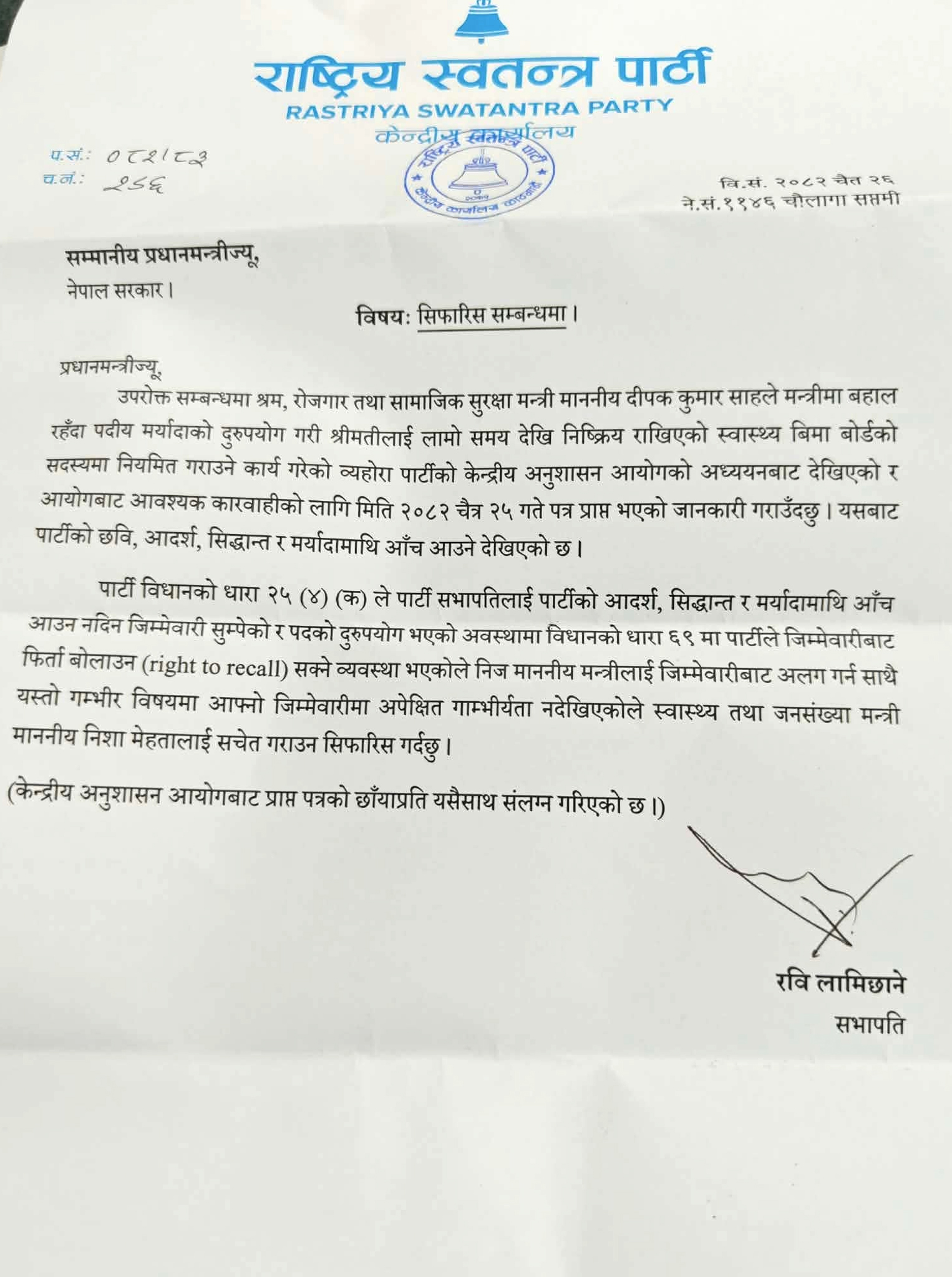
  • Prime Minister Balendra Shah dismissed Labour Minister Deepak Kumar Sah upon the recommendation of National Independent Party chairman Ravi Lamichhane.
  • Although the Rashtriya Swatantra Party’s (Raswap) statute includes a ‘Right to Recall’ provision, constitutional expert Dr. Bipin Adhikar stated that dismissing a minister does not equate to this right.
  • In Nepal, the ‘Right to Recall’ refers to the voters’ authority to withdraw their elected representatives.

March 27, Kathmandu — According to Greek historian Herodotus, democracy is a system of governance where all power rests with the people. Abraham Lincoln, the 16th President of the United States, defined democracy as a “government of the people, by the people, for the people.”

People transfer their sovereign power to representatives through ballots for a fixed term, and these elected representatives govern on behalf of the people.

But what happens if these elected representatives are unaccountable to the people? This question relates to a remark by former British Prime Minister and author Winston Churchill.

“A little man enters a small room, takes a small pencil, and makes a small mark on a small piece of paper. These small marks determine the country’s fate for five years,” Churchill said, “but after the election, that little man is forgotten, neglected, and ignored — until the next vote.”

When the people are neglected, the mechanism that allows them to remove elected representatives before their term ends is known as the Right to Recall. This ensures elected officials remain accountable to their constituents.

This right enables constituents to remove members of parliament or local representatives if they fail their responsibilities or break public trust. The Right to Recall is believed to strengthen democracy, although it is also associated with costs and political instability.

In Nepal, if the Prime Minister loses a vote of confidence, parliament can dismiss the government, and impeachment processes can remove the president or vice president. The Prime Minister has the exclusive authority to dismiss ministers.

Just last Thursday, Prime Minister Balendra Shah dismissed Labour, Employment, and Social Security Minister Deepak Kumar Sah. Sah was removed within two weeks of his appointment, following a recommendation from Rashtriya Swatantra Party (Raswap) Chairman Ravi Lamichhane.

The chairman’s letter noted that Sah was recalled following Raswap’s ‘Right to Recall’ provisions. However, the Prime Minister holds the authority to remove ministers even without party recommendations.

The Prime Minister has the prerogative to form his cabinet as he wishes. According to constitutional expert Dr. Bipin Adhikar, the Prime Minister may add or remove ministers at any time. He stated, “Whether or not it is written in a party’s statute, the Prime Minister’s authority to alter ministers is not obstructed.”

Raswap’s statute includes that “general members of the party from the concerned area shall have the right to recall a representative if the representative fails in their duties. Upon a decision by a specified number or percentage of members, the central committee will begin the process to remove that representative.”

Moreover, proportional representatives acting against party interests or for other reasons can also be recalled and dismissed through procedures outlined by the central committee’s regulations.

While Raswap’s decision to remove the contested minister is welcomed, associating the ‘Right to Recall’ directly with ministerial dismissals is misguided. The concept is distinct. Dr. Bipin Adhikar said, “A party recalling its own MPs or ministers is not the ‘Right to Recall.'”

As soon as Minister Sah was dismissed, analyst Dambar Khatri commented on social media platform X, “The Right to Recall means voters can withdraw their representatives if they fail to fulfill their mandates; it does not mean the party can recall ministers.”

The authority to decide on recall lies with voters, not party committees. Dr. Adhikar emphasized, “The right belongs to those who voted for the candidate, not party leaders.”

Current laws suffice to dismiss MPs who act against party directives or violate laws.

The Right to Recall is exercised by voters, not upper-level leaders. However, the ruling Raswap appears to interpret it differently.

For example, on July 9, 2020 (25 Ashad 2077 BS), Sarita Giri, a House of Representatives member from the Samajwadi Party, was dismissed after violating party whip during the passage of the constitutional amendment bill related to Limpiyadhura and Kanchanpur maps.

The party sent a letter to the parliamentary secretariat based on the Political Parties Act, 2016, and the interim statute of the Samajwadi Party, 2019. Note that this statute does not mention the ‘Right to Recall.’

Section 28 of the Political Parties Act allows parliamentary party chief whips to enforce directives on government policy and budget matters, giving grounds for disciplinary action when violated.

Additionally, Article 89 of the Constitution stipulates that MPs who leave their party lose their federal parliamentary seat.

In 2022 (2079 BS), Raswap expelled MP Dhaka Kumar Shrestha over the Durga Prasai controversy, leading to his removal from parliament.

Furthermore, resignation, death, or absence without leave for ten consecutive meetings also results in loss of parliamentary membership.

In August 2023 (Ashad 2080 BS), the Maoist Centre decided to recall Minister Aman Lal Modi. At that time, the party was preparing to appoint Anita Devi Sah, a proportional representative, as minister in his place.

Various parties have recalled ministers without mentioning the Right to Recall in their statutes, including the Maoist Centre.

Constitutional law and parliamentary experts state that party statutes and regulations cannot supersede constitutional provisions. The 2019 Constitution allowed members of the National Panchayat to be “recalled.”

After the republic was established, a proposal to allow 25% of voters to demand recall of MPs was submitted to the House State Affairs Committee but never adopted into law.

Without legal provisions, implementing recall is not feasible. Dr. Adhikar explained, “Disciplinary action under the Political Parties Act constitutes a form of recall. However, a party decision alone cannot be called a ‘Right to Recall.'”

Directive Issued to Add Four Types of Services at Airports Nationwide Within 24 Hours

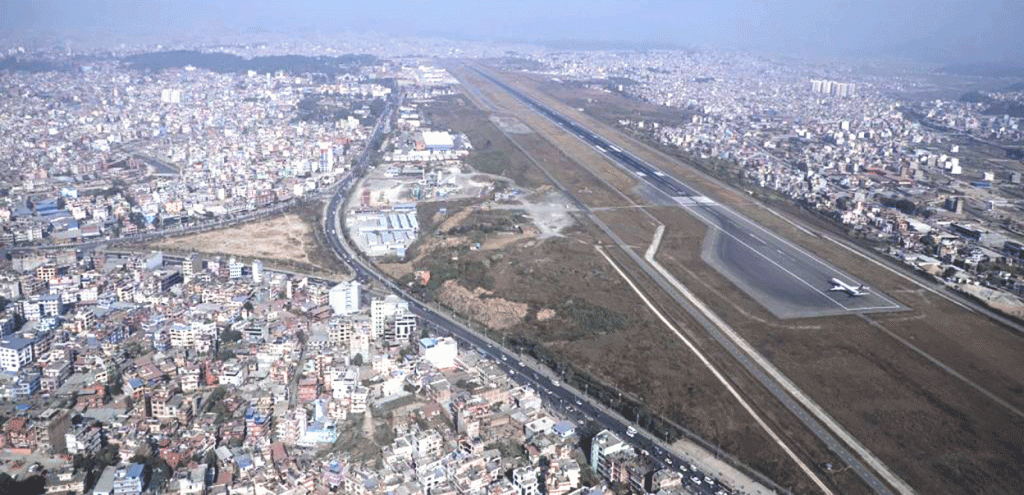
The Ministry of Culture, Tourism and Civil Aviation has issued a directive to add or upgrade four types of services at airports across the country within 24 hours. The ministry has instructed airports to establish breastfeeding and infant care rooms, as well as priority care rooms for patients and passengers with special needs. Additionally, it has mandated the provision of free sanitary pads, strict adherence to hygiene standards, and regular inspections.

Kathmandu, 27 Chaitra – The Ministry of Culture, Tourism and Civil Aviation has directed all airport offices nationwide to enhance or introduce four specific facility types. Secretary Mukundra Prasad Niraula has formally communicated to the Civil Aviation Authority of Nepal to improve the quality of airport services by implementing these changes within 24 hours.

The ministry has ordered the establishment of breastfeeding and infant care rooms at airports. These rooms must ensure cleanliness, safety, and privacy, either through new operations or necessary upgrades. There is also a directive to set up priority care rooms for patients and passengers with special requirements.

Furthermore, the ministry has stipulated that free sanitary pads should be made available. In line with the fourth directive, airport premises must maintain stringent cleanliness and hygiene standards. A logbook system will be implemented for daily sanitation activities, and the standards set forth by the World Health Organization and the International Civil Aviation Organization must be strictly followed. The ministry stated that if airport offices fail to submit reports, photographic evidence, and logbook details within 24 hours, disciplinary action will be taken. Additionally, passengers can lodge complaints via WhatsApp at the number 9851312722 if they have any grievances regarding airport services.

Mahendra KC Arrested in Unity Life Fraud Case; Was Fleeing Sentencing

Kathmandu, March 11 – Mahendra KC, a director of Unity Life International Limited who was absconding after being convicted in a fraud case, has been arrested by police. The Central Investigation Bureau (CIB) of the Nepal Police announced that KC was taken into custody on Friday from Samakhusi, Kathmandu. KC, 52, originally from Baglung Municipality-3, was residing in Kathmandu Metropolitan City-26, Samakhusi.
On April 14, 2025 (Baisakh 2, 2082 BS), the Supreme Court convicted KC in the Unity Life fraud case, sentencing him to a fine of NPR 25,000 and imprisonment for two years and six months. Authorities reported that KC had fled before the sentence was enforced. Following his arrest, the police have presented him to the District Court of Lalitpur to begin the execution of his sentence, according to the Central Investigation Bureau.

आवेगले कसरी निम्त्याउँछ हिंसात्मक घटना ? – Online Khabar

How Impulse Can Lead to Violent Incidents

News Summary

Editorially Reviewed.

  • On the evening of 27 Chaitra, Sumit and Sirjan Nembang were seriously injured after being stabbed at Patan Krishna Temple in Lalitpur.
  • The police have arrested 32-year-old Sanjiv Nepali and his accomplices; initial investigations indicate the incident was driven by impulsive anger.
  • Psychiatrists state that lack of impulse control and personality-related issues can lead to such violent events.

27 Chaitra, Kathmandu – As the evening was fading, Patan’s Krishna Temple was bustling with tourists and locals. Suddenly, screams shattered the peaceful ambiance.

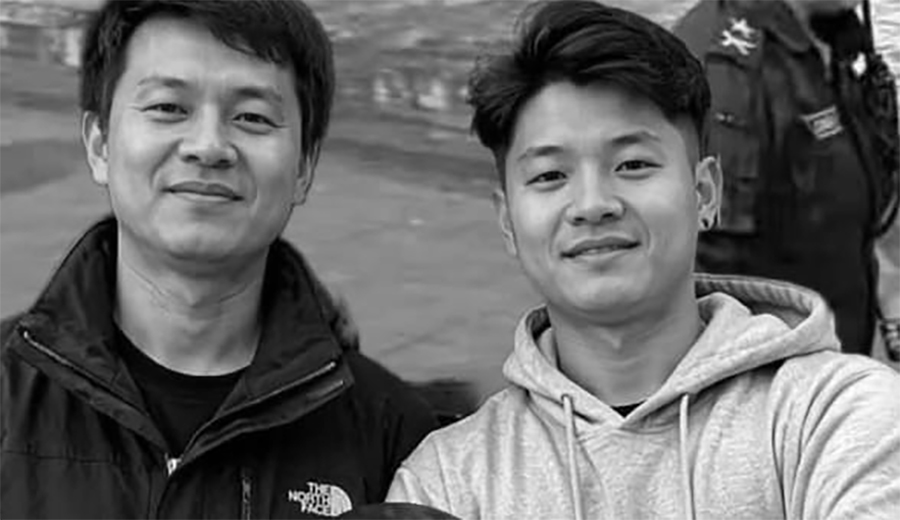
Within moments, the tranquil environment turned into panic. Sumit Nembang, 33, originally from Jhapa and residing in Lalitpur, and his 25-year-old brother Sirjan Nembang were attacked with a knife. The assailant was identified as 32-year-old Sanjiv Nepali (Sanju). The incident occurred around 7:30 PM on Wednesday.

Both victims were rushed to B&B Hospital in Lalitpur for urgent treatment. However, by 8:30 PM, doctors declared them dead. The two were siblings.

How did the incident take place?

Earlier in the day, Sumit and Sirjan had set out with their uncle, Basanta Nembang, to Mangolbazar. While touring the Patan Durbar area, Sumit called a friend but mistakenly dialed a wrong number belonging to Sanjiv Nepali from Bhoudhok, Lalitpur Metropolitan City. Neither of them knew each other prior to this call.

During their first phone conversation, a dispute arose. After realizing the mistake, Sumit ended the call, but Sanjiv repeatedly attempted to call back. According to Lalitpur Police Chief SSP Hobindra Bogati, Sanjiv asked Sumit over the phone, “Where are you?” Upon learning Sumit was in Mangolbazar, Sanjiv suggested meeting there.

Verbal abuses were exchanged over the phone. Later, around 7:30 PM, the Nembang brothers and three friends arrived at Krishna Temple in Mangolbazar. Soon after, Sanjiv and his friend Gagan Sunar arrived on a scooter.

Both groups met there. Sirjan and his friends sat downstairs while Sanjiv’s group was also seated nearby. Sumit and Sanjiv went upstairs via the temple steps. The conversation turned heated and led to a fight. At that moment, Sanjiv pulled out a knife.

According to Bogati, Sumit grabbed Sanjiv’s arm holding the knife and punched him, but Sanjiv freed his arm and stabbed Sumit in the neck. Sumit collapsed immediately. After injuring Sumit, Sanjiv descended the temple steps.

Sirjan tried to stop him, but Sanjiv stabbed Sirjan in the stomach and neck as well. Sirjan was severely wounded and also collapsed at the scene. Police have taken Sanjiv into custody and are conducting further investigations.

Nembang brothers

The Psychological Perspective

This incident raises the psychological question: how do impulses drive someone to make such critical decisions?

Psychiatrists identify intense impulse as the primary cause. Initial investigations also point to anger and agitation triggering the event. Lalitpur SSP Hobindra Bogati confirmed that the incident stemmed from impulsiveness and provocation.

According to Dr. Sagunballabh Pant, rapid impulses and losing control over them can cause such incidents. While anger is a normal emotional response, excessive anger impairs the ability to think through causes and consequences, which may result in accidents.

The brain’s frontal lobe, specifically the pre-frontal cortex, signals risks and possible outcomes. In normal circumstances, individuals heed this warning, preventing escalation. Yet, excessive impulses reduce this thinking capacity, making it difficult to manage anger, resulting in violence.

Sometimes, personality-related disorders weaken impulse control. Conditions like antisocial personality disorder, sociopathy, or psychopathy further diminish control, potentially provoking severe violent acts in moments of anger or excitement.

Personality-Related Issues

Dr. Rishabh Koirala explains that people’s temperaments vary; some are quick-tempered and aggressive by nature, often linked to personality disorders. Such disorders are categorized under personality disorder groups.

Dr. Pant notes that to fully comprehend the incident, it is important to study the accused’s background, mental condition, substance use, and impulse control capabilities.

When a person cannot manage their emotions, it is termed “Impulse Control Disorder,” leading to impulsive decisions and serious consequences. In the Lalitpur incident, both impulse and inherent temperament played significant roles.

Dr. Koirala states, ‘Ordinary disputes don’t involve someone carrying a knife; that indicates a pre-existing aggressive mindset.’

Some individuals regret their actions afterward, but others do not consider the repercussions. When emotions dominate, the ability to immediately evaluate consequences is diminished, potentially resulting in violent outcomes fueled by brief impulses.

Dr. Pant adds, “Psychological evaluation may be necessary to understand how the situation escalated to such extremes.”

People respond differently to insults, challenges, or domination. Some ignore provocations, while others engage in major conflicts.

Psychiatrist Dr. Sagunballabh Pant

Substance abuse can also impair impulse control. Dr. Koirala cautions against directly attributing crimes solely to mental illness.

“Most individuals involved in violent incidents are ordinary people. Those with mental illness occasionally make headlines, but most crimes arise from normal temperaments and circumstances,” Koirala explains.

Psychiatrists agree that individuals with excessive anger or aggressive tendencies can improve behavior through counseling and treatment.

Dr. Pant emphasizes that to curb the rising impulse-driven violence in society, people must learn to recognize emotional triggers, manage anger, and exercise restraint during disputes.

Dr. Koirala states, “If someone shows difficulty controlling anger, seeking counseling or professional mental health support is crucial. Early intervention can prevent such tragic events.”

Chaudhary Group to Build Luxury Heritage ‘Summit Hotel’ in Gorkha

News Summary

Editorially reviewed.

  • CG Hospitality has laid the foundation for the Summit Hotel, aiming to develop Gorkha as an international luxury tourist destination.
  • The Summit Hotel project will be built on 30 ropani of land, featuring 30 luxury rooms, with a goal to complete within two years.
  • Chaudhary Group plans to contribute to tourism development in Gorkha by creating employment and strengthening the local economy.

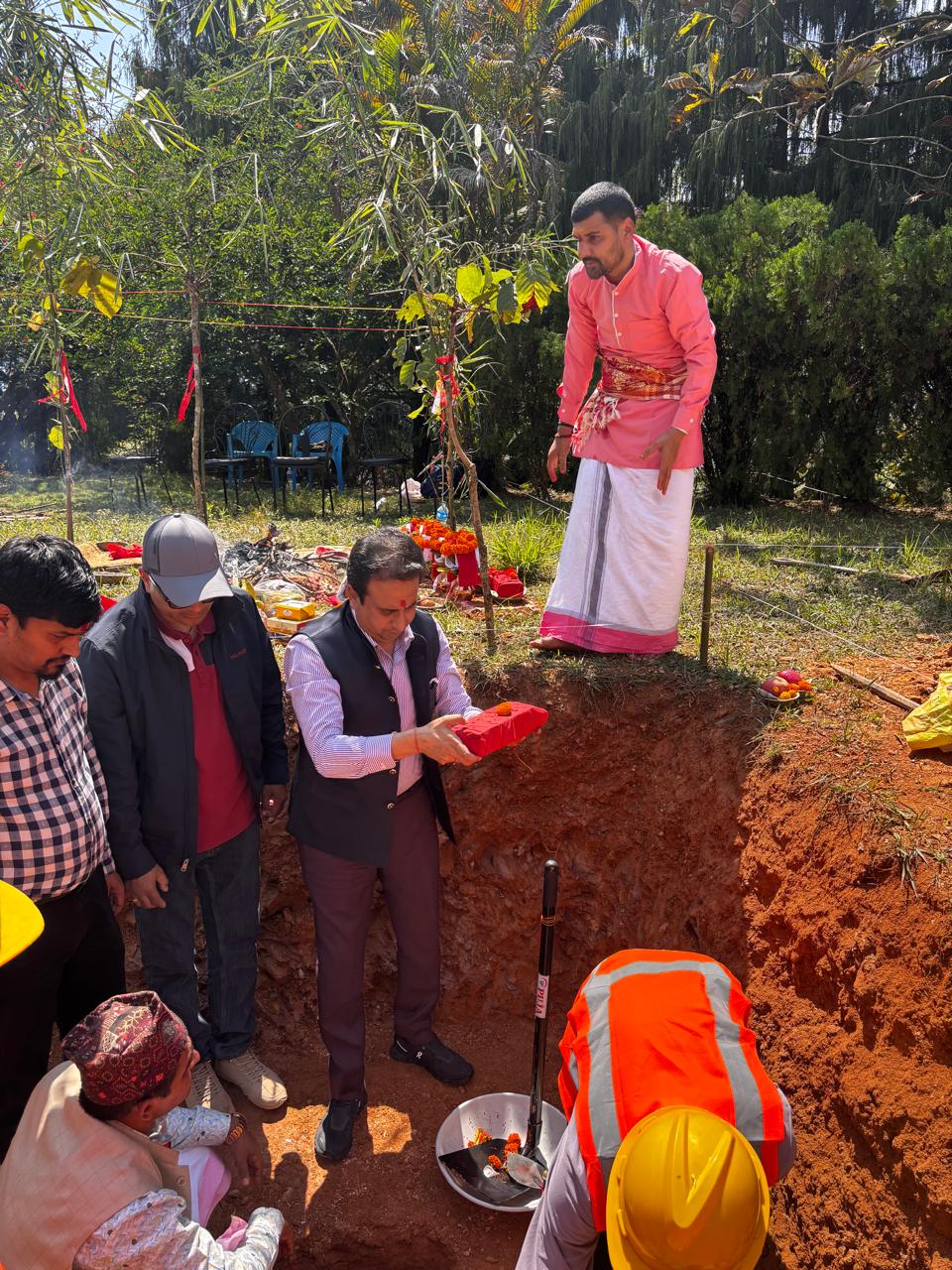
March 10 (27 Chaitra), Kathmandu – CG Hospitality, a subsidiary of the prominent Chaudhary Group, has laid the foundation for the renowned luxury heritage ‘Summit Hotel’ in Gorkha, with the vision to develop the district as an international standard luxury tourist destination.

Inspired by the famous Summit Hotel located in Kathmandu Valley, the company plans to develop this new project into a high-end luxury resort blending modern amenities with Nepalese authenticity.

According to CG Hospitality, the legacy of the historic Summit Hotel established in Lalitpur in 1978 will be revitalized with a fresh identity by integrating both modern conveniences and Nepalese cultural elements in the new Gorkha-based project.

Spanning approximately 30 ropani of land, the project is slated for completion within two years. The hotel will feature 30 luxury rooms with anticipated room rates around 500 US dollars.

The Summit Hotel aims to provide premium services targeting both domestic and international tourists.

The key objective of this project, as stated by CG Hospitality, is to position Gorkha among Nepal’s premier luxury tourist circuit destinations.

Located near the historically and culturally significant Gorkha Palace, the development is expected to promote Nepal’s rich history, authenticity, and culture on an international platform. Gorkha is famously known as the domain from which Prithvi Narayan Shah unified Nepal and founded modern Nepal.

Rahul Chaudhary, Managing Director and Chief Executive Officer of CG Hospitality Global, described the project as a significant step in Chaudhary Group’s ongoing commitment and confidence in Nepal’s tourism sector.

“Gorkha is a vitally important site that holds Nepal’s history. Our endeavor is to showcase Nepal’s history, culture, and authenticity along with the Summit Hotel legacy within Nepal and globally. Chaudhary Group has always supported the government’s goal to strengthen Nepal’s economy through tourism,” he said.

The Summit Hotel project is expected to create employment opportunities, strengthen the local economy, and attract new investments in Gorkha, which will further accelerate regional development through tourism.

Only a few days ago, Chaudhary Group laid the foundation of the prestigious luxury brand ‘The Ritz-Carlton’ hotel in Thamel, a key tourist hub in Kathmandu, in partnership with the world-renowned Marriott International.

CG Hospitality Global is currently expanding its global presence through partnerships with leading international hotel brands. The group operates over 230 hotels and resorts across more than 130 destinations in 12 countries, with a total room capacity of approximately 15,000.

Chaudhary Group is Nepal’s largest business conglomerate, a major taxpayer, and a frontrunner in employment generation. Its revenue contribution amounts to about 2 percent of the government’s annual revenue.

In the fiscal year 2078/79 (2021/22), Chaudhary Group contributed NPR 25.59 billion to the government revenue, and over the past five years, it has contributed a total of NPR 92.26 billion in revenue support.

Supreme Court Directs Alternative Arrangements in Courts During Two-Day Public Holidays

March 11, Kathmandu – The Supreme Court has directed subordinate courts to arrange alternative services for essential functions even during two-day public holidays. In its full court meeting held on Friday, the Supreme Court issued instructions that alternative arrangements must be made for critical services during leave periods exceeding 24 hours and even on Saturdays and Sundays designated as public holidays.

The Supreme Court specifically emphasized the need for such arrangements in cases requiring the issuance of arrest warrants, urgent approvals of arrest warrants, and permissions for detention. This is essential to ensure necessary cases are processed without delay.

According to Article 20(3) of Nepal’s Constitution 2015, any arrested person must be presented before a competent authority within 24 hours without exception. Due to difficulties implementing this provision during weekends and public holidays, the Supreme Court has issued this circular to mandate alternative arrangements.

This directive is binding on all High Courts, subordinate benches, special courts, and all judicial bodies across the country. Similarly, administrative courts, consumer courts, juvenile courts, and other specialized courts are required to strictly adhere to this circular.

The government has recently set office hours from 9 a.m. to 5 p.m., Monday through Friday, while designating Saturdays and Sundays as public holidays, as per last Sunday’s decision.

उद्योग मन्त्रालयको अवैतनिक काम गर्थे सुशान्त, मन्त्री नियुक्त भइन् गौरीकुमारी

Gaurikumari Yadav Appointed Minister as Sushant Vaidik Served Unpaid in Industry Ministry

March 11, Kathmandu: When Prime Minister Balendra Shah took his oath on March 26 and reshuffled his cabinet, he retained the Defense Ministry alongside the Ministry of Industry, Commerce, and Supplies. Informally, Shah had assigned Rastriya Swatantra Party (RSP) MP Sushant Vaidik to work at the Ministry of Industry, Commerce, and Supplies. However, in the latest cabinet reappointments on Friday, the responsibility of the ministry has been formally handed over to Gaurikumari Yadav, who was elected from Mahottari-4.

Soon after the elections, Vaidik, who was even considered for the position of Finance Minister, was engaged by the Prime Minister to “observe” the ministry’s functioning. According to ministry sources, MP Vaidik regularly visited the ministry in recent times. He held discussions with secretaries, joint secretaries, and chief division chiefs to understand the department’s challenges and to seek advice on potential solutions. A senior official described that Vaidik actively shared his perspectives on reforms within the ministry, consulting with top-level staff.

Vaidik also engaged with senior officials of the Nepal Oil Corporation and the Office of the Company Registrar. Furthermore, he consulted the heads of eight major divisions under the Ministry of Industry. A senior ministry official stated, “He was gathering information on problems and possible reforms and consulting the views of employees.” Vaidik holds a postgraduate degree in Economics from the London School of Economics (LSE) and another master’s in Economics and Business Administration from the Norwegian School of Economics (NHH) in Norway.

Despite his contributions, Vaidik was not appointed minister in Friday’s reshuffle. Instead, Gaurikumari Yadav has been appointed Minister for Industry, Commerce, and Supplies, while Ramji Yadav was named Minister for Labor, Employment, and Social Security. Gaurikumari Yadav entered RSP days before the elections and successfully won her seat. According to Subham Yadav, RSP chairman for Mahottari, Gaurikumari was previously active in social work rather than in active politics. He explained, “She did not engage in active politics before but was involved in social service.” Her husband, Shivji Yadav, was affiliated with the Janata Samajwadi Party (JSP) but has now also joined RSP following her election, as confirmed by Subham Yadav.

The newly appointed minister is 54 years old, has studied until the ISC level, and was elected from the Sangrampur area of Mahottari with a significant margin. She secured 30,132 votes, defeating the JSP candidate Surendra Kumar Yadav by approximately 22,000 votes.

Bagmati Province Recommends Increase in Vehicle Fares; Minimum Fare in Kathmandu Valley to Reach NPR 23.93

Following the recommendation of the Bagmati Province government, the minimum vehicle fare in Kathmandu Valley is set to increase by 25.96 percent, raising it to NPR 23.93. The Provincial Ministry of Transport has proposed a 12.39 percent fare hike for petrol-fueled taxis and a 26.79 percent increase for cargo vehicles. The fare for electric vehicles will remain unchanged at the rate set on 1st Baisakh 2079 (mid-April 2022), and preparations are underway to publish the fare adjustments in the provincial gazette.

As of 27 Chaitra in Kathmandu, plans are moving forward to raise vehicle fares within Bagmati Province. At a fare determination and adjustment recommendation committee meeting chaired by Labour, Employment, and Transport Minister Jayram Thapa, a 25.96 percent increase was suggested for the minimum fare in Kathmandu Valley. Currently, the minimum fare for distances between 0-5 kilometers is NPR 19, which will increase to NPR 23.93.

According to Pravin Shrestha, Chief of the Transport Division under the provincial Ministry of Transport, the fare hike recommendation is in place. Chief Minister Indrabahadur Baniya, who is currently in Kathmandu, is reviewing the proposal, with his private secretary Bhakta Bhandari confirming that preparations for approval are ongoing. Bhuvan Nyaupane, Deputy Secretary of the Ministry of Internal Affairs and Law, stated that the fare approval process is underway, with plans to publish it in the provincial gazette through the Chief Minister’s office. The last fare adjustment in Kathmandu was implemented on 7 Bhadra 2080 (August 2023).

Under the new recommendations, petrol-fueled taxis in Bagmati Province will see a 12.39 percent fare increase. For public passenger vehicles outside Kathmandu Valley, a 17.35 percent hike is proposed, while cargo vehicles will have a 26.79 percent fare increase. Electric vehicles operating within the province will maintain the fare rates established on 1 Baisakh 2079. Due to a significant rise in fuel prices, transport service providers have been exerting continuous pressure for fare adjustments. In response, the central government also recently raised long-distance transport fares this week.

Ruby Kumari Thakur Sworn in as Deputy Speaker, Takes Oath of Office and Secrecy

March 11, Kathmandu – Newly elected Deputy Speaker of the House of Representatives, Ruby Kumari Thakur, has taken the oath of office and secrecy. The oath-taking ceremony was held at the President’s Office, Sheetal Niwas, where Speaker Dol Prasad Aryal administered the oath. The ceremony was attended by dignitaries including Vice President Ram Sahaya Yadav, National Assembly Chair Narayan Dahal, Prime Minister Balendra Shah, and other senior officials.

In the election held on Friday, Ruby Kumari Thakur defeated Saraswati Lama of the Rastriya Prajatantra Party. Previously, she had represented the parliament as a member of the Labor Culture Party. Ruby Kumari was supported by her own party, the Labor Culture Party, alongside the ruling coalition parties Rastriya Swatantra Party, Nepali Congress, and the Communist Party of Nepal. The Rastriya Prajatantra Party contested the election independently, while the Communist Party of Nepal (Unified Marxist-Leninist) did not participate in this election.

Ongoing Dispute Between Donald Trump and Former Supporter Journalists

March 11, Kathmandu – A dispute has emerged between former US President Donald Trump and several journalists who previously played key roles in supporting his election victories. Tensions have been rising between Trump and media personalities such as Tucker Carlson, Megyn Kelly, Candace Owens, and Alex Jones. Recently, Trump has used his platform on ‘Truth Social’ to launch aggressive remarks against these journalists, labeling them as ‘crazy’ and ‘troublemakers.’ These figures were once considered fundamental pillars of Trump’s ‘MAGA’ campaign. However, they have recently been critical of Trump, especially concerning issues related to conflict with Iran.

In response to criticism from his former supporters, Trump expressed grievances, ridiculing them by stating that they have been removed from television and failed to secure roles in other TV programs. He accused these journalists of leveraging their podcasts merely to promote themselves through criticism of him. Additionally, Trump accused them of falsely alleging that Iran seeks to obtain nuclear weapons. Following Trump’s accusations, these journalists have collectively voiced their opposition.

Alex Jones, the founder of InfoWars, criticized Trump and suggested that the Republican Party should abandon its attachment to Trump and pursue a new direction. While acknowledging his past efforts to help Trump win, Jones stated that Trump has since chosen a misguided path and that a change is necessary. Jones also raised questions about Trump’s health standards, saying, “We never changed; Trump himself has changed.” Similarly, Tucker Carlson criticized Trump’s approach regarding the conflict with Iran. Specifically, he condemned Trump’s disrespectful and threatening language toward Iran over the opening of the Strait of Hormuz.

गण्डकी कांग्रेसको चुनावी समीक्षामा प्रश्नले घेरिए गगन

Gagan Faces Tough Questions at Gandaki Congress Election Review Meeting

March 10, Pokhara – The Nepali Congress Gandaki Province Working Committee organized a program titled ‘Election Review and the Future Path of Congress’ on Friday in Pokhara. Party Chairperson Gagan Kumar Thapa was also present at the event. However, throughout the program, Chairperson Thapa’s expressions were neither cheerful nor enthusiastic.

During the review session, district chairpersons of the province, direct and proportional candidates, as well as central officials, delivered their statements. Gagan attentively listened to all remarks but showed little enthusiasm. This was a stark contrast to his demeanor on January 6, when he came to Pokhara for the provincial assembly before the elections held on February 13.

During the election campaign, workers rallied behind Gagan with the slogan “Now or Never, Gagan Government,” but he introduced a new slogan at that gathering — “This Time, Hundred Percent.” Congress leaders and workers echoed this chant loudly. When he visited Pokhara on February 3 for an election rally, Gagan’s enthusiasm remained consistent. He expressed, “Congress must give voters the impression of change to secure victory,” adding, “We must carry the message of change to every village. Only Congress, as the freshest party brought by the Special General Convention, offers something new.”

However, the slogan “This Time, Hundred Percent” failed to translate into electoral success; Congress managed to secure only 38 seats, less than half of the desired target. The Rashtriya Swatantra Party (RSP), which contested the election with Balendra Shah (Balen) as the candidate for future prime minister, won nearly two-thirds of the seats, and Balen has since become prime minister. Even when Balen arrived, Gagan’s expression did not noticeably change.

Out of 18 seats in Gandaki Province, Congress won only from Mustang and Manang. Following this disappointing election result, it was natural that Gagan did not appear enthusiastic at the review meeting. Various leaders analyzed the results differently, and Gagan could not evade pointed questions. Some leaders attributed Congress’s failure to unify in government to the Special General Convention, which they said contributed to the party’s weak messaging during the elections. Many described public sentiment as a ‘storm’ and felt Congress’s election strategy was ineffective.

During the review, some leaders even issued warnings directed at Gagan, implying, “Yesterday you fought against the brothers; now you should not have to fight against the leadership from the Special General Convention.” Raju Thapa, chairperson of Syangja, urged Gagan to collaborate with other leaders like outgoing Chairperson Sher Bahadur Deuba. He recalled that earlier he had suggested that Congress might have been better off not contesting the election given the unfavorable political climate. Yet now, he stressed, unifying Congress is imperative, and asked Gagan to focus on this.

“Yesterday, it was said that the brothers carried the responsibility; now it is your turn to take charge, and we hope you will not have to confront another brother,” said Syangja Chairperson Thapa. He dismissed the idea that the Special General Convention caused fluctuations in votes, adding, “The votes neither increased nor decreased because of the Convention. The national and international environment was not in our favor.” He pointed out that populism is rising worldwide, and Nepal is experiencing a similar situation.

While listening to critical leaders, Gagan nodded frequently, taking notes in his diary. At times, he recalled speakers and even conversed quietly with Vice-Chairperson Bishwprakash Sharma. Gagan, who is normally jovial and astute in demeanor, did not appear enthusiastic, which prompted one female leader to express concern and ask for an explanation.

Gagan responded, “I am in contemplation, not anxiety.” After hearing the critiques and warnings from Gandaki leaders, he clarified his state of mind: “There is a big difference between worry and contemplation. Worry relates to fear and reaction, whereas contemplation is about self-reflection and analysis. I am more in contemplation.”

“The main part of contemplation is listening to oneself and others. I am currently undertaking a campaign of speaking less and listening more,” he added. Previously, Congress spokesperson Devaraj Chalise had advised not to be disheartened by election results, stressing the difference between a battle and a war. Echoing this, Gagan emphasized that he will treat the election outcome not as a failure but as a message to move forward.

He revealed plans to conduct regular general conventions within the upcoming Ashwin month and work both at the national level as the main opposition party and as the ruling party at provincial and local levels. “The responsibility is mine; the party must be flexible and strive to unite everyone. I will fulfill that responsibility,” he said. “I will go everywhere, engage in dialogue, and try to bring everyone together.” His focus is to make Congress the first party by the next provincial and local elections.

Vice-Chairperson Bishwprakash Sharma announced that the parliamentary party leader would be selected soon. He also appealed to outgoing Chairperson Deuba to return to Nepal and support investigations. Gagan claimed that the Supreme Court is currently considering cases related to the Special General Convention’s committee, and he expects decisions to be made favorably under law.

General Secretary Pradeep Paudel noted that election styles and campaign methods have evolved, emphasizing the need to advance with technical expertise and integrity.

Launch of E-Pension System Expected to Benefit Over 300,000 Pensioners

The government has introduced the e-pension authentication system, eliminating the necessity for pensioners to visit banks in person. Finance Minister Dr. Swarnim Wagle announced that this system, developed by the Office of the Auditor General, was formally launched on Friday. The ministry stated that the system will streamline the pension renewal process for 352,816 pension beneficiaries and reduce bank commissions to zero.

Kathmandu, 27 Chaitra – The government has ended the requirement for pensioners to rush to banks for pension collection. Finance Minister Dr. Swarnim Wagle inaugurated the e-pension authentication system today. With this launch, approximately 350,000 pensioners will be freed from the cumbersome process of pension renewal and the hassle of selecting banks. The ministry also noted that bank commissions paid by the government will be eliminated.

According to the Ministry of Finance, retired individuals will no longer need to be physically present; they can avail of the service from their homes. The annual average burden of bank commission fees, estimated to be around NPR 15 crore, is expected to be reduced. As cash flow becomes more predictable, managing treasury pressures will also become easier. The ministry added that human errors associated with manual pension calculations will also decrease. This new system will benefit 352,816 active and inactive pensioners.

Previously, newly retired individuals were obligated to appear in person at the Pension Management Office when choosing a bank. Pensioners had to visit banks individually each year to renew their accounts. Pension amounts and tax calculations were conducted manually. Failure to renew on time made it difficult to forecast cash flow accurately.