
Author: space4knews

The Battles Fought by Abhiman Singh Basnet

Article Summary

Reviewed.

  • Kaji Abhiman Singh Basnet fought various battles from 1819 BS onwards during the expansion of the Gorkha Kingdom.
  • In 1830 BS, Abhiman Singh successfully incorporated Majh Kirat into the Gorkhali Kingdom and served as its administrator in Vijaypur.
  • In the 1848 BS war between Nepal and Tibet, Abhiman Singh was assigned the responsibility to lead an attack towards Kerung.

Serving the then Gorkha Kingdom, warriors from various prominent regional clans earned immortal names in history. During the Gorkha kingdom’s expansion campaign, groups such as Thapa, Basnet, Pandey, Kunwar, along with Magar warriors, displayed great prowess in battle, shaping history.

Basnets traditionally worship the family deity Masht, distinguishing them from the Khas regional clans. The Basnet clan includes subgroups like Shripali, Khulal, and Khaptadi. The Shripali Basnets are believed to have originated from the Saipal Himal region of Bajhang district, carrying the name Shripal. The region still houses Shripal Kot, once the seat of the Shripal kingdom.

At that time, the kingdom of King Nagaraj spanned Shripal, Khaptadi, Kalikot, Khulal, and Sinja. Later, the residents of Shripal kingdom became known as the Shripali clan. Until 900 BS, this kingdom stretched from eastern Mansarowar to Gandaki (Dr. Binod Thapa, ‘Contribution of Shripali Basnets in Nation Building, Nepal’–2074:29–30).

According to author Purnaprakash Sharma ‘Yatri’, when new settlements were established, conflicts and legal matters frequently arose, requiring the appointment of a judge called ‘Basnyarthi.’ Over time, the word evolved into Basnyat, Basnyat, or Basnet. The settlements inhabited by these groups—Shripal, Khaptad, and Khulal—were named accordingly, with the residents called Shripali, Khaptadi, and Khulali respectively (Thapa, 2074:31–32).

Kaji Abhiman Singh Basnet (Source: Contribution of Shripali Basnyat in Nation Building)

Madan Singh Raja was a notable figure in the Shripali Basnet lineage. During the time of his clan member Bharat Singh, the Khas kingdom was divided. The children of this lineage settled in different regions. For example, Shivram Singh Basnet, son of Jayaraj Singh, was active during King Narbhupal Shah’s reign and became a famed military leader during Prithvi Narayan Shah’s era (Thapa, 2074:32–34). Shivram Singh had four sons—Naharsingh, Keharsingh, Abhiman Singh, and Dhaukalsingh—who gained prominence during Prithvi Narayan Shah’s rule. Several battles were led under Shivram Singh’s command.

At the time of Shivram Singh’s death, Kaji Abhiman Singh Basnet was only 1.5 years old. His upbringing was carefully overseen by his mother, Suraprabha, with King Prithvi Narayan Shah allocating lands to support their care (Tulsiram Vaidya et al., ‘Military History of Nepal’–2049:460).

Abhiman Singh Basnet showcased his military talents in numerous battles during the Gorkha Kingdom’s territorial expansion campaigns. He fought across fronts from Kathmandu to the east, west, north, and south. He gained fame under the reigns of Kings Prithvi Narayan, Pratap Singh, and Ran Bahadur Shah. Below is a brief overview of the battles he fought.

First Battle in Teenage Years

Abhiman Singh began demonstrating his military capabilities from 1819 BS. Under King Prithvi Narayan Shah’s direction, Keharsingh Basnet led the fight against Makwanpur, with Abhiman Singh present on the frontlines. Following Makwanpur’s annexation, he was active in the campaigns to capture seven villages in 1920 BS.

He displayed valor during the captures of Kathmandu in 1825 BS and Bhaktapur in 1826 BS (Thapa, 2074:85). This marked the beginning of Kaji Abhiman Singh’s military career.

War and Treaty with the Limbu

After concluding conflicts in the central region, King Prithvi Narayan Shah ordered Abhiman Singh to advance eastwards. Efforts began to incorporate Majh Kirat into the Gorkha Kingdom. Coordinating with priests from Chaudandi, Abhiman Singh deployed Bange Basnet there.

The Gorkhali army, led by Sardar Ram Krishna Kunwar and deputy leader Amar Singh Thapa, was sent towards Majh Kirat. On Bhadra 13, 1829 BS, they crossed the Dudh Koshi River by boat. Meanwhile, Abhiman Singh remained delayed in Makwanpur (Baburam Acharya, ‘Brief Biography of His Majesty King Prithvi Narayan Shah’–417–418).

Later, Abhiman Singh moved with ally Parath Bhandari towards Chaudandi, and by Saun 1830 BS, Chaudandi was annexed to the Gorkha Kingdom. Historical sources mention severe atrocities imposed on local Limbu communities in the hilly Majh Kirat region, affecting men, children, and even pregnant women under harsh conditions (Dr. Ramesh Dhungel, ‘Himal’ 15:22, Fagun 2062:61).

At that time, Harinanda Pokharel also provided financial support to the Gorkhali army. Letters have been found indicating that Abhiman Singh and his associates sent funds during this period (Imansingh Chemjong, ‘Brief History of Kirat-era Vijaypur’–2059:78–79).

After Majh Kirat, Abhiman Singh advanced toward Vijaypur, where internal conflicts among ministers were rampant. Minister Buddhikarna Rai had already assassinated King Kamdatt Sen. When Gorkhali forces entered Vijaypur, 85 Limbu soldiers were killed (Acharya, 2061:421–422).

However, the Limbu did not easily accept Gorkhali supremacy. Amid rising tensions, Abhiman Singh and others compelled them to take a salt-water oath to accept Gorkhali rule. Consequently, King Prithvi Narayan Shah issued red seals (lal mohar) in the names of the Limbu leaders (Chemjong, 2059:94–96).
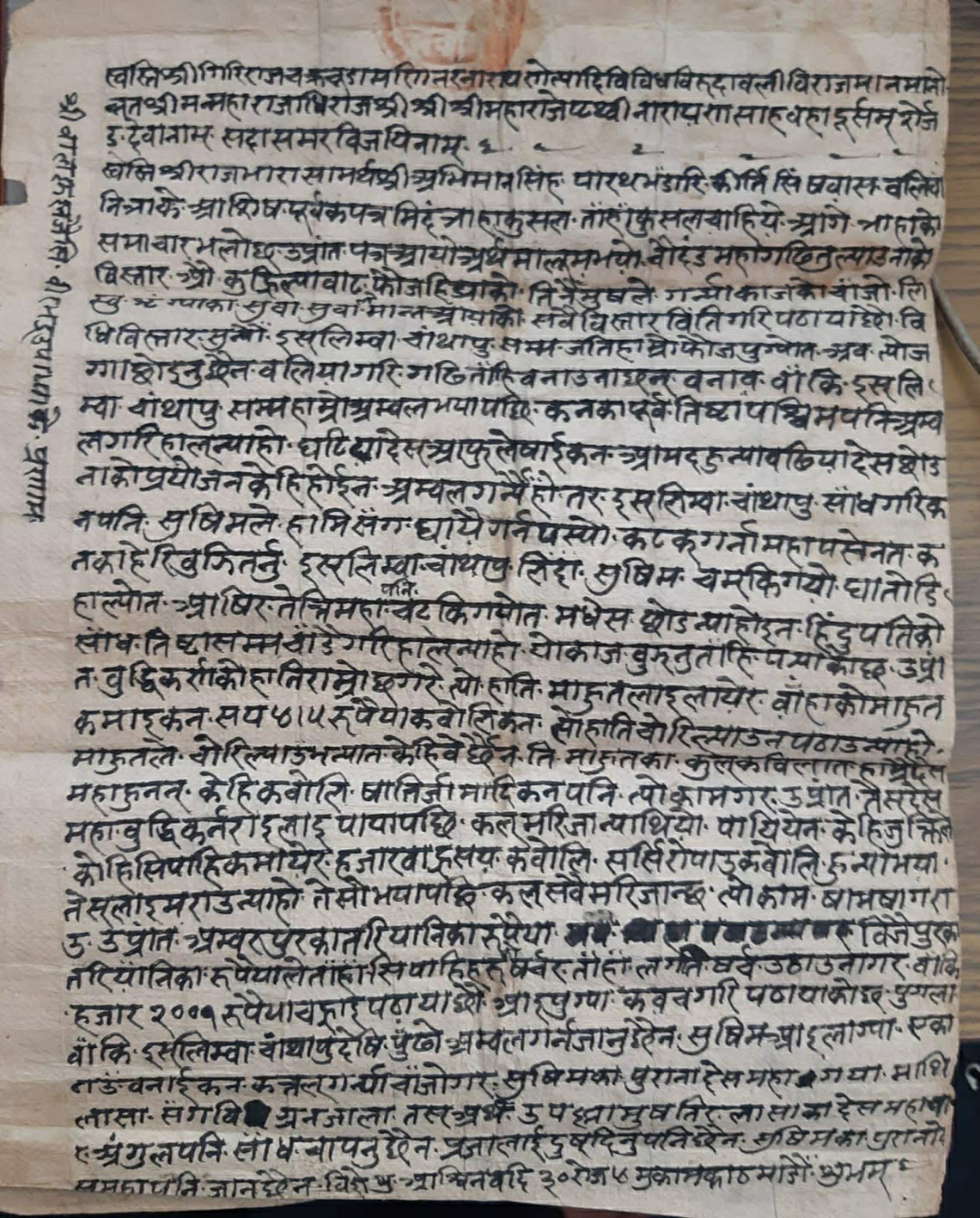
Red seal sent by King Prithvi Narayan Shah to Abhiman Singh Basnet and others leading the eastern front.

This red seal issued on the 1st and 2nd of Saun by King Prithvi Narayan Shah was documented by historian Shankarman Rajbanshi in the journal ‘Prachin Nepal’ (Issue 3, Baisakh 2025:29–30).

After subduing the Limbu, Abhiman Singh advanced through Kurlegadhi towards Isilimba and Chyangthapu regions of Panchthar. According to a red seal issued on Ashwin 30 by King Prithvi Narayan Shah, forces were dispatched to build the Chaudandi Mahagadhi fortification, preserved by Abhiman Singh’s descendants.

During the Gorkha expansion campaign, Abhiman Singh served as administrator of Vijaypur until 1834 AD. He received orders to arrest and execute the former minister Buddhikarna Rai, after the death of King Prithvi Narayan Shah.

Following Buddhikarna Rai’s assassination, peace prevailed among the Gorkhali. King Pratap Singh Shah expressed his gratitude in a letter to Abhiman Singh Basnet, who was subsequently rewarded generously, including grants of land and jagir.

Victory in Chitwan

The present-day Chitwan (Sumeshwar) was under Tanahun Kingdom at the time. With British observers watching closely, King Pratap Singh Shah appointed administrator Abhiman Singh for the eastern front. He was also specifically directed towards Chitwan in the red seal letters.
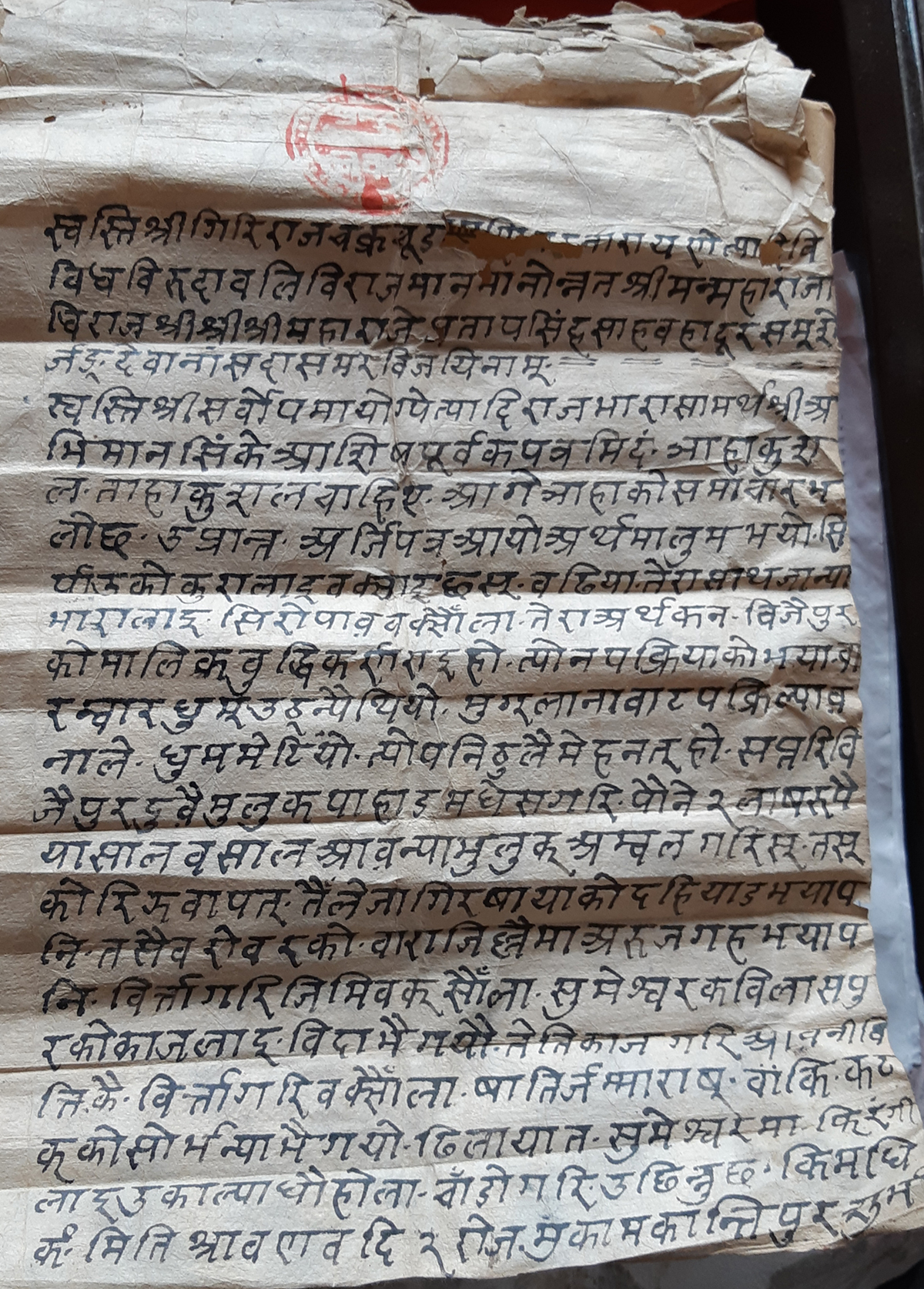
Red seal from King Pratap Singh Shah calling Abhiman Singh Basnet from Vijaypur for the Sumeshwar (Chitwan) campaign.

During the campaign to capture Chitwan, Kaji Swarup Singh Karki was sent from Kathmandu. The then Tanahun King Harakumar Datt Sen had his forces stationed at Sumeshwar and Kavilasgarh. Fierce battles took place as the Gorkhali encircled Kavilaspur, eventually forcing Tanahun forces to retreat. Among Abhiman Singh’s forces were Swarup Singh Karki, Ram Krishna Kunwar, and Parath Bhandari. On Saun 6, Kavilaspur was captured followed by Sumeshwargarhi on the 26th. Chitwan was annexed to the Gorkha Kingdom. Examples of the southern front campaigns include battles in Saptari, Chaudandi, and Chitwan.

Leadership on the Western Front

Abhiman Singh also distinguished himself in battles on the western front. He participated in battles for Palpa and Lamjung. During the war with the Parvat kingdom, commander Ganesh Malla was captured. While Abhiman Singh remained in Tanahun, Swarup Singh returned to Kathmandu. They secured victories in Rishing, Ghiring, Charikot, and Paitu. During Bahadur Shah’s deputyship, when Kaji Damodar Pandey advanced toward the Kaligandaki region, Abhiman Singh also fought alongside him (Vaidya et al., 2049:434).

Abhiman Singh in the Northern Campaign

In 1848 BS, a war broke out between Nepal and Tibet over conflicts related to mosque management in Khasa. Abhiman Singh Basnet and Ranjit Kunwar were tasked with leading an attack from Kerung. They departed the battlefield on Saun 30 and fought on Bhadra 26. However, the Nepali side was defeated and forced to retreat to Keraubari (Baburam Acharya, ‘China Tibet and Nepal’–2059:152).
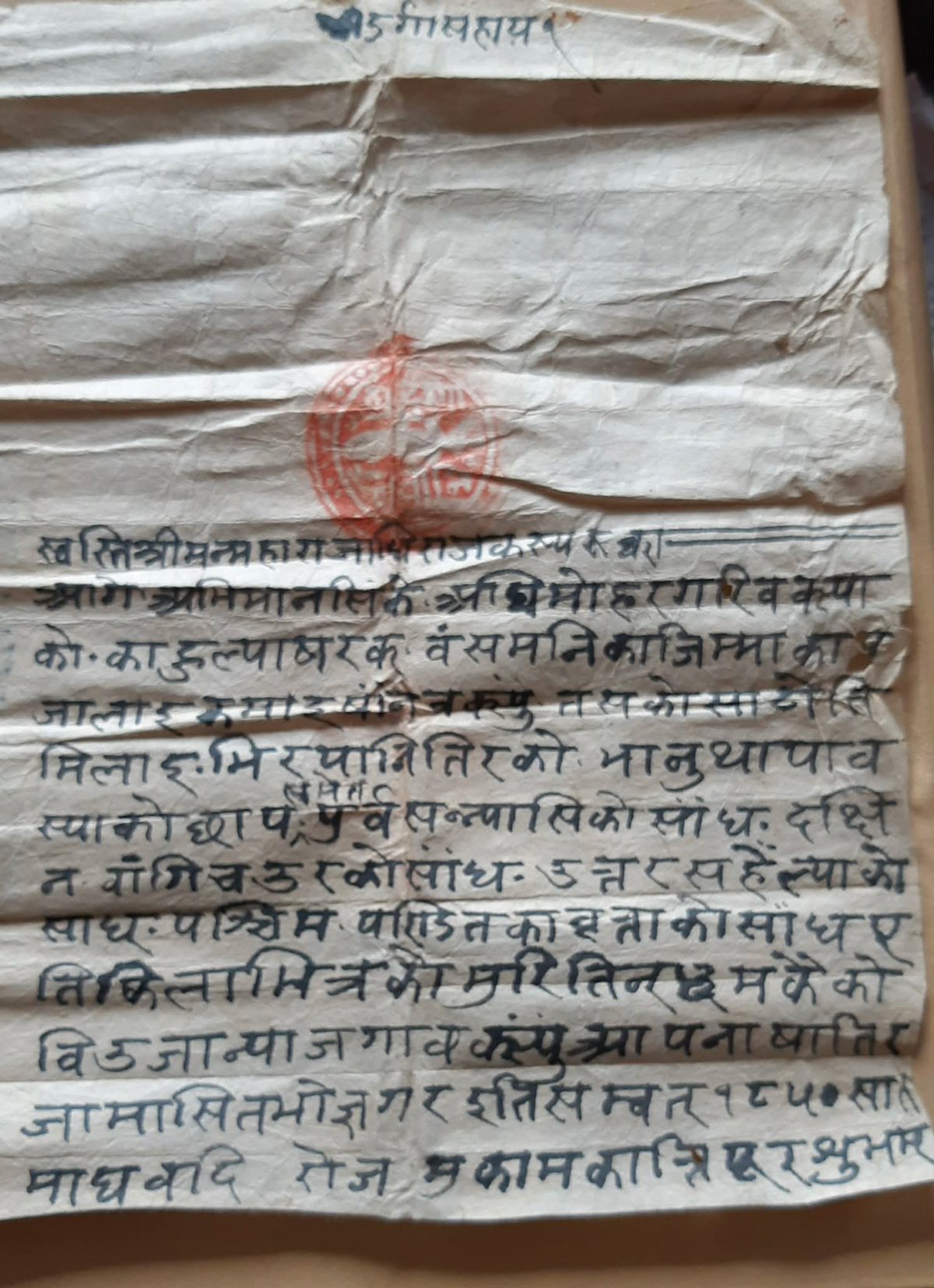
Red seal given by King Ranbahadur Shah granting land to Abhiman Singh Basnet in recognition of his service.

Following the looting of a monastery by the Nepali forces in Ditcharga town, China entered the war. Facing the massive Chinese army proved difficult. Tibetan-Chinese troops advanced as far as the Betrawati River. Despite the outcome, the Nepali army displayed significant valor and inflicted heavy damage on the opposing forces.

Eventually, both sides reached a peace agreement, signing a treaty on Bhadra 11, 1849 BS. A farewell feast was held for the Chinese forces, the necessary provisions for which were arranged by Abhiman Singh (Acharya, 2059:172–177).

Kaji Abhiman Singh Basnet’s extensive experience on the central, eastern, western, northern, and southern fronts has immortalized him in history as a brave warrior.

Abhiman Singh’s Residence

In Kathmandu’s Kel Tol area of Bal Kumari, an old palace showcasing exquisite Malla-era artistry still stands. Known as Tilanga House or Paltan House, its original name was ‘Man Mandir.’ This was the private residence of Kaji Abhiman Singh Basnet. In the then Narayanhiti complex, Abhiman Singh’s younger brother Dhaukalsingh Basnet had a separate residence.

Private residence of Abhiman Singh Basnet located in Kel Tol.

On Poush 10, 1833 BS, Abhiman Singh placed an inscription in the house complex, detailing its beauty, religious activities, and economic prosperity (Dhanvajra Bajracharya and Tek Bahadur Shrestha, ‘Inscriptions of the Shah Period’–2037:127–128).

The house originally belonged to Bhajudev Brahmin, the priest of Jayaprakash Malla. After the conquest of Kathmandu, it was confiscated and later granted to Abhiman Singh. In 1832 BS, King Pratap Singh Shah deposited one-sixth of the agreed sum and officially handed the house to Abhiman Singh. Old records bearing his name have been found there. Today, the house remains in ruins and is divided among the descendants of Abhiman Singh’s younger brother Dhaukalsingh.

Development of ‘Smart’ DNA Drug That Functions Like an Internal Computer in the Body

Scientists at the University of Geneva have developed a ‘smart’ drug system that operates like a tiny computer inside the body. Made from synthetic DNA, this drug specifically destroys cancer cells while protecting healthy cells. This research was recently published in the prestigious scientific journal Nature Biotechnology.

The system works based on the concept of computer “logic gates.” Similar to two-factor authentication used in digital banking, this drug activates through a dual-switch mechanism. The drug contains different DNA strands, and it only activates when it detects two specific markers on the surface of cancer cells. If it finds only one marker or none at all, the drug remains inactive, thereby safeguarding healthy cells that are free of cancer.

Upon detecting cancer cells, the drug initiates a chain reaction that increases the concentration of the drug at the tumor site, enhancing treatment effectiveness. Unlike conventional chemotherapy, which destroys both cancerous and healthy cells, this smart drug does not harm healthy tissues. Furthermore, it can carry multiple kinds of drugs simultaneously, helping to overcome the resistance that cancer cells often develop against medication.

According to lead author Professor Nicolas Winssinger, the complexity of designing new drugs with the aid of computers and artificial intelligence is now a thing of the past. This drug has the capability to understand biological signals and respond intelligently based on them. The technology is poised to open new doors for personalized medicine. Researchers are currently working to refine this approach further and develop even more complex “smart” drugs that can make decisions autonomously within the body.

निर्वाचनमा रोकिएको मतदाता नामावली संकलन कार्य भोलिदेखि सुरु हुँदै

Voter Registration Process to Resume Tomorrow After Suspension

March 21, Kathmandu – The Election Commission has decided to resume the voter registration and updating process starting tomorrow, Sunday. This decision was made during a meeting held on March 18.

Nepali citizens possessing a national identity card number can register their names online by filling in the details contained in their identity cards.

According to Narayan Prasad Bhattarai, the spokesperson for the commission, individuals without a national identity card must fill out an online form through the commission’s pre-enrollment system, providing a photo, fingerprint, and biometric information. Additionally, provisions have been made to allow registration at provincial and district election offices.

Dr. Shekhar Koirala Attributes Electoral Defeat to ‘Swing Votes’

March 21, Kathmandu – Nepali Congress leader Dr. Shekhar Koirala has attributed his party’s defeat in the recent House of Representatives election primarily to ‘swing votes.’ Speaking at the 18th Annual General Meeting of the VP Smriti Community Cooperative Hospital in Kathmandu on Saturday, he elaborated on this perspective. Koirala claimed that voters did not abandon the party outright but rather shifted their votes temporarily, and emphasized the importance of preventing such vote shifts in the future.

He identified the party’s weakened presence in parliament as largely due to a failure to understand public sentiment and the emerging political ‘storm.’ “Many wonder how we lost, what was done wrong,” Koirala said. “But it may be that such storms and political upheavals came, which we failed to comprehend.” He stressed that the next political battle will not be against leftists but against ‘liberal democrats,’ underscoring the need to strengthen the organization accordingly.

“Previously, our main contest was against the left, which was straightforward. Now, the battle is with liberal democrats,” he stated. “In this struggle, I believe we must not fall behind. We have the organization and the capability.” Koirala also recalled that from the beginning, the Central Working Committee had insisted on convening a special convention.

Regarding the special convention’s election of Gagan Thapa as party chairperson, he noted that the Supreme Court case filed by Sher Bahadur Deuba and Purna Bahadur Khadka remains pending a final verdict. Regardless of the court’s decision, Koirala reaffirmed his commitment to uniting the party. “The resolution of the case will begin tomorrow. I cannot say how long it will take,” he said. “But my final effort will be to consolidate Nepali Congress and bring everyone together.”

यूएईमा ड्रोन अवशेष खस्दा घाइते भएका सबै नेपाली खतरामुक्त, २ जना डिस्चार्ड

All Injured Nepalis Safe After Drone Debris Falls in UAE; Two Discharged from Hospital

March 21, Kathmandu – The Nepali Embassy in the United Arab Emirates (UAE) has provided updates on the condition of Nepali nationals injured when drone debris fell in Abu Dhabi. The Ministry of Foreign Affairs stated that the embassy has been in contact with the injured individuals to monitor their health status. Embassy staff have spoken with all seven injured Nepalis.

Among those injured on Friday, one individual’s condition is serious, but all seven are out of danger, said Lok Bahadur Paudel Kshetri, spokesperson for the Ministry of Foreign Affairs. He added, “We have established contact with everyone. One person sustained an injury to the hand, but their condition is stable. The embassy is actively assessing what further assistance may be required.”

According to spokesperson Paudel, two of the injured Nepalis have been discharged after treatment, while five remain hospitalized and continue to receive care. Following reports from UAE government media that seven Nepalis were injured, the embassy promptly sought information regarding their status.

The incident occurred after the UAE air defense system intercepted a drone launched by Iran with missiles, resulting in debris falling in the Al Azban area of Abu Dhabi on Friday. The event caused injuries to 12 people, including seven Nepalis and five Indian nationals.

Nepalese Embassy Seeks Information on Injured Nepalese in UAE Drone Debris Incident


March 21, Kathmandu – The Nepalese Embassy in the United Arab Emirates (UAE) has initiated efforts to ascertain the condition of Nepalese nationals injured after drone debris fell in Abu Dhabi. The embassy has formally requested detailed information regarding the injuries and health status of those affected from the UAE Ministry of Foreign Affairs.

According to Nepal’s Ambassador to the UAE, Tej Bahadur Kshetri, no formal details about the incident have been received so far. He stated that the embassy’s interest was piqued after UAE government media outlets reported that seven Nepalese were injured.

Ambassador Kshetri noted, “We are working to understand the situation of the injured Nepalese. Formal information is yet to arrive. We only became aware that seven Nepalis were injured through local government media reports. Based on this, we have sent a letter to the Ministry of Foreign Affairs requesting detailed information about what happened and the condition of the injured individuals.”

He added that a response from the Ministry has not yet been received but is expected by Monday. “The incident occurred on Friday. Saturday and Sunday were holidays here. We anticipate some updates by Monday,” he explained.

On Friday, debris from a drone fired from Iran fell in the Al Ajban area of Abu Dhabi after UAE’s air defense systems intercepted it with a missile. In total, 12 people were injured in the incident, including seven Nepalese and five Indian nationals. According to official media, one of the injured Nepalese remains in serious condition.

The incident occurred when the air defense system successfully intercepted threats coming through the air, causing debris to fall in parts of Abu Dhabi. The UAE has been continuously intercepting missiles and drones originating from Iran. However, during Friday’s interception, drone debris fell in the Al Ajban area. Immediately after the event, Abu Dhabi authorities mobilized emergency teams to secure the affected area and provide medical assistance to the injured.

Earlier, on March 19, a similar interception led to debris falling, resulting in the temporary shutdown of the Habshan gas facility. The UAE Ministry of Foreign Affairs strongly condemned the Iranian attacks targeting the Habshan gas facility and the Bab field.

Chinamaxing: Is Drinking Warm Water in the Morning Beneficial for Health?

A woman pouring hot water into a cup

Image source, Getty Images

Image caption, The habit of drinking warm water in the morning is a century-old tradition that has recently gone viral.

“I saw it on social media and kept watching one video after another… I thought, why not try it once,” says 21-year-old Maryam Khan.

This isn’t about adopting a strict workout regimen or buying expensive skincare products. The trend Maryam and many others are following is simple – drinking warm water in the morning.

The health benefits of drinking hot or warm water have been promoted for thousands of years in traditional medical systems such as Traditional Chinese Medicine and Ayurveda originating from India.

However, this ancient practice has gained a new global audience since it went viral on social media earlier this year.

On TikTok and Instagram, videos tagged with terms like “newly Chinese” and “Chinamaxing” have been viewed millions of times. These videos often show young people starting their day drinking warm water, having warm breakfasts, and doing gentle stretches.

काठमाडौं महानगरका १९०० मध्ये ७२३ सहकारीले मात्रै बुझाए प्रतिवेदन

Only 723 of 1900 Cooperatives in Kathmandu Submit Annual Reports

March 21, Kathmandu – Approximately 1,900 cooperative organizations operate within Kathmandu Metropolitan City. However, nearly 50 percent of them fail to submit their annual reports regularly. This situation indicates underlying issues within the cooperatives. According to the cooperative department of Kathmandu Metropolitan City (KMC), only 723 cooperatives have submitted their annual reports on a regular basis.

According to Duvrukumar Kafle, head of the KMC cooperative department, the metropolitan office has repeatedly urged these cooperatives to submit their annual reports consistently. Cooperatives that have not submitted reports for an extended period, often citing various excuses, are preparing to face legal action. Kafle stated, “Some cooperatives do not maintain contact, while others involved in disciplinary action fail to submit reports. Additionally, cooperatives that unlawfully grant loans typically do not submit regular reports either.”

The metropolitan office has directed these cooperatives to immediately conduct their annual general meetings and submit the audit reports along with the general assembly decisions and annual reports to the KMC cooperative department. Kafle explained that for cooperatives that continue to neglect submitting general assembly reports, an investigation trap has been planned. To prevent misappropriation of depositors’ funds, the metropolitan office will first require submission of reports before proceeding with deregistration processes.

KMC has cautioned all depositors against falling for the temptation of high-interest returns, which could result in losing their savings. Kafle advised, “Before saving money, it is important to verify whether the cooperative operates according to its rules, whether audits are conducted, if the interest rates are reasonable, the transparency of the institution’s finances, and the oversight by regulators.” He added, “Do not deposit money in cooperatives run by acquaintances or relatives without due diligence, as it could lead to losses.” Currently, many cooperatives managed internally face financial management problems, and lack of legal enforcement has exacerbated these issues.

Youth Union Secretariat Member Advocate Bam Arrested on Charges of Intimidation

Advocate Bam, a leader of the Youth Union, has been arrested on charges of intimidation. The Crime Investigation Department (CID) took him and 12 others into custody. He is currently held in the CID’s detention facility. Kathmandu, 21 Chaitra — Advocate Bam, a leader of the Youth Union, was arrested on charges of intimidation. The CID apprehended Bam during an operation targeting individuals involved in intimidation activities. He is a secretariat member of the youth organization affiliated with the Communist Party of Nepal (Unified Marxist–Leninist). Bam, active in the Youth Union office team, was arrested late Friday night and is currently in CID custody. In total, the CID detained 13 individuals including him. Originally from Palata Rural Municipality in Kalikot, Advocate Bam has been active in the Thamel area.

War Crimes Are No Longer Just Shameful Acts

This news summary has been prepared after editorial review. US President Donald Trump and Defense Secretary Pete Hegseth have violated international law by showing disregard for civilian protection in their war against Iran. Thousands have been killed and millions displaced in Iran, Lebanon, and Israel, highlighting the extensive humanitarian impact of the conflict. Governments must collect evidence of war crimes from satellite images, communication records, and footage and provide additional resources to the United Nations.

For decades, leaders responsible for war crimes have tried to appear ignorant of these issues or sought to justify these crimes as mere mistakes. However, the recent developments in West Asia clearly reflect the arrogant stance of leaders from the US, Israel, and Iran. They are outright neglecting, mocking, or openly violating international laws meant to protect civilians. If the international community does not clearly reaffirm its support for these laws, it will amount to tacit approval of their destruction.

President Trump conveyed to The New York Times that “international law is unnecessary” and that his greatest basis for controlling power is his own “morality,” while Secretary Hegseth dismissed “tepid legality” in favor of maximum lethality. Both have publicly shown minimal concern for protecting civilians affected by America’s war on Iran. The conflict recently entered its second month. After the US announced the destruction of Iran’s Kharg Island, Trump told NBC News, “We might hit it a few more times just for fun.” Defense Secretary Hegseth declared that Iran’s enemies would receive “no forgiveness or mercy,” implying authorization to kill surrendering forces rather than detain them—practices historically cited by the US military as examples of war crimes. Beyond the Trump administration, Israeli Defense Minister Israel Katz threatened to destroy homes in southern Lebanon and prevent the resettlement of millions during the Gaza conflict.

Iran’s Islamic Revolutionary Guard Corps (IRGC) has also designated American banks, investment companies, and commercial vessels as legitimate civilian targets. Its spokespeople warned that any opposition would face strikes even harsher than the January massacre that killed thousands nationwide. State television hosts further warned that overseas dissidents would face consequences that would plunge their families into mourning. These statements clearly demonstrate disregard for civilian life and suggest the intent to carry out such acts, demanding urgent attention.

More than 2,000 people have died in Iran, over 1,200 in Lebanon, and 17 in Israel. Millions have been displaced or forced to flee their homes across the Gulf, Israel, and Lebanon. Preliminary US military reports attribute responsibility to US forces for an attack on a primary school in Minab, Iran, where more than 170 children and staff were killed. Governments with advanced intelligence capabilities in South Asia must begin securing and publicly releasing evidence of war crimes—including satellite images, communication records, and open-source footage. It is also confirmed that the Israeli military has used white phosphorus in Lebanese homes, a substance banned in civilian areas, and that Iran has launched internationally prohibited cluster munitions into Israeli cities. International laws intended to protect civilians have not been suddenly violated without cause.

While Israel’s massacre in Gaza, destroying hospitals and water systems and killing thousands of Palestinians, was backed by the US—elevating some leaders above the law—this has fostered a double standard that diminishes the value of legal norms. Although attacks on energy infrastructure in the Gulf by Iran were promptly condemned, governments have remained silent over Israel’s illegal use of white phosphorus. Leaders must explicitly state that any attacks on Iranian energy sites, Lebanese homes, or Gulf civilian areas violate the laws of war. Otherwise, these rules will become mere instruments to punish only one’s adversaries. The Geneva Conventions not only require states to observe these laws but also empower the international community to halt weapons deliveries to militaries and groups that fail to comply. Yet many warring parties continue to receive arms, a matter that urgently demands thorough review.

Opportunistic European governments are indirectly supporting illegal airstrikes. If the actions of US and Israeli forces align with their leaders’ irresponsible rhetoric, the countries supplying them weapons may also be complicit in war crimes. Documentation and accountability, as seen in former Yugoslavia and recent Ukraine conflicts, must occur during wartime, not afterward. But warring parties in West Asia have reversed this practice. Iran has shut down internet access and imprisoned those sharing videos of attacks. Israel has blocked live broadcasts and detained journalists. Gulf countries are punishing citizens posting images online. In the US, the Federal Communications Commission condemned the Trump administration and threatened to revoke licenses of broadcasters covering the Iran conflict. Governments must promptly preserve and publicize war crimes evidence and provide additional resources to the UN. Justice must be clear at any time. Waiting until hostilities cease risks losing crucial evidence and political will. Warring parties know this well and may be relying on it.

Leaders who reject the laws of war imagine they can benefit from lawlessness, where brutal force settles all questions and harm to civilians is dismissed as “collateral damage.” But one violation cannot justify another. Such obligatory retaliation endangers both sides. Supporting the existing system to control war’s brutality is essential; otherwise, when the world burns in future conflicts, we will have to answer why we remained silent.

Search Continues for Crew Member of US Fighter Jet Downed by Iranian Attack

US military forces continue to search for a crew member from a fighter jet downed in an Iranian attack. Of the two American fighter pilots who ejected from aircrafts downed at separate locations in Iran, one crew member has been rescued, while the other reportedly ejected using the aircraft’s safety equipment. US media report that both American and Iranian military forces are engaged in ongoing efforts to locate the missing crew member.

CBS, citing US sources, told the BBC that a weapons systems officer from the US F-15 fighter jet, which was brought down in southern Iran, remains missing. The pilot of the aircraft has been rescued, but the weapons officer is still unaccounted for. US President Donald Trump declined to comment on rescue operations but stated that the incident would not affect negotiations with Iran.

Tehran has appealed to local residents to assist in locating the missing crew member. An announcement has been made offering a reward to anyone who finds the individual. It is reported that the US forces have placed a reward of $66,000 (approximately 1 crore Nepalese Rupees) for information leading to the safe recovery of the personnel.

Iranian media have also reported that another US A-10 Warthog aircraft was intercepted and forced to separate from its pilot over the Persian Gulf. According to US Central Command, six people died on March 12 after a US refueling plane collided with another aircraft in western Iraq.

‘शोले’ निर्देशक – Online Khabar

Director of ‘Sholay’ Compares Rajesh Hamal to Nepal’s Amitabh Bachchan and Dharmendra

Bollywood director Ramesh Sippy has described actor Rajesh Hamal as Nepal’s Amitabh Bachchan and Dharmendra. The conversation took place during the ‘Cinema Dialogue’ session at the Nepal International Film Festival, where Sippy and Hamal discussed the film ‘Sholay’. Sippy shared that the shooting of ‘Sholay’ began on October 2, 1973, with a budget that eventually reached three crore rupees.

Speaking at the event in Kathmandu, Sippy said, “Nepal is a fortunate country because you (Rajesh Hamal) embody both Amitabh and Dharmendra.” He openly discussed the film’s development and revealed that the writer duo Salim-Javed entrusted him to direct ‘Sholay’. He remarked, “They did not say this was a film in my style.”

Sippy provided details about the production timeline, noting that filming started six months after the script was completed, commencing on October 2, 1973. He added, “Initially the budget was set at one crore, but it finally escalated to three crore.”

Actor Hamal expressed admiration for Sippy’s direction of ‘Sholay’, highlighting how all the film’s characters and even the horse’s name have become iconic among audiences. Sippy shared, “Due to weather conditions, one particular scene took 21 days to shoot.” Their dialogue lasted for nearly an hour.

18 Individuals Detained at Tribhuvan International Airport for Passenger Scuffling

March 21, Kathmandu – Authorities have detained 18 individuals at Tribhuvan International Airport. The police took these measures last night amid reports of passenger scuffles occurring at the airport. SSP Ramesh Thapa of the Kathmandu District Police Office confirmed the arrests, stating that those apprehended include taxi drivers and hotel representatives involved in the incidents.

In addition to these arrests, police also took into custody a large number of individuals linked to gang-related activities during the night. The list of the 18 detainees is as follows: 1) Surya Maji, 18, originally from Sarlahi and residing in Kathmandu’s Sinamangal area; 2) Ekesh Tamang, 22, from Banke, residing near the airport; 3) Premkumar Magar, 26, originally from Panchthar and residing near the airport; 4) Rajkumar Rai, 32, from Sindhuli, living in Nayabasti; 5) Magalman Ghilan, 40, from Makwanpur, residing near the airport; 6) Khagendra Limbu, 38, from Panchthar, living in Tokha; 7) Ashis Khatiwada, 29, from Morang, residing near the airport; 8) Bishwo Moktan, 34, from Makwanpur, residing in Sambhumarg; 9) Birendra Jha, 45, from Dhanusha, residing near the airport; 10) Lada Miya, 60, from Siraha, living in Tilgaga; 11) Parsuram Rai, 46, residing in New Buspark; 12) Santu Tamang, 27, originally from Ramechhap, living in Bhaktapur; 13) Raghuvir Shah, 53, from Dhanusha, living in Tilgaga; 14) Rajivkumar Rawat, 33, from Mahottari, residing in Tilgaga; 15) Sarojkumar Mahto, 26, from Dhanusha, living in Gausala; 16) Ajaylama, 19, from Makwanpur, residing in Kaji Gausala; 17) Keshav Limbu, 39, originally from Jhapa, living in Sinamangal; 18) Ramprasad Joshi, 20, from Bajhang, residing in Sinamangal; and 19) Bimalraj Joshi, 29, from Bajhang, residing in Kirtipur.

अमेरिकी विमान खसालेपछि इरानको पछिल्लो अवस्था के छ ?

Current Situation in Iran Following the Downing of a U.S. Fighter Jet

Summary prepared after a news review. In West Asia, the United States and Israel have launched over 200 attacks on Iran, while Iran has also retaliated. Iran has announced a reward of 10 billion Iranian tomans for anyone who captures and surrenders the pilot of the downed U.S. fighter jet alive. Clashes continue between Israel and Hezbollah in Lebanon, with both sides launching missile attacks. (March 21, Kathmandu)

Tensions in West Asia have escalated significantly. While the U.S. and Israel continue their intense attacks on Iran, Iran is actively retaliating. On Saturday, the U.S. is actively searching for its downed fighter jet pilot, while Iran continues missile strikes against America. Based on direct reports received Saturday morning, the recent situation in Iran is as follows: The U.S. has deployed a C-130 Hercules aircraft to search for the pilot of the American fighter jet downed in Iran. A video circulated on social media shows the plane flying at a very low altitude over Iran while releasing hot flares.

This flare release technique helps the aircraft evade missile attacks by diverting missiles to the flares’ heat signatures instead of the engine’s hot parts. Meanwhile, an Israeli official has claimed that one of the two pilots of the downed U.S. fighter jet has been rescued alive in Iran. The search for the other pilot is ongoing. However, this claim has yet to be officially confirmed. Iran initially claimed to have shot down an American F-35 fighter jet, but some reports suggest the plane might have been an F-15E. Additionally, in the Gulf region near Hormuz, an A-10 Warthog aircraft crashed, and U.S. officials say one of the two pilots was rescued.

Iran Announces Reward for Capturing U.S. Pilot Alive. Iran’s state media IRIB presenter has called upon the public, announcing a reward of 10 billion Iranian tomans for anyone who captures and surrenders the U.S. fighter jet pilot alive. After declaring the downing of the U.S. aircraft, celebrations have been reported on the streets of Iran. Iranian officials have warned that their military capabilities are vast and that attacks will continue. Mohammad Bagher Ghalibaf, Speaker of the Iranian Parliament, sarcastically stated, “Those who boasted about defeating Iran 37 times are now unable to find their own pilot.”

Over 200 Attacks in 24 Hours. In the last 24 hours, the U.S. and Israel have launched more than 200 attacks on Iran. The human rights organization based in the U.S., Human Rights Activists in Iran, reported that from Thursday to Friday, 206 attacks occurred across 13 provinces in Iran, resulting in the death of one civilian. However, the New York Times, citing American intelligence reports, said Iran was able to restore its underground missile bunkers damaged by U.S. and Israeli strikes within a few hours. Iran is also believed to have preserved a large number of missiles and mobile launchers safely.

Iran’s Retaliation. On Friday night, Iran fired missiles targeting Israeli and American checkpoints. Iranian ballistic missiles struck Kiryat Atta and Petah Tikva in northern Israel, causing damage to vehicles and buildings. The armed group Islamic Resistance in Iraq claimed it launched 19 drone and missile attacks on U.S. military bases in Iraq and neighboring areas in the past day, although the U.S. has not confirmed this. During these events, an Iranian drone crashed in Bahrain’s Sitra region, injuring four people and damaging homes.

Similarly, drone debris fell while intercepting an air attack in Dubai’s Marina area, but no human injuries were reported there. U.S. President Donald Trump stated that the downing of the fighter jet will not affect potential talks with Iran, adding, “This is war. We are in a state of war.” Republican Congressman John Curtis said that Congress will not provide further military funding until formally declaring war. Meanwhile, Italian Prime Minister Giorgia Meloni indicated Europe would not fully support the U.S. in a war against Iran, emphasizing national interests as the top priority. Trump criticized European allies for not supporting a war with Iran. NATO Secretary General Mark Rutte is scheduled to meet with Trump on April 8. A proposed U.N. Security Council vote on Bahrain’s proposal to ensure safe navigation in the Strait of Hormuz has been postponed until next week.

Clashes in Lebanon. In Lebanon, violent clashes continue between Israel and Hezbollah. The Israeli Air Force destroyed rocket launchers fired by Hezbollah in northern Israel and conducted attacks on various locations in Beirut. Hezbollah claimed it launched rockets and guided missiles targeting Israeli troops at three different locations in southern Lebanon. (With agency contributions)

Today’s Foreign Currency Exchange Rates Announced

21 Chaitra, Kathmandu – Nepal Rastra Bank has set the foreign currency exchange rates for today. The buying rate for the US dollar is NPR 148.67, and the selling rate is NPR 149.27. The European Euro’s buying rate is NPR 171.62, and the selling rate is NPR 172.31. The British Pound Sterling has a buying rate of NPR 196.76 and a selling rate of NPR 197.55, while the Swiss Franc’s buying rate is NPR 186.22 with a selling rate of NPR 186.97.

The Australian Dollar is priced with a buying rate of NPR 102.71 and selling rate of NPR 103.12. The Canadian Dollar’s buying rate is NPR 106.76 and selling rate is NPR 107.19. The Singapore Dollar has a buying rate of NPR 115.65 and a selling rate of NPR 116.11. The Japanese Yen per 10 units has a buying rate of NPR 9.32 and a selling rate of NPR 9.36. The Chinese Yuan’s buying rate is NPR 21.61 and selling rate NPR 21.69. The Saudi Arabian Riyal is bought at NPR 39.59 and sold at NPR 39.75, and the Qatari Riyal has a buying rate of NPR 40.78 and a selling rate of NPR 40.94.

According to the central bank, the Thai Baht’s buying rate is NPR 4.57 with a selling rate of NPR 4.58. The UAE Dirham is priced at NPR 40.48 for buying and NPR 40.64 for selling. The Malaysian Ringgit’s buying rate is NPR 36.88 with a selling rate of NPR 37.03. The South Korean Won per 100 units is bought at NPR 9.85 and sold at NPR 9.89. The Swedish Krona’s buying rate is NPR 15.76 and selling rate NPR 15.82, while the Danish Kroner is bought at NPR 22.96 and sold at NPR 23.06.

Nepal Rastra Bank has set the Hong Kong Dollar’s buying rate at NPR 18.97 and selling rate at NPR 19.05. The Kuwaiti Dinar is bought at NPR 484.50 and sold at NPR 486.46. The Bahraini Dinar’s buying rate is NPR 393.83 with a selling rate of NPR 395.42, and the Omani Riyal is bought at NPR 386.21 and sold at NPR 387.76. The Indian Rupee for 100 notes is set at a buying rate of NPR 160.00 and a selling rate of NPR 160.15.

The central bank has indicated that these exchange rates may be revised at any time as necessary. Commercial banks may offer different exchange rates, and the updated exchange rates are available on the central bank’s official website.