Author: space4knews

Upgrading of Bahrabise-Kodari Road Begins with Goal to Complete Within Three Years

File Photo


Kathmandu: The upgrade of the Bahrabise-Kodari road, which falls under the Araniko Highway, has commenced. The Department of Roads, with financial approval of NPR 2.37 billion from the Ministry of Finance, has initiated work to repair damages caused by the monsoon rains on this highway.

Following the financial clearance from the Ministry of Finance, the Road Division Office in Charikot completed the tender process and signed an agreement last December with the construction company MS NS Galwa J.V. to proceed with the construction. The contract was awarded for NPR 1.34 billion, according to Narayan Datt Bhandari, Chief of the Charikot Road Division Office (CDE).

Under the upgrade project, a 26-kilometer stretch from Bahrabise to Kodari will be widened to a double-lane road, Bhandari stated.

Construction of necessary structures for the double-lane upgrade is progressing rapidly. Measures such as gabion retaining walls and pavements are being constructed in landslide-prone areas, as explained by CDE Bhandari. The physical progress of the project has reached 7 percent thus far.

Gauri Upreti, Director of the construction firm MS NS Galwa JV, which holds the responsibility for the project, confirmed that if no obstacles arise, the work will be completed on time.

The construction company signed the contract on Mangsir 1, 2082 BS (mid-November 2025), and began work at the site from Mangsir 20 (early December 2025), according to Upreti. At present, structural construction work is actively underway.

Upreti also stated that barring any issues with materials or the project itself, they are prepared to complete the construction within the scheduled timeline.

Israeli Prime Minister Says Agreement Provides Opportunity to Achieve War Objectives


March 23, Kathmandu – Israeli Prime Minister Benjamin Netanyahu, in a video message, stated that the agreement offers an opportunity to fulfill the objectives of the war. He emphasized that the agreement will safeguard Israel’s essential interests.

In the video message released on X, Netanyahu said, “Building on the major success achieved through cooperation with the US military, we have obtained an opportunity to achieve the objectives of the war through this agreement. Such an agreement will protect our vital interests.”

He also reaffirmed his commitment to protecting Israel’s vital interests under any circumstances.

Netanyahu provided updates on ongoing attacks in both Iran and Lebanon. He said, “We continue our operations in both Iran and Lebanon. We are striving to dismantle Iran’s missile and nuclear programs and are conducting sustained major attacks against Hezbollah.”

According to him, two Iranian nuclear scientists recently died.

In the final week of February, Israeli and American forces carried out attacks in Iran that resulted in the deaths of leaders including Supreme Leader Ali Khamenei.

Trump Claims Talks Underway with Iran; Iranian Officials Deny, Call It ‘Misleading News’

Donald Trump

Image source, EPA

Reading time: 3 minutes

US and Iranian officials have issued conflicting statements regarding ongoing talks aimed at ending current hostilities.

US President Donald Trump has claimed that discussions are taking place in the Middle East to “completely resolve enmity” between the two nations. However, the Speaker of Iran’s Parliament has refuted these claims, labeling them as “misleading news.”

Trump, describing the dialogue with Tehran as “fruitful discussions,” announced via social media that planned attacks on Iran’s energy infrastructure have been postponed for five days.

Trump also stated that these talks will continue throughout the week.

“Based on the tone and style of these deep, detailed, and constructive discussions, which will continue throughout the week, I have instructed the war controller to suspend all military actions targeting Iran’s power plants and energy infrastructure for five days, pending ongoing meetings and talks,” Trump wrote on social media.

महावीर पुन – Online Khabar

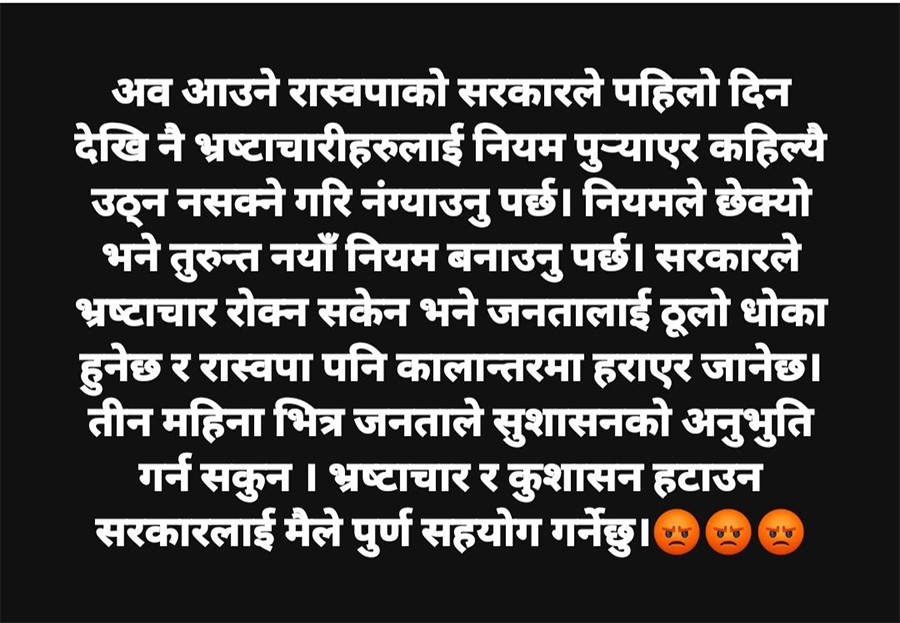
Mahavir Pun Urges Strict Action Against Corrupt Officials from Day One


March 23, Kathmandu – Former Education Minister Mahavir Pun has emphasized that the upcoming government must take stringent action against corrupt individuals from the very first day, ensuring no corrupt official continues unchecked under any pretext.

Pun, elected as a Member of Parliament from Myagdi, wrote on social media platform Facebook on Tuesday morning that if existing regulations hinder punishment of corrupt individuals, new rules should be enacted immediately. He stated, “The new Rastriya Swatantra Party government must, starting from day one, unmask corrupt officials by revising rules so they can never recover. If the rules obstruct, new laws must be promptly established.”

Expressing concern that failure to control corruption would severely betray the people, Pun predicted that the Rastriya Swatantra Party (Raswapa) itself will eventually fade away. He added, “Within three months, the people should begin to feel good governance. I will fully support the government in eradicating corruption and mal-administration.”

Chaiti Chhath Festival Celebrated Today


10 Chait, Janakpurdham — The Chaiti Chhath festival is being celebrated with great enthusiasm today in Janakpurdham and across the Madhesh region. According to traditional rites of Chaiti Chhath, the evening worship involves offering Arghya (water offering) to the setting sun. Tomorrow morning, after offering Arghya to the rising Sun God, known as Dinanath, the Chaiti Chhath festival will formally conclude.

In Janakpurdham, the festival is particularly vibrant at Gangasagar and Argajasar, where both sites have been beautifully decorated like brides in preparation for the celebrations.

There is a widespread belief that observing Chaiti Chhath fulfills all desires and protects devotees from skin-related diseases.

Observed over four days with strict rituals and devotion, the first day of Chaiti Chhath is known as ‘Nahay-Khay’ (bathing and eating). On the second day, devotees fast all day and consume only kheer (a sweet rice pudding) made with sugar at night. The third day falls on Shashthi Tithi (sixth lunar day), when devotees fast without food or water and offer Arghya while standing in a water body during the sunset.

Today, devotees enter the water body an hour before sunset to meditate on Shashthi Mata and offer Arghya to Dinanath. The offerings include traditional items such as Thekuwa (a baked sweet), Bhuswa (a type of snack), radish, sugarcane, puffed rice, bananas, and coconuts, which are presented as prasada (sacred offerings).

Devotees keep vigil through the night and on the following day, the festival concludes with the Arghya offering to the rising sun on Chaitra Shukla Saptami.

Although the number of participants in Chaiti Chhath is not as large as that of the Chhath festival celebrated in Kartik, the number of devotees observing this festival is gradually increasing each year.

Iran States War Prolonged Due to Israel; Will Not Halt Attacks Until Compensated


March 24, Kathmandu – Iran has taken a firm stance, vowing not to retreat in the conflict with the United States and Israel. Iran insists the war will continue until compensation is received for the joint US-Israeli attacks.

This position has sparked intense discussion, especially following Donald Trump’s announcement of a five-day halt to attacks on Iran.

Mohsen Rezaee, senior military advisor to Iran’s Supreme Leader Mojtaba Khamenei, stated in a television interview that the conflict will persist until reparations are made.

He also emphasized the immediate removal of all economic sanctions imposed on Iran and demanded clear guarantees that the United States will refrain from any future interference.

Rezaee highlighted that the Iranian military is fighting at full capacity and that under the leadership of the new Supreme Leader Mojtaba Khamenei, the country is advancing robustly.

“Israel Is the Reason the War Has Prolonged”

Rezaee suggested that the war could have ended within a week but has been prolonged due to Israel. He explained, “The United States was prepared to agree to a ceasefire and end the conflict. However, Israeli Prime Minister Benjamin Netanyahu insisted on continuing attacks, which caused the war to extend.”

According to Rezaee, after the 15th day of the conflict, the US had acknowledged the decreasing likelihood of winning the war.

Trump: The US Is Working on Alternatives for a New Political System in Iran

Meanwhile, US President Donald Trump stated that America is working on alternatives for a new political structure in Iran.

Speaking to journalists in Florida, Trump said, “Similar to Venezuela, a new leader could be brought in, or a joint leadership working with the US could be established.”

Expressing optimism, Trump expressed his desire to reach an agreement with Iran soon and announced a five-day pause in military actions.

He also revealed ongoing discussions with a particular individual regarding potential regime change in Iran. However, Iran has rejected Trump’s claims.

बालेनले पार गर्नुपर्ने राजनीतिका ५ घुम्ती – Online Khabar

The 5 Key Political Challenges Ahead for Balendra Shah

News Summary

Editorially Reviewed.

  • Senior leader Balendra Shah of the Rastriya Swatantra Party (RSP) is poised to become Prime Minister at just 35 years old.
  • The RSP secured nearly a two-thirds majority in the recent House of Representatives election, gaining the mandate to govern for the next five years.
  • Balendra faces five critical challenges including forming a cabinet, ensuring good governance, reforming civil service administration, managing relations with local governments, and shaping foreign policy.

Nepalese politics has reached another historic turning point. At just 35 years old, senior leader Balendra Shah (commonly known as Balen) of the Rastriya Swatantra Party (RSP) is preparing to assume the role of Prime Minister. Following the parliamentary elections held on February 21, where the RSP achieved nearly a two-thirds majority, Balen’s ascendancy to power is now assured. Prior to the election, when Balen was the mayor of Kathmandu Metropolitan City, a seven-point agreement was reached between him and the RSP, nominating him as the party’s candidate for Prime Minister. The RSP’s surprising victory has granted it the authority to form the government and implement its agenda over the next five years.

This electoral triumph is not merely a shift in Nepal’s political priorities but also reflects the strong desire of the Nepali people for change. Frustrated by the existing practices of ruling parties, the electorate has expressed hope for government reform through new and effective leadership.

Recent public opinion indicates that Balendra and his party have been chosen as capable leaders to steward Singha Durbar for the next five years. The sizable majority won by the RSP was previously considered nearly impossible given Nepal’s constitutional challenges where many parties find it difficult to secure an outright majority over the opposition. While electoral support signals the start of change, it does not guarantee successful governance. To transform this mandate into effective leadership, Balen must pass five crucial tests, which are outlined in detail below.

1. Building an Effective Governing Team

The success of Balen’s five-year term will largely depend on how his cabinet and advisory team perform. He must decide whether to lead this process directly or collaborate closely with RSP Chairman Ravi Lamichhane. Each approach carries its own risks. Forming a cabinet based primarily on party loyalty could reinforce traditional political patterns, whereas including experts without political ties may lead to weak local and national awareness within the administration.

Balen will need to establish this governing structure promptly, as circumstances will not wait for him.

Government ministers and advisors must be well-acquainted with the country’s challenges and possess the capability to implement the policies and programs announced by the party effectively. Moreover, the team must clearly understand recent regional and global political shifts and their geopolitical implications. Any missteps in team selection may cause weaknesses not only early in the administration but throughout its entire duration.

2. Making Wise and Balanced Decisions

Balen is set to face three major demands simultaneously as he assumes the premiership: good governance, public service reform, and job creation. The public expects clear improvements in these areas within the early months of the new government.

Additionally, there is pressure to hold accountable those responsible for the violence and destruction during youth protests on September 8 and 9. There is widespread anticipation for serious investigation of long-standing corruption and for perpetrators to be brought to justice through legal channels. Though valid and legal, these demands carry political risks if not handled cautiously.

Aggressive moves on such sensitive issues could spark confrontations with opposition forces both in parliament and on the streets. Therefore, Balen must prioritize these matters carefully and establish strict enforcement strategies. How he navigates these demands will be critical to his administration’s effectiveness.

3. Strengthening and Reforming Civil Service Administration

Nepal’s civil service and security agencies can either be the engines driving forward Balen’s goals or significant obstacles. This issue is more complex than it appears. Decentralizing power and resources to local and technical levels is not just an administrative change; it is a political decision involving power balance, rights redistribution, and the essence of governance.

Balen’s success depends not only on his decision-making and leadership but also on establishing wise alliances, strategic coordination, and a long-term vision with the civil service. Although the constitution positions the civil service as pivotal to development and service delivery, a historically centralized mindset has weakened it by limiting decision-making authority to higher levels.

Without effective civil service reforms, government policies cannot be implemented successfully. Security and stability are essential priorities that do not occur naturally; they form the foundation for development, a business-friendly environment, and social harmony. Balen must collaborate with these institutions and apply pressure for meaningful improvements without provoking political instability.

4. Managing Relations with Local and Provincial Governments

Winning a working majority is politically difficult, but governing according to public expectations is even more challenging.

This may be the least discussed but among the most critical challenges. The protests on September 8 and 9 caused damage to nearly 300 local governments, including provincial capitals and their institutions. Many provincial governments are struggling to strengthen themselves. These local and provincial bodies deliver services such as health, education, infrastructure, and administration to the people. If Balen’s government neglects these levels, policies formulated at the federal level will fail to reach the population effectively.

The distances between Kathmandu, hill, and remote mountain regions are not only geographical but also institutional. Now is the time for the federal government to prioritize and invest in enhancing the capacities of local and provincial governments rather than delay these efforts.

5. Balancing Relations with Neighboring and Friendly Nations

Situated between two major global powers, India and China, Nepal must maintain balanced relations with both, as well as with Western partners. Balen has inherited the responsibility of managing this delicate diplomatic balance. Any tilt toward one side risks increasing domestic criticism and opposition support.

Within the RSP itself, there are diverse views on foreign policy. A constitutional, well-structured, and impartial foreign policy is not only diplomatically prudent but also essential to keeping the party united and preventing foreign policy from becoming a source of internal conflict.

Enthusiasm Alone Is Not Enough

The fifth challenge ties into all the others. Desiring change and being capable of implementing it successfully are two very different things. Many governments have failed precisely because they could not bridge this gap. Balen carries not just the trust placed in him from outside the political system but also the confidence of a confused populace within. However, if he fails to channel energy and enthusiasm into effective governance, that trust may soon erode.

Ultimately, Nepal is a small landlocked country caught between sensitive geopolitical neighbors and faces its own serious internal challenges. Managing these realities requires not just vision but practical plans, capable partners, an implementable governmental structure, and consistently vigilant leadership. Balen must establish this foundation quickly, as circumstances will not wait for his preparation.

The next five years could represent a rare opportunity for Nepal if Balen turns his majority not simply into a means to retain power but into a tool for genuine transformation. Tasks left unfulfilled by previous governments — reforming the civil service, making services consumer-centric, fostering a culture of real accountability, and adopting a balanced foreign policy focused on national interests — can finally commence.

If these efforts succeed, this period will not merely be a story of government change but a turning point in how the state itself is managed. Yet, this will not happen automatically; it will require sound decisions and strong commitment. Balen and his team must deeply understand their responsibilities and dispel the misconception that winning the election was the hardest task. Winning was not difficult; governing well will be far tougher. The public desires not just new faces in leadership but tangible improvements in their lives. This real test has already begun.

(The author Bhattarai is a visiting research fellow at the Kroc Institute for International Peace Studies, University of Notre Dame, USA. He focuses his studies and research on Nepal’s politics, peace, good governance, and social policy.)

Motorcyclist Dies in Jhapa After Collision with City Safari Vehicle


March 23, Jhapa – A 50-year-old motorcyclist, Shukdev Ganesh, has died after being hit by a City Safari vehicle in Kachankawal Rural Municipality-4.

According to Khagendra Bahadur Khadka, spokesperson for the District Police Office, on Monday night, a motorcycle bearing the number BR-11C-3071, traveling from Baniyani towards Lodhobari, collided head-on with a City Safari vehicle numbered PR-1-01-002B 6411 coming from the opposite direction. The motorcyclist, Ganesh, sustained serious injuries in the accident.

He was taken to Om Sai Pathibhara Hospital in Bhadrapur for treatment, where doctors declared him dead upon arrival, police confirmed.

Police have arrested the City Safari driver, 19-year-old Saijan Miya, who is a local resident, and are conducting further investigations into the incident.

Kuwait and Bahrain Issue Warnings of Potential Iranian Attacks


March 24, Kathmandu – Amid ongoing conflict in the Middle East, several Gulf countries have consecutively issued warnings about potential attacks. Recently, Kuwait and Bahrain have also highlighted the possibility of Iranian attacks and have urged their citizens to remain in safe locations.

Bahrain’s Ministry of Interior issued a security alert to its citizens, as reported by BBC. The ministry posted on ‘X’ that “sirens have sounded. Citizens are urged to remain calm and proceed to the nearest safe area.”

Additionally, the ministry has called on citizens to comply with official instructions.

According to BBC, the Kuwaiti Armed Forces informed through ‘X’ that there were multiple missile and drone attacks in the country from Monday night until Tuesday morning.

A message posted recently by the military on ‘X’ stated, “Kuwaiti air defense is currently confronting hostile missile and drone attacks.”

The Armed Forces have made a special appeal to all citizens to follow any directives issued by relevant authorities to ensure their safety.

पर्वतमा जिप दुर्घटना हुँदा चालकको मृत्यु – Online Khabar

Driver Dies in Jeep Accident in Parvat District


March 23, Parvat – A jeep accident occurred along the Kaligandaki Highway near the Kaligandaki riverbank on the Kusma-Falawas road in Mudikuwa-4 of Falawas Municipality, resulting in the death of the driver, Sajjan Pariyar.

The jeep, bearing the number G1J 8029, was traveling from the district headquarters Kusma Bazaar towards Falawas Municipality carrying urea fertilizer when it fell approximately 30 meters down the roadside on Monday evening.

According to Inspector Dinesh Paudel of the District Police Office, the 35-year-old driver was alone in the vehicle. Pariyar was rescued and was being transported to the Provincial Hospital but died en route.

Authorities stated that slippery uphill roads caused by the rain may have contributed to the accident. Armed Police Force Chandika Battalion and personnel from the District Police Office carried out rescue operations under difficult conditions, according to Armed Police Force Deputy Superintendent Khitij Kshetri.

Why Gulf Countries Have Avoided Direct Attacks on Iran

In response to attacks by the United States and Israel, Iran has continued targeting US military bases and infrastructure in the Gulf region. However, Gulf countries have refrained from direct attacks on Iran, focusing instead on strengthening their defense systems, successfully intercepting many missiles mid-air. Experts say these countries have avoided direct confrontation with Iran due to the potential risk of regional war, economic stability concerns, diplomatic restraint, and the sensitive situation in the Strait of Hormuz. (March 24, Kathmandu)

Following attacks by the US and Israel on Iran, Iran has targeted US military bases located in Gulf countries. The targets include strategic locations in Bahrain, Kuwait, Saudi Arabia, Qatar, Oman, and the United Arab Emirates (UAE). Reports indicate damage to airports, energy infrastructure, hotels, and residential areas in these nations. Recently, after Israel attacked Iran’s South Pars—the world’s largest natural gas field—Iran retaliated by striking Qatar’s Ras Laffan energy facility, causing significant damage.

There are several key strategic and political reasons behind the Gulf countries’ decision to avoid direct attacks on Iran. These include the desire to maintain regional peace and prevent war, safeguard economic development plans, exercise diplomatic restraint and mediation efforts, and address the sensitivity of the Strait of Hormuz. Although the UAE’s airports have reportedly been targeted by Iran, many Gulf nations prefer to enhance their defensive capabilities rather than launch armed offensives against Iran.

Currently, 22 countries including the UAE have issued a joint statement strongly condemning attacks on ships in the Strait of Hormuz. According to Rob Geist Pinfold, a professor of International Security at King’s College London, while the Gulf countries condemn Iran’s actions as “terrorist activities,” their primary motivation for restraint is to protect their national security, economic future, and prevent territorial devastation.

Lipulekh Dispute: As India Prepares to Resume Trade with China, What Is Nepal Doing?

Xi Jinping and Narendra Modi meet during BRICS summit in Kazan, Russia, October 2024

Image source, Reuters

Reading time: 6 minutes

The government of India in Uttarakhand has announced plans to resume cross-border trade with China through the Lipulekh border point starting this year, six years after the last trade activity. In response, the Nepalese government has commenced a detailed study and is preparing an appropriate diplomatic reaction.

On Friday, the Press Trust of India (PTI) quoted the District Magistrate of Pithoragarh that preparations are underway to conduct cross-border trade scheduled from June to September under directives from the Indian government.

Nepal’s Foreign Minister Balananda Sharma confirmed ongoing discussions and stated that the Nepalese government will prepare an appropriate response.

Both Nepal and India claim the Lipulekh area as sovereign territory. However, recent Chinese advances towards the tri-junction border points have caused dissatisfaction in Nepal.

In August, during Chinese Foreign Minister Wang Yi’s visit to India, the two countries agreed to restart trade via the Lipulekh pass. Nepal had meanwhile alerted its concern, emphasizing Lipulekh as integral to Nepalese territory and objecting to the use of this route for trade.

रोल्पामा पहिलोपटक भूतपूर्व सैनिक सम्मेलन हुँदै – Online Khabar

First-Ever Veterans Conference to Be Held in Rolpa

March 23, Rolpa – Rolpa is set to host its first-ever veterans conference. The event targets retired soldiers who receive pensions from the Nepali Army, as well as single women veterans, and is named Veterans Conference 2082.

Organized under the coordination of the Nepali Army’s Gangi Adda management and the Nepali Army Welfare Board, the conference will take place at the Suryadal Battalion Libang Barrack in Rolpa on Chaitra 22, according to Ishwar Thapa, chief soldier of the Suryadal Battalion Rolpa.

“To participate in the conference, we have set up a registration desk at the battalion from Chaitra 1 to 17,” said Soldier Thapa. “Registration is open daily from 10 a.m. to 5 p.m.”

According to Khim Bikram KC, president of the Veterans Association Rolpa, there are currently 110 veterans residing in the district. “Among them, 10 are single women,” he added. “Some live outside the district, but our aim is to have everyone present; we are yet to see the final turnout.”

Conferences to Be Held in Other Districts as Well

The Central Office of the Nepali Army has also announced a veterans conference on Chaitra 22 under the Mid-Western Command Headquarters for 2082 BS.

For veterans residing in Rupandehi, Kapilvastu, Nawalparasi-West, and Nawalparasi-East districts, the main venue will be the Yogikutti Barrack in Butwal.

Similarly, veterans living in Dang, Pyuthan, Rolpa, Rukum West, Rukum East, Salyan, Arghakhanchi, Gulmi, and Palpa will participate at respective sub-centers located within Nepali Army units in their districts.

Further conferences are scheduled to be held under the Western Command Headquarters on Chaitra 25, at the Mid-Eastern Command Headquarters at Bardibas Military Camp, Mahottari on Baishakh 3, 2083, and at the Khadgad Dal Battalion Ramchechhap Barrack on Baishakh 4, 2083.

Increase in Embassy-Name Scams Targets Nepalis Amid Middle East Conflicts

March 23, Kathmandu – Due to escalating conflicts among Israel, Iran, and the United States in West Asia, cyber scams have sharply increased alongside growing security concerns. Scammers have specifically targeted Nepalis residing in the region amid fears related to the conflict.

Recently, cybercriminals have hacked WhatsApp accounts of Nepalis living in Israel, Qatar, UAE, and other countries, then contacted their family and acquaintances from hacked contact lists, requesting OTP codes to extort money. These scammers impersonate the Nepalese embassy, falsely claiming, “This is a call from the Nepal Embassy,” and appeal for money under the pretext of emergency rescue or assistance.

Groups hacking WhatsApp accounts of Nepalis in Israel have become notably active. Instances of scams claiming calls from the Nepal Embassy using various phone numbers have increased.

Scammers operate by sending a verification code via phone and then calling back to ask for that code, which they use to hack into WhatsApp accounts.

Officials of the Non-Resident Nepali Association (NRNA) in Israel have urged vigilance as these incidents have become widespread. They advise not to share codes if called by unknown persons and to block these contacts immediately.

Similar fraudulent activities have begun to surface in Gulf countries including Qatar, UAE, Saudi Arabia, and Kuwait. Nepalis working abroad are targeted through social media and messenger apps, prompting calls for enhanced awareness.

The Nepalese embassies and the Ministry of Foreign Affairs in the concerned countries have also issued warnings to remain alert.

It has been clearly stated that no embassy or government agency will ever request OTP codes or confidential information through calls or messages. People are urged not to trust unknown callers or messages and to verify any financial transactions through official channels beforehand.

The Nepal Police have also highlighted the rising cyber fraud activities, repeatedly advising citizens not to share OTPs, passwords, or personal information with anyone, avoid clicking suspicious links, and remain cautious of unsolicited messages. If account hacking is suspected, victims are recommended to immediately recover accounts and file complaints with relevant authorities.

The Nepal Police Cyber Bureau has warned about increasing cases where hackers compromise WhatsApp accounts to send messages like “I am in trouble, please send money immediately” or “There is an issue with my banking app; please send money to this QR code,” targeting friends and relatives. They have called for heightened awareness regarding such scams.

Even in urgent situations, people are advised not to trust such messages instantly, to confirm by direct phone calls if possible, and to refrain from downloading suspicious links, codes, or files.

The Cyber Bureau also requests that all users enable two-step verification, never share their OTP or verification codes with others, and remember to log out after using WhatsApp Web.

Embassies report that Nepalis living in conflict zones are already facing mental stress and insecurity, and these scams add to their difficulties. Scammers exploit emergencies, fear, and uncertainty to apply emotional pressure and extort money.

Why Gulf States Have Refrained from Responding to Israeli-American Attacks on Iran

Iran continues to launch missile attacks in the Gulf region amid its ongoing conflict with the United States and Israel. Last week, after an attack on Israel originating from South Pars—home to the world’s largest natural gas field located in Iran—Iran struck Qatar’s Ras Laffan energy facility. Despite repeatedly being targeted, Qatar and other Gulf states have so far chosen not to take retaliatory action against Iran. Why have these states hesitated to respond militarily, and what factors might compel them to act in the future?

Gulf states have refrained from attacking Iran due to the high risks involved and the limited benefits of such actions. Sina Toosi, a senior non-resident fellow at the US-based think tank Center for International Policy, explains, “From their perspective, this is not their war, and retaliating could expose them from being relatively low-profile actors to major targets.” He adds that the Gulf countries depend heavily on their economies, energy infrastructure, maritime transport, and investor confidence—all of which Iran has demonstrated the capability to disrupt.

According to Pinfold, Gulf states fear that the US is conducting “an open campaign without clear objectives or a post-war plan.” Nevertheless, leaders of the Gulf nations believe that diplomacy remains the sole viable path to ending this conflict. They emphasize that “the only way to protect themselves from attacks is to reach some form of agreement and pursue a negotiated solution.”

Despite their current restraint from retaliatory measures, “the political dynamics could shift rapidly,” warns Dr. H.A. Hellier, a senior associate at the UK-based Royal United Services Institute. He added, “If there are large-scale attacks on energy infrastructure, the outlook of Gulf states could change dramatically.”