Author: space4knews

‘मिस वर्ल्ड’ को फिनाले ५ सेप्टेम्बरमा तय, लुनाको तयारी कस्तो छ ?

Miss World 2023 Finale on September 5: How is Luna Preparing?

The 75th edition of the world-renowned beauty pageant, Miss World, will be held in Vietnam from August 9 to September 5, according to the organizers. The event will commence in the capital city of Hanoi with the arrival of participants on August 9, while the final competition is scheduled for September 5 in Ho Chi Minh City. Luna Luintel, Miss Nepal World 2025, is participating in the contest and is currently engaged in physical and mental training as well as working on her ‘Beauty with a Purpose’ project.

This year’s Miss World competition is set to take place in Vietnam. Official information states that the event will begin on August 9 and conclude with the final on September 5. The announcement of this historic edition was made during the Miss World Vietnam finale held on March 29. The event was attended by Julia Morley, chairperson of the Miss World Organization, and representatives of the local organizing committee.

Founded in 1951 by Eric Morley, the first Miss World pageant took place in London. This year, the organization is celebrating its 75-year journey by presenting the 75th edition under the theme ‘Beauty with a Purpose.’ Currently, Julia Morley and the reigning Miss World from Thailand, Opal Suchada, are in Vietnam collaborating with the local organizers to officially launch this landmark event. Luna has been preparing intensively for several months ahead of the competition.

Agriculture Department Recommends Support Price for Chaite Rice

March 30, Kathmandu – The Agriculture Department has recommended a support price for Chaite rice. The department submitted a detailed report based on field studies conducted in 25 districts to the Ministry of Agriculture and Livestock Development to ensure fair pricing for farmers. The report analyzed production costs, seeds, fertilizers, labor, inflation, market prices, and production expenses to determine the recommended price, according to the department’s Director General, Prakash Sanjel.

Following the on-site studies, a scientific price proposal covering production costs, transportation expenses, market rates, and other relevant factors was received, said the ministry’s Information Officer, Mahananda Joshi. He added that stakeholders have been consulted regarding the proposed per quintal price and preparations are underway to present the proposal to the Council of Ministers. The price will be publicly announced only after approval by the council.

Moisture standards for rice will also be taken into account to finalize the support price for farmers’ produce. The ministry stated that if the moisture content is up to 18%, the fixed price will apply, while any moisture content exceeding 18% will result in a weight reduction according to established rules. The government will purchase rice at the fixed price through the Food Management and Trading Company Limited. Last year, the government had set the support price at NPR 2,800 per quintal. – Rastriya Samachar Samiti

Newly Appointed Member-Secretary of Karnali Province Sports Council Ravindra Chand Sworn In

Ravindra Chand, the newly appointed member-secretary of the Karnali Province Sports Council, has taken the oath of office and secrecy. On Monday, Minister Ghanshyam Bhandari administered the oath at an event held at the Ministry of Social Development. Chand was appointed as the council’s second member-secretary during the Provincial Council meeting held on Chaitra 12 (March 26, 2023).

A total of 21 candidates applied for the member-secretary position, among whom Chand scored the highest 67.17 points in the interview. On the same occasion, the council’s vice president Pramod Hamal and members Pawan Kumar Thapa, Pankhabahadur Malla, Bhimakumari Bhusal, Gorkhabahadur Shahi, and Kiran Kishor Sapkota also took their oaths.

The member-secretary position had been vacant since Poush 4, 2081 (December 20, 2024). Previously, the selection committee had conducted interviews on Magh 3 (January 17, 2023) and recommended three candidates to the government, including Ravindra Chand, Deepak Hamal, and Pramod Hamal. Among them, Chand achieved the highest score of 67.17, Deepak Hamal scored 60.63, and Pramod Hamal earned 52.37. Initially, 21 candidates applied for the member-secretary role, of whom 10 were shortlisted for interviews.

ओलीको स्वास्थ्य अवस्था सामान्य, चिकित्सक भन्छन्- डिस्चार्ज गर्न सकिन्छ

KP Sharma Oli’s Health Stable; Doctors Suggest Possible Discharge Soon

Summary of News

  • CPN-UML Chairman KP Sharma Oli’s health condition is stable, with doctors indicating he is fit to be discharged soon.
  • Although gallstones were detected in Oli’s gallbladder, immediate surgery is not required; doctors advise deciding based on risk assessment.
  • Former Energy Minister Deepak Khadka is hospitalized at Tribhuvan University Teaching Hospital with a stable condition, hospital sources confirmed.

March 29, Kathmandu – CPN-UML Chairman and former Prime Minister KP Sharma Oli’s health remains stable, according to the medical team overseeing his treatment.

Admitted since Saturday morning, doctors have stated that Oli can potentially be discharged soon. “All medical reports have come back normal, and after discussions, the medical team agrees he is fit for discharge,” said one of the attending doctors.

Following complaints of heart issues reported Saturday morning, doctors conducted further tests. On Sunday, Oli was fitted with a Holter monitor to observe his heart rhythm over a 24 to 48 hour period. The device’s reports confirmed that his heart rate is normal.

Despite some urinary tract infection indicators, Oli showed no overt symptoms. As a precaution, cultures were taken to confirm the infection. “Some bacteria were detected in the urinalysis; however, there are no significant symptoms,” the doctor explained, “so a urine culture was performed for further confirmation.”

An X-ray on Saturday revealed the presence of gallstones in Oli’s gallbladder, but immediate surgery is not deemed necessary. A team of gastro surgeons advised that operating now could pose risks.

Given Oli’s history of two kidney transplants, his age, and heart condition, doctors consider surgery risky at this time.

“It is not urgent to remove the gallstones immediately,” said one doctor involved in the treatment. “Since the condition is not seriously impacting his health, waiting for an appropriate time to operate is the better option.”
However, Oli himself has expressed a preference to have the gallstones removed to resolve the issue.

“He has mentioned that since the stones are increasing, it would be best to remove them surgically,” the doctor added. “But the decision will be based on a careful assessment of potential risks.”

Hospital sources indicate that given Oli’s improving condition, discharge is likely soon.

“Looking at the current situation, he does not need to be hospitalized for much longer,” said another physician. “After one or two days of monitoring, he can be safely discharged.”

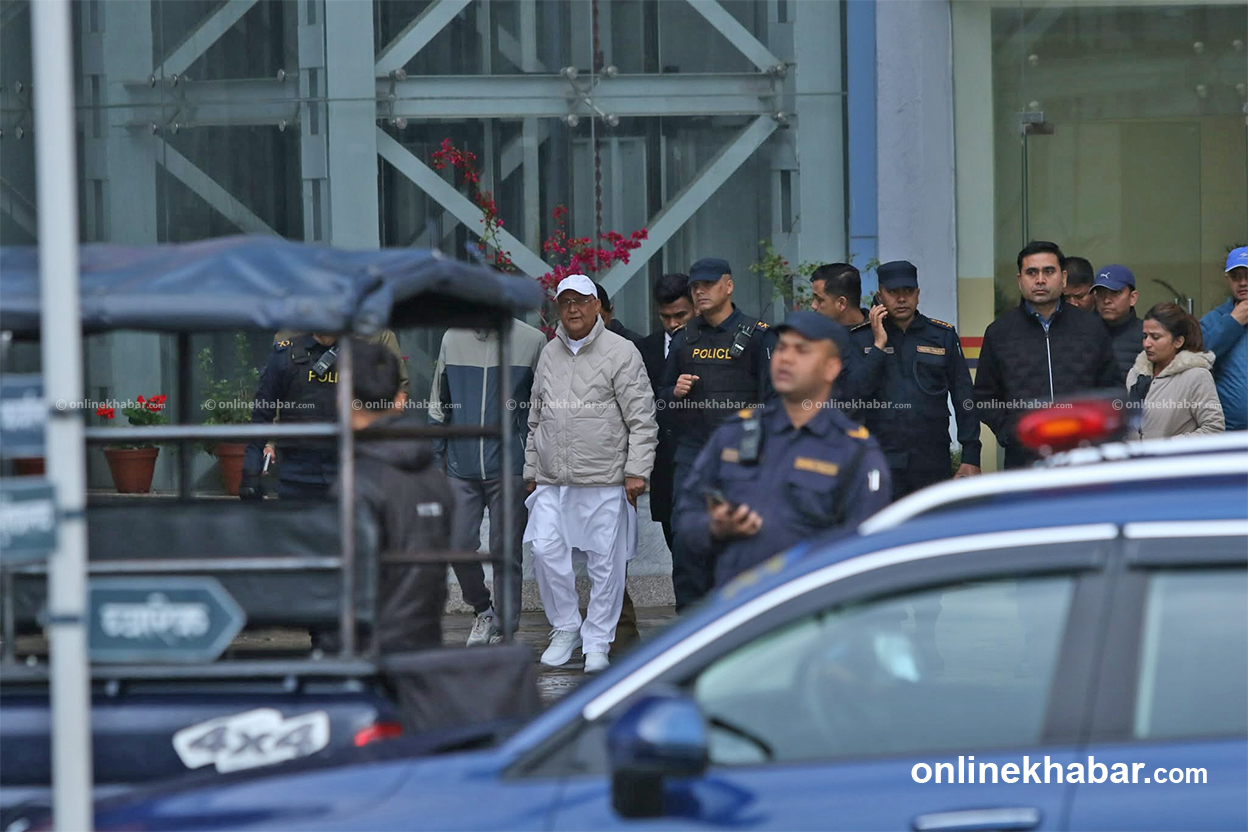
Oli was brought to Tribhuvan University Teaching Hospital by police following his arrest Saturday morning for a health checkup. Initial assessment was conducted in the emergency ward, where he reported heart palpitations.

Subsequently, he was admitted to bed number 501 in Annex-1 for further evaluation.

During the people’s movement of mid-September, when Oli was Prime Minister and Ramesh Lekhak was Home Minister, a commission led by former Justice Gauri Bahadur Karki investigated the events and found both Oli and Lekhak responsible, recommending a criminal probe for possible loss of life.

Based on this report, the government arrested Oli and former Home Minister Ramesh Lekhak on Saturday morning. Kathmandu District Court granted a five-day extension to custody. While Lekhak is being held and investigated at Nepal Police’s Maharajgunj unit no. 2, Oli remains hospitalized for health reasons.

Former Minister Deepak Khadka Admitted with Stomach Issues

Former Minister of Energy, Water Resources and Irrigation, and Congress leader Deepak Khadka has also been admitted to Tribhuvan University Teaching Hospital. The Anti-Money Laundering Investigation Department arrested him on Sunday in connection with assets seized from his home during the September 24 people’s movement protest. The court authorized seven days of detention for investigation.

On the night of admission, Khadka developed high blood pressure and diarrhea and was initially taken to Norvic Hospital. Due to lack of available beds there, he was referred to Tribhuvan Teaching Hospital at 3 a.m.

Hospital sources reported that Khadka was admitted to bed number 1029. He is under observation due to diarrhea and vomiting.

Initial tests showed that Khadka’s blood pressure is under control, and symptoms of diarrhea and vomiting are subsiding.
A hospital source stated, “His current health status is normal, medical reports are stable, and there is no need for prolonged hospitalization.”

Blood tests revealed a slight infection, indicated by an elevated leukocyte count. “His leukocyte count was around 17,000 at Norvic Hospital, now approximately 13,000 at the Teaching Hospital,” a doctor explained.

Doctors note that a leukocyte count above 11,000 is indicative of infection. Khadka is currently receiving antibiotic treatment.

Yemen’s Houthi Rebels Join Iran’s War, Raising Fears of Further Escalation

Missile Attack

Image Source, ANADOLU GETTY IMAGES

Reading time: 3 minutes

Yemen’s Iran-backed Houthi group has confirmed the first missile attack against Israel since the war with Tehran, initiated by Israel and the United States a month ago, began.

The group stated that it launched ballistic missiles targeting “sensitive Israeli military sites,” asserting this was in response to Israeli attacks on Iran, Lebanon, Iraq, and Palestinian territories.

They have declared their operations will continue until all fronts cease hostilities.

Earlier, the Israeli Defense Forces reported successfully intercepting missiles fired from Yemen.

A New Front Opens in the Conflict

According to Joe Floto, BBC’s Middle East bureau chief in Jerusalem, the Houthis have expressed support for Iran for several weeks, making their active participation in the conflict anticipated.

बधाई-शुभकामना दिन मन्त्रालय नआउनू – Online Khabar

Rastriya Swatantra Party Urges Against Crowding Ministries to Offer Congratulations and Best Wishes

The Rastriya Swatantra Party (RSP) has requested its leaders and well-wishers not to crowd ministries to offer congratulations and best wishes to the Prime Minister and ministers. Acting Chief of the RSP Central Disciplinary Commission, Ramakant Rimal, made this appeal, warning that unnecessary meetings could hinder government performance.

According to the statement, “Instructions have been issued against such activities as they can affect the government’s workflow and cause delays in prompt service delivery.” On Chaitra 16 (March 30), in Kathmandu, party leaders, members, and well-wishers visiting ministries to congratulate the newly appointed Prime Minister and ministers have engaged in unnecessary meetings, garlanding, and photo sessions, which are contrary to party discipline and have sparked controversy.

Therefore, the Central Disciplinary Commission has urged against such conduct. The statement emphasized, “Recognizing the necessity of prioritizing citizen service and effective governance at this time, unnecessary meetings, gatherings, and crowding within ministries to congratulate the Prime Minister and ministers will delay government performance, affect quality of work, and ultimately impact the overall government system. Hence, a strict directive has been issued to all party officials and members not to undertake such actions.”

Discussion on the Role of Media in Promoting Women Entrepreneurship

March 29, Kathmandu – A discussion program focused on the role of media in promoting women entrepreneurship was organized by the Journalists’ Group Nepal on Monday in Kathmandu. The event featured experts who deliberated extensively on the extent to which mainstream media prioritizes the issues faced by women entrepreneurs. Editors, representatives from civil society, human rights activists, and journalists participating in the discussion emphasized the need for positive media coverage of the stories of small-scale women entrepreneurs.

Journalists’ Group Nepal shared that, with support from GIZ Nepal, they published 21 fellowship stories titled ‘Entrepreneurial Women’ highlighting the struggles and successes of women entrepreneurs across the country. Haribahadur Thapa, Editor-in-Chief of Baahrakhari, noted that in the current scenario where political topics receive most attention, bringing inspiring stories of women entrepreneurs to mainstream media is a positive step. He added that showcasing even small but motivational stories can encourage other women to pursue entrepreneurship.

During the program, woman entrepreneur Shyam Badan Shrestha shared her experience, stating that despite managing family responsibilities and engaging in business during saved time, media has not given adequate space to women entrepreneurs. She stressed the need for media to provide encouragement and support in market promotion. Human rights activist Charan Prasain highlighted the importance of addressing women entrepreneurship from a human rights perspective. He advocated for the media to play a role in increasing the government’s sensitivity towards women involved in small businesses.

Babita Basnet, advisor and former president of the Journalists’ Group, emphasized prioritizing the promotion of women entrepreneurship through digital media. She stated that stories of struggles faced by small enterprises can reach wider audiences via digital platforms. Advocate Pundavi Maharjan pointed out that alongside success stories, the media should also focus on strengthening the legal aspects related to women entrepreneurship. Binija Nepal, Component Manager at GIZ Nepal, emphasized the necessity of collaboration between media and various organizations to promote women entrepreneurship.

An accompanying six-month study report presented at the event revealed that coverage of women’s issues varies across provinces. In Sudurpashchim and Karnali provinces, topics like Chhaupadi and health are frequently reported, whereas entrepreneurship, digital businesses, and political participation dominate news in other provinces. Kamala Panthi, Chairperson of Journalists’ Group Nepal, stated that despite progress, media still tends to prioritize negative issues such as violence, rape, and accusations over women’s achievements. The event was attended by 21 fellows, editors, mentors, civil society representatives, advocates, and women entrepreneurs.

The Third Edition of Tikapur Literary Festival Successfully Concludes

The third edition of the ‘Tikapur Literary Festival 2082’ was successfully held in Tikapur from Chaitra 13 to 15. The festival, jointly organized by the Tikapur Literary Society and the Sudurpashchim Academy, concluded on Sunday. Organizers informed that the festival encompassed various themes including language, literature, art, culture, education, and social development. According to Mahesh Bikram Shah, the founding coordinator of the festival, the third edition focused particularly on the theme of ‘Tharu Literature and Cultural Festival.’

Mahesh Bikram Shah stated, “Our efforts have strengthened and sustained the literary and cultural identity of Sudurpashchim Province, while promoting the message of multilingual and multicultural coexistence.” Throughout the festival, 21 special sessions were held featuring in-depth discussions and interactions on language, literature, art, music, local livelihoods, history, identity, politics, society, and contemporary issues. The event saw the participation of esteemed linguists, writers, artists, social thinkers, doctors, journalists, researchers, cultural experts, development specialists, and tourism activists from across the country.

The first series of the festival included a boat ride on the Karnali River and a performance of Tharu cultural dance. The second series featured street drama performances, writing workshops, and a province-level poetry festival. During the third series, various activities took place including theatrical performances, displays of Tharu folk culture, intellectual dialogues, poetry and ghazal recitals, musical programs, and a presentation of Deuda, a traditional dance from Sudurpashchim. The fourth series showcased the critically endangered ‘Ramleela dance,’ an important heritage of Tharu folk culture.

Mahesh Bikram Shah claimed that the direct dialogue involving the knowledge, experience, and creative journeys of established figures in literature, art, and social fields benefitted the local community. He added, “We believe our efforts will help establish Tikapur Municipality as a center of literature and culture.” The festival is expected to positively influence local tourism promotion, economic activities, and cultural awakening.

Five Strategies to Reduce Children’s Screen Time

If you are a parent, you might find validation in a recent US court ruling that held Meta and Google accountable for building addictive social media platforms that harmed a young woman’s mental health. The young woman, named Kelly, was represented by lawyers who argued that features like Instagram’s never-ending ‘infinite scroll’ are intentionally addictive. The court’s decision has been hailed as a ‘defining moment’ for social media companies. However, for parents trying to reduce the amount of screen time their young children spend, this ruling holds limited practical value. We consulted several child-rearing experts to gather their advice on how to help children spend less time on phones, even if only for a short while.

1. Start Early and Be Realistic. Many parents have already given their children tablets or smartphones, so thoughtful consideration before introducing these devices is crucial. Child psychologist Dr. Jane Gilmer emphasizes that completely banning phone use is often not the right choice. She explains, “Changing habits is never easy.” She advises that changes should be introduced calmly and objectively rather than during arguments over screen time. “A calm mindset facilitates effective communication.” As a first step, designating a specific place in the home for storing devices, such as a particular drawer, can be beneficial. “Assign a specific spot for chargers where the phone can be placed to charge when turned off, and that’s where the matter ends.”

2. Collaborate. Child psychologist Dr. Marihan Baker believes that instead of imposing strict rules, older children and teenagers should be involved in discussions about screen time. She says, “I understand this space is important for connecting with your friends. I recognize the social pressure that comes with not using it. Therefore, it’s important we discuss how to balance your time and ours, which will help you stay away from the phone when needed.” Parenting coach Olivia Edwards adds that building a strong relationship with the child or adolescent is essential to successfully reduce screen time.

3. Use Screen Time as a Learning Opportunity. Many parents struggle to understand the trends and features of social media, but this can create opportunities for open discussions about screen time between adults and children. Olivia suggests, “You can ask, ‘Do you know how social media works? Apps are designed to attract people. They earn money based on the time people spend watching – did you know that?'” Dr. Jane points out that this approach helps parents teach children digital literacy.

4. Model Good Behavior. It’s clear that children imitate their parents, so reflecting on your own screen habits is crucial to establishing healthy practices. Marihan recommends approaching this in a light and fun way: “We can say to our children with self-awareness, ‘We all are guilty of this, and our relationship with phones needs improvement. I haven’t been the best at it either.’”

5. Don’t Panic. Raising children has never been easy, and today’s screen era adds complexities we must understand, including concerns. Dr. Tony Sampson, a digital communication expert at the University of Essex, advises parents not to fall into excessive fear. “Parents often become petrified by communication fears and assume every adolescent’s brain is wired to be addicted to social media,” he says. However, children and teenagers have a brain capability called ‘neuroplasticity,’ which allows them to adapt to and recover from their circumstances.

“Social media doesn’t disrupt attention; it captures it, directing it toward commercial content,” he adds. “Positive use of technology can enhance neuroplasticity, fostering creativity, exploration, and learning.”

Five Effective Ways to Reduce Children’s Screen Time

Symbolic image of a child watching a mobile phone

Image source, Getty Images

If you’re a parent, you may feel validated by a recent US court ruling finding that Meta and Google knowingly created addictive features on social media platforms which harmed a young woman’s mental health.

The young woman’s lawyers claimed that features like Instagram’s endless “infinite scroll” are designed to be addictive.

The court’s decision has been hailed as a ‘decisive moment’ for social media companies. However, for parents trying to reduce their children’s screen time, its practical relevance may be limited.

We consulted several parenting experts for practical advice on how to limit children’s time on phones, even if only for short periods.

1. Start Small and Be Realistic

Many parents have already given their children tablets or smartphones, so it’s important to make thoughtful decisions about when and how to provide these devices. However, child psychologist Dr. Jane Gilmer advises against completely banning phone use, as that is often unrealistic.

राष्ट्रपतिद्वारा संसद् अधिवेशन आह्वान – Online Khabar

President Calls for Federal Parliament Session

President Ramchandra Paudel has announced the convening of a session for both houses of the Federal Parliament on Chaitra 19. The Cabinet meeting had recommended the President to call the parliamentary session on that date. This will be the first session of the Federal Parliament since the formation of the new government.

Chaitra 16, Kathmandu. President Ramchandra Paudel has formally convened sessions for both houses of the Federal Parliament. On Monday, the Cabinet meeting proposed to the President to convene Parliament on Chaitra 19. Based on this decision, President Paudel has called for the session, according to Ritish Kumar Shakya, spokesperson for the President’s Office. The government had recommended holding the parliamentary session at 2 PM on Chaitra 19. This marks the first session of the Federal Parliament following the elections held on Falgun 21 and the subsequent formation of the new government.

Former President Bhandari Inquires About KP Sharma Oli’s Health Condition

Kathmandu, March 30 – Former President Bidya Devi Bhandari visited Tribhuvan University Teaching Hospital in Maharajgunj on Monday to inquire about the health condition of KP Sharma Oli, chairman of the CPN-UML. Rajkumar Rai, Bhandari’s personal secretary, confirmed that the former president obtained updates on Oli’s health and also consulted with doctors regarding his condition.
Oli, who has also served as Prime Minister, was arrested by police on Saturday under government directive to implement the report of the investigative commission led by Gauribahadur Karki. The commission was appointed to probe the incidents of September 8 and 9. Following his arrest, Oli was admitted to the teaching hospital for medical treatment. –Rastriya Samachar Samiti

History of Elections and Controversies at the All Nepal Football Association (ANFA)

The All Nepal Football Association (ANFA) was established in 1953. Following the restoration of multiparty democracy, ANFA has started selecting its leadership through a democratic electoral process. However, the election process within ANFA has not been smooth or free from controversy. As Nepal’s most popular sport and highest-budget organization, ANFA has repeatedly experienced disputes during leadership selection.

In 1987, after a cyclone caused the death of over 71 people at the Dashrath Rangashala stadium, sports officials resigned on moral grounds. Those who resigned included then Sports Minister Keshar Bahadur Bista, National Sports Council Secretary Sharad Chandra Shah, and ANFA President Kamal Thapa. After Thapa’s resignation, Chandra Bahadur Gurung was appointed as ANFA president. After Gurung also stepped down, Dhruva Bahadur Pradhan served as acting president. Subsequently, Adityadhwaj Joshi took over ANFA’s leadership, but he too resigned, after which acting president Purushottam Shrestha assumed responsibilities.

Ganesh Thapa was appointed president on March 6, 1995 (Chaitra 22, 2051 BS). However, FIFA did not recognize Thapa’s leadership, instead recognizing the leadership of Rukma Shamsher. Thapa’s ad hoc committee held elections in October 1995 (Ashwin 2052 BS), which FIFA accepted, beginning an era of Thapa’s leadership in Nepali football. However, controversies started during his tenure. In 2005/06 (2062/63 BS), when elections were due, clubs in the ‘B’ division launched protests demanding 18 specific demands. Thapa had raised players’ salaries, which caused financial difficulties for the clubs.

Although ANFA’s term was set to end by July 19, 2026 (Asar 4, 2083 BS), its executive committee decided on January 12, 2026 (Magh 28, 2082 BS) to hold early elections. This decision sparked disputes. Several clubs and districts opposed holding central elections without conducting elections at lower levels. The Department of Sports sent a letter to ANFA instructing that elections should not be held without approval and ordered a postponement. ANFA responded by stating it was holding elections under FIFA’s directives and its own constitution and refused to halt the process. Currently, ANFA has suspended the Department of Sports, but the controversy continues.

Russian Deputy Foreign Minister Galuzin Emphasizes Eurasian Security Architecture Should Be Based on Regional Organizations

News Summary

  • Russian Deputy Foreign Minister Mikhail Galuzin stressed that the Eurasian security framework should be based on regional organizations.
  • Galuzin stated that the Eurasian security system must be founded on the concept of “equal and indivisible security.”
  • The Deputy Foreign Minister argued that regional countries must take full responsibility for their own security and development.

Russian Deputy Foreign Minister Mikhail Galuzin highlighted that the security architecture of Eurasia must be grounded in regional organizations.

He expressed this view while addressing the conference titled “Russia-Uzbekistan: Strategic Partnership in Eurasia,” held in Termez, Uzbekistan.

According to Galuzin, the Eurasian security system should not be targeted against any country but should be based on the concept of “equal and indivisible security,” meaning no nation should secure its own safety by endangering the security of another.

Deputy Foreign Minister Galuzin asserted that the concept of the “Greater Eurasian Partnership,” advanced by Russian President Vladimir Putin, aligns with Uzbekistan’s “Uzbekistan 2030” strategy.

He further argued that regional nations must assume full responsibility for their security and development without external military, political, or economic pressure.

Galuzin emphasized that institutions such as the Commonwealth of Independent States (CIS), the Union State of Russia and Belarus, the Eurasian Economic Union (EAEU), and the Collective Security Treaty Organization (CSTO) will play decisive roles in this process.

165
Direct Seats

Parties Direct Seats

0 Seat

0 Seat

Proportional Total Seats

Land Secured in Jumla for Karnali High Altitude Training Center

News Summary

Prepared after review.

  • A land parcel measuring 6,120 square meters has been secured in Jumla for the Karnali High Altitude Training Center.
  • Kavidatt Nyaupane, Chief of the Jumla Sports Development Committee office, handed over the land ownership certificate to Ramcharitra Mehtal, Member-Secretary of the National Sports Council.
  • The land is located in Lothchaur, Ward No. 3 of Patarasi Rural Municipality and was provided by Lauro Bohara, Gor Bahadur Bohara, and Kumbhar Bohara.

March 30, Kathmandu – A parcel of land has been obtained in Jumla for the development of the Karnali High Altitude Training Center.

On Monday, Kavidatt Nyaupane, Chief of the Jumla Sports Development Committee office, formally handed over the land ownership certificate to Ramcharitra Mehtal, Member-Secretary of the National Sports Council.

The land, located in Lothchaur, Ward No. 3 of Patarasi Rural Municipality, was generously provided by Lauro Bohara, Gor Bahadur Bohara, and Kumbhar Bohara, according to Chief Nyaupane.

The land covers an area of 6,120 square meters.