
Advertisement1200×100-inside-1

Author: space4knews

एक हिउँद माया – Online Khabar

A Winter’s Affection: Subin Bhattarai’s Literary Journey

Author Subin Bhattarai revealed that his novel ‘Summer Love,’ written 15 years ago, marked a significant turning point in his life. At that time, he was unemployed but was filled with confidence while writing ‘Summer Love,’ which was eventually published by Fineprint Publications. The book received nationwide acclaim and established Bhattarai’s literary identity.

“I vividly remember those days fifteen years ago. The festivals of Dashain, Tihar, and Chhath had just passed, and the winter had just begun. The room was very cold, and sunlight didn’t reach inside directly. In that chilly atmosphere, my heart felt strangely melancholic. Resting my head and placing the laptop on my lap, I spent the entire winter day writing. I didn’t feel the cold at all, nor did the sunlight outside tempt me. The winter rains would start and stop intermittently, but I was indifferent to them. Staying indoors all day, my knees started to stiffen, my back began to ache, and the monotonous routine became tiring, yet I stubbornly kept writing my story.”

“I was searching for light in the dark tunnel of the story. The colorful facets of the tale resonated with the sadness of the frost and snow around me that year. I found the words incredibly warm, which made me forget the entire winter chill. If someone were to ask when I experienced the least cold in my life, I would say, ‘The year I wrote Summer Love.’ When I wrote Summer Love, I was almost unemployed. I say almost because I was teaching one class a week at a college — that little work saved me from complete unemployment.”

“My employment status then was like the single remaining leaf on a tree in O. Henry’s ‘The Last Leaf.’ Hope was just as scarce. Many friends were employed, some were married, and their Facebook pages were filling up with honeymoon photos. I was lost in my own worries. Meeting friends only heightened my loneliness. Though I spent many hours in warm cafes, others failed to see my condition. When someone tried to get close, I would pull away. Despite all this, if asked ‘When was the most enjoyable time for you?’ I would say, ‘When I wrote Summer Love.’”

“Back then, I was unknown, with no grounds to trust myself. I was just an author of a failed book which even readers didn’t believe in. Who knew if the book hadn’t found a good publisher and distribution, I might have ended my writing career with Summer Love. That unemployed, sad, and disheartened author was given a great opportunity by Fineprint. My journey with storytelling began anew. I nurtured the words throughout winter and lit the lamp of my life. The vibrant environment of Twitter and Facebook in the capital city further brightened my words.”

“After three months, that writing, like life itself, was completed. Even if no one read or trusted the first book, I was confident. I never felt lost on the path I had chosen. Writing was not just about putting words on paper; it was about living life again. I felt once more the life I had just left behind. Memories of studying environmental science at Tribhuvan University — conversations with friends, days of study, teachers, going to watch movies, friends’ love stories, examinations, and thesis — all those remain etched in my mind.”

“Within three months, the first draft of ‘Summer Love’ was complete. Back then, I would put old books in a bag and go everywhere promoting the new one. I approached some critics and reviewers, saying, ‘Please read it.’ I would add, ‘If you write something, I would be grateful.’ I always faced them with a smile. Many books piled up, and so did hopes. One day I received a Facebook message: ‘Subinji, I read your story and liked it very much.’ That day, though hungry, my heart was filled with joy. Later, I spoke with Ajit Baral from Fineprint, who invited me for another book. This opportunity felt incredible. I went to Fineprint’s office and handed over the manuscript. Within two weeks, Fineprint offered a large-scale publication of 10,000 copies. With this campaign reaching hundreds of young people, a new journey of success began for me.”

“‘Summer Love’ was published with an attractive cover and high production quality. Fineprint’s team promoted it nationwide during the launch. Dozens of copies reached readers, and I started meeting others and receiving recognition for my work. ‘Summer Love’ gave new life to me and my readers. Its characters remain young in readers’ hearts, and the new generation of readers is growing. ‘Summer Love’ is significant to me not just legally but also emotionally. The feedback from readers continues to inspire me on this journey. I consider it my favorite book because ‘Summer Love’ is not just a book but a personal sentiment. Even today, readers ask about the shadows and past of ‘Summer Love’s’ characters, to which I respond, ‘The characters were fictional.’”

Subin Bhattarai wrote this reflection in the month of Poush, 2082 (Nepali calendar).

Will There Ever Be a Time When Women Can Walk Fearlessly Alone at Night?

In the fiscal year 2078/79, Nepal recorded 2,507 cases of rape, with many victims being women and girls. Perpetrators of these crimes include fathers, brothers, husbands, teachers, and other relatives. Calls have been raised for reform in the patriarchal mindset, social structures, and the justice system. On July 27, 2018, 13-year-old Nirmala Pant was raped, murdered, and her body dumped in a sugarcane field. Similarly, on February 3, 2021, 17-year-old teenager Bhagirathi Bhatt was raped, murdered, and her body found in the forest. On September 8, 2082, the deceased body of 16-year-old teen Inisha Bik was discovered in a jungle near Birendranagar; her death was caused by forced rape leading to severe bleeding. In November of the fiscal year 2019–20 alone, eight rape incidents were reported involving victims aged 3, 7, 11, and 13 years old. Those involved in these heinous crimes range in age from 16 to 60 years, and some victims have even been assaulted by their own fathers. These are only the reported cases; many more likely remain hidden.

How can women remain safe from rape? Is any relationship immune? There seems to be almost no age limit, nor respect for relationships anymore. Trust has already been shattered. Whether at home, school, temple, or on the street; whether the perpetrator is a father, brother, lover, or husband—how can a woman close her eyes and trust anyone? Who is truly at fault? Is being born a woman a curse? What further struggles must daughters endure? From the mother’s womb, a daughter fights battles of fate and survival, striving to protect herself from the men of society. The word “man” itself can evoke bitterness. Sometimes it feels as though not all men in society are bad, but the harsh reality is that some men are perpetrators of sexual violence. But again, the question arises—who is at fault in all these rapes?

In our society, where such inhuman, cruel crimes occur frequently, the burden of questioning the victim often falls on women themselves. Questions such as, “Who were you with?” “Why were you walking alone?” “What were you wearing?” “Did you have a boyfriend?” “What kind of work do you do?” These questions imply that blame lies in a woman’s clothing or behavior alone. For instance, when a 40-year-old father repeatedly raped his teenage daughter (in Lalitpur), her wearing short clothes apparently triggered his lust. Numerous studies show that sexual desire alone is not the cause of rape. How can clothing be blamed? How can a profession be held responsible when a doctor—who has pledged to save lives—wears a white apron on duty and is raped and murdered? Yet, some intellectuals still hold illusions that shorter clothing reduces rape incidents.

Today, when a woman is raped by her own father, brother, husband, lover, teacher, or a trusted relative, what sacred relationship remains? Where can she say, “I am struggling”? To whom can she safely reveal, “I am a victim”? In Nepal, on average seven women and girls are raped daily. In the fiscal year 2080/81 alone, there were 2,507 reported cases. These are not just numbers but cries from empty wombs and tears from shattered lives. Rape is not merely physical injury; it is a continuous daily torment of self-respect. How can we comprehend the post-traumatic stress disorder, anxiety, and depression experienced by survivors? Our society, instead of healing wounds, only pours salt on them. To have a man claim entitlement to a woman’s body without consent is a moment that destroys life itself. What must be going through the minds of women who endure such violence? What feelings arise when perpetrators roam freely in society?

Nepal’s constitution and the Criminal Code 2074 provide for strict punishments, but these seem ineffective beyond paper. What kind of mindset does a man have who rapes a woman even before she is born? To such individuals, women are not human beings but objects for exploitation. In a society that worships goddesses, why does such brutal violence and the silence around it persist? Where did our society fail? Women who protest against rape often face violence themselves, and some are forced into circumstances that lead them to become offenders. Where are we stuck?

According to the World Health Organization, one in three women experiences sexual violence, yet many cases remain unreported. The pain survivors endure is immense, sometimes to the point they cannot openly cry. Research confirms that sexual desire alone does not cause rape. Patriarchal thinking, male privilege, dehumanization of women, normalization of male dominance, and social structures are the main causes. This highlights the urgent need to reevaluate the social system that glorifies male power. When families have sons and daughters of the same age, sons do not face questioning; daughters are reminded “you are a girl,” supporting patriarchal systems. When mothers instill a sense of duty in daughters but fathers fail to teach responsibility to sons, patriarchal influences deepen.

I envision a society where a woman can walk fearlessly outside her home at 8 p.m. Where a 21 or 22-year-old daughter can leave the house without her mother worrying if her 11- or 12-year-old brother should accompany her. Where a father can send his daughter to and from the bus without questioning whether she is accompanied by a boy or a girl. Is such a society possible? Do we have the right to dream of such change? Hello, government! I am a woman— I have the right to live freely and safely!

Road Upgraded After 18 Years – Route Successfully Reopened

News Summary

Prepared after review.

  • The road connecting Bagarphat–Kopre in Ward No. 2 to Dudhekola in Ward No. 3 of Beni Municipality was upgraded after 18 years.
  • The Infrastructure Development Office had contracted the road upgrade in Jestha 2081 (May 2024) for NPR 55.9 million.
  • The upgrade has reduced travel time from 20 minutes to five minutes, significantly benefiting local residents.

Chaitra 9, Myagdi – The road linking Bagarphat–Kopre in Ward No. 2 of Beni Municipality to Dudhekola in Ward No. 3 has been upgraded after 18 years.

The Bagarphat–Kopre–Dudhekola section of the Handebhir–Bagarphat–Bhakimli road, managed by the Infrastructure Development Office in Myagdi, was widened and improved with better bends, grade correction, drainage, and retaining walls.

Originally opened in 2064 BS (2007-08) as an agricultural road stretching from Beni Bazaar via Handebhir and Bagarphat to Bhakimli, this dirt track saw partial paving two years ago on the section from Handebhir to Bagarphat up to Mangalghat, excluding the cliff area.

With the recent expansion, drainage, retaining walls, and graveling of approximately 2.5 kilometers from Bagarphat to Dudhekola, local residents have gained substantial convenience, according to Chandrabhadur Ghimire of Beni Municipality Ward No. 2.

“The narrow and potholed road posed major problems during the rainy season due to waterlogging and mud,” he said. “With this upgrade, the travel time has dropped from 20 minutes to just five minutes.”

Neeraj Bhandari, a representative of the construction company, reported that except for 390 meters of culvert work, cleaning of drains, and repairs of damaged sections in the Halle Gauda area, 80 percent of the work has been completed.

This project was selected as a multi-year plan under the Gandaki Province Physical Infrastructure Ministry. In Jestha 2078 BS (May 2021), the Infrastructure Development Office signed a contract worth NPR 55.9 million with Machhapuchhre Himalayan JV for the upgrade.

The project implementation was conducted via competitive bidding with a total estimated cost of NPR 100 million. The approximately 2.5-kilometer road from Bagarphat to Dudhekola was widened to eight meters and graveled, easing transportation and reducing travel time, noted Om Bahadur Ghartimagar, a resident of Kopre.

However, 390 meters of road from Dudhekola to Bhakimli remain to be asphalted. Despite the contract’s deadline extending to Chaitra end (mid-April 2024), work has been delayed due to insufficient funds from the provincial government, according to construction businessman Bhandari.

This road connects to Tarakhola and Kathekholas rural municipalities of Baglung district. It is a vital route used by residents of Beni Municipality’s Wards 2, 3, and 4, as well as Wards 3 and 4 of Mangala Rural Municipality, to reach the district headquarters in Beni.

Missile Debris Injures Indian Citizen in Abu Dhabi

A piece of missile debris fell in Abu Dhabi, the capital of the United Arab Emirates, causing minor injuries to an Indian citizen. The UAE Ministry of Defense reported that the Abu Dhabi air defense system successfully intercepted a ballistic missile. Officials have advised the public to rely only on official sources to avoid rumors.

The state media in Abu Dhabi confirmed the incident, citing authorities, and stated that the air defense system effectively stopped the ballistic missile before debris fell. The injured Indian citizen sustained minor wounds. Authorities reiterated the importance of obtaining information solely from official channels.

Officials have also urged people to avoid spreading unverified information or rumors. News agency PTI also reported that debris from the intercepted missile caused minor injuries to an Indian citizen in the Al-Shawamekh area of Abu Dhabi on Monday, following the successful missile interception.

The UAE Ministry of Defense noted that the country’s air defense system remains alert against threats posed by Iranian missiles and drones. The sounds heard in the Abu Dhabi area were attributed to the interception of missiles and drones, the ministry stated.

Rastriya Swatantra Party: How Feasible and Challenging Is It to Secure a Two-Thirds Majority for Constitutional Amendments?

The Rastriya Swatantra Party (RSP) has prioritized constitutional amendment in its electoral manifesto for 2079. The manifesto states, “Within three months of assuming office, we will prepare a discussion paper on proposed constitutional amendments aimed at establishing national consensus.” The discussion paper will include topics such as a directly elected executive, fully proportional parliament, non-parliamentarian ministers, non-partisan local governments, and an improved federal structure.

Although a clear majority to form the government has been established, whether the two-thirds majority needed for constitutional amendment can be achieved remains uncertain amid ongoing proportional vote counting. While the government had previously spoken of amending the constitution, law professor and constitutional expert Bipin Adhikari suggests that due to the proposer’s limited political strength, those intentions were merely conceptual. “The next government will have stronger capacity, enabling it to advance this process,” he notes.

The RSP’s manifesto commits to amending or rewriting the constitution under Articles 274 and 275. Article 275 specifically mandates a public referendum. Other parties had also prepared to conduct a decade-long review of constitution implementation. Professor Bipin Adhikari emphasizes that once expert opinions are submitted, the government will need to take action. “The government must proceed not only from a political standpoint but adopt a national perspective. Since this is a nationwide process, it is best for the government to advance it with broad collaboration,” he added.

The constitution requires that any amendments be passed by at least a two-thirds majority of all members present in both houses of the Federal Parliament. The RSP currently holds no representation in the National Assembly, whose members are elected by provincial assembly members and local government chairpersons and deputy chairpersons. With roughly one year left in local government terms and two years remaining in provincial assemblies, it appears that the RSP alone lacks sufficient power in the House of Representatives to pass constitutional amendments without broader support.

Iran’s Cluster Bomb Attacks Devastate Israeli Cities; Israel Retaliates with Missile Strikes in Tehran


March 23, Kathmandu – On Sunday night, Iran launched cluster bomb attacks on multiple cities in Israel.

On the 24th day of the ongoing conflict between the United States, Israel, and Iran, Iran targeted various cities including Israel’s capital, Tel Aviv, with cluster bombs.

Approximately 15 people were injured in the attacks, with one individual in critical condition. Additionally, numerous homes and roads sustained damage.

In immediate response on Monday, Israel conducted missile strikes in Tehran, the capital of Iran.

Meanwhile, Israeli Ambassador to the United States, Yechiel Leiter, stated that Israel will continue its military operations against Iran “until they are brought to their knees.” He emphasized, “Israel cannot coexist with a country that continuously attacks it.”

Conversely, Iranian President Masoud Pezeshkian declared that any attacks will be met with battlefield retaliation. He warned that if Iran’s nuclear facilities are targeted, the Strait of Hormuz will be closed, a move that would significantly impact global oil supplies.

Simultaneously, according to a report published by Axios, a team associated with former U.S. President Donald Trump is seeking to negotiate a ceasefire with Iran. Senior advisors Jared Kushner and Steve Wittkoff are actively involved in these efforts.

However, Iran has stipulated conditions for negotiations: a halt to the war, reparations for incurred damages, and clear guarantees against any future attacks.

On the other hand, Trump has indicated he is not yet prepared to agree to all of Iran’s terms, particularly expressing opposition to the demand for reparations. Direct negotiations between the U.S. and Iran have not occurred, but nations such as Egypt, Qatar, and the United Kingdom are playing mediating roles.

The United States is seeking Iran to temporarily suspend its missile program, cease uranium enrichment, and close nuclear facilities. Additionally, Trump insists that Iran cut off financial support to Hezbollah and Hamas as part of the conditions.

Congress General Secretary Paudel Demands Public Release of Investigation Report on Janajati Movement

News Summary

  • Pradip Paudel, General Secretary of Nepali Congress, has demanded the government publicly release the investigation report on the Janajati movement incidents.
  • The commission led by Gauribahadur Karki submitted the report to the government on February 7 but it has not yet been made public.
  • Paudel described the secrecy surrounding the report as ironic and said it has raised numerous suspicions.

March 22, Kathmandu – Pradip Paudel, General Secretary of the Nepali Congress, has urged the government to publicly release the investigation report on the Janajati (JENJI) movement incidents. He made the appeal on Monday morning via his Facebook account.

“The Nepali Congress has already demanded the release of the report at the Central Working Committee meeting,” Paudel wrote. “I again request this outgoing government to fulfill its responsibility by releasing the report as soon as possible.” The Nepali Congress Central Working Committee, at its meeting on March 21, had decided to demand the report’s disclosure.

The commission headed by Gauribahadur Karki investigated the events that took place during the Janajati youth movement on September 8 and 9. The commission submitted its report to the government on February 7 this year. On the same day, commission member and spokesperson Bijanraj Sharma told the media that this report would not suffer the same fate as the earlier Mallik and Rayamajhi commission reports.

The Cabinet meeting held on March 14 accepted the report. Following the meeting, Home Minister Om Prakash Aryal told reporters, “The report will come out tomorrow,” but as of now, it remains unpublished. Leaders of the Janajati movement and the Accountability Monitoring Group have been pressuring the government to make the report public.

“Secrecy is an irony”

Although demands for the report’s disclosure have been growing, it remains unpublished—an irony highlighted by General Secretary Paudel. He pointed out that the interim government’s tenure is ending, and failing to release the report before leaving office reflects a neglect of responsibility. He stated, “Publishing the report submitted by the commission is the government’s duty and responsibility. Keeping it secret like previous commissions’ reports is an irony.”

Paudel also noted that the interim government’s failure to publicize the investigation report has raised numerous questions. “What issues have prevented the release of the Karki commission’s report? Why is it not being made public? These are pressing questions,” he wrote.

तोलामा साढे ६ हजार रुपैयाँ घट्यो सुन, एक सातामै ३४ हजार सस्तियो

Gold Price Drops by Rs 6,500 Per Tola; Falls by Rs 34,000 in One Week

News Summary

Editorially Reviewed.

  • The Nepal Gold and Silver Traders Association has set the gold price at Rs 275,500 per tola for Monday.
  • The gold price has dropped by Rs 34,000 within a week; it reached Rs 339,300 per tola on Magh 15 (January 29).
  • The conflict in West Asia has led to a rise in oil and US dollar prices, causing a decline in gold and silver prices.

9 Chaitra, Kathmandu – On Monday, the price of gold declined by Rs 6,500 per tola. It had dropped by Rs 12,500 the previous day.

The Nepal Gold and Silver Traders Association fixed the gold price at Rs 275,500 per tola for Monday.

The previous day’s price stood at Rs 282,000 per tola. Over the span of one week, gold has lost Rs 34,000 in value.

Last Monday, gold was traded at Rs 309,500 per tola, and on Magh 15 (January 29), it reached an all-time high of Rs 339,300 per tola.

The escalating conflict in West Asian countries has caused oil prices to soar, leading countries to require more US dollars for purchases. This increase in dollar demand has driven the US dollar’s value higher. International media report that the greater amount of dollars collected through gold sales has caused a significant drop in gold prices.

Globally, the spike in oil prices has triggered inflationary pressures, prompting calls for interest rate hikes worldwide. This has put additional downward pressure on gold and silver prices.

On Monday, silver prices dropped by Rs 115 per tola. The previous day, silver traded at Rs 4,540 per tola but slipped to Rs 4,425 per tola on Monday.

Over the week, silver prices declined by Rs 840 per tola. Last Monday, silver was traded at Rs 5,265 per tola, while on Magh 15 it had peaked at Rs 7,505 per tola.

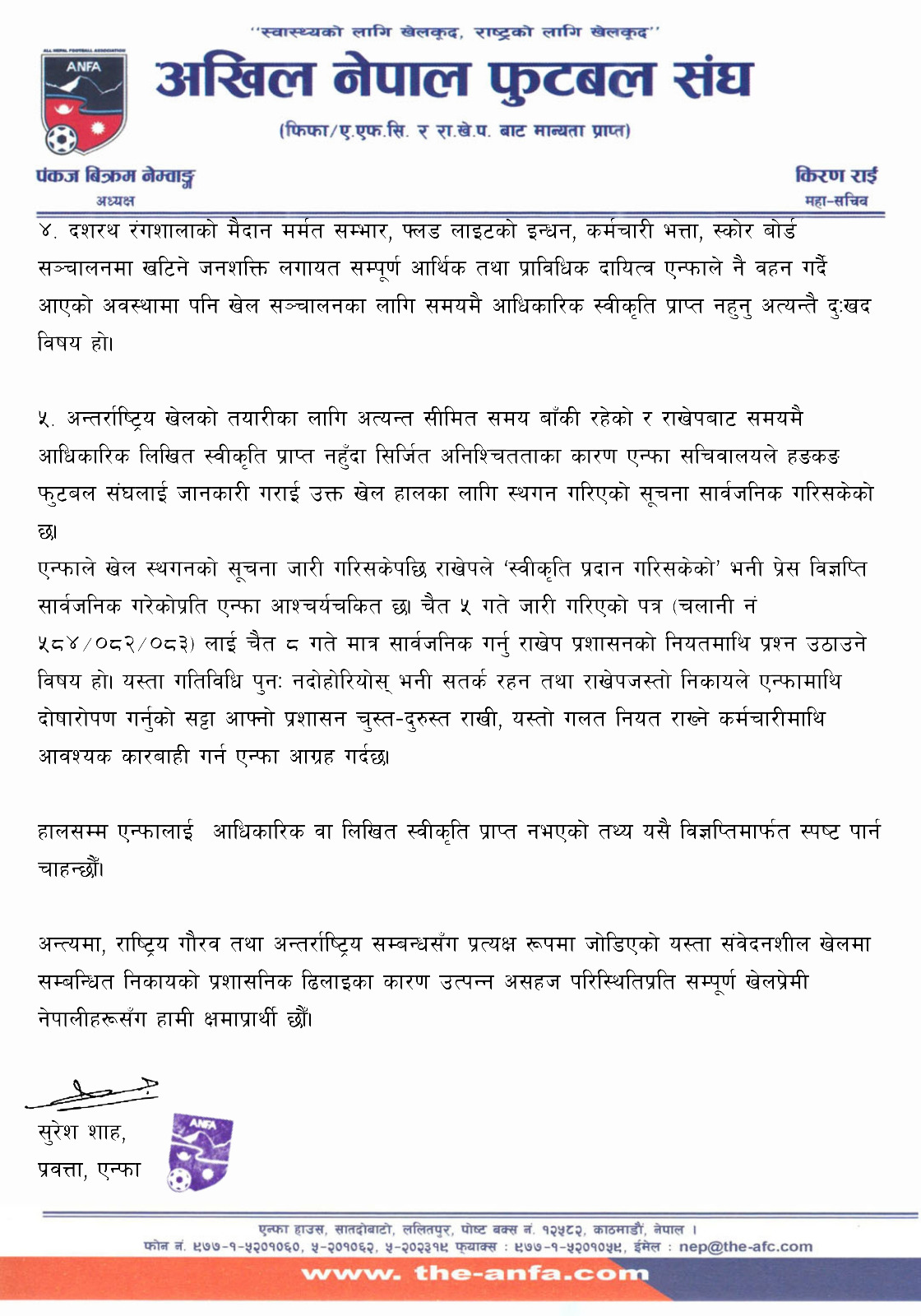
ANFA States No Approval Received from RAKHEP for Nepal-Hong Kong Match

Despite ANFA officials being present at the RAKHEP office from the morning until afternoon of Chaitra 5, no written approval was granted, according to ANFA.

Chaitra 9, Kathmandu – The All Nepal Football Association (ANFA) has clarified that it has not received any official approval from the National Sports Council (RAKHEP) for the international friendly football match scheduled between Nepal and Hong Kong on Chaitra 12.

In a statement released Monday morning, ANFA asserted that it failed to secure timely approval for the maintenance of Dashrath Rangasala Stadium and other necessary clearances.

Earlier, on Sunday afternoon, ANFA had announced that the match between Nepal and Hong Kong was canceled due to RAKHEP not making the Dashrath Rangasala available.

Furthermore, Nepal had informed the Hong Kong Football Association through a letter that the game was canceled due to political tensions in Nepal. However, on Sunday evening, RAKHEP refuted ANFA’s claims, stating that approval for the use of Dashrath Rangasala had been granted on time and accused ANFA of spreading misinformation. The following day, ANFA issued another statement countering RAKHEP’s letter.

According to ANFA, a request for the necessary approvals and use of Dashrath Rangasala was sent to RAKHEP on Magh 10, which was officially registered on Magh 11. Yet, no written permission was received for a prolonged period.

Despite repeatedly seeking clarification from relevant RAKHEP officials, ANFA claims they received no clear response. Even on Chaitra 5, with ANFA staff present at the RAKHEP office from morning till afternoon, written approval was not provided.

ANFA stated that it has been solely bearing all financial and technical responsibilities related to the maintenance of Dashrath Rangasala, including floodlight fuel, staffing, and other arrangements, making the lack of timely approval a regrettable incident.

Following ANFA’s announcement to postpone the match, it expressed surprise over RAKHEP’s subsequent press release claiming to have granted approval. ANFA also questioned RAKHEP’s intentions, noting that the letter dated Chaitra 5 was only made public on Chaitra 8.

ANFA reiterated that it has yet to receive any official or written approval and apologized to football fans nationwide for the circumstances caused by administrative delays.

The conflict between RAKHEP, the executive body for sports, and ANFA, Nepal’s largest sports organization, has intensified after RAKHEP refused to grant approval for ANFA’s early elections scheduled on Chaitra 13 in Jhapa.

The standoff between the two organizations, which began on Sunday, continued into Monday. While opposing teams compete to score goals on the football field, a contrasting confrontation is unfolding outside between RAKHEP and ANFA.


US Issues New Security Alert for Citizens Worldwide Amid Middle East Tensions


March 23, Kathmandu – In light of the ongoing tensions in the Middle East, the US Department of State has issued a new security alert for its citizens residing around the world.

The State Department appealed on the social media platform X, stating, “We urge our citizens worldwide, especially those living in the Middle East, to remain extra vigilant.”

The alert notes, “There may be intermittent closures of air routes, potentially disrupting travel. Additionally, US embassies outside the Middle East have also been targeted.”

The Department further warned, “Groups supported by Iran might target locations abroad associated with the US and its citizens.”

Three Possible Ways the Universe Could End

Video caption begins,

How Might Our Universe Come to an End?

What will happen to the universe in the future? This remains one of the most challenging and mysterious questions in science. Experts acknowledge that there are far more questions than answers on this topic.

Possibly, long after humanity has become extinct, the universe itself may one day come to an end.

Scientists have not yet reached a definitive conclusion on how the universe will end. However, several theories have been proposed on the subject.

Watch this video to learn more.

We also offer science-related content on our YouTube channel. To watch our latest videos and subscribe to the channel, click here. You can also follow us on Facebook, Instagram, and Twitter. Additionally, the Nepali service programs can be heard on the radio from Monday to Friday at 8:45 PM.

How Will Nepal Communist Party Discipline Unrecognized Central Members?

News Summary

Reviewed.

  • Pushpa Kamal Dahal Prachanda, Coordinator of the Nepal Communist Party, has issued a warning to central members who voted for Rastriya Swatantra Party (Raswapa) during the elections, threatening disciplinary action.
  • Although the Nepal Communist Party contested the election by uniting 25 groups, it secured only 17 seats.
  • The party is preparing to hold a review meeting and reorganize its structure in the near future.

March 23, Kathmandu – The latest remarks by Nepal Communist Party Coordinator Pushpa Kamal Dahal Prachanda regarding the election results have drawn considerable attention both within the party ranks and across the national political landscape.

At an event held last Friday at the party’s central headquarters in Parisdanda, Prachanda issued a strong warning, threatening disciplinary action against central members who reportedly voted for the Rastriya Swatantra Party (Raswapa).

The event, attended by leaders from affiliated organizations, also saw the former Prime Minister Prachanda presenting the party’s future roadmap. Yet the main focus of concern was his threat of disciplinary measures against those central members who allegedly supported Raswapa.

“Action will begin, starting right from the central members. Reports have surfaced that some central members voted for Raswapa,” Prachanda stated, “Bring us concrete evidence—who did not campaign in their area? Who was seen voting for Raswapa? We will take decisive action against them.”

Given the election outcome where the party, formed through the unification of 25 parties or groups, won only 17 seats, many leaders naturally focus on Prachanda’s warning. “The unity campaign was run with a clear objective, and many leaders were aligned under it. The results, however, were not as expected,” a senior leader commented. “Without serious review, moving forward is not feasible. The message from the party coordinator must be taken seriously.”

The Nepal Communist Party, which united roughly two dozen groups including the CPN (Maoist Centre) and CPN (Unified Socialist), boasts an array of top leaders. Former Prime Ministers Prachanda, Madhav Nepal, and Jhalnath Khanal are part of the leadership, alongside numerous former Deputy Prime Ministers, Home Ministers, and Cabinet members.

These leaders, based on their unity, had indicated intentions to lead or actively participate in government formation after the elections. However, the Rastriya Swatantra Party won close to a two-thirds majority independently.

Preparations Underway for a Review Meeting

This election result almost certainly marks the end of Prachanda’s continuous presence in power since participating in the interim government of 2006 (2063 BS).

With the party limited to 17 seats—eight in the direct election and nine proportional—the Nepal Communist Party now faces a difficult situation. Even if Raswapa faces internal crises, seeking to lead government formation could prove a major challenge.

“The expected result did not materialize. Now, we will move forward with a review and organizational restructuring plan,” stated leader Dr. Beduram Bhusal. “A review meeting will likely convene soon.”

However, leaders remain unclear about which specific committee will hold the meeting. “It could be the coordination committee or the secretariat,” Bhusal added. Yet, membership for both committees has yet to be finalized.

Only Prachanda and Madhav Nepal have confirmed leadership roles within the Nepal Communist Party. As coordinator and co-coordinator respectively, they have been central decision-makers. For the February 21 election, the party submitted a list of 138 central members to the Election Commission, but leaders clarify this was a technical list only.

Uncertainty Surrounds Central Members’ Identities

During the party formation process, a proposal existed to create a secretariat of 125 members, alongside a coordination committee comprising top leaders. However, decisions regarding the individual members have yet to be made.

“As the unification drive dragged on and more leaders joined, no clear designation or committee assignments were established,” a former official explained. “The coordinators and co-coordinators lose track of some group leaders.”

This means the party has not finalized even the executive leadership composition, which explains why Prachanda issued the disciplinary warning. Yet many within the party tend to interpret his threat as a political statement rather than a concrete measure. “If there is proof of someone responsible for the election campaign supporting another candidate, then that person should reconsider their party responsibilities. But it is unlikely there will be a witch-hunt to find out exactly who voted for Raswapa,” another leader remarked.

A major issue remains the lack of clear identification of central members within the party. Although plans were set to enroll 2,500 members as central leaders, many remain unfamiliar even among themselves. During the unification of eight groups, central member oaths were taken virtually since not all could be present at the Parisdanda headquarters.

Thus, rather than hunting down individuals for discipline, leaders emphasize the need for a comprehensive review of the election defeat. “It is not about who voted or did not vote, but fundamentally why the party lost,” they said. “We must assess why we failed to effectively educate society.”

Leadership Must Take Responsibility for Party’s Defeat

Leaders believe that disciplining some members based on suspicion or proof will not break the party. Instead, the root cause of defeat should be found within the leadership ranks. “Comrade Prachanda himself confused workers by making contradictory remarks during the election,” one leader said. “Statements about possible alliances with Congress, CPN-UML, or Raswapa left workers baffled.”

One candidate from the party noted that Prachanda’s comments did not create a conducive environment for unity. “When Prachanda said it might be possible to join forces with Balen tomorrow, many undecided voters may have cast their ballots for Raswapa—or at least that is what happened,” he added.

Ashesh Ghimire, candidate from Jhapa-1, urged focusing on party-level issues rather than blaming individual setbacks for the electoral defeat. “Communists have enjoyed majority support for decades, but landless peasants have not benefited materially. Only the party has changed; the leadership rhetoric is the same,” Ghimire remarked. “The Communist Party needs a serious introspection to understand why the election outcome was unfavorable.”

According to his analysis, the election marked a defeat for Marxism, with postmodernist ideologies prevailing. “When Communist parties distance themselves from class-based ideology, it opens the door to postmodernist attacks,” Ghimire said. “This weakens organizational and collective power, elevates individual glorification, and ultimately impacts election results.” He suggested that failing to understand the attacks from forces who formed parties in opposition to traditional parties may be at the core of this problem and must be investigated.

Iran Threatens Full Closure of Hormuz Strait Following Attack on Energy Facilities

The Islamic Revolutionary Guard Corps (IRGC) of Iran has warned that the Strait of Hormuz will be completely closed if there is an attack from the United States. Iranian Foreign Minister Abbas Araghchi stated that the Strait of Hormuz is not currently closed, but the behavior of the US and Israel has disrupted maritime traffic in the route.

Earlier, US President Donald Trump had issued a warning on March 21 that if the Strait of Hormuz was not reopened within 48 hours, power plants would be destroyed.

According to a statement released by Iranian media, the IRGC declared, “If there is an attack on Iran’s energy facilities, the Strait of Hormuz will be closed until the destroyed power plants are rebuilt.” The Strait of Hormuz, which connects Iran to the Persian Gulf, the Gulf of Oman, and the Arabian Sea, is the only maritime route linking these bodies of water. About 20 percent of the world’s petroleum products pass through this vital passage. Following attacks by the US and Israel, Iran has effectively blocked this route, causing supply disruptions and increasing global oil prices.

The IRGC also stated, “We will target power plants, energy sites, and IT infrastructure in Israel extensively. All American companies will be targeted.” Iranian Foreign Minister Abbas Araghchi emphasized, “The Strait of Hormuz is not closed. Insurance companies that cover oil tankers have become fearful of the so-called ‘war of choice,’ which was initiated by the US and Israel, not Iran.”

Araghchi further added, “Respect this. Without freedom of trade, freedom of passage through maritime routes has no meaning. Both sides must show respect; otherwise, no one should expect anything in return.” More than 160 people were injured near Israel’s nuclear facility at Dimona due to Iranian missile strikes. Since the Israeli air force launched an attack on Iran on February 28 with US support, Iran has reportedly launched around 400 missiles in retaliation.

Iran Conflict: Tehran’s Firm Response as Trump’s Deadline to Reopen Strait of Hormuz Nears

Strait of Hormuz

Photo source, Getty Images

Reading time: 3 minutes

US President Donald Trump has issued a 48-hour ultimatum to Iran to reopen the Strait of Hormuz, warning of severe military action if ignored; Tehran has responded with a firm stance.

Following Trump’s threat last weekend to target Iranian energy facilities, Tehran warned it will fully close the vital waterway should the United States follow through on its threats.

A senior Iranian commander declared that energy, oil, technology, and water treatment centers in the Gulf region are legitimate targets.

Iranian President Masoud Pezheshkian characterized the US threats as “desperation,” asserting they will strengthen national unity.

“Threats and terrorism only fortify our unity. Except for those who violate our land, the Strait of Hormuz remains open to all. We face dangers on the battlefield with unwavering resolve.”