




News Summary
- Chinese President Xi Jinping and Russian President Vladimir Putin, both in power for 39 years, refer to each other as closest friends.
- Russia is China’s largest trading partner, with Russia importing over 90% of its restricted technologies from China.
- Though there is no formal alliance, a strategic partnership endures between China and Russia due to shared borders, economic complementarities, and mutual opposition to the West.
April 18, Kathmandu – In September, while walking together in Beijing’s Tiananmen Square, Chinese President Xi Jinping and Russian President Vladimir Putin discussed the possibility that human organ transplants could extend life expectancy.
Putin’s interpreter said, “Human organs can continually be transplanted. The longer you live, the younger you become, potentially reaching immortality.” Xi’s interpreter responded, “Some estimate that this century people may live up to 150 years.”
For these two powerful leaders, who have jointly held power for 39 years with no signs of stepping down, describing each other as “closest friends” was a significant moment.
This informal and brief conversation offers a rare glimpse into an often misunderstood partnership. It is one of the limited opportunities to understand the highly confidential relationship between the two.
Putin is returning to Beijing this week to mark the 25th anniversary of the Treaty on Good-Neighborliness and Friendly Cooperation between Russia and China.
Last week, US President Donald Trump was welcomed with grand banquets featuring golden tableware and visits to ancient temples during a meeting with Xi Jinping, whereas Putin’s upcoming visit appears more subdued with little advance public information.
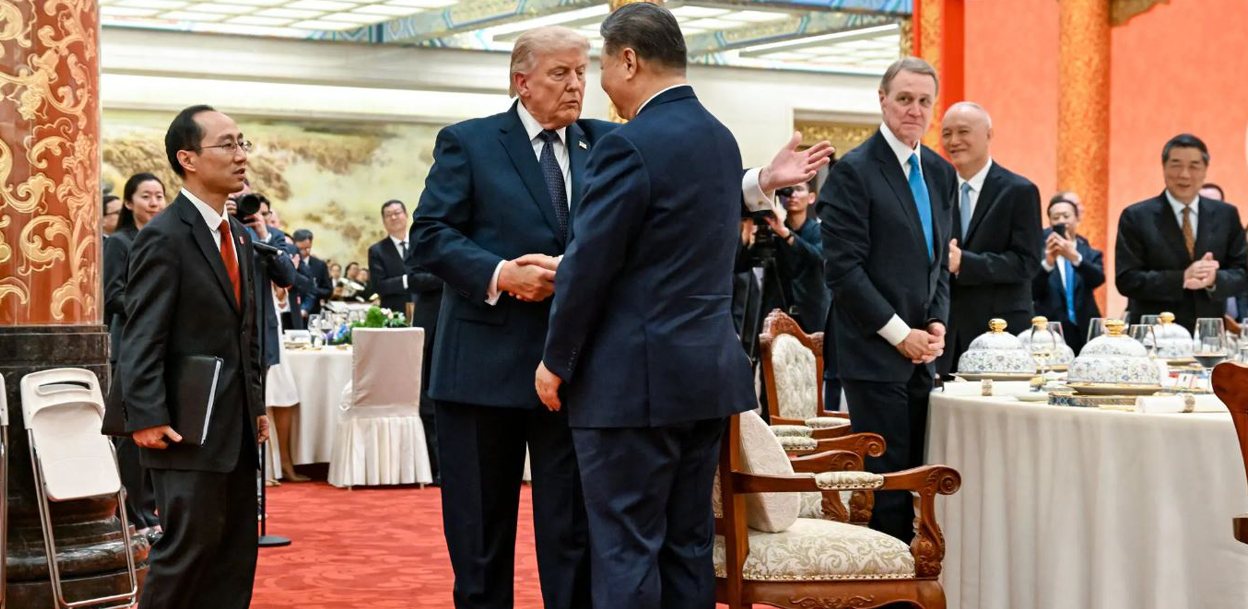
Kremlin spokespersons expressed hope for “direct” insights from the Trump-Xi meeting.
Reports indicate that during last week’s closed meeting at Zhongnanhai, Xi mentioned Putin to Trump, noting Putin had already visited this political sanctuary in Beijing.
Although some in Washington hoped Trump’s visit would divide China from Moscow, such expectations were not strongly realized.
In recent years, China and Russia have characterized their relationship as an unlimited friendship. So, what is the basis of this friendship and how sustainable is it?
Under Chinese Terms
According to Alexander Gabuev, director of the Carnegie Russia Eurasia Center, the relationship between the two countries is unbalanced, with all agreements being on Chinese terms. He says, “Russia is entirely under China’s control and China can impose its conditions.”
This dynamic extends especially in economic fields. China is Russia’s largest trading partner, while Russia accounts for just 4% of China’s international trade. China exports more to Russia than to any other country, and its economy vastly exceeds Russia’s.
Western sanctions over the years have gradually pushed Moscow closer to Beijing. After carrying US sanctions and being removed from the UK’s 5G network, tech giant Huawei leveraged the absence of Western companies to become fundamental to Russia’s telecommunications sector.
As relations with the West worsen, China has become Russia’s primary destination for expertise in technology, science, and industry.
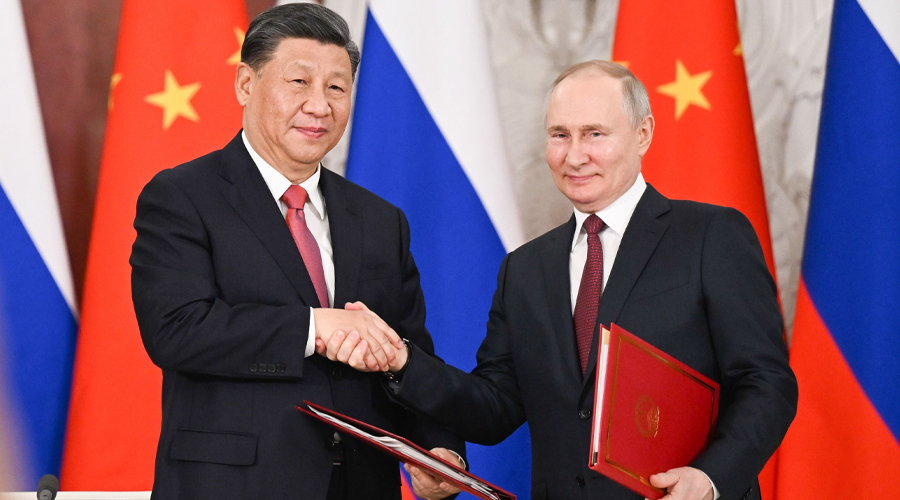
Following the full-scale invasion of Ukraine in 2022, Moscow’s reliance on Chinese components and technology has grown. A recent Bloomberg report indicated Russia imports more than 90% of its restricted technology from China, an increase of 10% over the previous year.
Russia is fully aware of the risks this imbalance presents. Dimitri Trenin, chairman of the Russian International Affairs Council, wrote that Russia does not want to become subordinate to anyone.
Regarding China, he emphasized the importance of maintaining equality and understanding that Russia is a great power that cannot be a junior partner.
Moscow has limited alternatives to Beijing because China provides the large markets and demand that are vital to Russia’s survival. If China were to reduce trade due to deteriorating Western ties, Russia’s foreign policy would become more complicated.
However, Moscow’s strength lies in its ability to maintain a firm stance without succumbing to Beijing’s pressures.
Marcin Kaczmarski, associate professor of security studies at the University of Glasgow, notes the significant imbalance in China-Russia relations but says, “China is not pressuring Russia; it is acting in a balanced manner.”
One reason for this balance is Russia’s identity as a self-aware sovereign nation. Gabuev adds that although China tries to exert influence, Russia is not a country that will easily agree.
In 2023, during Xi’s visit to Moscow, he reportedly urged Putin not to use nuclear weapons in Ukraine. Days later, Russia announced the deployment of nuclear weapons in Belarus, signaling its autonomy to the world.
While the prolonged war in Ukraine may hold Russia accountable, for Beijing, which contemplates a possible Taiwan invasion, Russia remains a strategic asset. Gabuev mentions, “Russia can contribute by selling military technology and equipment, and by testing Chinese devices.”
Russia possesses considerable energy resources that hold strategic significance for China. In May, Putin stated both countries were set to make major progress in oil and gas sectors.
Gazprom and China National Petroleum Company recently signed preliminary agreements for the ‘Power of Siberia 2’ pipeline after long negotiations.
This pipeline will transport 50 billion cubic meters of Russian gas through Mongolia to China, potentially changing the geopolitical energy landscape.
Amid crisis in the Strait of Hormuz, Russia’s energy availability to China is invaluable not just financially but for ensuring China’s internal energy security amid global instability.
No Formal Alliance, But a Strategic Partnership
Despite differences, a deep truth underlies China and Russia’s relationship: neither country is subordinate to the other, as this is not a formal alliance.
Bob Low, former deputy head of mission at the Australian embassy, states the strategic flexibility of this partnership strengthens it.
He explains, “It is not an alliance but an emergent strategic partnership, which, despite facing challenges, continues to survive.”
Western analysts often view the China-Russia relationship in two ways: as a ‘dictatorial axis’ united by a shared desire to defeat the West, or as a fragile brotherhood on the brink of collapse.
Neither perspective fully captures the complexity and depth of the partnership. Despite imbalances and disagreements, common interests remain strong.
According to Bob Low, even if relations improve with the West, there are many practical reasons for China and Russia to stay connected.
The most important reason is their 4,300-kilometer shared border, historically a center of disputes. Also, their complementary economies and their shared opposition to US global leadership are key factors.
On how long this ‘love affair’ can last, an anonymous Chinese analyst said the public display of being the closest couple is largely a partial performance aimed at showing unity and stability.
Russia and China do not criticize each other on human rights issues, such as Western sanctions and penalties. Despite Western scrutiny due to human rights violations in China’s Xinjiang and the death of Russian opposition leader Alexei Navalny, Moscow and Beijing largely ignore these topics.
Gabuev explains, “They do not publicly criticize each other regarding Xinjiang, Navalny’s poisoning and death, and agree on many local governance issues at the UN, fostering a biological and symbiotic relationship.”
China and Russia have a long history of improving ties. Gabuev notes, “This pragmatic relationship began in the late 1980s and has similarly evolved in China.”
Regarding the question of the partnership’s longevity, a Chinese analyst believes the public camaraderie is partly performative, with the intent of signaling unity and stability.
In truth, it is a useful political tool to manage and resolve disagreements arising from self-interest. Both governments oppose Western dominance but with different outlooks: Russia seeks to remove the US entirely from global influence, while China is more patient and seeks long-term outcomes.
China’s restraint over US actions in Iran and its continued dialogue with Washington during preparations for Trump’s visit reflect this difference; unlike Russia, China wants to avoid unnecessary tensions while maintaining communication with Washington.
The Human Dimension
This partnership is often viewed from geopolitical and security perspectives, but another critical factor is the deepening social and cultural connections between the two societies.
At the highest levels, Putin and Xi have showcased an unparalleled friendship. This is Putin’s 25th visit to China, and Russian officials are likely engaging more with their Chinese counterparts.
Charles Parton, a former British diplomat, expresses skepticism about the natural cultural closeness between Chinese and Russian citizens.
Although the growing imbalance between Moscow and Beijing highlights long-term weaknesses, the relationship is unlikely to break soon.
He questions: “Do Chinese people want to study, live, or buy property in Moscow? Probably not.” He believes Russians prefer investing in Paris, London, or Cyprus rather than Beijing.
However, Gabuev notes that Western sanctions and European visa policies have driven Russians closer to China, with increasing exchanges between their peoples.
Travel to China from Russia has become easier, with visa-free arrangements and daily flights allowing arrival in a few hours.
Western sanctions have led Russians to increasingly use Chinese phones and cars.
Gabuev states, “Exchange, visa-free travel, payment, and navigation conveniences have brought China much closer than before. Joint research and scholarship programs are also fostering closer ties between the societies.”
Despite the growing imbalance highlighting some vulnerabilities, the partnership shows low likelihood of collapse in the near term.
Though differences exist, Low concludes: “The China-Russia partnership is flexible. Both sides agree it is important that the partnership does not fail, especially given the lack of other viable alternatives.”


