




News Summary
- Even seven months after the formation of the Nepal Communist Party (NCP), organizational structures beyond the central committee remain unresolved.
- The enormous 2,500-member central committee has been unable to convene meetings, leading the party’s decision-making to be conducted by a ‘Central Coordination’ committee.
- Although the NCP has scheduled a unification general convention from November 26 to 30, it seems unlikely that organizational integration will be completed by mid-July.
May 28, Kathmandu – Despite seven months since unification, the Nepal Communist Party (NCP) has yet to create a unified organizational structure.
Thus far, only the central committee has been unified.
On November 4 of last year, the then Maoist Center, Unified Socialist party, NSCA, and other groups merged to form the Nepal Communist Party.
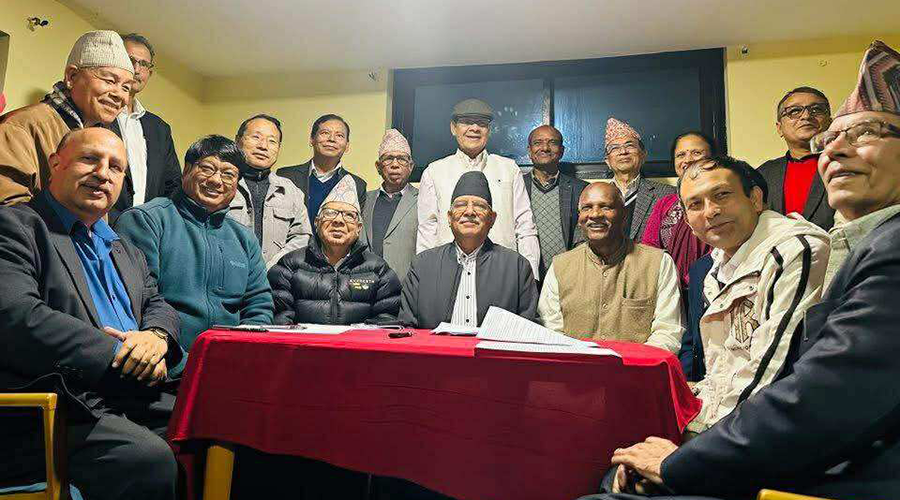
This unification, initiated under the leadership of Convener Pushpa Kamal Dahal ‘Prachanda’ and Co-Convener Madhav Kumar Nepal, brought together two dozen parties and groups.
Given the large number of groups involved, the size of the central committee has become so vast that regular meetings cannot be held. On January 12, virtual sessions were even required to administer the oath to central members.
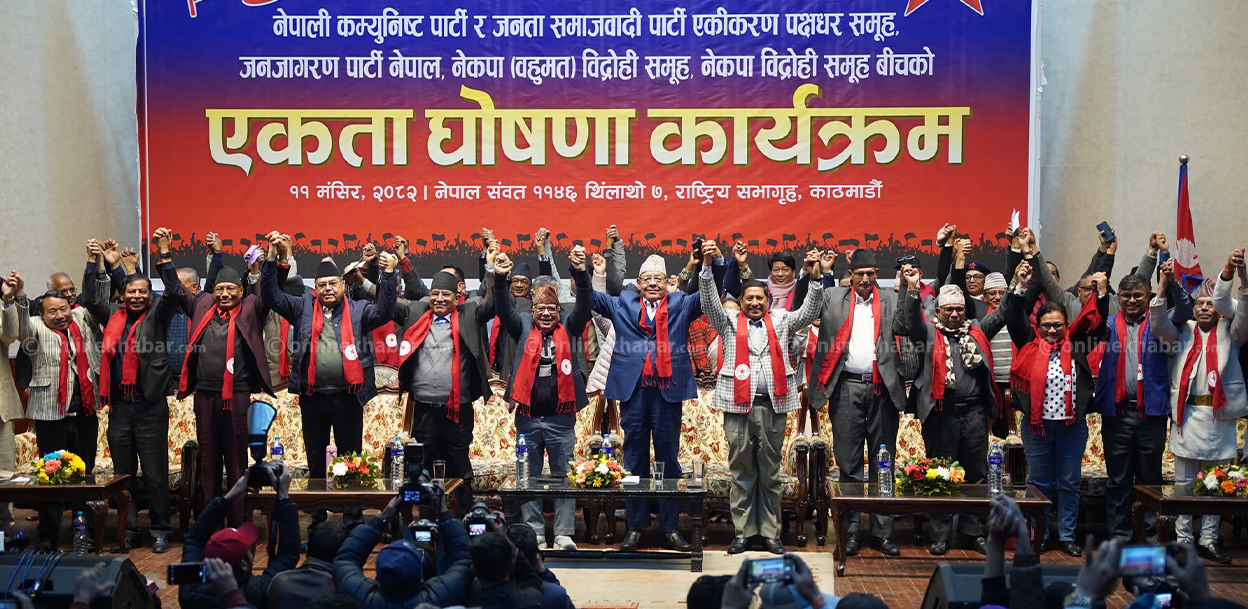
Central members took their oath standing in an open field at the party headquarters in Paris Danda or via virtual means. At that time, the central committee was estimated to have 2,300 members. Leadership has since decided to increase this number to 2,500.
Due to the unmanageably large size of the central committee, the party formed a ‘Central Coordination’ committee to make decisions. To date, formal decisions and activities have been handled through this coordination committee.
‘The coordination committee is the only structure currently capable of making party decisions and holding meetings,’ a senior leader says, ‘but even this committee has not made decisions that can accelerate the party’s progress. The unification process has become extremely delayed.’
This coordination committee has been used to publicly present the party’s formal stance on national issues, but there is still no committee in place to properly define the identity of the integrated party to leaders and activists at the grassroots level. Several leaders have openly expressed their dissatisfaction.
‘We have leaders, provincial in-charges, co-in-charges, conveners, and co-conveners,’ states central committee member Osim Alam on social media, ‘yet at the provincial, district, municipal, and ward levels, the organization still reflects the old Maoist Center and Unified Socialist parties. Even the mass organizations remain split.’
Though a merger reportedly occurred among 25 groups, Maoist Center and Unified Socialist being the major constituents, Alam indicates that these two parties’ separate practices persist. Many other leaders share similar grievances.
‘Although the party has existed for seven months, we still operate separately in mass organizations,’ says Madan Dhakal, central vice-president of the revolutionary faction of ANNFSU, ‘in-charges and co-in-charges have been appointed to unify, so we hope to finalize integration soon.’
During ongoing protests against government decisions, student activists affiliated with the NCP continue to use separate banners. Students linked to the Maoists use the ANNFSU (Revolutionary) banner, while those aligned with Unified Socialist carry the ANNFSU banner. Different practices are also evident in leadership and organizational structures.
According to party central office deputy chief Mina Gyawali, no update has been received indicating that integration has been completed.
‘Although integration was expected to be done, no confirmation has come to the central office yet,’ Gyawali adds.
Leaders assert that the main challenge lies at the lower committee levels, which have yet to unify after seven months.
‘It’s been months since the NCP was formed, yet district committees remain separate, as do municipal and metropolitan committees,’ says central member Alam, ‘Meanwhile, the organization is in limbo, and rumors of merging with UML persist among some leaders.’
In the meantime, the party participated in elections held on February 3, suffering a heavy defeat; despite this, the NCP has not completed organizational unification.
Unification Unlikely to Finish by Mid-July
The coordination committee’s meeting held on April 26 decided to finalize organizational integration by the end of July.
The NCP has announced a national unification convention to be held between November 26 and 30. Plans are in place to start membership renewal from mid-June.
Given the current pace, it appears unlikely that party integration will be completed by mid-July.
Although in-charges for geography and mass organizations have been appointed to move the process forward, no significant progress has been reported.
Lakshman KC for youth, Ramdeep Acharya for workers, and Ratna Dhakal for students have been entrusted with completing the integration of youth organizations. A front coordination committee led by Rajendra Pandey has been formed to finalize all mass organization integration.
‘Discussions to finalize integration are underway. Leaders responsible are organizing meetings,’ says central office head Ganeshman Pun, ‘and main integration tasks are planned to be completed within this month.’
Leaders indicate that coordinators and co-coordinators in mass organizations are being appointed. Once these positions are finalized, the central committee will be formed, and the process to unify lower committees will proceed. However, no mass organization integration has been accomplished yet.
Specific leaders have been assigned to organize integration geographically. Rajendra Rai serves as in-charge and Harka Nembang as convener in Province 1, overseeing provincial, district, and local committee integration.
In the Madhesh region, Mahendra Rai Yadav is in-charge with Raju Khadka as convener; Bagmati has Gangalal Tuladhar as in-charge and Saral Sahayatri as convener; Gandaki has Devendra Paudel as in-charge and Krishna Nepali as convener; Lumbini has Chakrapani Khanal as in-charge and Abdul Hussain as convener.
Karnali has Chandra Bahadur Shahi as in-charge and Bimala KC as convener, while Sudurpashchim has Bhanubhakta Joshi as in-charge and Hariram Chaudhary as convener, all actively working on integration.
‘The integration of provinces and districts is progressing; some provinces have held meetings, and dates are scheduled for others,’ Pun explains. He notes that meetings in Lumbini are set for June 1-2 and in Gandaki for May 31.


