Skill Testing Now Mandatory for Nepali Workers to Obtain Employment in Saudi Arabia; Government Remains Silent




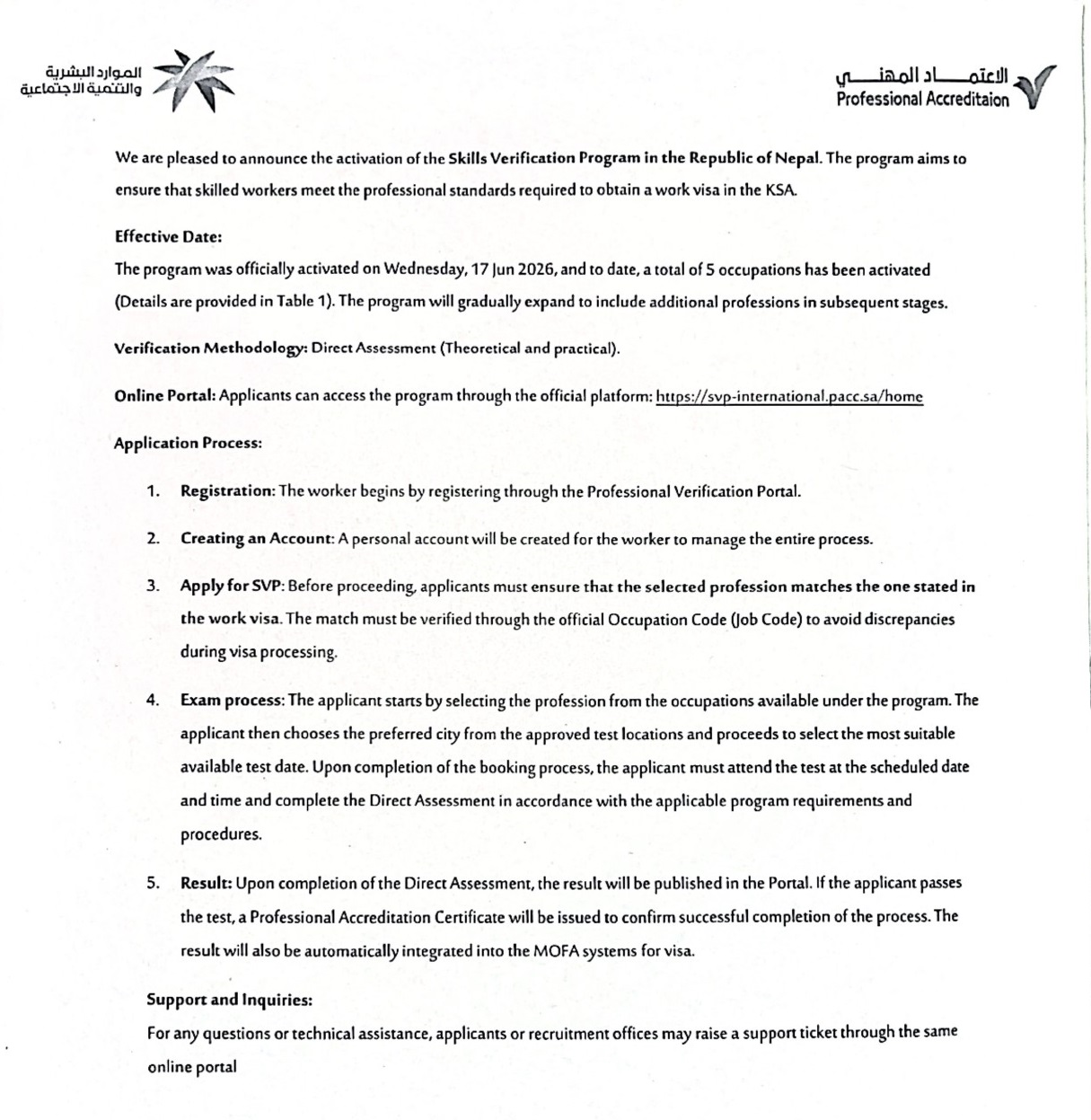
June 16, Kathmandu – Nepali workers who fail to pass the mandatory skill test will no longer be permitted to travel to Saudi Arabia for foreign employment. Starting Wednesday, workers without skill certification will be barred from obtaining labor approval to enter Saudi Arabia.
The Saudi government has made skill certification compulsory for Nepali workers. According to the new regulation, starting this Wednesday, those without a passed skill test will not receive labor permits for Saudi employment.
Saudi Arabia has introduced a Skill Certification program as a prerequisite for labor visa issuance. Workers are required to pay a total fee of 100 US dollars (approximately NPR 15,000), which includes 50 USD for the exam and 50 USD for Recognition of Prior Learning (RPL).
To obtain skill certification, workers must upload the required documents online through the “Skills Verification Program” (SVP) portal.
Nepal and Saudi Arabia signed a labor agreement last year, which specifies that recruitment issues should be discussed through a Joint Technical Committee. However, no formal discussions or agreements took place regarding the implementation of the skill certification program. Saudi Arabia has unilaterally imposed the mandatory skill test without consultation or consent from the Nepalese government.
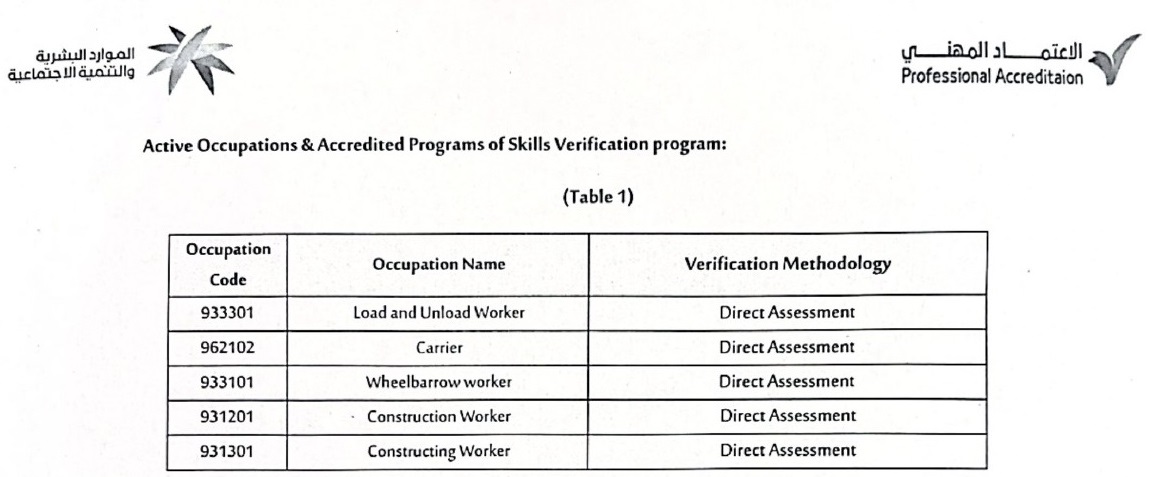
According to a notice issued by Saudi Arabia’s Ministry of Human Resources and Social Development, this program aims to verify the professional competency of workers. Even laborers engaged in loading and unloading, porter work, cart driving, and construction sectors are required to undergo the skill test.
Workers must register online and pay the applicable fees via the Saudi SVP’s “Professional Accreditation” portal to take the test. After registration, approved exam centers and dates can be selected. The approximately three-hour-long exam results are expected to be published within 24 hours to one week.
The notification states that each worker will be allowed up to three attempts to pass the exam. Failure after three attempts will disqualify the worker from seeking employment in Saudi Arabia.
The Nepal Foreign Employment Entrepreneurs Association has expressed dissatisfaction with this decision, highlighting concerns that it will impose additional financial burdens on workers and complicate the foreign employment process.
Dik Bahadur Khatri, President of the Nepal Foreign Employment Entrepreneurs Association, criticized the mandate as a “syndicate under the guise of skill testing.” He argued that this system will place heavy financial strain on workers and enable another form of syndicate exploitation.
Drawing on examples from neighboring countries, he stated, “In India, the skill test fee is 20,000 Indian Rupees, while in Bangladesh, a receipt of 3,500 plus a collection of 30,000 Taka is charged. Nepal is preparing for a similar scenario where workers must pay up to NPR 15,000 and wait for a month, which does not serve the interests of the workers.”
Khatri further noted that experienced workers, such as masons who have worked for decades in Qatar and other countries, being forced to pay NPR 15,000 and wait a month for skill certification again is unjust.
He questioned the logic of requiring skill testing for unskilled laborers working in loading and unloading jobs, calling the policy highly controversial and impractical. Khatri also mentioned that the association visited the Ministry of Labor on Tuesday to raise awareness about the issue. However, Labor Minister Ramji Yadav did not allocate time to meet with the entrepreneurs.
“We engaged in discussions for one and a half hours, but the minister did not grant us time. His secretariat seemed to underestimate the seriousness of the issue,” Khatri said. “While there is talk about improving foreign employment abroad, it is not a good signal to encourage such syndicates internally.”
The memorandum submitted to the minister’s secretariat stated that the Nepalese embassy had informed workers traveling to Saudi Arabia, via the information partner, that skill certification has become mandatory. The new regulation entails additional fees, longer processing times, and increased complexity and costs in the employment procedure.
The association urged the minister to engage in diplomatic efforts with Saudi Arabia to find worker-friendly solutions. They also indicated that similar burdens have previously been imposed under the guise of police report certification for UAE migration, and that the new Saudi requirement would cause further hardship for workers.
They warned that failure to take timely action could lead to significant problems in the foreign employment sector.
Highlighting that similar regulations in India and Bangladesh have not been worker-friendly, the association cautioned that Nepal risks repeating the same issues.


