Author: space4knews

Is Returning Funds After Being Found Guilty a Way to Avoid Punishment?

Nepal Rastra Bank

Image source: NRB

Published

Reading time: 4 minutes

The CPN-UML, which was previously led by the government, has confirmed that funds spent by former heads of state and government leaders on medical treatment abroad were returned to the government treasury.

According to details confirmed by the Ministry of Finance, approximately NPR 37 million was deposited back into the government treasury for medical treatment expenses related to former President Ram Baran Yadav, former Prime Minister KP Sharma Oli, and Jhalanath Khanal. The CPN-UML has also confirmed the refund of these amounts.

A former Supreme Court justice has stated that returning the money does not exempt one from legal proceedings or punishments.

The Commission for the Investigation of Abuse of Authority (CIAA) is conducting an ongoing investigation on the matter and has stated that due to confidentiality, details cannot be disclosed.

High-ranking government officials and constitutional body members have long been using significant public funds for treatment expenses, drawing widespread public criticism.

राप्ती प्रतिष्ठानमा एक महिनामा ११३ जना मिर्गौला पत्थरीको शल्यक्रिया

Rapti Health Institute Successfully Performs 113 Kidney Stone Surgeries Within One Month

At Rapti Health Science Institute, a total of 113 successful kidney stone surgeries were performed between the 1st and 31st of Baisakh. During this period, the Urology Department provided outpatient services to 505 patients and admitted 61 patients for treatment. The institute has expanded its urology services through collaboration with Bir Hospital and Tribhuvan University Teaching Hospital, although a lack of physical infrastructure remains a significant challenge.

Dang, 9 Jestha – Within just one month, Rapti Health Science Institute successfully operated on 113 patients suffering from kidney stones. According to institute records, from Baisakh 1 to 31, the Urology Department completed surgeries on a total of 113 patients. In the same timeframe, 505 patients received outpatient department (OPD) services, and 61 were admitted for inpatient care.

Under the leadership of Urologist Surgeon Dr. Sushil Khaniya, a team of doctors, nurses, and healthcare workers at the institute regularly perform surgeries of varying complexity. According to the institute, more than 70 patients seek consultation and treatment daily through the urology OPD.

Previously, due to a lack of urology services in the district, patients had to travel to hospitals in other districts to receive even basic or specialized treatment. However, with the expansion of urology services at the institute equipped with state-of-the-art medical equipment, local patients now have easier access to effective care.

Under urology services, the institute provides treatment for conditions including urinary disorders, prostate issues, kidney stones, gallstones, urinary tract problems, testicular swelling or tenderness, as well as symptoms such as painful or leaking urination. Dr. Khaniya noted that the number of patients seeking urology care is increasing day by day.

Dr. Suresh Rasaily, Acting Chief of Office, Director, and Associate Professor at the institute, described the urology services as highly effective and said that patients are pleased to receive specialized treatment locally. Dr. Khaniya is an experienced physician who has been providing urology services at the institute for many years.

The institute has initiated collaboration with Bir Hospital and Tribhuvan University Teaching Hospital to strengthen specialized services including urology. Despite service expansion, the institute acknowledges that the lack of adequate physical infrastructure continues to pose challenges.

Ravi Lamichhane Expresses Joy After Court Revises Charges Against Him

May 23, Kathmandu – Ravi Lamichhane, president of the Rastriya Swatantra Party, has expressed happiness following the amendment of charges related to money laundering and organized crime against him. The District Court of Kaski revised the allegations, prompting Lamichhane to share his reaction. “I have not yet read the order. We must act according to the court’s directive,” Lamichhane told reporters. “I am happy about this development.”

Although the decision came from Kaski, Lamichhane said his battle is far from over. Cases remain pending against him in other districts. “The fight is still ongoing. I need to address cases in other districts as well,” the party president explained. “Only one district’s case has been concluded. I am glad to hear it’s from Kaski.”

In the order issued on Friday, Judge Himalal Belbase’s bench at Kaski District Court stated, “Upon reviewing the application as appropriate, the original, supplementary, and additional charge sheets are amended such that charges of cooperative fraud are maintained while other charges regarding organized crime and money laundering are removed, as per Section 36 of the Muluki Criminal Procedure Code, 2074.”

Earlier, the election government led by Sushila Karki under Attorney General Savita Bhandari Baral’s leadership decided during the last week of Poush (mid-December) to withdraw ongoing money laundering and organized crime cases against Ravi Lamichhane across various district courts. Based on that decision, the District Government Attorney’s Office in Kaski filed a petition to amend the charges in court. After nearly four and a half months, the District Court amended the charge sheet. Currently, only charges of cooperative fraud remain against Lamichhane in Kaski.

Risks of Preeclampsia During Pregnancy and Preventive Measures

Preeclampsia during pregnancy is a serious health condition that can threaten a mother’s life. It is characterized by high blood pressure and the presence of protein in the urine, which can impair organ function and increase the risk of emergency cesarean sections and strokes. Worldwide, preeclampsia and related hypertensive disorders cause the deaths of approximately 70,000 women and 500,000 infants annually.

While medications can help manage the symptoms during pregnancy, a complete cure for preeclampsia currently exists only through delivery of the baby. Researchers continue to explore new treatment options for this condition. For more detailed information, please watch the video provided.

सदस्यता अद्यावधिकमा असहयोग गर्ने वडा सभापतिहरूको जिम्मेवारी खोस्दै कांग्रेस

नेपाली कांग्रेसले सदस्यता ननवीकरण गर्ने वार्ड अध्यक्षहरूलाई जिम्मेवारीबाट हटायो

काठमाडौं, २३ मे — नेपाली कांग्रेसले सक्रिय पार्टी सदस्यता अद्यावधिक नगर्ने लगभग ५० वार्ड अध्यक्षहरूको जिम्मेवारी हटाउन सुरु गरेको छ। पार्टीका अध्यक्ष गगन थापाले सदस्यता ननवीकरण गर्ने वार्ड अध्यक्षहरूको स्थानमा नयाँ व्यक्तिहरूलाई जिम्मेवारी सुम्पिएको जानकारी दिएका छन्। थापाले सबै नेता र कार्यकर्ताहरूले १५ औं महाधिवेशनको लागि आफ्नो सदस्यता अद्यावधिक गर्नुपर्नेमा जोड दिएका छन् र २०८२ सालको नवीकरण स्वीकार्य नहुने बताएका छन्।

नेपाली कांग्रेसले सक्रिय पार्टी सदस्यता अद्यावधिकमा अवरोध गर्ने वार्ड अध्यक्षहरूलाई जिम्मेवारीबाट हटाउने प्रक्रिया सुरु गरेको छ। विशेष महाधिवेशनमा भाग नलिने faction का वार्ड अध्यक्षहरूले सदस्यता अद्यावधिक कार्य गर्न असफल भएको कारण पार्टीले यो कदम चालेको हो। पार्टीको “रुट क्याम्पेन” अन्तर्गत लगभग ५० वार्ड अध्यक्षहरूको सदस्यता अद्यावधिक जिम्मेवारी हटाइएको छ र ती जिम्मेवारी अन्य व्यक्तिहरूलाई सुम्पिएको छ।

गगन थापाले शुक्रबार सुनसरीको लाउकहीमा आयोजित ‘प्रदेश र स्थानीय स्तरका बैठकहरू’ मा भने, “मैले यो निर्णय हिजो मात्र गरेको हुँ। म उपाध्यक्षहरूलाई पनि जानकारी गराउँदैछु।” उनले भने, “मले लगभग ५० वार्ड अध्यक्षहरूको स्थानमा नयाँ साथिहरूलाई सक्रिय सदस्यता कार्यको जिम्मेवारी सुम्पिएको छु।” थापाले भने कि वार्ड अध्यक्षहरूका आधिकारिक पदहरू कायम रहनेछन्। “वार्ड अध्यक्षहरू वार्ड अध्यक्ष नै रहन्छन्; म तिनीहरूको पद हटाइरहेको छैन,” थापाले भने।

थापाले सदस्यता अद्यावधिक कार्यको जिम्मेवारी अर्को व्यक्तिलाई सुम्पन पार्टीका नियमले उनलाई अधिकार दिएको बताएका छन्। उनले भने, “कसैले यो गर्न चाहँदैन भने, पार्टीको निर्णयलाई सम्मान गर्नुपर्छ।” थापाले सदस्यता नवीकरण प्रक्रियालाई “अद्यावधिक” भन्नु गलत भएको स्वीकार गरे। उनले भने, “यो प्रक्रिया ‘अद्यावधिक’ भन्नु अहिले अनुपयुक्त लाग्छ।” उनले सदस्यता नवीकरण गर्दा आवश्यक डेटा अनिवार्य रूपमा पेश गर्नुपर्ने सुझाव दिएका छन्। “म नवीकरणको अवधारणालाई अस्वीकृत गर्दै छैन, तर यो अनिवार्य रूपमा डेटा पेश गर्नुपर्ने हुनुपर्छ,” थापाले भने।

Today’s Weather Conditions

9 Jestha, Kathmandu – Nepal is currently under the influence of western winds and local airflows, with a low-pressure area affecting the eastern region. According to the Department of Hydrology and Meteorology’s Weather Forecast Division, the Koshi Province along with other hilly and mountainous regions are generally cloudy. The Madhesh Province experiences partly cloudy skies, while the remaining Terai areas mostly have clear weather. Some locations in Gandaki Province and one or two spots in Sudurpashchim Province are experiencing moderate to heavy rainfall accompanied by thunder and lightning.

The department forecasts that this afternoon, Koshi, Bagmati, and Gandaki Provinces will generally see cloudy conditions. Partly cloudy skies are expected across the mountainous and hilly areas of Madhesh Province and other provinces, while the rest of the Terai region will mainly experience clear weather. Some specific locations in the hilly and mountainous areas of Koshi, Bagmati, and Gandaki Provinces, as well as certain Terai areas of Madhesh, Koshi, Bagmati, and Gandaki Provinces, along with one or two places in the mountainous and hilly regions of Lumbini and Karnali Provinces, may witness moderate to heavy rains and possible snowfall.

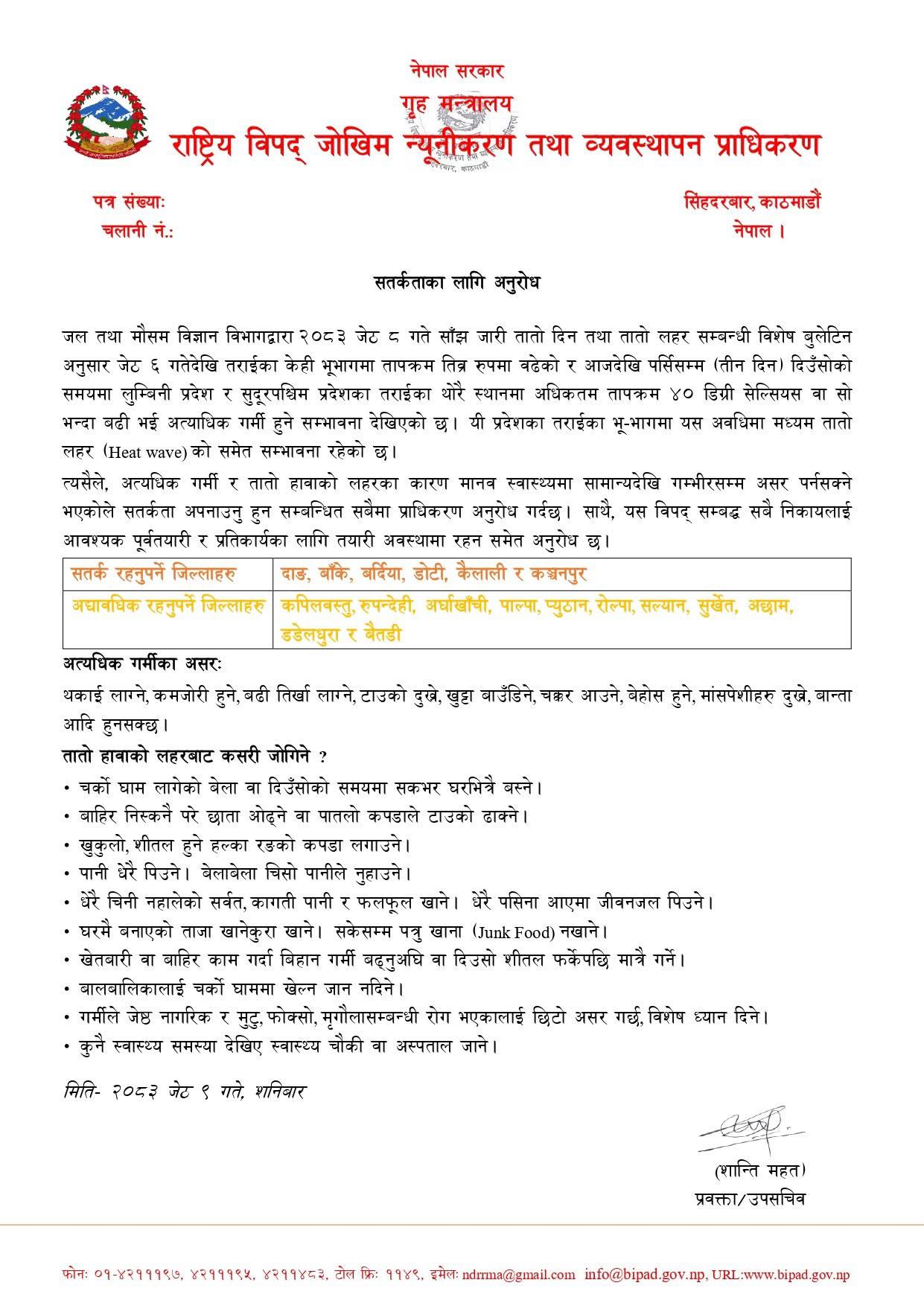
There is a chance of heavy rainfall in one or two hilly areas of Gandaki Province. Hot days are likely in the hilly regions of Sudurpashchim and Lumbini Provinces, with heatwaves expected on the Terai plains. Tonight, Koshi, Madhesh, Bagmati, and Gandaki Provinces will mostly have cloudy skies. The mountainous and hilly areas of other provinces will be partly cloudy, while the remaining Terai plains will mainly enjoy clear weather. In some parts of Koshi and Madhesh Provinces, as well as in the hilly and mountainous regions of Bagmati, Gandaki, and Karnali Provinces, moderate to heavy rainfall and snowfall accompanied by thunder and lightning may occur. There is also a possibility of heavy rainfall in one or two locations in the hilly and Terai regions of Koshi Province.

Support or Doubt Among Business Leaders Over Government’s Halt on New Public Vehicle Registrations

Traffic congestion on a Kathmandu street

Image source, Getty Images

Image caption, File photo

The Department of Transport Management issued a circular on Thursday to all seven provinces, mandating a halt on registering new public vehicles. This move has sparked discussions around the government’s forthcoming plans and objectives.

The government’s decision not to register any new public vehicles, including electric ones, signals a significant shift in the transport sector, drawing keen interest from transport operators and industry experts alike.

Officials from several organizations related to the transport business have reported internal discussions regarding the potential impacts of the government’s decision.

Vijay Swar, former president of the National Transport Business Federation, expressed that the government’s initiative could be a first step toward improvement.

“We have been in continuous dialogue with the new government led by Balendra Shah regarding public transport reform. This decision likely stems from those talks, though it was not made directly with our consultation,” he said. “Regardless, we do not object to efforts aimed at positive change.”

पाँचथरको याङवरकमा बाढी-पहिरो, क्षतिको विवरण आउन बाँकी

Floods and Landslides Cause Extensive Damage in Yangwarak, Panchthar; Detailed Assessment Pending

Jestha 9, Panchthar – Severe floods and landslides have caused significant damage in the northern Yangwarak Rural Municipality of Panchthar. The flood that struck during the night damaged roads, bridges, agricultural land, and houses. The Mid-Hills Highway is completely blocked due to the destruction. A landslide occurred near Oyama Bazaar. According to local sources, farmlands in various locations within Phalaicha and Chyangthapu have been washed away. Two houses in Chyangthapu have also sustained damage.

The bridge over the Indrawati River on the route from Panchthar to Taplejung has been damaged. Similarly, the Limbuni Bridge, which is under construction as part of the Tamor Corridor, has also suffered damage due to floodwaters and landslides. Local reports indicate that neighboring Taplejung’s Sidingba area has been affected by floods and landslides as well. Both the Kaweli and Tamor Rivers have experienced flooding.

Upon receiving reports of damage to roads, bridges, and farmlands due to these natural hazards, Panchthar’s Police Chief, DSP Anish Karn, stated that a comprehensive assessment of the damage is currently underway.

Arghakhanchi’s ‘Rock Garden’ Emerging as a Key Tourist Destination

May 23, Sandhikharka – The unique natural rock formations known as the ‘Rock Garden,’ located in Sandhikharka Municipality-11, Divarna, are rapidly becoming a major tourist attraction in Arghakhanchi. Situated about a 20-minute drive from Sandhikharka market, this site features massive rock structures that appear as if sculpted by nature itself, spreading out like a stone garden. The cool, fresh air and constantly changing weather captivate visitors at every moment. First-time visitors are often amazed by the extraordinary texture and formation of the rocks. Some look as though they were artistically chiselled by humans, others resemble carefully arranged flower beds, yet all are entirely natural creations.

Spanning several hundred ropanis, this rocky expanse offers visitors a profound sense of mystery, beauty, and tranquility all at once. The increasing influx of tourists has gradually positioned the Rock Garden as a preferred destination for domestic travelers. People from various parts of the district regularly visit the site daily. Locals note that the clean environment, cool climate, and breathtaking natural scenery provide a refreshing escape from the urban crowd, rejuvenating the mind and body. “The number of tourists visiting has increased significantly,” said Chetan Narayan Acharya, Ward Chairperson of Sandhikharka Municipality-11. “We are focusing on infrastructure development to better organize this exceptional natural gift.”

The municipality has initiated multiple efforts to develop the area into a well-structured tourist site. Facilities such as restrooms, resting areas, and a temple have been constructed to enhance visitor convenience. A long-term tourism development strategy is also being formulated. The Rock Garden offers a distinctive spot for photography and sunrise viewing, where expansive panoramic views can be enjoyed. From here, not only is the footprint of Sandhikharka Municipality visible, but also parts of Bhumikasthan Municipality, Malarani, Panini, and Chhatradev Rural Municipalities, as well as sections of Palpa and Pyuthan districts. The scenery during sunrise and sunset is especially enchanting, attracting nature enthusiasts and photography fans alike.

Regarding plans to integrate the site into a tourism circuit, local youth Narayan Acharya stated, “With proper promotion and conservation, the Rock Garden could become the top tourist destination in the municipality.” He added, “Currently, most visitors come from within the district, but raising awareness beyond district borders will further enhance its significance.” Local businessman Dilaram Bhusal expressed, “If tourists visiting the Lumbini and Supa Deurali temples could be routed through Sandhikharka market to Argha Bhagwati Temple and the Rock Garden, the district’s tourism activities would grow substantially. This would directly benefit hotels, transportation, and local businesses.”

Municipality Chief Krishna Prasad Shrestha mentioned that plans are underway to connect Khanchikot Bhagwati Temple, Siddheshwar Temple, and Argha Bhagwati Temple to the Rock Garden as part of a tourism circuit. “Our main aim is to boost local income and expand economic activities alongside tourism development,” he said. Promod Khanal, Chief Administrative Officer of Sandhikharka, added, “With comprehensive promotion, conservation, and infrastructure development involving all stakeholders, the Rock Garden will be established as a shining destination on Arghakhanchi’s tourism map.”

Wholesale Price Status of Vegetables and Fruits Today

May 23, Kathmandu: The Kalimati Fruit and Vegetable Market Development Committee has set the maximum wholesale prices for agricultural products today. According to the committee, the prices are as follows: Large Nepali tomato at NPR 80 per kilogram, Large Indian tomato at NPR 80 per kilogram, Small local tomato at NPR 40 per kilogram, Small Terai tomato at NPR 40 per kilogram, Small tunnel tomato at NPR 70 per kilogram, Long red potato at NPR 30 per kilogram, Round red potato at NPR 26 per kilogram, Indian red potato at NPR 26 per kilogram, and Dried Indian onion at NPR 38 per kilogram.

Carrots (local) are priced at NPR 60 per kilogram, Cabbage (local) NPR 40 per kilogram, Local cauliflower NPR 40 per kilogram, White hybrid radish NPR 20 per kilogram, Long spinach NPR 50 per kilogram, and Leafy spinach NPR 50 per kilogram.

In addition, stem beans are NPR 40 per kilogram, corn beans NPR 60 per kilogram, local cowpea NPR 60 per kilogram, hybrid cowpea NPR 50 per kilogram, soybean NPR 120 per kilogram, bitter gourd NPR 60 per kilogram, bottle gourd NPR 55 per kilogram, local pumpkin NPR 50 per kilogram, Terai pumpkin NPR 50 per kilogram, sponge gourd NPR 35 per kilogram, bran NPR 40 per kilogram, winged bean NPR 60 per kilogram, ripe pumpkin NPR 60 per kilogram, long green pumpkin NPR 35 per kilogram, round green pumpkin NPR 35 per kilogram, sugarcane NPR 80 per kilogram, okra NPR 40 per kilogram, and snake gourd NPR 60 per kilogram.

Other prices include ridge gourd NPR 70 per kilogram, Pointed gourd NPR 80 per kilogram, spinach NPR 120 per kilogram, mustard greens NPR 40 per kilogram, water spinach NPR 120 per kilogram, fenugreek greens NPR 120 per kilogram, green onion NPR 150 per kilogram, taro NPR 60 per kilogram, oyster mushroom (female) NPR 220 per kilogram, oyster mushroom (male) NPR 400 per kilogram, King oyster mushroom NPR 300 per kilogram, and shiitake mushroom NPR 1,000 per kilogram.

Bitter melon is priced at NPR 350 per kilogram, broccoli NPR 70 per kilogram, beetroot NPR 60 per kilogram, okra NPR 80 per kilogram, red cabbage NPR 40 per kilogram, jeera leaf NPR 100 per kilogram, parsley NPR 300 per kilogram, celery NPR 150 per kilogram, dill greens NPR 120 per kilogram, mint NPR 100 per kilogram, ginseng root NPR 60 per kilogram, tamarind NPR 180 per kilogram, copper NPR 150 per kilogram, tofu NPR 150 per kilogram, and dried leafy greens NPR 300 per kilogram.

Among fruits, Fuji apples are priced at NPR 325 per kilogram, lemon NPR 260 per kilogram, Malbhog bananas NPR 220 per dozen, Nepali bananas NPR 200 per dozen, pomegranate NPR 450 per kilogram, Dasheri mango NPR 280 per kilogram, green grapes NPR 380 per kilogram, green watermelon NPR 35 per kilogram, sweet potato per piece NPR 230, local cucumber NPR 60 per kilogram, hybrid cucumber NPR 20 per kilogram, local cross cucumber NPR 40 per kilogram, bitter gourd NPR 70 per kilogram, Nepali walnut NPR 90 per kilogram, Indian walnut NPR 100 per kilogram, Indian lychee NPR 280 per kilogram, and avocado NPR 800 per kilogram.

Furthermore, raw coconut is NPR 80 per kilogram, green coconut NPR 180 per kilogram, ginger NPR 160 per kilogram, dried chili NPR 430 per kilogram, long green chili NPR 90 per kilogram, bullet green chili NPR 90 per kilogram, bird’s eye chili NPR 60 per kilogram, sheep chili NPR 60 per kilogram, fresh garlic NPR 200 per kilogram, fresh coriander NPR 120 per kilogram, dried Chinese garlic NPR 190 per kilogram, dried Nepali garlic NPR 120 per kilogram, dried dried mushrooms NPR 140 per kilogram, fish (Rahu) NPR 330 per kilogram, fresh fish (Bachuwa) NPR 310 per kilogram, and fresh fish (Chhadi) NPR 260 per kilogram.

गाउँमै विशेषज्ञ सेवा पुग्दा राहत – Online Khabar

Specialized Health Services in Rural Areas Bring Relief to Residents

9 Jestha, Kathmandu – Accessibility to specialized health services remains limited in rural areas, forcing many to travel outside their districts for routine treatments. This is particularly challenging for women facing reproductive health issues, who often endure pain silently due to the unavailability of proper testing facilities. However, a two-day free health camp held in Marke, Sharada Municipality Ward No. 8, offered specialized services locally, bringing much-needed relief to the community. For the first time, extensive specialist reproductive health services reached the village, generating notable enthusiasm among local women. From early Thursday morning, a steady stream of patients gathered at the Marke Health Post premises. Some came with uterine-related concerns, while others stood in line for diabetes and hypertension screenings. Women previously deterred by financial constraints and lack of specialist services found comfort in receiving free examinations and consultations right in their village.

Local resident Srijana Budhathoki explained that due to the absence of specialist doctors in her district, seeking treatment often meant traveling to Kathmandu. She expressed that receiving free services within the village made access much easier. She emphasized that women from economically disadvantaged families face the risk of worsening health problems without timely medical attention. “We endured uterine-related pain for a long time, but there were no specialist doctors available locally. Even basic check-ups required traveling to Kathmandu, where the treatment costs were high and not affordable for all. Now, with this free health camp in the village, the situation has improved significantly. Timely examinations and consultations offer great relief to women,” she said.

Kalpana Thapa Kshetri, another participant, highlighted that many rural women still hide their health issues and stressed the importance of regular camps like this. She pointed out that the availability of specialist services within the village has improved healthcare accessibility. “Many women still face the challenge of traveling long distances for treatment. Financial hardship, transportation difficulties, and lack of awareness prevent many from getting timely care. Holding such camps at intervals of a few months would greatly benefit rural residents,” she noted.

The camp served 762 individuals over two days, including 665 women and 97 men. Among the women, 326 received gynecological services, and 203 underwent cervical screening using the VIA method. During the screenings, 18 individuals with complex conditions were referred for further treatment. Additionally, 15 VIA-tested women exhibited signs of cervical erosion, with 11 of them receiving ring pessary placements. Vinayak Regmi, Executive Director of Dalit Development Society in Salyan, explained that due to the lack of specialist reproductive health services in the district, the camp aimed to bring disease detection and treatment directly to the community level. “Since specialized reproductive health services are not available in the district, we organized this free camp targeting citizens of various wards. We plan to collaborate with other local governments to conduct similar programs in the future,” Regmi said.

The camp was coordinated by Sharada Municipality, iPass Nepal, the Dalit Development Society Salyan, and the Salyan Health Service Office. It offered expert examinations and consultations on reproductive health, cervical screening, diabetes, and hypertension. Sharada Municipality Mayor Prakash Bhandari emphasized the municipality’s commitment to prioritizing citizen health by organizing various health camps and pledged to continue such initiatives. “We have been conducting health camps at different times to facilitate our citizens’ access to healthcare. We will continue to sustain these programs moving forward,” he stated.

China Maintains Silence on Diplomatic Note Concerning Lipulekh Pass

In April, the Nepalese government sent diplomatic notes to India and China protesting the use of the Lipulekh Pass. India responded within hours, claiming the pass has been in use since 1954 and rejecting Nepal’s claim as lacking historical facts and evidence. India also left the door open for bilateral talks. China, however, has remained silent, prompting Nepal to call for a trilateral dialogue to resolve the dispute. Kathmandu, May 21 – Following the increased use of the Lipulekh Pass by India and China, Nepal dispatched diplomatic notes to both countries in April. While India promptly replied, the Chinese government has kept its traditional silence. Indian Ministry of External Affairs spokesperson Randhir Jaiswal asserted that the Lipulekh Pass is an old route in use since 1954 and is not a new development. He refuted Nepal’s claims as not being grounded in historical facts or evidence but stated that India remains open to bilateral talks. The Ministry of Foreign Affairs in Nepal has not issued a clear position given the lack of response from China. Foreign Minister Shisir Khanal said continuous dialogue is ongoing with the northern neighbor. “We are in constant contact and dialogue with our northern neighbor,” Minister Khanal told a parliamentary committee. “They have expressed interest in our priority issues, especially regarding which topics will take precedence after the formation of the new government. We continue to engage on these matters.” The border dispute involving Nepal, India, and China is not new. Despite resurfacing tensions, Nepal’s efforts to initiate talks have not been met with serious consideration. In 2015, India and China had already agreed to allow pilgrims and trade to pass through Lipulekh Pass. The late former Prime Minister Sushil Koirala’s administration also sent diplomatic notes to both neighbors concerning Lipulekh, but China reportedly did not respond at that time either. Nepal’s western border was defined under the 1816 Sugauli Treaty, which ended the Anglo-Nepalese war but resulted in significant territorial loss for Nepal. Article 5 of this treaty extinguished Nepal’s claim to the west of the Kali (Mahakali) River; however, ambiguity over the river’s true origin has perpetuated the dispute. Conflicting representations of the Kali’s source on Survey of India maps have deepened tensions. This ambiguity, combined with diplomatic inconsistencies, has made the Kalapani region the most contentious geopolitical issue between the two neighbors. When Nepal and China signed a border treaty in 1961, the westernmost tri-junction point among India, Nepal, and China had not been clearly determined. Though King Mahendra agreed on a border with China, the tri-junction involving Kalapani and Lipulekh was kept undefined, likely due to sensitivities with India. Foreign affairs expert Dr. Yubaraj Sangroula explains that this unclear tri-junction point has complicated the border issue further: “Even though the tri-junction was agreed upon, no boundary pillars or identifying markers were placed there, increasing uncertainty.” In Nepal-China treaties, the western limit of their border is described as the “initial point of the Nepal-China border’s western end.” Old joint maps and documents from that era support Nepal’s assertion that the Lipulekh area falls within Nepal’s territory, a point China has officially acknowledged. However, India’s diplomatic note counters by saying the Lipulekh Pass has been used since 1954, during a period when Nepal-China formal ties were not established. After India included the Kalapani region in its new political map in 2019, Nepal protested by sending a diplomatic note, but dialogue did not follow. When India’s Defense Minister Rajnath Singh inaugurated a 79-kilometer road passing through Lipulekh in 2020 for pilgrims traveling to Kailash Mansarovar, Nepal also objected. Despite repeated calls from Nepal for dialogue, these have largely been ignored. Nepal issued a new “Chuche” map including Limpiyadhura, Kalapani, and Lipulekh, which was ratified by parliament and became constitutional law. India rejected it as “artificial” and “unilateral.” During Chinese Foreign Minister Wang Yi’s India visit in August 2025, the two neighbors agreed to commence border trade via Lipulekh Pass. Decisions made in their absence regarding land claimed by Nepal seriously challenge Nepal’s sovereignty. India’s diplomatic reply to Nepal emphasized longstanding trade practices, while China maintained silence. Against this backdrop, former Prime Minister KP Sharma Oli raised the Lipulekh issue with Chinese President Xi Jinping during his September 2025 visit to China. President Xi reportedly described it as a bilateral issue between Nepal and India to be resolved independently and hinted at China’s verbal position. The Lipulekh dispute is likely to persist unless all three countries convene to officially demarcate the tri-junction point. Dr. Bhattarai notes that despite the absence of formal responses to diplomatic notes, conversations indicate positions, as reflected in President Xi’s reply. Dr. Sangroula finds it diplomatically unusual that Nepal’s border dispute is included in India-China bilateral summit talks. Nepal’s long-standing absence from asserting land claims and inconsistent diplomatic engagement may have psychological impacts. Although Nepal possesses historical evidence from the Sugauli Treaty, India has prioritized administrative and military control that has persisted for decades. This clash between historical records and administrative practice underpins the dispute. Former Ambassador to China Mahendra Pandey remarked, “China is not hasty or impulsive in international affairs and is always prepared for serious dialogue.” Nevertheless, with China agreeing on trade and pilgrim access with India via Lipulekh Pass, it should not ignore Nepal. Constructing roads in Bhutan without consulting Nepal violates border treaties and is unacceptable. Pandey added, “China’s silence is also a diplomatic message. For this sensitive matter, mandatory consultation with Nepal before decisions is essential.” The former ambassador emphasized that trilateral talks among Nepal, India, and China are the only viable and practical long-term solution to this complex issue. Though the Lipulekh dispute will continue until the tri-junction is officially established, it needs to be addressed through dialogue.

यस्तो छ आज विदेशी मुद्राको भाउ – Online Khabar

Today’s Foreign Currency Exchange Rates

9 Jestha, Kathmandu – Nepal Rastra Bank has set the foreign currency exchange rates for today. According to the rates, the buying rate for Indian 100 rupees is 160 and the selling rate is 160.15. The buying rate for the US dollar is 152.81, with a selling rate of 153.41. The Euro has a buying rate of 177.17 and a selling rate of 177.86. The British Pound Sterling’s buying rate is 205.06, while the selling rate is 205.87. Among Gulf currencies, the Saudi Riyal has a buying rate of 40.72 and a selling rate of 40.88. The Qatari Riyal’s buying rate is 41.94 and the selling rate is 42.10. The UAE Dirham is set at a buying rate of 41.61 and a selling rate of 41.77. The Kuwaiti Dinar’s buying rate is 498.08 and the selling rate is 500.03. Likewise, the Bahraini Dinar’s buying rate is 405.24, with a selling rate of 406.87. The Omani Riyal’s buying rate is 396.90, and its selling rate is 398.46.

Key Meeting Between Education Minister Pokharel and British Minister Malhotra

May 21, Kathmandu – Education and Sports Minister Sasmita Pokharel held a meeting with British Minister Seema Malhotra at the Ministry of Education in Singha Durbar on Friday during her visit to Nepal. The ministry stated that the discussion focused on strengthening the long-standing diplomatic relations between Nepal and the United Kingdom, expanding strategic collaboration in the education and sports sectors.

Discussions also covered ongoing partnership programs aimed at education development between the two countries as well as potential future cooperation. Both sides emphasized significant consultations on the concept and implementation of the ‘Autism School’ initiative, which the Nepal government plans to implement across all seven provinces.

Minister Pokharel, who also serves as the government spokesperson, outlined the ministry’s priorities and action plans for education reforms. She requested technical assistance, resource management, and capacity development support from the UK government to ensure quality education and a supportive environment for children with autism. She highlighted the need for a ‘paradigm shift’ in education restructuring and affirmed the government’s commitment to expanding specialized teaching methods and support systems for children with disabilities, especially those with autism.

Pokharel further expressed expectations for enhanced cooperation from the UK government through budgetary aid, financial support, and the transfer of expertise and knowledge to facilitate capacity building. In response, British Minister Malhotra emphasized the historic ties, development partnership, and mutual interests shared by Nepal and the UK, underlining the importance of deepening bilateral relations.

She informed that the new UK government is advancing modern reform programs in the education sector and plans to increase investment and partnership efforts in countries like Nepal. Minister Malhotra also proposed collaboration with Nepalese universities to introduce British-standard quality higher education programs. Additionally, she stated the UK government’s readiness to amend necessary legal frameworks to promote inter-country education systems and expand cooperation.

Focusing on equality and the Indo-Pacific region, Minister Malhotra arrived in Nepal this morning for a three-day visit.

रविको मुद्दा संशोधनमा अदालतले लिएका ६ आधार – Online Khabar

Six Key Reasons Cited by the Court for Revising Charges Against Ravi Lamichhane

The District Court of Kaski has withdrawn the charges of money laundering and organized crime against Ravi Lamichhane, retaining only the allegation of cooperative fraud. Following this withdrawal, Lamichhane’s suspension was automatically lifted, enabling him to legally participate in parliamentary activities. The District Court stated that the revision of charges was primarily based on the necessity to return the victims’ funds, thereby opening the path for reconciliation.

May 22, Kathmandu – The District Court of Kaski has amended charges against Ravi Lamichhane, chairman of the Rastriya Swatantra Party and former Home Minister, removing accusations related to money laundering and organized crime. On the decision of Attorney General Savita Bhandari Baral, who led the transitional electoral government under Chief Justice Sushila Karki, the case involving money laundering and organized crime was withdrawn in late December. Following that, the District Government Attorney Office in Kaski filed a petition to amend charges at the District Court. Four and a half months later, the court issued an order to revise the charges.

Now, only the cooperative fraud case remains pending against Lamichhane in Kaski. The District Judge, Himalal Belbase, stated in his order, “After reviewing the petition, it has been deemed appropriate to maintain the charge of cooperative fraud alone and remove the charges of organized crime and money laundering under Section 36 of the Criminal Procedure Code, 2074.” The order effectively leaves only the cooperative fraud charge in the Kaski District Court against Lamichhane, simultaneously quashing the money laundering charge there.

Following this order, Lamichhane’s suspension was automatically lifted, and options for reconciliation by refunding victims’ money became available. Since the withdrawal removes the legal restrictions that mandated suspension for public office holders, Lamichhane is now legally permitted to participate in parliamentary activities. This decision also applies to others implicated in the Surya Darshan cooperative fraud case in Pokhara, including GB Rai and Chhabilal Joshi. If the accused refund the funds, reconciliation might be possible at any time, potentially resulting in case dismissal.

Kaski District Attorney Kamala Kafle commented, “The path for reconciliation is now open. The court has withdrawn charges of organized crime and money laundering, which can be considered effectively nullified. Some have already filed petitions for reconciliation, and the process will move forward.”

Six Grounds Cited by the Court

The permission to amend charges against Ravi Lamichhane granted by the District Court and the Attorney General’s decision largely align in justification. The Kaski District Court outlined six key grounds for approving the charge revision:

  1. Return of Victims’ Savings: The court prioritized the swift and easy return of the victims’ savings as the primary basis for amending charges. Since the core purpose of the case is to refund the victims, the court permitted the revision accordingly.
  2. Initial Charge Registration: The government did not initially file charges of money laundering and organized crime, which the court noted as a second basis for amendment.
  3. Victims’ Claims: Beyond the cooperative complaint, victims did not claim the two additional charges. The court respected this when revising the charges, noting that victims can still recover their money via cooperative fraud.
  4. Mediation Feasibility: Maintaining charges of money laundering and organized crime would make reconciliation between complainants and accused impossible, necessitating the amendment of these two charges for mediation.
  5. Procedural and Substantive Justice: The court emphasized that while legal process is foundational to justice, it should not override the essential spirit of justice. The prosecution’s amendment request showed no ill intent and demonstrated sensitivity to the rights of both parties.
  6. Rights Sensitivity: Reinforcing the above, the court noted the balanced consideration of the rights and protections of all involved.

Pending Cases in Other Districts

Although charges have been amended in Kaski, cooperative fraud and organized crime allegations remain pending against Lamichhane in other districts. For example, there is no organized crime charge in Chitwan. In Kathmandu, Rupandehi, and Parsa, reconciliation seems unlikely because organized crime charges have also been filed. Withdrawal of these charges in other districts would require formal petitions by government attorneys in court. Outside Kaski, money laundering charges do not exist; however, even if organized crime charges were withdrawn, only cooperative fraud allegations would remain. Should victims receive refunds, reconciliation is likely, which could lead to case dismissal and avoidance of conviction or punishment.

Why Did It Take Four Months?

Attorney General Savita Bhandari authorized the withdrawal of money laundering and organized crime charges against Ravi Lamichhane and instructed government attorneys to proceed accordingly in late December, upon Lamichhane’s request. She stated the need to preserve the possibility of a settlement by removing charges other than cooperative funds misappropriation from primary, additional, and supplemental charge sheets. However, soon after the decision became public, three writ petitions were filed at the Supreme Court, claiming the attorney general’s authority to amend charges was unconstitutional and demanding its revocation.

The Supreme Court prioritized the hearing but did not issue an immediate order, assigning the case to a three-judge full bench. Despite two scheduled hearings, proceedings were postponed due to petitions from the Attorney General’s office. Meanwhile, the District Government Attorney Office in Kaski requested charge withdrawal amid ongoing Supreme Court deliberations. Judge Neetigya Rai instructed filing the petition at the District Court only after orders from the Supreme Court.

Further complicating matters, Ram Bahadur Khanal, director of Surya Darshan Cooperative, filed a case in the High Court of Pokhara seeking to annul the District Court order. The two-judge panel led by Judges Dr. Ratna Bahadur Bagchand and Merina Shrestha ruled that all government attorneys and stakeholders must be heard before the final decision.

Subsequently, the District Court heard the petition and amended the charges. District Attorney Kamala Kafle said, “Acquittal is not automatic based on refunded government funds. If victims recover their savings, a settlement will be reached; otherwise, the cooperative fraud case will remain, and if the evidence suffices, punishment can be imposed.”