May 16, Kathmandu – The government had introduced eight different ordinances during the parliamentary recess. These ordinances were presented to both houses of the federal parliament on the very first day of the new session, April 11. During the parliamentary recess, the government issued the Public Procurement (Second Amendment) Ordinance, the Special Provisions Ordinance on the Dismissal of Public Officials, and the Constitutional Council (Duties, Responsibilities, Powers, and Procedures) (First Amendment) Ordinance.
Other ordinances promulgated include the Anti-Money Laundering (Third Amendment) Ordinance, several ordinances amending various Nepal Acts, the Cooperative (First Amendment) Ordinance introduced by Minister for Land Management, Cooperatives and Poverty Alleviation, Pratibha Rawal, the Ordinance amending certain Nepal Acts related to the Health Sciences Academy, and the ordinance amending various Nepal Acts concerning universities.
After being introduced in both houses of the federal parliament, these ordinances require passage by both houses to enable the government to bring replacement bills. According to the Constitution, replacement bills must be introduced within 60 days of the ordinance being tabled and passed by both houses, then certified by the President to be converted into law. However, the government has yet to decide when it will move the proposal to approve these ordinances. Notably, the parliamentary calendar approved by the House of Representatives, running until June 29, does not include any provision for the approval of these ordinances.
While the government may still choose to advance such a proposal, and the Speaker has the authority to change the parliamentary schedule, the current calendar does not provide for ordinance approval. Article 114 of the Constitution governs ordinances; subsection 2(a) states that ordinances promulgated when parliament is not in session must be presented to both houses upon reconvening, and if not approved, they become null and void automatically.
The government does not appear to face obstacles in securing approval from the House of Representatives, where the ruling coalition holds a two-thirds majority despite being short by two seats of an absolute majority. However, the ruling coalition has no presence in the National Assembly. Opposition parties have consistently opposed these ordinances from the start, registering formal notices with the parliamentary secretariat to reject them. The Communist Party of Nepal (Unified Marxist-Leninist) has formally registered a rejection of all eight ordinances. The Communist Party of Nepal (Maoist Centre) has registered rejection notices for four ordinances, while the Nepali Congress has registered rejection notices for two ordinances, specifically opposing the Constitutional Council and certain Nepal Act amendment ordinances. The Communist Party has called for the rejection of ordinances related to the Constitutional Council, certain Nepal Act amendments, the dismissal of public officials, and universities.
Monthly and biweekly tentative schedules of the House of Representatives:
A fire broke out in a Scorpio vehicle parked at the Seti Provincial Hospital after an oxygen cylinder exploded. The vehicle, driven by 40-year-old Mukunda Joshi from Dhangadhi Sub-Metropolitan City–5, was completely burned and destroyed, according to the District Police Office. There were no human casualties, and the fire was brought under control through coordinated efforts by the fire brigade, Nepal Police, Armed Police, and Municipal Police. 2 Jestha, Dhangadhi.
On Saturday evening at around 5:30 PM, the Scorpio with registration number Ba. Pra. 01–027 Cha 0074, driven by 40-year-old Mukunda Joshi of Dhangadhi Sub-Metropolitan City–5, caught fire while parked at the hospital, the District Police Office reported. Police Inspector Lok Raj Joshi confirmed that the fire was caused by the explosion of the oxygen cylinder attached inside the vehicle for patient use. The Scorpio was completely destroyed by the fire. With the assistance of the Dhangadhi Sub-Metropolitan fire team and coordination among local police, Nepal Police, Armed Police, and Municipal Police, the fire was successfully controlled. Authorities confirmed that there were no human injuries in the incident.
Although Rakhap responded that CAN’s complaint was stalled at the Commission for the Investigation of Abuse of Authority (CIAA), the ministry claimed that the complaints investigated by Rakhap and the ministry differ. On April 27, Education and Sports Minister Sasmit Pokharel decided to seek a final explanation from the Nepal Cricket Association (CAN) and proceed with disciplinary action. The National Sports Council (Rakhap) returned the ministry’s directive letter citing technical reasons and was instructed to request necessary documents from CAN to continue the investigation. The probe into the first edition of the Nepal Premier League remains incomplete, and there is a risk that disciplinary action could be delayed or suspended due to CAN’s failure to provide the required documents.
May 15, Kathmandu – Following Minister Sasmit Pokharel’s final request for clarification from the Nepal Cricket Association on April 27, a decision was made to advance disciplinary proceedings. On that same day, the ministry also sent a directive letter to the National Sports Council (Rakhap), instructing the council to move forward with action given CAN’s lack of cooperation during the investigation into the Nepal Premier League (NPL) inaugural season. However, Rakhap has returned this letter to the ministry.
Rakhap claims confusion over the ministry’s letter and has communicated on Thursday seeking further clarification. “We have the report prepared by the committee led by Rakhap’s executive members, but we do not have the report from the committee formed by the ministry. Due to this confusion, we have sent a letter requesting clarification,” a Rakhap insider said. The ministry, in turn, stated that no letter from CIAA had been forwarded. “The ministry did not instruct that the letter should not be sent to CAN, but the circumstances are unclear,” the source explained.
Rakhap member secretary Ramcharitra Mehta confirmed the letter was returned to the ministry because of technical problems. “The letter was returned due to technical issues,” he said. Ministry spokesperson Jagdish Parajuli explained that, according to ministerial instruction, Rakhap has been directed to request documents from CAN and continue the investigation. “Since the investigation was stalled, Rakhap was asked to proceed by requesting documents from CAN. The complaint lodged by Rakhap is currently pending at CIAA,” he said. “These are different complaints. The investigation led by the ministry is separate. Because that complaint is stalled, Rakhap sought clarification.” Parajuli added that a decision would now be made after consulting Minister Pokharel. “No decision has been finalized by the ministry yet. It will be settled after discussions with the minister and within the ministry,” he said.
May 16, Kathmandu – Soon after India imposed a ban on sugar exports, a serious debate has arisen in Nepal emphasizing the need for self-reliance in the sugar sector. Gauri Kumari, Minister of Industry, Commerce, and Supplies, has initiated discussions by convening meetings with relevant stakeholders. According to the ministry, Minister Kumari recently held talks with officials from the Nepal Sugar Producers Association and other stakeholders focusing on consumer interests, price stability, and easy availability of sugar.
During these discussions, plans to enhance production through the cultivation of improved sugarcane varieties to make the country self-sufficient in sugar were explored, sources say. Stakeholders have advised the Ministry of Industry to work in coordination with the Ministry of Agriculture, Forestry, and Environment to increase production capacity in Nepal’s sugar industry and to facilitate the adoption of modern technologies in sugarcane farming for farmers. Industrialists have also committed to supplying sugar regularly in the market at affordable and accessible prices.
To prevent sugar shortages in the market, the Ministry of Supplies has decided to reinforce production promotion, supply management, market monitoring, and regulation. Producers and traders have pledged to contribute toward improving productivity, fostering a clean market environment, and protecting consumer interests. Netra Prasad Subedi, spokesperson for the Ministry of Supplies, stated that the ministry is fully committed to maintaining the supply and price stability of essential goods, including sugar, which directly affect everyday life of citizens. The ministry reports that existing stock within the Nepalese sugar industry, supplemented by sugar imports through Food Management and Trade Company Limited and Salt Trading Corporation Limited, is sufficient to meet approximately eight months of demand. The ministry appealed to consumers and stakeholders to avoid unnecessary hoarding and assured that there would be no scarcity or disruption in sugar availability and supply.
Manchester City triumphed over Chelsea with a 1–0 victory to claim the English FA Cup football title. The crucial goal came in the 72nd minute of the final match held at Wembley on Saturday night, scored by Antoine Semenyo, with an assist from Erling Haaland. While the first half ended goalless, City intensified pressure in the second half, ultimately breaking through with Semenyo’s decisive strike.
Following the victory, City captain Bernardo was visibly emotional. Speaking to the BBC after the match, he said, “Since I arrived here, I’ve won 20 trophies; that’s no small achievement. I love Manchester City deeply. Every moment spent with the coach has been unforgettable.” This victory marks Manchester City’s eighth FA Cup title.
June 15, Birgunj – In the first 10 months of the current fiscal year, the Birgunj Customs Office has collected nearly NPR 200 billion in revenue. From mid-July to the end of April, the customs office amassed NPR 199.40 billion, according to available data. The Department of Customs had set a revenue collection target of NPR 223.18 billion for this period at the Birgunj Customs Office, achieving only 89.35 percent of the goal. Uday Singh Bisht, Information Officer at the customs office, stated that revenue collection in the current fiscal year has been satisfactory.
According to him, the primary sources of revenue at the Birgunj Customs Office include the import of petroleum products, vehicles, and their spare parts. The Department has set an annual revenue collection target of NPR 273.39 billion for this office. With two months remaining in the fiscal year, the office expects to collect additional revenue.
Data shows that the monthly revenue collections during the current fiscal year were NPR 18.44 billion in mid-July, NPR 20.73 billion in August, NPR 19.09 billion in September, NPR 17.33 billion in October, and NPR 20.80 billion in November. Additionally, the office collected NPR 20.20 billion in December, NPR 18.92 billion in January, NPR 19.34 billion in February, NPR 22.82 billion in March, and NPR 21.74 billion in April, Information Officer Bisht noted. – RAS
Rastriya Swatantra Samajwadi Party (RSWP) MP KP Khanal has announced a full scholarship program under the ‘MP Scholarship Program’ for 55 students from impoverished and disadvantaged families. Sharing a link to apply under the program titled ’55 Students, 55 Dreams,’ Khanal stated that this initiative aims to honor the hopes expressed by parents by reaching back to them through the scholarship.
On 2nd Jestha in Kathmandu, MP Khanal unveiled the scholarship plan specifically for students who have passed the SEE examination. The program targets talented students from poor and vulnerable families in his constituency, offering scholarships to 55 such individuals. Khanal emphasized that this effort is a way to fulfill the faith shown by guardians during the election period by extending support through this initiative.
Applicants interested in the full scholarship program “55 Students, 55 Dreams” are encouraged to fill out the application form via the shared link. They are also requested to select their nearest municipal center to their residential area. Further details will be provided through a video message by the organizers.
The House of Representatives has released the parliamentary calendar up to Ashad 15, but it does not include a direct question-and-answer session with the Prime Minister. According to Rule 56 of the House of Representatives Rules of Procedure, a direct question time with the Prime Minister is to be held during the first week of every month. However, according to Ekram Giri, Joint Secretary of the Federal Parliament Secretariat, this program is not included in the calendar due to increased discussions related to the budget. Kathmandu, Jestha 2.
Per the House Rules, there should be one session in Jestha and another in Ashad where the Prime Minister faces direct questions, but both months lack this session in the calendar. Ekram Giri stated, “Since there will be extensive discussions related to the budget, the direct question time with the Prime Minister has not been included in the calendar.”
According to the parliamentary calendar, from Jestha 4, the House of Representatives will begin discussions on the principles and priorities of the Appropriation Bill (excluding tax proposals). Deliberations will continue on Jestha 5. On Jestha 6, answers to questions raised during the Appropriation Bill discussions (excluding tax proposals) will be provided. On Jestha 13, the Economic Survey for the fiscal year 2082/083 will be presented.
Since April 30, India has enforced a new SOP requiring mandatory lab testing for every consignment of Nepalese tea, effectively halting exports.
Nepal’s Ministry of Industry and the embassy in India have been engaging in continuous diplomatic efforts, but Indian authorities have not granted any exemptions.
Tea entrepreneurs have urged Prime Minister Balendra Shah for high-level political intervention to remove export obstacles.
May 16, Kathmandu – Tea exports from Nepal to India have completely come to a halt over the past two weeks.
This disruption began after the Indian Tea Board introduced a new Standard Operating Procedure (SOP) effective from April 30, imposing stringent new regulations on tea imports into India.
Under the new directive, every truck and consignment of Nepalese tea entering India must undergo individual laboratory testing, placing significant strain on Nepal’s tea industry, including producers, entrepreneurs, and farmers.
Despite continuous diplomatic efforts by Nepal’s Ministry of Industry, Commerce and Supplies and the Nepali Embassy in New Delhi, no resolution has yet been reached.
Entrepreneurs report that although the embassy has regularly communicated with officials from India’s Ministry of Commerce and the Indian Tea Board, appealing for removal of these restrictions, the Indian authorities continue to enforce the new regulations without exception.
With diplomatic and administrative efforts yielding no tangible results, uncertainty has grown within the Nepalese tea community.
Consequently, tea producers, businessmen, and farmers are calling for direct and high-level intervention from the Prime Minister to resolve the export hurdles.
Recalling past occasions when former Prime Ministers directly contacted their Indian counterparts to swiftly address such barriers, they emphasize the need for a similar level of political dialogue now to resolve the issue.
They argue that the current diplomatic attempts at lower levels are insufficient to resolve the problems created by the new Indian regulations and urge Prime Minister Balendra Shah to take immediate, decisive action to safeguard Nepal’s key agricultural export market.
Previously, one sample test report was valid for 15 days or up to 10 trucks, but India has discarded this provision.
Now, every individual truck must pay a testing fee of INR 11,120 (Indian Rupees) and await test results, which can take at least two weeks, creating a costly and cumbersome process.
Senior Vice President of the Nepal Tea Producers Association, Shivkumar Gupta, confirmed that this stringent policy has effectively halted exports for the past half month.
During this time, Indian buyers have only taken an extremely limited quantity of tea at their own risk, approximately 10-12 tons from the Terai region and 4-5 tons from the hills, transported via just two trucks.
“Although the tea season is just beginning and major business losses have not yet occurred, with recent rainfall the production is expected to increase sharply within the next 10 days,” Gupta said. “If exports remain blocked during that period, producers and farmers will face storage shortages and significant losses.”
Similarly, Kamal Mainali, President of the Nepal Tea Association, highlighted the increased risks that the new Indian regulation imposes on entrepreneurs.
He warned that delays of 15 days at the border risk degrading tea quality, while failure to pass lab tests requires destruction of the product.
“Selling is not allowed until the test report is received. If the tea fails testing, it must be returned to Nepal, but government regulations presently do not permit return shipments,” he explained. “Returning tea entails paying 40% customs and 13% VAT, resulting in significant financial losses for businessmen.”
Given that diplomatic and administrative measures alone have proved ineffective, Mainali has called for high-level political intervention.
“In the past, when such challenges arose, former Prime Ministers Girija Prasad Koirala and Pushpa Kamal Dahal directly called their Indian counterparts to remove the barriers,” he noted. “Prime Minister Balendra Shah should now undertake similar high-level efforts to ensure a long-term solution for the tea export issues.”
He also stressed the importance of seeking alternative markets, warning that recurring difficulties with India undermine Nepal’s tea industry.
“Our tea should not be limited to a single market like Vietnam or Kenya,” he added. “If India continues to create problems, the government should explore new markets such as Pakistan or Middle Eastern countries for Terai CTC tea, and Europe, the US, and Russia for orthodox tea from the hills.”
Director and spokesperson of the National Tea and Coffee Development Board, Deepak Khanal, said that a meeting was held two days ago involving the Commerce Ministry Secretary Krishna Bahadur Raut, around 30 tea entrepreneurs from Ilam, Jhapa, and Kathmandu, and representatives from eight associations to address the export difficulties.
He said the Secretary was briefed about all the existing issues and expressed commitment to facilitate solutions.
“We are pursuing resolution efforts on technical, diplomatic, and political fronts,” Khanal said. “A key focus is advocating for India to recognize lab reports issued by Nepal’s Food Technology and Quality Control Department. If India accepts our official lab reports, the problem with India will be permanently resolved.”
According to statistics, Nepal exported 15,598,660 kilograms of tea in the fiscal year 2081/82 (2024), earning approximately NPR 459 crore (4.59 billion) in foreign exchange revenue.
The home team, which lost the first match of the ongoing series against Scotland, will gain confidence from this victory. Kathmandu, May 16 – Under pressure in the ICC World Cup Cricket League 2, the Nepali team achieved a remarkable win against the United States on Saturday. The Nepalese bowlers dominated the American batsmen, and in response, opener Kushal Bhurtel played the hero’s role. Bhurtel, who had been out of form recently and benched in previous matches, seized the opportunity today by scoring a century, amassing 120 runs.
At the Tribhuvan University Cricket Ground, the USA won the toss and elected to bat first, posting 195 runs in 43.3 overs. Opener Smit Patel was the top scorer for the USA, contributing 84 runs. Although the American team looked poised to chase a target of 300 at one point with a score of 122 for 1, Nepal’s bowlers and fielders launched a courageous comeback, dismissing the entire US side for 195 runs by the 44th over. Vice-captain Dipendra Singh Airee took four wickets, Sompal Kami claimed two, while Sandeep Lamichhane and Gulshan Jha got one wicket each, along with two run-outs.
After restricting the USA to a modest total, Nepal’s opening batsmen, Kushal Bhurtel and Asif Sheikh, laid a solid foundation with a 145-run partnership. Bhurtel completed his century, while Asif contributed a half-century with 58 runs. Following Asif’s dismissal, Nischan Pandey joined Bhurtel and supported him until the end to secure the victory. Nepal reached the target in 36.4 overs of the 50-over match. Nepal will face Scotland again on Monday for the next game in the series.
The National Independent Party has scheduled its first general convention in Chitwan from July 21 to 23. Provisional committees have been formed at ward and municipal levels to facilitate the convention, which will be conducted in two phases. The convention will elect committees across six levels: central, provincial, district, electoral constituency, municipality, and ward.
Kathmandu, May 16 — The ruling National Independent Party (Raswapa) has set the date for its inaugural general convention to coincide with the party’s four-year anniversary. Founded on July 21, 2022, Raswapa plans to hold the convention from July 21 to 23, 2023. Previous attempts to organize the convention were postponed multiple times. The most recent postponement took place last February due to elections.
A recent extended meeting in Sauraha, Chitwan, decided that the convention would be held within six months following the elections. On May 14, the party’s central committee finalized the date and venue. Raswapa officially made Chitwan their convention site. Starting this Saturday, the party’s activities will focused on organizing the upcoming convention.
On May 16, gatherings are scheduled to form provisional committees in wards that have yet to establish them, followed by meetings on May 23 for municipalities without such committees. These sessions aim to establish provisional committees where they are missing. The schedule for holding ward and municipal conventions has been announced, dividing them into two phases based on whether the party structure is in place.
For wards where provisional committees are already established, ward conventions will be held on May 17. For municipalities with committees formed before April 8, the municipal conventions are scheduled for May 23. The second phase includes ward conventions by June 30 for committees formed by May 17 and municipal conventions on July 1 for those established by May 23. Raswapa has decided to fast-track the general convention process.
According to Secretary of Raswapa’s Election Committee, Bhuminanda Baral, the convention process will continue even if only 30 percent of wards in a municipality or 30 percent of municipalities in a district have conducted their respective conventions. “Once 30 percent of wards in a municipality have conducted their conventions, the municipal convention can proceed. Similarly, district conventions can be held without requiring 100 percent completion of all municipal conventions,” Baral explained. “Even if some municipal conventions are not held, district-level conventions may still take place. Holding the general convention is a mandatory requirement, which is why the fast-track plan has been adopted.”
In 1976, a surprising incident took place in Mexico City where Mario Vargas Llosa punched Gabriel García Márquez, causing a sensation in the Latin American literary community.
In 1976, an unusual event unfolded in Mexico.
Latin America’s renowned writer Gabriel García Márquez extended his hand in a friendly pugilistic challenge toward fellow author Mario Vargas Llosa. However, Vargas Llosa responded by punching Márquez in the face, saying, “You deserved this.” The punch left Márquez’s face bruised.
Márquez was unprepared for this unexpected reaction. The incident occurred at a movie theater in Mexico City.
This surprising event gained widespread attention not only in the Latin American literary world but also globally.
While disputes or quarrels among authors worldwide are common, this particular incident received extensive media coverage because Márquez’s facial injury was highly visible.
However, no one could uncover the exact reason why Vargas Llosa struck Márquez, as neither party disclosed clear motives.
Following this incident, their friendship broke down and communication ceased.
000
Mario Vargas Llosa was born in 1936 in Arequipa, Peru. In 1971, he published a book titled García Márquez: Story of a Decider, which originated from his thesis at the University of Madrid. The two writers were friends at the time.
This work provided a serious critical analysis of Márquez’s One Hundred Years of Solitude. Mario discussed how authors create alternative realities, assuming the role of ‘gods’ by ‘killing’ the real world to sustain the existence of their creations.
Interpreting the narrative as a rebellious act, he wrote that writers destroy reality to present a new, structured, and imaginary world.
The book, produced as a doctoral thesis, became symbolic of Latin American literature and the friendship and admiration between the two authors.
It offered a profound examination of Márquez’s magical realism style and his mythical, existential themes.
This surprising episode, where a distinguished fellow author was punched, remained a mystery to readers and literary critics alike.
000
Mario and Márquez first met in 1967, the year One Hundred Years of Solitude was published.
Mario was highly impressed by the novel, leading to the growth of their friendship. They became neighbors in Barcelona between 1970 and 1974, which brought them closer.
Both came from similarly divided family backgrounds and were raised by grandmothers. They shared a common admiration for American author William Faulkner’s works.
Photo of Gabriel García Márquez after the punch incident.
Mario described One Hundred Years of Solitude saying, “I was amazed reading it. It was a fresh novel about Latin American nights that presented fictional facts without diminishing reality’s essence.”
He praised it as a masterpiece that expanded linguistic boundaries and captivated narrative enthusiasts.
In the late 1960s, Mario taught Márquez’s works in universities across Spain, Puerto Rico, and the United Kingdom, which aided him in publishing his doctoral thesis.
000
Márquez was nine years older than Mario, though both were born in March. Márquez was born on March 6, 1927; Mario on March 28, 1936.
Both were involved in journalism. While Mario engaged in politics, Márquez was less involved politically, though he maintained a friendship with Cuban leader Fidel Castro.
Castro was a reader of Márquez, and U.S. President Bill Clinton once hosted Márquez for dinner at the White House. Clinton’s daughter Chelsea once cited Márquez as her favorite author.
000
Márquez had earlier published novels such as In Evil Hour, Leaf Storm, and No One Writes to the Colonel, but it was the 1967 release of One Hundred Years of Solitude that catapulted him to global fame.
This magical realist novel has been translated into over 50 languages and sold more than 50 million copies worldwide.
Márquez never allowed this novel to be adapted into a film during his lifetime, though many of his other stories were made into movies.
To preserve readers’ imaginative engagement, he withheld permission for its cinematic adaptation, though his sons authorized it after his death.
Conversely, Mario Vargas Llosa gained recognition with his first novel The Time of the Hero published in 1963, a story about the Peruvian military establishment.
He wrote this while a teenager at the Leoncio Prado Military Academy and later published it after refining it in France.
The novel sparked major controversy, with military officials publicly burning a thousand copies in protest. Peruvian director Francisco Lombardi later adapted it into a film.
Mario considered One Hundred Years of Solitude his opposite in style and regarded Márquez’s weakest book as the 1975 The Autumn of the Patriarch.
000
What led Mario to punch Márquez? A 2019 report by Silvana Paternostro for the Paris Review included interviews with key witnesses such as Márquez’s photographer friend Rodrigo Moya, Guillermo Angulo, Gregory Rabassa, Plinio Apuleyo Mendoza, and Jaime Abello Banfi.
000
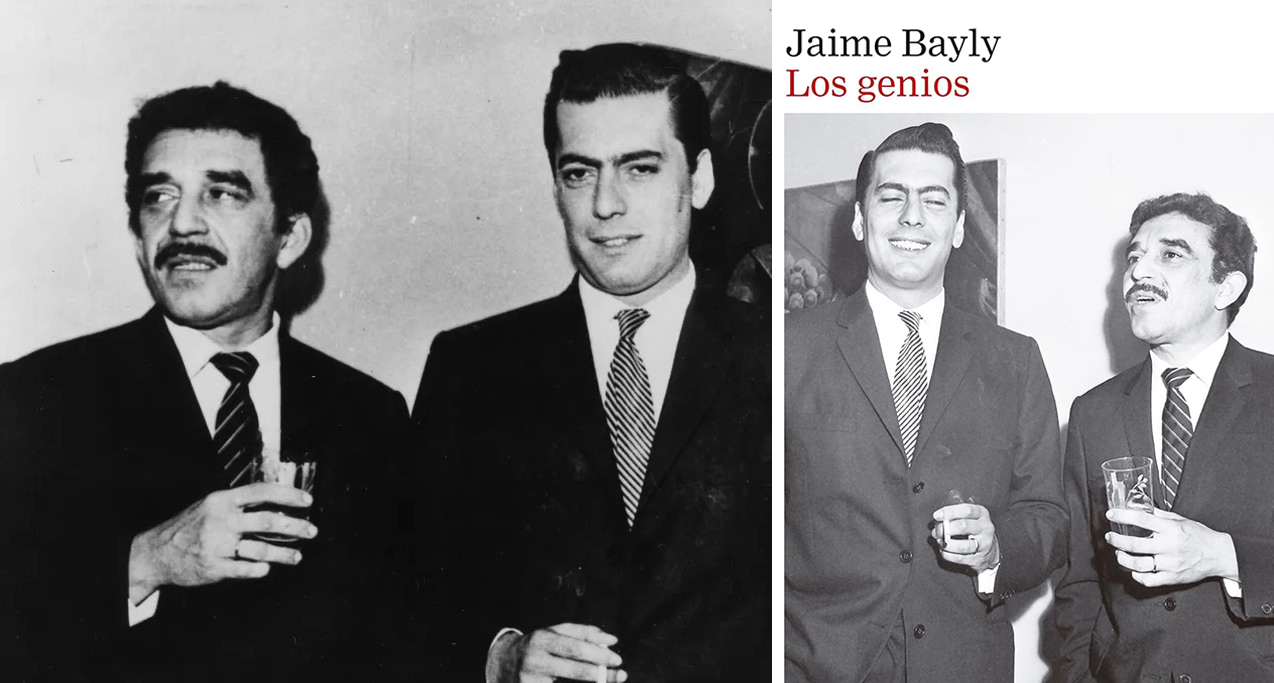
Inspired by this incident, Peruvian author Jaime Bayly wrote the novel The Genius.
Mario dismissed the novel at its release as “a bundle of lies!”
Bayly responded, “Yes, it is full of lies, but those lies are credible, as novels often are.” He emphasized that the novel was a fictional work blending invented events with historical facts.
At its opening, Bayly quoted from Mario’s own book The Real Life of Alejandro Mayta, noting: ‘The main lesson when reconstructing events is that all stories combine truth and falsehood.’
Bayly interviewed authors Jorge Edwards, Plinio Apuleyo Mendoza, Tomás Elva Martínez, and Álvaro Mutis to bring the novel closer to reality.
Márquez and Mario alongside their novel covers.
Bayly said, “When two talented individuals refuse to discuss a topic, it sparks literary curiosity. I view literature as a process of digging into the skeleton to study the object inside.”
This novel should be seen as a narrative process or more poignantly, the tragic end of a broken friendship between two literary giants. The literary world has largely interpreted it this way.
000
During their close friendship, Mario and Márquez planned to collaborate on a novel about the war in the Amazon jungle between Peru and Colombia.
However, Mario felt Márquez’s knowledge on this subject was partial and insufficient for a realistic novel.
Thereafter, they kept in touch through letters, many of which are now preserved at Princeton University in the United States.
000
In a 1990 interview with the Paris Review, Mario discussed the incident, mentioning that although he rarely spoke about it, he might consider writing a memoir later—but never did.
000
In 2021, journalist Walker Kaplan published an in-depth report revealing the incident’s story. The report stated that Mario was traveling from Barcelona to El Callao, where he had begun a romantic relationship with an attractive woman, even though his wife Patricia was on the same ship.
According to Mario’s friend Guillermo, “Mario was charming in a way that captivated women.”
After the ship stopped in Chile, Patricia returned to Barcelona to collect her belongings, helped by Márquez and his wife Mercedes, who acted like genuine friends.
Márquez even accompanied Patricia to the airport and advised her about communicating with Mario. However, Patricia misunderstood this advice, which angered Mario.
Though Mario was involved with other women, he had not separated from Patricia. At one point, Patricia said to Mario in a taunting manner, ‘Was I insulted because I’m not beautiful? Those who look back at me are like Márquez.’
This statement reportedly pushed Mario to strike Márquez in Nepal, shouting, “This is the consequence of what you said to my wife!”
The punch was forceful enough to stagger Márquez, breaking his glasses and causing some bleeding.
The next day, Márquez and his wife visited photographer Rodrigo Moya to document the injury with photographs.
Rodrigo likened the experience to looking at a criminal arrested by the Mexican police. These photos were only made public after 2007.
000
Despite these events, Mario wrote a special foreword for the 40th anniversary edition of Márquez’s One Hundred Years of Solitude.
000
In Márquez’s final decade, he attempted to meet Mario twice—once in Barcelona, once in Cartagena—but Mario never appeared, and they never reconciled.
Márquez faded from public view and passed away on April 17, 2014.
Afterward, Mario expressed, “The world lost a great writer whose works elevated and expanded the literature of our language. His novels will live on and continue to win the hearts of readers everywhere. I offer my condolences to his family.”
In 2025, on April 13, Mario Vargas Llosa died in Lima, Peru’s capital. The Gabo Foundation, named after Márquez, expressed sorrow and issued a condolence statement.
Although the punch incident gradually faded from headlines after their deaths, the episode persists as a notable topic within literary circles.
Following editorial review, the National Assembly is set to advance a proposal on Jestha 7 to approve eight ordinances, including those related to public procurement, dismissal of public officials, and the Constitutional Council. Opposition parties have already registered notices demanding the rejection of these ordinances, with CPN-UML calling for the dismissal of all eight. The National Assembly has indicated that only after ordinance approval can the government introduce replacement bills.
On Jestha 2, Kathmandu: The parliamentary calendar of the National Assembly includes the agenda to present these ordinances for approval on Jestha 7. During the parliamentary recess, the government introduced several ordinances: the second amendment to the Public Procurement Ordinance; a special provision ordinance concerning the dismissal of public officials; the first amendment to the Constitutional Council (duties, functions, rights, and procedures) Ordinance; the third amendment to the Money Laundering Prevention Ordinance; the first amendment to various Nepali Cooperative Acts; amendments related to the Health Science Institute; and revisions pertaining to university legislation.
All these ordinances have been tabled in both houses of the federal parliament, the House of Representatives and the National Assembly. Both chambers must decide whether to approve or reject them. According to Article 114 of the Constitution, sub-section 2 (ka), “After issuance, ordinances must be presented to both houses of the Federal Parliament, and if not approved by both, they shall become void.” Accordingly, the National Assembly is preparing to submit these ordinances for decision on Jestha 7.
At the National Assembly, the ruling Rastriya Swatantra Party is absent. The 59-member assembly’s largest party is the Nepali Congress with 24 seats, followed by CPN with 17, CPN-UML with 10, JSP with 2, LOSPA with 1, National People’s Front with 1, and 2 members nominated by the President.
Opposition parties have submitted notices demanding the ordinances be rejected. CPN-UML filed a notice requesting the rejection of all eight ordinances. The Nepali Communist Party has demanded rejection of four ordinances, while the Nepali Congress has sought the rejection of two ordinances, specifically those related to the Constitutional Council and amendments to certain Nepali Acts. The CPN has demanded the rejection of ordinances concerning the Constitutional Council, certain Nepali Act amendments, dismissal of public officials, and university-related legislation.
To decide on these matters, the National Assembly’s parliamentary calendar is set to present the ordinances for resolution on Jestha 7. Only after approval by both the House of Representatives and the National Assembly will the government be allowed to introduce the ordinance replacement bills.
Scientists have found evidence that a mysterious asteroid is gradually breaking apart due to the extreme heat from the Sun. Analysis of millions of data points collected by automated all-sky camera networks in Canada, Japan, California, and Europe led to the identification of a new group composed of 282 meteoroids. This group is linked to an unidentified asteroid disintegrating close to the Sun.
Small rocky particles entering Earth’s atmosphere from space heat up intensely due to friction, creating bright streaks commonly known as “shooting stars,” referred to scientifically as meteoroids. Most meteoroids originate from comets composed of ice and dust, whereas asteroids are generally dry and rocky. When an asteroid becomes active due to intense solar heat, high-speed orbit, or collisions, it begins releasing dust and rock fragments into space. As these fragments disperse, they form meteoroid streams, and when Earth passes through these streams, meteor showers occur.
A recent study published in The Astrophysical Journal notes that the trajectories of these 282 meteoroids are extreme, orbiting five times closer to the Sun than Earth’s own orbit. Scientists believe that the asteroid’s surface has developed fissures because of the severe solar heat, allowing gases inside to escape. Consequently, the entire celestial body is slowly disintegrating into dust particles. This active behavior has led to the asteroid being called a “rock-comet.” Previously, such activity was only observed on the well-known asteroid 3200 Phaethon, which is responsible for the annual December Geminid meteor shower. However, the precise location and identification of the primary asteroid causing this shower have remained unknown.
These asteroids are difficult to observe with regular telescopes due to their proximity to the Sun and brightness. However, studying meteoroids makes it possible to detect hidden and potentially hazardous asteroids invisible to conventional telescopes. According to scientists, NASA’s “NEO Surveyor” mission, scheduled for launch in 2027, will significantly aid in unraveling this mystery. This spacecraft is designed specifically to travel close to the Sun and detect dark asteroids that pose potential threats to Earth. This discovery will not only advance understanding of the solar system’s evolution but also pave the way for successful planetary defense strategies against possible future cosmic collisions.
The beloved Jacaranda tree of the valley has adorned streetsides, parks, and office areas with vibrant colors. Its beauty has always been highly admired. Recently, jacaranda flowers have bloomed in Kathmandu’s Kamalpokhari, Ratnapark, Tudikhel, and Darbarmarg regions. The colorful display of jacaranda can also be seen along the Satdobato–Balkhu road area in Lalitpur. June 15, Kathmandu.
The valley’s streets are currently decorated with the vibrant blossoms of jacaranda trees. The purple hue adds even more charm to the spring season. The blue flowers blooming on roadside trees make the city even more scenic and captivating. Many people are notably taking photos and videos against the floral backdrop. Fallen flowers have also stained the ground with a beautiful bluish tint. Originally from Europe and Africa, jacaranda is believed to have spread across various countries in Asia.