
Author: space4knews

When One Renowned Author Struck Another: Literary World Stirred by a Punch

News Summary

  • In 1976, a surprising incident took place in Mexico City where Mario Vargas Llosa punched Gabriel García Márquez, causing a sensation in the Latin American literary community.

In 1976, an unusual event unfolded in Mexico.

Latin America’s renowned writer Gabriel García Márquez extended his hand in a friendly pugilistic challenge toward fellow author Mario Vargas Llosa. However, Vargas Llosa responded by punching Márquez in the face, saying, “You deserved this.” The punch left Márquez’s face bruised.

Márquez was unprepared for this unexpected reaction. The incident occurred at a movie theater in Mexico City.

This surprising event gained widespread attention not only in the Latin American literary world but also globally.

While disputes or quarrels among authors worldwide are common, this particular incident received extensive media coverage because Márquez’s facial injury was highly visible.

However, no one could uncover the exact reason why Vargas Llosa struck Márquez, as neither party disclosed clear motives.

Following this incident, their friendship broke down and communication ceased.

000

Mario Vargas Llosa was born in 1936 in Arequipa, Peru. In 1971, he published a book titled García Márquez: Story of a Decider, which originated from his thesis at the University of Madrid. The two writers were friends at the time.

This work provided a serious critical analysis of Márquez’s One Hundred Years of Solitude. Mario discussed how authors create alternative realities, assuming the role of ‘gods’ by ‘killing’ the real world to sustain the existence of their creations.

Interpreting the narrative as a rebellious act, he wrote that writers destroy reality to present a new, structured, and imaginary world.

The book, produced as a doctoral thesis, became symbolic of Latin American literature and the friendship and admiration between the two authors.

It offered a profound examination of Márquez’s magical realism style and his mythical, existential themes.

This surprising episode, where a distinguished fellow author was punched, remained a mystery to readers and literary critics alike.

000

Mario and Márquez first met in 1967, the year One Hundred Years of Solitude was published.

Mario was highly impressed by the novel, leading to the growth of their friendship. They became neighbors in Barcelona between 1970 and 1974, which brought them closer.

Both came from similarly divided family backgrounds and were raised by grandmothers. They shared a common admiration for American author William Faulkner’s works.

Photo of Gabriel García Márquez after the punch incident.

Mario described One Hundred Years of Solitude saying, “I was amazed reading it. It was a fresh novel about Latin American nights that presented fictional facts without diminishing reality’s essence.”

He praised it as a masterpiece that expanded linguistic boundaries and captivated narrative enthusiasts.

In the late 1960s, Mario taught Márquez’s works in universities across Spain, Puerto Rico, and the United Kingdom, which aided him in publishing his doctoral thesis.

000

Márquez was nine years older than Mario, though both were born in March. Márquez was born on March 6, 1927; Mario on March 28, 1936.

Both were involved in journalism. While Mario engaged in politics, Márquez was less involved politically, though he maintained a friendship with Cuban leader Fidel Castro.

Castro was a reader of Márquez, and U.S. President Bill Clinton once hosted Márquez for dinner at the White House. Clinton’s daughter Chelsea once cited Márquez as her favorite author.

000

Márquez had earlier published novels such as In Evil Hour, Leaf Storm, and No One Writes to the Colonel, but it was the 1967 release of One Hundred Years of Solitude that catapulted him to global fame.

This magical realist novel has been translated into over 50 languages and sold more than 50 million copies worldwide.

Márquez never allowed this novel to be adapted into a film during his lifetime, though many of his other stories were made into movies.

To preserve readers’ imaginative engagement, he withheld permission for its cinematic adaptation, though his sons authorized it after his death.

Conversely, Mario Vargas Llosa gained recognition with his first novel The Time of the Hero published in 1963, a story about the Peruvian military establishment.

He wrote this while a teenager at the Leoncio Prado Military Academy and later published it after refining it in France.

The novel sparked major controversy, with military officials publicly burning a thousand copies in protest. Peruvian director Francisco Lombardi later adapted it into a film.

Mario considered One Hundred Years of Solitude his opposite in style and regarded Márquez’s weakest book as the 1975 The Autumn of the Patriarch.

000

What led Mario to punch Márquez? A 2019 report by Silvana Paternostro for the Paris Review included interviews with key witnesses such as Márquez’s photographer friend Rodrigo Moya, Guillermo Angulo, Gregory Rabassa, Plinio Apuleyo Mendoza, and Jaime Abello Banfi.

000

Inspired by this incident, Peruvian author Jaime Bayly wrote the novel The Genius.

Mario dismissed the novel at its release as “a bundle of lies!”

Bayly responded, “Yes, it is full of lies, but those lies are credible, as novels often are.” He emphasized that the novel was a fictional work blending invented events with historical facts.

At its opening, Bayly quoted from Mario’s own book The Real Life of Alejandro Mayta, noting: ‘The main lesson when reconstructing events is that all stories combine truth and falsehood.’

Bayly interviewed authors Jorge Edwards, Plinio Apuleyo Mendoza, Tomás Elva Martínez, and Álvaro Mutis to bring the novel closer to reality.
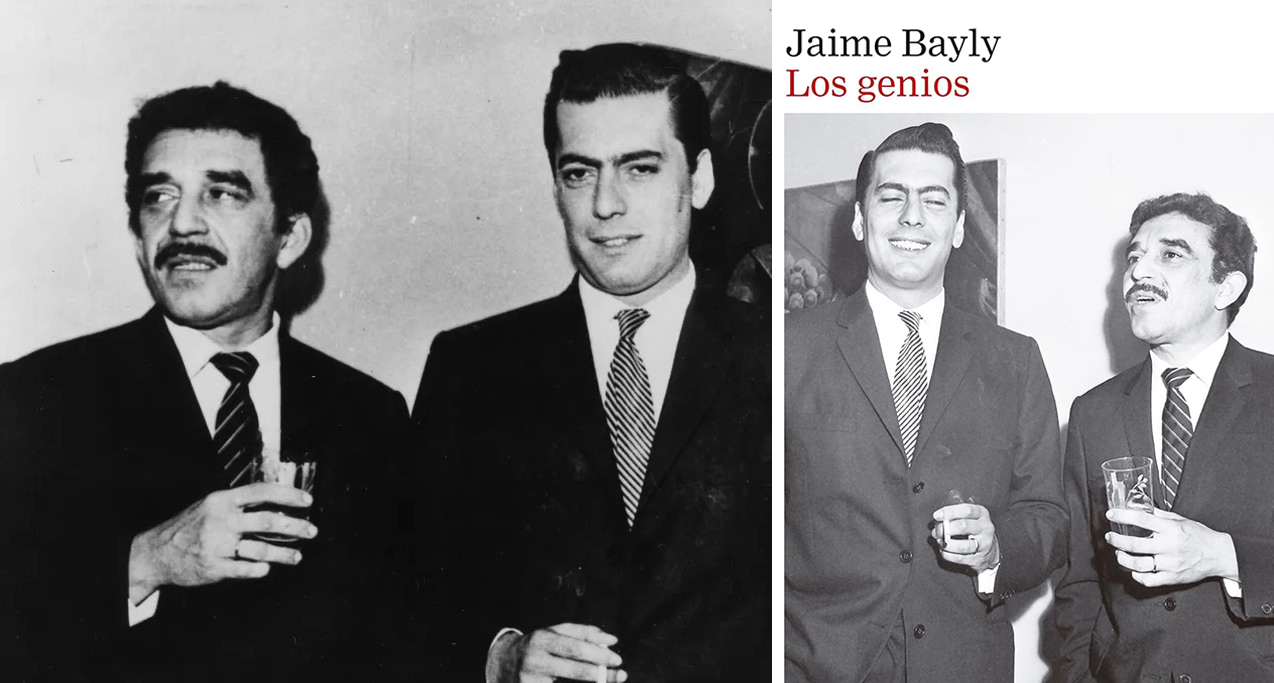
Márquez and Mario alongside their novel covers.

Bayly said, “When two talented individuals refuse to discuss a topic, it sparks literary curiosity. I view literature as a process of digging into the skeleton to study the object inside.”

This novel should be seen as a narrative process or more poignantly, the tragic end of a broken friendship between two literary giants. The literary world has largely interpreted it this way.

000

During their close friendship, Mario and Márquez planned to collaborate on a novel about the war in the Amazon jungle between Peru and Colombia.

However, Mario felt Márquez’s knowledge on this subject was partial and insufficient for a realistic novel.

Thereafter, they kept in touch through letters, many of which are now preserved at Princeton University in the United States.

000

In a 1990 interview with the Paris Review, Mario discussed the incident, mentioning that although he rarely spoke about it, he might consider writing a memoir later—but never did.

000

In 2021, journalist Walker Kaplan published an in-depth report revealing the incident’s story. The report stated that Mario was traveling from Barcelona to El Callao, where he had begun a romantic relationship with an attractive woman, even though his wife Patricia was on the same ship.

According to Mario’s friend Guillermo, “Mario was charming in a way that captivated women.”

After the ship stopped in Chile, Patricia returned to Barcelona to collect her belongings, helped by Márquez and his wife Mercedes, who acted like genuine friends.

Márquez even accompanied Patricia to the airport and advised her about communicating with Mario. However, Patricia misunderstood this advice, which angered Mario.

Though Mario was involved with other women, he had not separated from Patricia. At one point, Patricia said to Mario in a taunting manner, ‘Was I insulted because I’m not beautiful? Those who look back at me are like Márquez.’

This statement reportedly pushed Mario to strike Márquez in Nepal, shouting, “This is the consequence of what you said to my wife!”

The punch was forceful enough to stagger Márquez, breaking his glasses and causing some bleeding.

The next day, Márquez and his wife visited photographer Rodrigo Moya to document the injury with photographs.

Rodrigo likened the experience to looking at a criminal arrested by the Mexican police. These photos were only made public after 2007.

000

Despite these events, Mario wrote a special foreword for the 40th anniversary edition of Márquez’s One Hundred Years of Solitude.

000

In Márquez’s final decade, he attempted to meet Mario twice—once in Barcelona, once in Cartagena—but Mario never appeared, and they never reconciled.

Márquez faded from public view and passed away on April 17, 2014.

Afterward, Mario expressed, “The world lost a great writer whose works elevated and expanded the literature of our language. His novels will live on and continue to win the hearts of readers everywhere. I offer my condolences to his family.”

In 2025, on April 13, Mario Vargas Llosa died in Lima, Peru’s capital. The Gabo Foundation, named after Márquez, expressed sorrow and issued a condolence statement.

Although the punch incident gradually faded from headlines after their deaths, the episode persists as a notable topic within literary circles.

Agenda for National Assembly on Jestha 7: Presentation of Ordinances for Approval

Following editorial review, the National Assembly is set to advance a proposal on Jestha 7 to approve eight ordinances, including those related to public procurement, dismissal of public officials, and the Constitutional Council. Opposition parties have already registered notices demanding the rejection of these ordinances, with CPN-UML calling for the dismissal of all eight. The National Assembly has indicated that only after ordinance approval can the government introduce replacement bills.

On Jestha 2, Kathmandu: The parliamentary calendar of the National Assembly includes the agenda to present these ordinances for approval on Jestha 7. During the parliamentary recess, the government introduced several ordinances: the second amendment to the Public Procurement Ordinance; a special provision ordinance concerning the dismissal of public officials; the first amendment to the Constitutional Council (duties, functions, rights, and procedures) Ordinance; the third amendment to the Money Laundering Prevention Ordinance; the first amendment to various Nepali Cooperative Acts; amendments related to the Health Science Institute; and revisions pertaining to university legislation.

All these ordinances have been tabled in both houses of the federal parliament, the House of Representatives and the National Assembly. Both chambers must decide whether to approve or reject them. According to Article 114 of the Constitution, sub-section 2 (ka), “After issuance, ordinances must be presented to both houses of the Federal Parliament, and if not approved by both, they shall become void.” Accordingly, the National Assembly is preparing to submit these ordinances for decision on Jestha 7.

At the National Assembly, the ruling Rastriya Swatantra Party is absent. The 59-member assembly’s largest party is the Nepali Congress with 24 seats, followed by CPN with 17, CPN-UML with 10, JSP with 2, LOSPA with 1, National People’s Front with 1, and 2 members nominated by the President.

Opposition parties have submitted notices demanding the ordinances be rejected. CPN-UML filed a notice requesting the rejection of all eight ordinances. The Nepali Communist Party has demanded rejection of four ordinances, while the Nepali Congress has sought the rejection of two ordinances, specifically those related to the Constitutional Council and amendments to certain Nepali Acts. The CPN has demanded the rejection of ordinances concerning the Constitutional Council, certain Nepali Act amendments, dismissal of public officials, and university-related legislation.

To decide on these matters, the National Assembly’s parliamentary calendar is set to present the ordinances for resolution on Jestha 7. Only after approval by both the House of Representatives and the National Assembly will the government be allowed to introduce the ordinance replacement bills.

Mysterious Asteroid Fragmenting Due to Intense Solar Heat Discovered

Scientists have found evidence that a mysterious asteroid is gradually breaking apart due to the extreme heat from the Sun. Analysis of millions of data points collected by automated all-sky camera networks in Canada, Japan, California, and Europe led to the identification of a new group composed of 282 meteoroids. This group is linked to an unidentified asteroid disintegrating close to the Sun.

Small rocky particles entering Earth’s atmosphere from space heat up intensely due to friction, creating bright streaks commonly known as “shooting stars,” referred to scientifically as meteoroids. Most meteoroids originate from comets composed of ice and dust, whereas asteroids are generally dry and rocky. When an asteroid becomes active due to intense solar heat, high-speed orbit, or collisions, it begins releasing dust and rock fragments into space. As these fragments disperse, they form meteoroid streams, and when Earth passes through these streams, meteor showers occur.

A recent study published in The Astrophysical Journal notes that the trajectories of these 282 meteoroids are extreme, orbiting five times closer to the Sun than Earth’s own orbit. Scientists believe that the asteroid’s surface has developed fissures because of the severe solar heat, allowing gases inside to escape. Consequently, the entire celestial body is slowly disintegrating into dust particles. This active behavior has led to the asteroid being called a “rock-comet.” Previously, such activity was only observed on the well-known asteroid 3200 Phaethon, which is responsible for the annual December Geminid meteor shower. However, the precise location and identification of the primary asteroid causing this shower have remained unknown.

These asteroids are difficult to observe with regular telescopes due to their proximity to the Sun and brightness. However, studying meteoroids makes it possible to detect hidden and potentially hazardous asteroids invisible to conventional telescopes. According to scientists, NASA’s “NEO Surveyor” mission, scheduled for launch in 2027, will significantly aid in unraveling this mystery. This spacecraft is designed specifically to travel close to the Sun and detect dark asteroids that pose potential threats to Earth. This discovery will not only advance understanding of the solar system’s evolution but also pave the way for successful planetary defense strategies against possible future cosmic collisions.

आहा ! मनै लोभ्याउने ज्याकाराण्डा (फोटो/भिडियो) – Online Khabar

The Enchanting Display of Jacaranda Blossoms Brightens Streets and Parks Across the Valley

The beloved Jacaranda tree of the valley has adorned streetsides, parks, and office areas with vibrant colors. Its beauty has always been highly admired. Recently, jacaranda flowers have bloomed in Kathmandu’s Kamalpokhari, Ratnapark, Tudikhel, and Darbarmarg regions. The colorful display of jacaranda can also be seen along the Satdobato–Balkhu road area in Lalitpur. June 15, Kathmandu.

The valley’s streets are currently decorated with the vibrant blossoms of jacaranda trees. The purple hue adds even more charm to the spring season. The blue flowers blooming on roadside trees make the city even more scenic and captivating. Many people are notably taking photos and videos against the floral backdrop. Fallen flowers have also stained the ground with a beautiful bluish tint. Originally from Europe and Africa, jacaranda is believed to have spread across various countries in Asia.

Google Prepares to Launch New AI-Powered ‘Googlebook’ Laptop Based on Gemini AI

Google is preparing to replace the 15-year-old Chromebook concept with a new category of laptops called ‘Googlebook,’ which integrates features of the Android operating system and Chrome OS into an artificial intelligence-powered platform. This device is not merely an operating system but an ‘intelligence system’ fueled by Gemini AI, designed to intuitively simplify everyday user tasks.

The standout features of Googlebook are Gemini Intelligence and the Magic Pointer, which are most apparent in the laptop’s cursor. Developed in collaboration with Google’s DeepMind team, the Magic Pointer transforms the mouse cursor into an AI agent. A slight cursor movement activates Gemini AI. For example, when a user hovers the cursor over a date in an email, the system will automatically offer to schedule a meeting in the calendar. Similarly, selecting photos of a room and a new sofa on screen will instantly visualize how the sofa would look in that room virtually.

The device also offers an easy, natural-language-based widget creation feature, allowing users to type simple descriptions to generate customized widgets. Gemini aggregates information from apps like Internet, Gmail, and Calendar into a unified dashboard. For instance, when planning a trip, Gemini can create an attractive desktop widget that combines hotel bookings, flight details, and a countdown to the travel day.

Built on Android technology, Googlebook aims to bridge the gap between phones and laptops. When working on the laptop and feeling hungry, users can order food through phone delivery apps directly on the laptop screen. The ‘Quick Access’ feature enables users to view, search, and use files stored on their phones directly through the laptop’s file browser without transferring them.

For this new laptop category, Google has partnered with globally recognized companies including Acer, Asus, Dell, HP, and Lenovo. Googlebooks will be marketed with premium materials and outstanding craftsmanship. A unique ‘Globar’ light on the laptop’s outer cover glows attractively when AI is active and serves not only a visual role but also facilitates AI interaction. Detailed information about this technology and the first Googlebook laptops is expected to be available on the market by the end of this year.

Policy Exists, But Implementation Lags in Nepal’s Climate Finance Management

Based on a review of available data, Nepal took a pioneering step in climate finance management by implementing the Climate Budget Tagging (CBT) system as early as 2012. However, the CBT system has not been effectively implemented at the local government level, resulting in weak monitoring and reporting of climate finance. To secure additional financial support from international sources, Nepal needs to ensure robust monitoring and transparency in climate finance.

Nepal is recognized globally for its forward-looking climate policies. It has consistently raised a strong voice on climate finance platforms worldwide, advocating for international climate funds to enhance community resilience and strengthen adaptive capacities.

Among the top 10 countries vulnerable to climate risks, Nepal was the first to apply the CBT system in 2012. This system was designed to classify and monitor public expenditures related to climate change. The Ministry of Finance has led its implementation, applying the system at the project level rather than just at activity level. National-level projects are categorized based on their contribution to climate action as direct, indirect, or neutral, and further classified into adaptation, mitigation, or mixed benefit categories. To strengthen climate finance management and monitoring, the Ministry of Finance also approved the Climate Change Financing Framework (CCFF) in 2017.

Nepal’s Climate Change Policy, National Adaptation Plan (NAP), and Nationally Determined Contributions (NDC) have reinforced the country’s commitment to bolstering climate resilience and low-carbon development. The government has promoted the Local Adaptation Plan of Action (LAPA) framework to ensure planning at the local level, and has committed to channeling 80 percent of total climate finance to local governments. On paper, these policies, systems, and structures appear impressive and align with global best practices and institutional vision. However, the reality is quite different. Discussions with local government officials reveal a consensus: although the CBT system exists, its practical use is very limited.

In many areas, officials lack sufficient awareness or have not received necessary training to implement the system effectively. Institutional efforts to integrate CBT within local planning and budgeting processes are minimal. This does not mean that climate-related activities are absent; municipalities regularly allocate budgets for sectors such as energy, agriculture, forestry, and natural resource management. However, these expenditures are not systematically tagged, monitored, or reported as climate finance. Consequently, significant climate-related investments remain invisible within formal systems. For instance, an initial analysis of CBT format budgets in Devchuli and Gaindakot municipalities showed that approximately 10 to 15 percent of the annual budget could be attributed to climate-related activities, but without formal tagging, these figures are excluded from official reports.

Local officials themselves acknowledge this gap. One municipal officer stated, “The work is happening; only now have we realized that these activities are related to climate. However, these have not been formally recorded as climate interventions.” The official added, “We develop annual plans through participatory processes, but to my knowledge, climate tagging has not been applied.” Amid the global expansion of climate finance, Nepal faces the risk of missing out on resources—not due to lack of available funds, but because mechanisms to demonstrate effective use have not been fully operationalized. This points to a lack of awareness among many local-level staff about climate finance systems and a deficiency in technical capacity to build, report, and monitor climate budgets.

According to officials in planning divisions, incorporating CBT into local plans is possible with appropriate training before the planning process begins. Why is this monitoring critical? While it may initially seem a technical issue, its implications are profound. Without effective monitoring, Nepal cannot clearly demonstrate how much it is investing in climate actions or measure the effectiveness of these investments. Most importantly, opportunities to attract additional climate finance from international sources may be compromised. Globally, climate finance operates on principles of transparency, performance, and accountability. Major funds like the Green Climate Fund (GCF), Global Environment Facility (GEF), and Adaptation Fund expect measurable results, not just commitments, from countries like Nepal. Failure to clearly display how climate funds are utilized risks losing these opportunities.

Access and Equity: Who Benefits from Climate Finance? Nepal’s climate policies consistently prioritize poor families, women, marginalized communities, and citizens living in climate-vulnerable areas. However, without clear expenditure records, it is difficult to verify whether these communities truly benefit. The main question remains: does climate finance reach the communities most at risk? Current circumstances suggest that well-connected or influential communities may receive more resources, while vulnerable remote areas might be neglected. The absence of a clear monitoring and prioritization system risks relegating equity goals to policy rhetoric rather than real practice. The failure to apply CBT within planning processes reinforces this imbalance.

Looking ahead, Nepal faces a growing dilemma. As global climate funds increasingly focus on results-based financing, transparency, and accountability, the country must demonstrate its capacity to manage these resources effectively. Nepal currently finds itself caught between having robust policies and institutional structures for climate finance monitoring and the challenge of practical implementation. During this time of global climate finance expansion, Nepal risks missing out on funds—not because money is unavailable, but because mechanisms to showcase its utilization are not fully functional. Without the ability to demonstrate how local governments invest in climate actions and the outcomes achieved, leveraging international resources becomes difficult.

Meanwhile, Nepal faces another governance challenge in climate finance: a widening gap between growing adaptation needs and domestic financial capacity. The National Adaptation Plan (NAP) 2021/2050 deemphasizes climate resilience as a national priority, yet approximately 90 percent of its financial requirements depend on external sources. Major funding mechanisms include the GCF, Adaptation Fund, GEF, bilateral and multilateral donors, and other international frameworks. Accessing these funds requires climate budget monitoring, transparent reporting, and impact evidence. Institutional and technical capacity deficits, especially at provincial and local levels, hamper these efforts.

Improving governance, establishing effective data systems, enhancing local capacity, and strengthening institutional coordination can progressively reduce the gap between climate finance needs and implementation. Closing this gap requires reinforcing climate finance governance, institutional capacity, and accountability mechanisms at all levels. The most critical step is institutionalizing climate budget tagging within local planning and budgeting processes. Climate-related investments should be tagged not only at the project level but activity level as well, enabling accurate measurement of contributions to adaptation and mitigation. This will help local governments clearly trace where climate finance is being spent and what outcomes it achieves. Capacity building is equally essential. Regular training, technical guidance, and deployment of climate-focused personnel at local and provincial levels can make planning more effective.

In addition, the development of a robust Monitoring, Reporting and Verification (MRV) system is crucial. Global climate funds require proof of how investments reduce risks and increase resilience. Strengthening data systems, impact assessments, and record-keeping processes is imperative. Coordination and ownership among federal, provincial, and local governments are also critical. Currently, responsibilities related to climate finance are dispersed across various agencies, leading to duplication and weak reporting. Clear roles and regular integration of climate finance into development planning can enhance system effectiveness.

In conclusion, Nepal has established a strong policy framework for climate finance. The next challenge is to implement it effectively on the ground. Ultimately, climate finance is not merely an issue of policy or budgeting—it represents assistance aimed at reaching the communities most in need. If systems remain confined to paper only, so will the commitment to climate finance. However, if these systems are effectively institutionalized, they can serve as powerful tools to build community resilience. Through improved governance, data systems, local capacity enhancement, and institutional coordination, Nepal can progressively bridge the gap between climate finance needs and implementation. The author is a researcher specializing in climate change and environmental issues in Nepal under Forest Action Nepal.

Trump and Xi Discuss Taiwan’s Geopolitical Significance at Summit

Taiwan, a small island nation located on the western edge of the Pacific Ocean, has been at the center of geopolitical tensions between the United States and the People’s Republic of China for over five decades. From the landmark 1972 agreement between U.S. President Richard Nixon and Chinese Communist Party Chairman Mao Zedong to the May 2026 summit between U.S. President Donald Trump and Chinese President Xi Jinping, Taiwan has consistently emerged as one of the most challenging issues in diplomatic discussions between the two powers.

In the late 1960s, ideological rifts between China and the Soviet Union intensified. A violent military clash in 1969 prompted the U.S. to engage China in diplomatic talks. The Taiwan issue dates back to 1949, when Chiang Kai-shek’s Nationalist government sought refuge on the island. The U.S. had long recognized Taiwan as a legitimate government. Mao Zedong had stated that the Taiwan issue could be deferred for a century, but the threat from the Soviet Union demanded immediate attention.

Nixon’s historic visit to China in 1972 ended the silence of the Cold War era. Following this visit, Taiwan lost its seat at the United Nations, and Beijing assumed the permanent seat on the U.N. Security Council as China’s official representative. Taiwan’s importance increased further during Trump’s presidency, as relations with Taiwan were strengthened to an unprecedented degree. Taiwan boosted its defense budget and began adopting “asymmetric warfare” tactics.

At the May 2026 summit between Trump and Xi, Taiwan was declared the “most important issue in U.S.-China relations.” President Xi warned that failure to carefully manage the Taiwan issue could lead to broader conflict. For the U.S., Taiwan’s security represents not only the defense of democracy but also a matter of economic and military dominance. Taiwan is widely recognized as a critical geopolitical “flashpoint.”

अमेरिकाविरुद्ध ओपनिङ जोडीको कमाल – Online Khabar

Nepal’s Opening Pair Delivers Outstanding Performance Against USA

By reinstating their experienced opening pair, Nepal showcased the strength of the Kushal–Asif duo in the match against the United States. In the ICC Cricket World Cup League 2, Nepal successfully chased down a target of 196 runs in just 37 overs to secure a remarkable victory over the USA team. Kushal Bhurtel played a stellar innings, scoring an unbeaten century off 120 balls, while Asif Sheikh contributed 58 runs before being dismissed. Dipendra Singh Airee added pressure on the USA bowling with figures of 4 wickets in 7 overs and 3 balls. (2 Jestha, Kathmandu)

On Saturday, Nepal delivered an excellent performance to defeat the United States in the ICC Cricket World Cup League 2. Facing a strong American side, Nepal displayed resilience and strength. The top-order batting played a crucial role in Nepal’s victory, rekindling confidence and hope after a prolonged period of underperformance. Additionally, Nepal is also providing opportunities to new players.

In the recently completed Nepal–Oman–UAE series, Asif Sheikh and Kushal Bhurtel opened the innings in the first two matches but had poor starts. Following this, the opening pair was rearranged; against UAE, Vinod Bhandari and Arjun Kumal opened and lost the first wicket after 25 runs. In the subsequent match, Vinod and Asif opened. In the current series, Vinod and Asif started as openers against Scotland, but without success.

In the second game against the USA, Nepal returned to their former opening duo of Kushal and Asif. Together, they compiled a 145-run partnership that laid the foundation for victory. Kushal delivered an extraordinary unbeaten century, while Asif scored 58 before dismissal. Nepal chased down the USA’s target of 196 runs in just 37 overs at the Tribhuvan University Cricket Ground. Kushal struck 13 fours and 4 sixes in his 120-ball unbeaten 120.

Kushal Bhurtel commented, “The top order had not been giving us good starts. Today, Asif and I gave a solid opening, and I’m happier about the century than anything else.” His partnership with Asif is the second-highest ODI opening stand for Nepal. Asif scored 58 runs off 72 balls, while debutant Isan Pande remained unbeaten on 20 from 30 balls.

Bowling first after winning the toss at the Tribhuvan University Cricket Ground, the USA lost their first wicket at 22 runs. From 122–1, they added only 73 more runs while losing 9 wickets. Dipendra Singh Airee was the standout bowler for Nepal, taking 4 wickets for 24 runs in 7 overs and 3 balls. Saurav Sompal took 2 wickets, while Sandeep Lamichhane and Gulsan Jha each claimed one wicket.

Taiwan Voices Serious Concerns Amid US-China Summit Discussions

At the upcoming high-level talks in Beijing between US President Donald Trump and Chinese President Xi Jinping, Taiwan is paying close attention. Despite the absence of formal diplomatic relations between the US and Taiwan, strong unofficial ties prompt Taiwanese leadership to carefully analyze this visit and Trump’s recent remarks. In an interview with Fox News, President Trump clarified that the US does not seek war. He stated that as long as the current status quo is maintained, China is likely to be satisfied, and no one should unilaterally declare independence based solely on the assumption of American support. Trump emphasized, “I don’t want to see anyone become independent. You know, we’d have to travel 9,500 miles for a war—I am not looking for that kind of situation. I want them to keep the peace, and for China to remain calm as well. We don’t want war, and if the current situation continues, I believe China will be satisfied. But I don’t want anyone to say, ‘America is backing us, so let’s declare independence.’”

Responding to Trump’s remarks, Taiwan’s Deputy Foreign Minister, Chen Ming-chin, stated on Saturday that Taiwan requires further clarity to fully understand the implications of those comments. He added that US law permits arms sales to Taiwan, and the arms agreements between Taiwan and the US have consistently served as a cornerstone for regional peace and stability. According to Reuters, President Lai’s spokesperson also reaffirmed that US arms sales are part of America’s security commitment to Taiwan and help bolster shared resistance against regional aggression. Taiwan’s Foreign Minister, Joseph Wu (Lin Chia-lung), informed that his team is closely monitoring the US-China summit and maintaining strong communication with the US and other allied nations.

The Taiwanese officials highlighted that Taiwan has always been a guardian of peace and stability in the region, accusing China’s aggressive military actions and authoritarian repression of increasing regional threats. The majority of Taiwanese citizens prefer maintaining the current status quo in their relationship with China. Previously, China reacted strongly to perceived softening in America’s stance on Taiwan’s independence. In February 2025, China expressed sharp objections after the US Department of State removed its longstanding pledge opposing Taiwanese independence from its official website.

Account Officer of National Vigilance Center Dies After Fainting on Visit to Badimalika

2 Jestha, Kathmandu – An account officer from the National Vigilance Center in Kathmandu has passed away after fainting while traveling to Badimalika in Bajura district. According to the Bajura District Police Office, the deceased is 56-year-old account officer Bishwaraj Panthi, who was stationed in Bhairahawa.

The police reported that a four-member team, including Panthi, had traveled to Bajura for a pilgrimage to Badimalika. On their way through the forested area of Khare within Badimalika Municipality-8, Panthi fainted. He was rescued and taken to Martadi District Hospital at 5:45 am on Friday. Upon arrival at 5:50 am, medical personnel declared him dead.

Along with Panthi, Deputy Secretary Shivahari Nyaupane, Section Officer Jeevan Ghimire, and Accountant Umesh Sharma—all colleagues at the National Vigilance Center—had accompanied the group on the Badimalika pilgrimage, according to police information.

Prince and Rashila Secure Double Titles as Army Team Clinches Championship

Prince Dahal from APF and Rashila Maharjan of Nepal Army won the singles titles at the 42nd National Badminton Championships. The Army team claimed the team championship by winning three gold medals, while APF secured two golds. The competition featured 115 players across 10 teams, including squads from all seven provinces and three departmental teams. The event took place on May 16 in Kathmandu.

Prince Dahal emerged as the national champion in men’s singles after defeating Army’s Bidhyan Adhikari in straight sets, 21–16, 21–3, at the final held in the Covered Hall of the National Sports Council (RAN), Tripureshwor. This marks Prince’s second consecutive national title, having first won the trophy in 2022.

In the women’s singles category, Rashila Maharjan secured her third national championship by beating three-time champion Nangshal Tamang in straight sets, 21–18, 21–18. Rashila had previously won the title in 2019 and 2022. Fellow Army players Amita Giri and Rihana Sherchan finished in third place. Both singles champions, Prince and Rashila, also captured gold medals in doubles competitions.

The tournament, organized by the Nepal Badminton Association, saw Rashila and Amita from the Army team win the women’s doubles title. They defeated the Koshi Province pair of Roji Rai and Nisam Subba 21–17, 21–17. In men’s doubles, APF’s Prince Dahal and Dewaraj Rana beat their team-mates Bhojbahadur Gurung and Kshitij Khanal 21–10, 21–18 in the final. The mixed doubles title went to Bidhyan Adhikari and Amita Giri of the Army team.

With three gold medals, the Army team was crowned the overall team champion, receiving the team trophy along with a cash prize of NPR 100,000. Since the final match of the mixed doubles was set to be contested by Army players, the team champion was determined before this last event. Winners were awarded in a ceremony presided over by Nepal Olympic Committee President Jeevan Ram Shrestha, Vice President Chatur Narayan Rajbhandari, Secretary-General Rajiv Shrestha, member Lakpa Chiring Lama, and Ramjibahadur Shrestha, the chair of the organizing association.

Intensified Talks of Government Change in Sudurpashchim Province

In Sudurpashchim Province, preparations for a government change between the Nepali Congress and the UML have accelerated. Chief Minister Kamal Bahadur Shah has urged swift decisions, holding discussions with UML Chairman KP Sharma Oli and Party President Gagan Kumar Thapa. Both Chairman Oli and President Thapa have indicated ongoing talks concerning the possibility of a three-party coalition, government change, and cabinet reshuffling. Due to disputes over the power-sharing equation between Congress and UML in Sudurpashchim, Chief Minister Shah’s position remains uncertain, pending the party leadership’s decision.

The discussion of a provincial government change has created significant waves in Sudurpashchim. Leaders from Nepali Congress and CPN UML are intensifying groundwork for a leadership transition in the provincial government. Keeping the old power-sharing formula, both parties have initiated talks on government change or reconstruction. In this context, Chief Minister Kamal Bahadur Shah traveled to Kathmandu and met Chairman KP Sharma Oli and Party President Gagan Kumar Thapa at Gundu in Bhaktapur.

Shah requested a prompt decision regarding the provincial government. According to sources, “The Chief Minister has held separate conversations with Chairman Oli and President Thapa. His demand is for an expedited resolution on the province’s government issue,” a close source to Shah said. Chairman Oli mentioned that discussions are underway to include other factions of the party in the provincial government along with Shah, while President Thapa confirmed ongoing talks among all involved parties.

However, some UML leaders have argued that since Chairman Oli is reportedly dissatisfied with Chief Minister Himmat Kari Karki, the UML might consider leaving Congress. “Congress has already proposed taking over Koshi Province and leaving Sudurpashchim to UML, but our Chairman has not made any decisions yet,” one leader disclosed. Nevertheless, signs indicate that after mutual consultations, a decision may be reached within two to three days.

Political Turmoil Over Government Change in Sudurpashchim Province

Summary

Reviewed Content.

  • In Sudurpashchim Province, preparations for a government change between Nepali Congress and UML are ongoing as Chief Minister Kamal Bahadur Shah has urged for a swift decision after discussions with KP Sharma Oli and Gagan Kumar Thapa.
  • UML Chairman KP Sharma Oli and Parliamentary Party Leader Gagan Kumar Thapa have indicated ongoing talks about cooperation among three parties, government changes, and ministerial reshuffles.
  • The power dynamics between Congress and UML have put Chief Minister Shah’s position at risk, with a decision from party leadership still pending.

1 Jestha, Dhangadhi – The discussion of a provincial government change has stirred significant political waves in Sudurpashchim Province. Leaders from Nepali Congress and CPN-UML are intensifying efforts to alter the leadership of the provincial government.

Maintaining the previous political balance, Congress and UML have begun talks regarding either a government change or reconstitution. In this context, Chief Minister Kamal Bahadur Shah traveled to Kathmandu.

Shah held discussions with UML Chairman KP Sharma Oli and Parliamentary Party Leader Gagan Kumar Thapa at Gundhu in Bhaktapur. According to sources, Shah urged them to make a swift decision regarding the provincial government.

“The Chief Minister had separate conversations with Chairman Oli and Leader Thapa. His demand was for an expedited decision on the provincial government issue,” said a source close to Shah. “Both leaders are consulting on the matter, and indications suggest a conclusion is near.”

Chairman Oli mentioned ongoing discussions about including other factions of the Nepal Communist Party in the provincial government. Meanwhile, Leader Thapa confirmed talks among all parties are continuing. “He (Oli) spoke of collaboration among three parties moving forward. The Leader also informed that discussions with all parties are underway,” the source added.

An understanding had been reached wherein the UML would lead the government in Koshi Province, and the Nepali Congress would lead in Sudurpashchim Province. Thapa, elected as parliamentary party leader through a special general convention, plans to alter the government leadership without breaking the partnership with UML immediately.

Thapa has authorized Vice Chairman Bishwaprakas Sharma to negotiate with UML and other parties regarding the provincial government. After attending provincial-level meetings in Karnali and Sudurpashchim, Sharma returned to Kathmandu and has since discussed matters with Oli in Gundhu.

Sharma proposed that the Koshi Province Congress faction be allocated accordingly while abandoning the UML’s position in Sudurpashchim, according to party insiders. However, Oli has not yet provided a clear response. Some UML leaders argue that Oli is dissatisfied with Chief Minister Himmat Karki, which might influence the party’s willingness to relinquish its position in Sudurpashchim to Congress.

“While Congress has proposed taking over Koshi Province and abandoning Sudurpashchim UML, our chairman has not made any decision yet,” said one leader. “Oli is reportedly not positive about Karki.”

However, considering Oli is also in talks with the Nepal Communist Party, some leaders speculate that the situation may change to enable cooperation among three parties moving forward.

Despite this, the Congress parliamentary party continues recognizing Sher Bahadur Deuba as chairperson even after the special general convention, reinforcing that Sudurpashchim is not a priority for Thapa and Bishwaprakas.

Although Chief Minister Shah requested a rapid decision regarding the government, sources suggest that parties have asked to delay any change in power until after the budget session. Ministers representing both UML and Congress are actively lobbying on this matter.

UML leaders, including General Secretary Shankar Pokharel, are reportedly not in favor of an immediate government change, creating a situation where Chairman Oli cannot make unilateral decisions. Nonetheless, signs indicate a decision may be reached within two to three days following further consultations.

Position Under Threat Despite Managing Internal Discontent

At a provincial-level meeting organized by Nepali Congress on 26 Baisakh in Dhangadhi, Chief Minister Kamal Bahadur Shah expressed his anger, claiming attempts were underway to remove him from office.

He accused some provincial MPs and leaders of discrediting parliamentary party leader Thapa while pushing for his dismissal, vowing to resist from all fronts. On the same evening, Thapa held discussions with all provincial MPs regarding the government and Chief Ministerial matters.

MPs lobbying for a change in parliamentary party leadership and the Chief Minister’s position voiced their demands openly. Thapa instructed unity and stated he would decide on government issues in Kathmandu. There were also talks about potential complications the leadership change could cause in the political balance.

Following Thapa’s remarks, internal dissatisfaction appeared somewhat addressed. However, the possibility that past agreements between Congress and UML regarding Sudurpashchim and Koshi Provinces could be reversed has forced Shah’s position to remain precarious.

It is claimed that up to eight provincial Congress MPs favor Shah’s dismissal, but they have held back due to lack of clear signals from the party leadership. Divan Singh Bisht and Padam Shahi are reportedly leading this campaign, with eight signatures already collected.

“We support a change in the Chief Minister, but the lack of direction from leadership has paused us,” said one MP. “We now await guidance from higher levels. Our steps will follow the mutual understanding of top leaders from UML and Congress.”

Within UML, discussions about a government change have further intensified unrest. Ministers representing the government wish to retain power, while some leaders hope for ministerial appointments.

MPs seeking to remove Parliamentary Party Leader Rajendra Singh Rawal have already demanded ministerial posts from Oli at Gundhu.

“Currently, the Congress-UML power balance favors government continuity,” said one leader. “If talks bear fruit, UML is likely to take leadership in Sudurpashchim, but it remains unclear what the role of the Nepal Communist Party will be.”

MPs from the Nepal Communist Party suggest the electoral alliance with Congress and UML will continue, but no concrete decisions have been made. “In-depth discussions about the three parties moving forward together are ongoing. UML and the Nepal Communist Party may reach an understanding as well,” said one MP, “but nothing is confirmed yet.”

Congress Sets Meeting with Janajati Leaders to Discuss Constitution Amendment

May 16, Kathmandu – The Nepali Congress is preparing to consult with Janajati leaders to gather their opinions on amending the constitution. For this purpose, the Congress has called a meeting with Janajati leaders on Sunday at 2 PM at its central office in Sanepa.

The Congress committee responsible for studying constitutional amendments and presenting suggestions has organized this consultation to collect feedback from 18 invited Janajati leaders, to whom invitation letters were sent. The meeting will be attended by Congress President Gagan Thapa, constitutional expert Tejman Shrestha, and Professor Krishna Khanal, among others.