Recently, the competition in women’s volleyball between Nepal and India has gained significant attention. Once thought almost impossible for Nepal to win a single set against India, Nepal has now succeeded in defeating India in matches.
Summary
Prepared with editorial review.
- The Nepal women’s volleyball team will face India in their first match at the CAVA Women’s Volleyball Championship 2026, scheduled from May 21 to 28 in Kathmandu.
- In 2024, Nepal defeated India 3-2 in the league phase of the CAVA Nations League on home court but lost in the final.
- The Nepali squad includes new players, and coach Jagadish Bhatt is confident of strong performance on home soil.
April 14, Kathmandu – The Nepal women’s volleyball team is set to commence their campaign at the CAVA Women’s Volleyball Championship 2026, hosted on home ground, competing against their familiar rivals India.
According to the schedule released by the Central Asian Volleyball Association (CAVA), Nepal shares Group A with India, Kyrgyzstan, and Maldives. Eight teams are participating, with Iran, Kazakhstan, Sri Lanka, and Bangladesh in Group B.
Nepal has regularly competed against India in recent CAVA tournaments, as well as in the South Asian Games and Asian Games, with these two teams being traditional rivals.
In women’s volleyball, the rivalry between Nepal and India has recently become quite prominent. Previously, Nepal struggled even to win a set against India, but now Nepal not only wins sets regularly but has also defeated India in some matches.
Two years ago, Nepal defeated India on home soil in the CAVA Nations League. This year, the CAVA Women’s Volleyball Championship is scheduled from May 21 to 28 at home, with a confirmed clash between Nepal and India.
Being in the same group, these two teams will face each other in the opening match, which is crucial for both to progress to the semifinals. Nepal is aiming to secure a win in this first encounter.
The Nepali team and fans are excited to play India in the very first match. Coach Jagadish Bhatt said, ‘Playing India first makes this game more popular and exciting.’
Bhatt added, ‘Having India as the opening opponent will increase spectatorship and help promote volleyball nationally in Nepal.’
Coach Bhatt believes that playing a strong team like India first on home ground is advantageous for Nepal. ‘It is tougher to play strong teams abroad, but on home soil, starting with a strong opponent is beneficial. If we beat India in the first game, it will be great for us.’
Coach Shrestha noted that the pressure will be greater on the Indian team playing away. ‘They come from a different location having prepared elsewhere, so India will face more pressure. Nepal has the home court advantage.’
***
India has had past success on Nepali courts as well, winning the 13th South Asian Games title in 2019 at the Dashrath Rangasala covered hall by defeating Nepal. India also defeated Nepal in the 2024 CAVA Nations League final. Both finals were thrilling and competitive, with Nepal losing narrowly.
The Nepali women’s volleyball team is currently preparing to deliver a strong performance. The initial 20-player squad was trimmed to 16, and the final team list will be announced soon.
Coach Jagadish Bhatt leads the training with assistance from Rupesh Bishtha and Lokesh Budha. Players are enthusiastic to compete at home.
Bhatt said the players are motivated and ready to face India in their opening match. ‘They have the mindset to perform well. Since it’s the first game, and on home court, Nepal will have an advantage.’
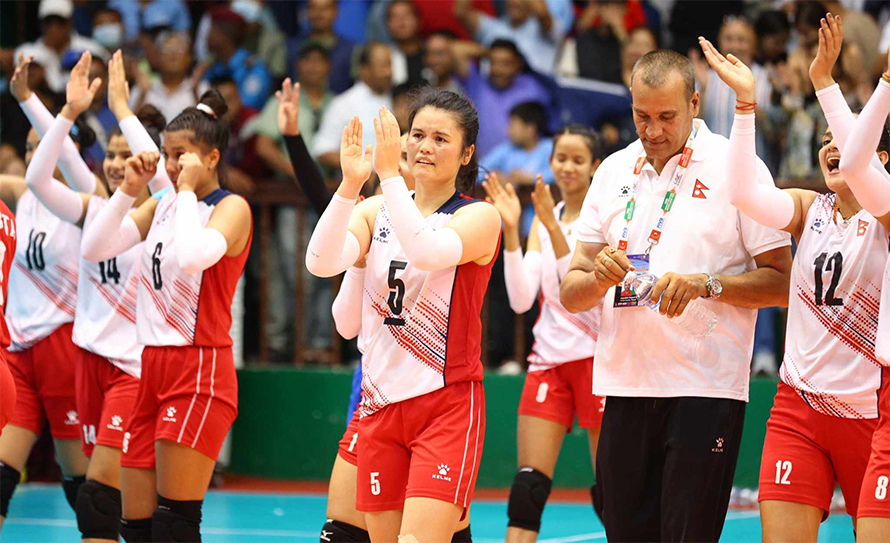
This time, several senior players, including regular captain Aruna Shahi, are not in the Nepali squad. This allows new players to gain valuable opportunities on the national team. Players like Niruta Thagunna, Usha Bhandari, Salina Shrestha, Kamana Bishtha, and Sumitra Regmi are the most experienced members currently.
Involving new players has infused youth and energy into the team. Coach Bhatt remarked, ‘We have many new players who are enthusiastic and training well. Good performance could lead to favorable results.’
Nepal will open the group stage against a strong Indian team. The squad believes that a positive outcome in this match will benefit their subsequent games. Bhatt noted, ‘This time, each team will play three matches in the group stage, so performing well can enhance chances of progressing. A good first match will boost morale.’
History of Nepal-India Rivalry
Nepal and India have a long-standing rivalry in women’s volleyball, initially limited mainly to the South Asian Games (SAG) but now extending to other tournaments.
The competition has spanned multiple South Asian Games, the inaugural South Asian Women’s Volleyball Championship held in Kathmandu in 2013, friendly matches, CAVA events, and even the 19th Asian Games.
To date, Nepal has defeated India only once, with India winning the majority of their encounters.
Below is a summary of five recent matches between Nepal and India since 2019, all captained by Aruna Shahi. However, the upcoming contests will feature new leadership for Nepal.
At the 13th South Asian Games in 2019 in Kathmandu, Nepal lost 3-2 to India, marking the first time Nepal won a set against India. Despite strong efforts in the final, Nepal was denied the title due to lack of experience.
In earlier South Asian Games, Nepal had been defeated comfortably by India.
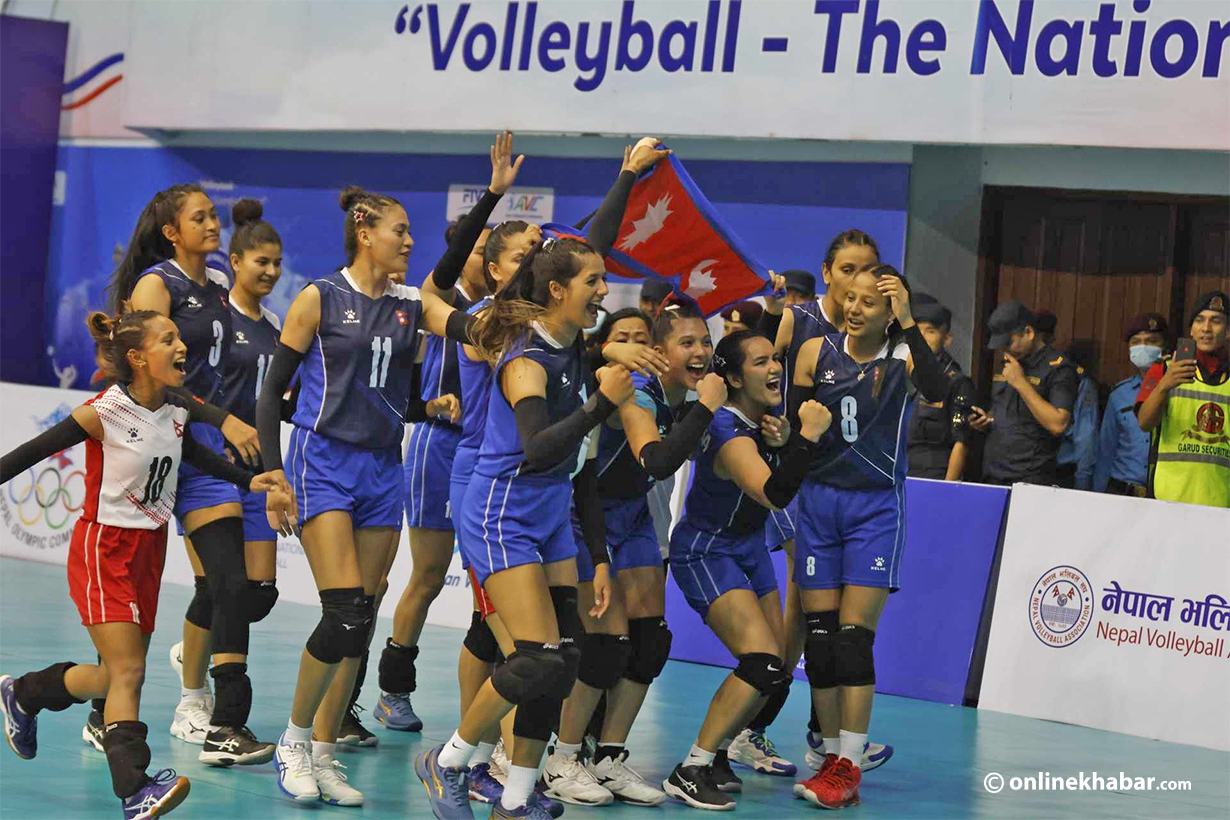
Nepal has faced India four times over the past three years, including two recent CAVA tournaments and the 19th Asian Games. India won three of these encounters, while Nepal secured one win.
In the final of the 13th SAG in 2019, hosted in Kathmandu, Nepal was narrowly defeated 3-2 by India.
In 2023, Nepal lost 3-1 to India at the CAVA Women’s Volleyball Challenge Cup group phase. Scores were 25-12, 26-24, 21-25, 25-11.
During the 2023 19th Asian Games in Hangzhou, China, Nepal lost 3-1 to India with scores of 25-23, 26-28, 25-23, 25-17.
In 2024 on home court, Nepal achieved a historic 3-2 win against India during the league phase of the CAVA Women’s Nations League, but lost to India in the final.
At Dashrath Rangasala’s covered volleyball hall in Tripureshwor, Nepal won the league match against India 3-2 with set scores of 25-18, 12-25, 25-17, 18-25, 15-13.
In the final, Nepal was defeated 3-2 by India, with India winning the title by 23-25, 25-14, 22-25, 25-12, 15-5.
Once again, Nepal will compete against India on home soil. As India is their first opponent in this tournament, Nepal aims to start off with a splendid victory.
Head-to-Head Record
Up to now, Nepal and India have competed internationally and in friendly matches 10 times. Nepal has won only one of those games, with India victorious in nine.
The first encounter was in 1998 at the Rupabihini Women’s Volleyball in Sri Lanka, where Nepal lost straight sets to India. Subsequent losses followed in the South Asian Games of 1999, 2006, and 2016. Nepal also lost to India in the 2014 first South Asian Women’s Invitational Volleyball Tournament held in Kathmandu.
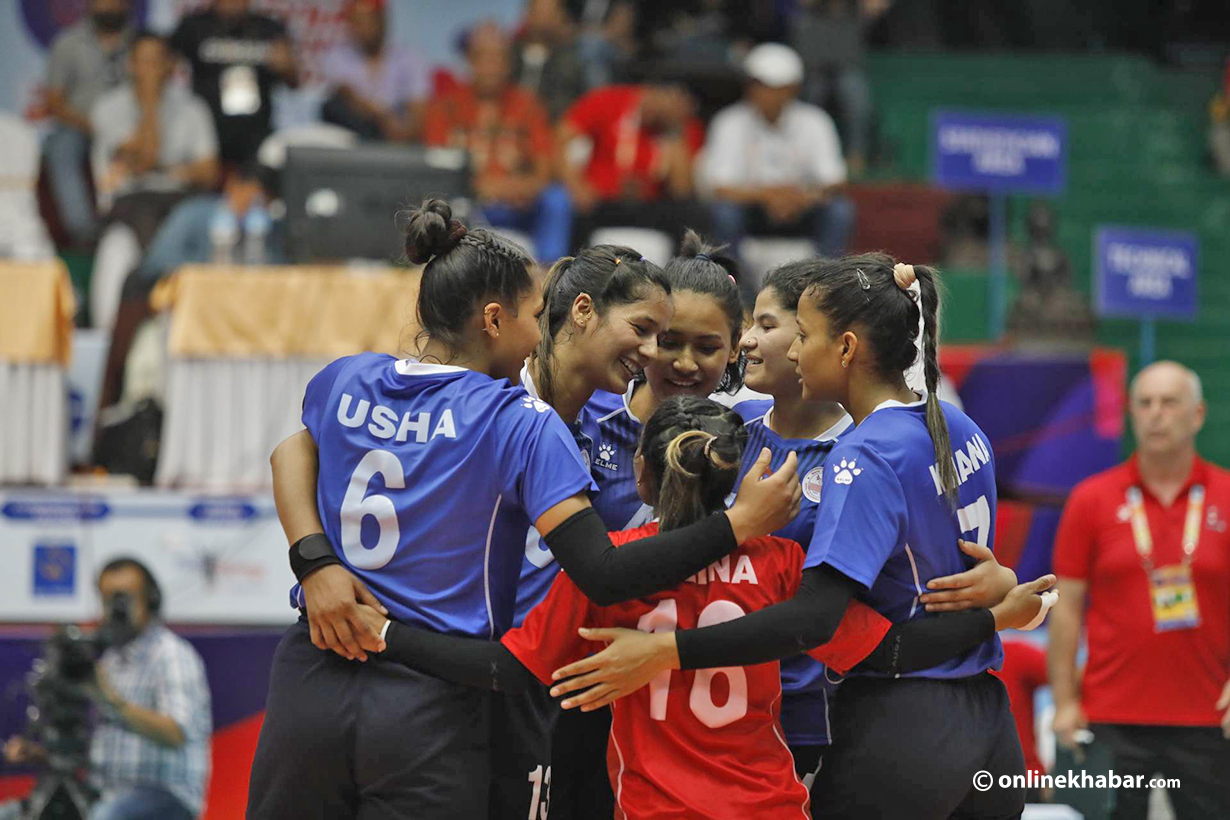
However, Nepal has increasingly challenged India in recent years, notably taking India to 3-2 in the final at the 13th South Asian Games in 2019.
Likewise, Nepal lost to India in the 19th Asian Games and CAVA Women’s Volleyball tournaments in 2023 but managed a group stage victory over India in the 2024 CAVA Women’s Challenge Cup.
Additionally, Nepal and India have played some friendly matches, mostly ending in India’s favor.